

Medical Peer Review Lawyer: What Physicians Should Protect Before Committee Review
By Andrew Rhoden | Masterly Legal Solutions
When should a physician hire a peer review lawyer? Ideally, as soon as a hospital or medical staff committee requests a formal response, raises concerns about clinical care, or begins reviewing professional conduct. Early legal guidance can help physicians understand their rights, meet important deadlines, and address concerns before decisions affect hospital privileges or professional standing.
What a Physician Peer Review Lawyer Does
A physician peer review lawyer represents doctors facing questions about clinical judgment, patient care, professional conduct, or hospital privileges. Legal counsel reviews medical staff bylaws, evaluates allegations, prepares written responses, and advises physicians during committee proceedings. The goal is to protect the physician's legal rights while addressing the hospital's concerns through the appropriate process.
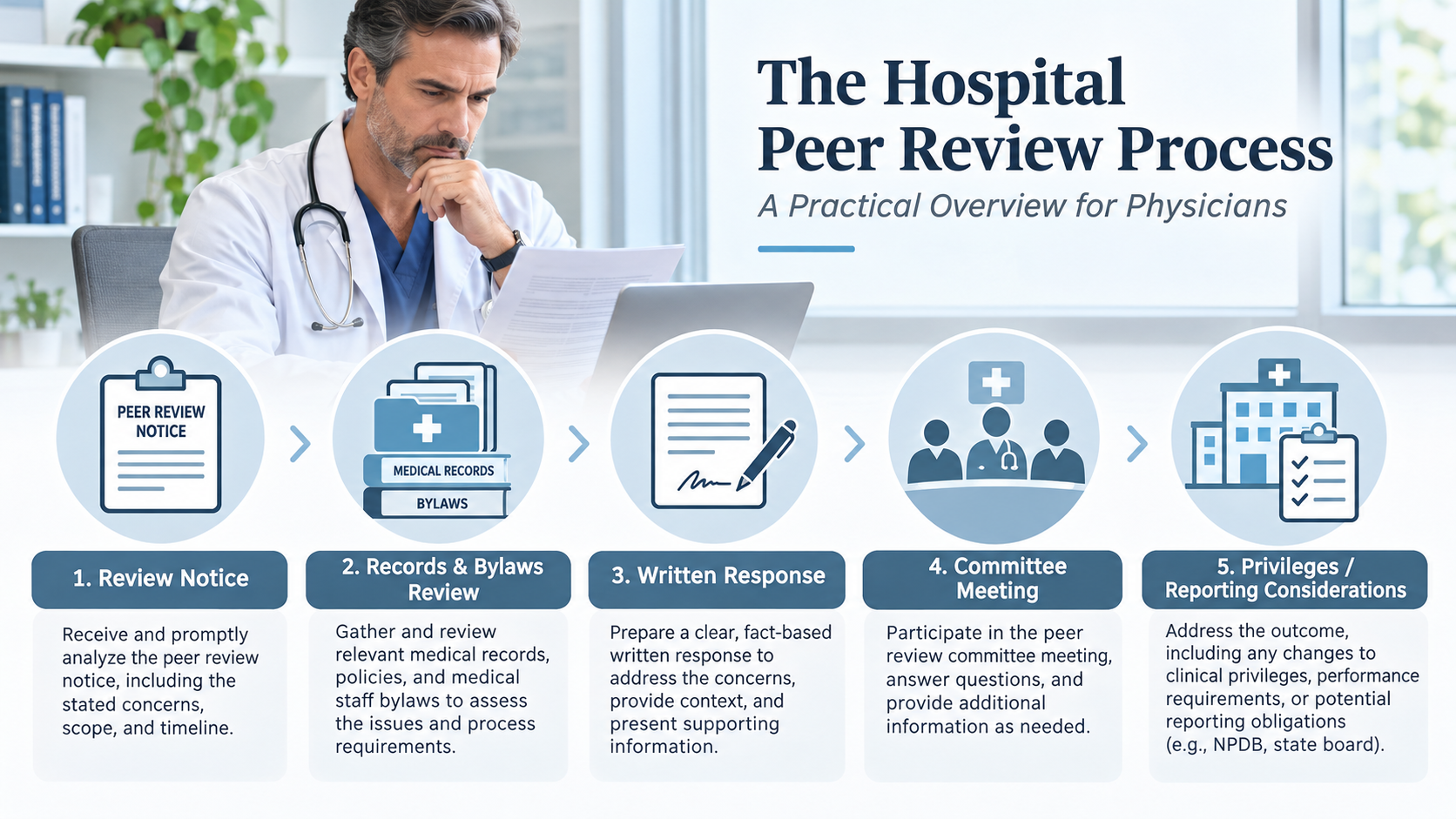
Why Legal Representation Matters During Medical Peer Review
Receiving a hospital peer review notice can create uncertainty, even for experienced physicians. A request to explain a treatment decision or appear before a medical committee may seem routine. However, the review could develop into a more serious examination of clinical performance or professional conduct.
Hospitals use the medical peer review process to improve quality, assess the quality of care, and protect patients. The process can involve medical records, patient outcomes, clinical decisions, and communication with other healthcare professionals. Clinical peer review is an essential part of hospital quality assurance and quality and patient safety efforts within healthcare organizations.
Although peer review serves an important patient safety purpose, the vast majority of reviews are conducted in good faith. Some disputes, however, involve allegations of sham peer review or bad faith driven by competitive or retaliatory motives by hospitals or other entities.
A poorly understood allegation, incomplete written explanation, or missed deadline may complicate the physician's position. Depending on the circumstances, a review can affect hospital privileges, professional relationships, credentialing, and future employment opportunities. HCQIA, enacted in 1986 to encourage effective professional peer review, also created the National Practitioner Data Bank and can affect how adverse actions are reported.
Early legal representation provides an opportunity to evaluate the situation before the physician makes statements or decisions that may have lasting consequences.
Masterly Legal Solutions assists physicians in understanding the concerns raised, reviewing applicable procedures, and developing a response that reflects both the clinical facts and the physician's legal interests.
How Hospital Peer Review Works, From Focused Review to Hearing
The hospital peer review process varies by institution because physician peer review has long been required across all hospitals in the USA as part of accreditation expectations in US hospitals. The Joint Commission, formerly JCAHO, mandated physician peer review in US hospitals in 1952, though implementation still varies by institution. Medical staff bylaws, hospital policies, and applicable law determine how concerns are evaluated and what procedural rights may apply.
A review often begins when a hospital identifies a possible issue involving patient care, clinical performance, documentation, or professional behavior.
Initial Review and Clinical Concerns
A hospital may conduct a focused review after an unexpected patient outcome, a complaint, reported adverse events, or other reported incidents involving concerns about a physician's clinical decisions.
The matter may be evaluated by a department chair, quality committee, medical staff leadership, or another authorized reviewer.
Not every review results in disciplinary action. Some matters conclude after clarification, further evaluation, or recommendations for improvement, and early reviews may be part of a professional practice evaluation intended to assess quality of care and, in a process that originated in the 1950s to standardize care, improve performance rather than punish physicians.
However, physicians should understand whether the hospital is conducting routine quality assessment, a focused investigation, or a formal professional review proceeding.
These distinctions can affect procedural rights and potential reporting obligations, especially when a specific concern leads to a focused professional practice evaluation, often called a professional practice evaluation FPPE.
Medical Staff Committee Review
If concerns require further consideration, the hospital may refer the matter to a medical executive committee or another authorized body.
The peer review committees may examine clinical records and other relevant information, including professional conduct, prior findings, and the physician's response before recommending further action.
Hospitals may also seek external peer review or another independent assessment when specialized expertise, due process concerns, or a potential conflict make an outside opinion useful.
Reviewers should use an evidence based approach and consider the physician's decision making process to reduce hindsight bias.
Possible recommendations may include additional monitoring, education, limitations on clinical activities, or formal action involving medical staff privileges.
A physician peer review lawyer can evaluate whether the committee is following the applicable bylaws and whether the physician has an appropriate opportunity to address the concerns.
Formal Hearing and Fair Procedures
When a qualifying adverse professional review action is proposed, the physician may be entitled to notice and an opportunity for a hearing under applicable procedures.
The federal Health Care Quality Improvement Act (HCQIA) was designed to encourage effective professional peer review by providing immunity protections when statutory standards are met.
Under 42 U.S.C. § 11112, those standards include reasonable efforts to obtain facts, a reasonable belief that the action would advance health care quality, and fair procedures in the circumstances, along with related process requirements and due process requirements. The statute also describes due process protections, including notice, a hearing, and appeal rights when clinical privileges are restricted or revoked, as well as representation by counsel in qualifying hearings.
HCQIA immunity is not automatic or total; it generally depends on good faith compliance with the statute's fairness standards.
HCQIA does not require every preliminary review to include a formal hearing. The applicable procedures depend on the action involved, the hospital's governing documents, and other relevant law.
For more information about formal proceedings, see Medical Peer Review Hearings: Preparing the Record, Witnesses, and Professional Response.
Early Steps a Physician Can Take: Records, Written Responses, and Deadlines
The period immediately after receiving a peer review notice can be important. Physicians may have limited time to respond, request information, or exercise rights provided by their medical staff bylaws.
A lawyer can help assess these obligations before the physician submits a statement or attends a committee meeting.
Reviewing the Notice and Medical Staff Bylaws
A peer review notice may identify the clinical incident, alleged conduct, or specific concerns under consideration.
Counsel can review the notice alongside the hospital's bylaws and relevant policies to determine:
- Whether the matter is an informal review or formal proceeding.
- What information the physician is entitled to receive.
- Whether a written response or committee appearance is required.
- Which deadlines apply to objections, hearing requests, or appeals.
- Whether the proposed action could affect clinical privileges.
Understanding these requirements helps the physician make informed decisions about representation and participation.
Protecting the Accuracy of Medical Records
Medical records often form the foundation of a physician peer review matter. Treatment notes, diagnostic findings, orders, and communications may be examined to evaluate the physician's clinical decisions.
An attorney can coordinate the lawful review of relevant records, identify missing context, and determine whether additional supporting information is needed.
Physicians should preserve relevant materials through authorized channels and follow patient privacy requirements. They should not alter existing records or obtain protected information outside permitted procedures.
When clinical issues are complex, counsel may also evaluate whether external peer review could provide an independent assessment. Outside reviewers are often board certified and may be used to support quality assurance, the credentialing process, and CMS or accreditation requirements.
Preparing a Professional Written Response
A written response may become part of the record considered by medical staff leadership.
It should accurately address the concerns without speculation, unnecessary admissions, or statements that could be misunderstood, while addressing the relevant clinical factors and explaining the physician's reasoning clearly and professionally.
Masterly Legal Solutions can assist with evaluating allegations, organizing records and other relevant information, and preparing a response that explains the physician's position clearly while framing any performance improvement issues without unnecessary admissions.
The appropriate response depends on the evidence, the hospital's procedures, and the possible consequences.
For a closer look at investigation-related concerns, read How Physicians Should Respond to a Hospital Peer Review Investigation.
How Peer Review Can Affect Hospital Privileges and Professional Standing
One reason to involve legal counsel early is that the consequences of medical peer review may extend beyond the hospital committee.
Depending on the findings and resulting action, physicians may face concerns involving clinical privileges, credentialing, professional reputation, or regulatory reporting.
Hospital Privileges and Future Credentialing
Clinical privileges authorize physicians to perform particular medical services within a healthcare institution.
When a professional review action restricts, suspends, or revokes those privileges, the decision may affect the physician's ability to practice within that facility and can affect later applications at hospitals and other healthcare organizations during the credentialing process.
Other hospitals and credentialing organizations may request information about prior adverse actions when evaluating future applications. Some hospitals also use ongoing professional practice evaluation as part of credentialing and reappointment review.
A physician peer review lawyer can examine the proposed action, its legal basis, the available procedures for challenging it, and its possible effects on future credentialing.
National Practitioner Data Bank Reporting
The National Practitioner Data Bank (NPDB), created under HCQIA, collects certain reports involving healthcare practitioners, including qualifying adverse clinical privileges actions.
Under federal reporting rules, a professional review action following the medical peer review process and based on competence or conduct that adversely affects a physician's clinical privileges for more than 30 days generally must be reported.
Surrendering or restricting privileges while under investigation for possible professional incompetence or improper conduct, or in return for avoiding such an investigation or professional review action, may also trigger reporting requirements.
An investigation alone is not automatically reportable. Reporting depends on the nature of the action and the applicable federal criteria.
Importantly, resigning from the medical staff does not necessarily prevent a report.
Legal counsel can help physicians evaluate the possible NPDB consequences before agreeing to restrictions, surrendering privileges, or accepting proposed resolutions.
Texas Medical Board Reporting and License Concerns
A hospital peer review matter can also raise questions involving the Texas Medical Board (TMB).
Under Texas Occupations Code Chapter 160, certain medical peer review findings and professional conduct concerns must be reported to the Board when statutory requirements are met.
For example, Section 160.002 addresses reporting involving specified peer review outcomes, while Section 160.003 addresses information concerning physicians considered a continuing threat to public welfare through the practice of medicine.
Not every hospital peer review results in a TMB investigation or disciplinary action.
However, when the circumstances create potential licensing concerns, physicians may benefit from legal representation that considers both the hospital process and their regulatory responsibilities.
Masterly Legal Solutions also assists with issues involving physician licensing and professional discipline. Learn more about Texas Medical Board lawyer services.
When Should You Contact a Physician Peer Review Lawyer?
Physicians do not need to wait until a hospital recommends suspension or termination of privileges before speaking with an attorney.
Legal guidance may be particularly valuable when a physician receives a formal committee notice, faces allegations involving patient safety, is asked to submit a detailed explanation, or learns that restrictions on clinical practice are being considered.
Representation is also important when the hospital requests a voluntary resignation, offers an agreement affecting privileges, or raises concerns about possible regulatory reporting.
An attorney can review the specific situation and explain which legal options may be available.
How Masterly Legal Solutions Supports Physicians
Masterly Legal Solutions provides legal representation for physicians facing professional review concerns, hospital committee proceedings, and related licensing issues.
The firm's approach begins with understanding the allegations, examining relevant medical staff documents, and identifying the decisions that may affect the physician's professional future.
Depending on the circumstances, representation may involve reviewing clinical and administrative records, advising on communication with hospital leadership, preparing formal responses, evaluating proposed restrictions, or addressing hearing-related concerns. The vast majority of matters in US hospitals are handled internally, and 87% of US hospitals conduct peer review in-house, with only a smaller share sent for external peer review or an independent assessment.
For physicians who want to understand the role of counsel before committee review, Physician Peer Review Attorney: Preparing for Hospital Committee Review provides additional context.
Every case depends on its facts. The purpose of legal representation is to help physicians understand their rights, evaluate risks, and make informed decisions throughout the review process.
Frequently Asked Questions About Physician Peer Review Lawyers
Can a physician bring a lawyer to a peer review meeting?
It depends on the type of meeting and the hospital's medical staff bylaws. Some preliminary meetings limit direct attorney participation, while qualifying formal hearings may provide a right to representation. HCQIA describes attorney representation among its hearing safeguards. Even when an attorney cannot attend a particular meeting, legal counsel can help a physician prepare, understand the process, and evaluate the next steps.
Is hospital peer review confidential?
Texas law generally protects medical peer review committee proceedings, records, and communications under Section 160.007 of the Texas Occupations Code. However, confidentiality has statutory exceptions, and certain information may be disclosed to regulatory authorities or other permitted recipients. Ordinary medical records do not automatically become privileged simply because a peer review committee considers them. An attorney can explain which protections apply to the specific materials.
Can peer review lead to a report to the Texas Medical Board?
Yes. Certain peer review findings or actions may trigger reporting obligations under Texas law. A qualifying adverse privileges action may also result in an NPDB report, with information provided to the appropriate state licensing board. Not every review leads to a report or disciplinary proceeding. A physician peer review lawyer can evaluate the circumstances and explain the potential regulatory consequences.
Request a Confidential Consultation With Masterly Legal Solutions
If you have received a hospital peer review notice or are concerned about a medical staff committee's review of your care, early legal guidance can help you understand your position before important decisions are made.
Masterly Legal Solutions assists physicians with peer review concerns, hospital privileges, professional responses, and related regulatory matters.
Call (972) 236-5051 to discuss your situation and available legal options.
This article
provides general legal information and does not constitute legal advice. The rights, procedures, and possible outcomes in any matter depend on the applicable law and individual circumstances.








Looking for Legal & Business Solutions? Contact Us Now
Fill in the form or call us to set up a meeting