Retaliation in the Workplace: The Critical Differences Between School Investigations and TEA Proceedings

April 14, 2026

When an employee is placed on administrative leave, the experience can feel sudden, confusing, and deeply unsettling. One moment you are performing your job, and the next you are told not to return while an investigation unfolds. For educators and staff in Frisco ISD and across north texas, this process often raises urgent questions about rights, next steps, and potential outcomes.


At Masterly Legal Solutions, we understand how overwhelming this moment can be. Our attorneys regularly assist individuals navigating employment disputes, including those involving wrongful termination, constructive discharge, and allegations tied to public policy violations. What happens after administrative leave begins is not always explained clearly, and that uncertainty can place an employee at a disadvantage.


This article walks you through what typically happens after administrative leave is issued, how investigations develop, and what legal considerations may arise along the way.


What Administrative Leave Means for an Employee


Understanding the Immediate Impact

Being placed on administrative leave does not always mean you have done something wrong. In many cases, it is simply a precaution while an employer reviews allegations or conduct. However, the implications can be serious, especially if the situation leads to termination or a wrongful discharge claim.

Some employees are placed on paid administrative leave, which allows them to continue receiving pay and benefits during the investigation. Others may experience restrictions that affect their ability to communicate with co worker colleagues or access school property.


The Role of Employer Policies

School districts generally follow internal policies when placing an employee on administrative leave. These policies are influenced by state law, statutory requirements, and broader principles of employment law, often reflected in detailed employee handbook policies and procedures.


Even though at will employment is the general rule in Texas, there are still limits. An employer cannot act for an unlawful reason or in a way that contravenes fundamental public policy.


Why Administrative Leave Is Issued


Common Reasons for Administrative Leave

There are several reasons why an employee may be placed on administrative leave in a school district.

  • Allegations of sexual harassment or discrimination
  • Claims involving illegal conduct or policy violations
  • Concerns about student safety or professional conduct
  • Reports tied to employment discrimination or retaliation


Each example reflects a situation where the employer believes it must pause normal duties to determine what occurred.


The Connection to Public Policy

In many cases, the justification for administrative leave must align with public policy. Actions taken by a school district cannot be based on an arbitrary or irrational reason or an irrational reason that lacks factual support.

If the employer acts outside these boundaries, it may create grounds for a wrongful termination claim or even a constructive discharge claim later in the process.


The Investigation Phase Begins


Initial Fact-Finding and Reporting

Once administrative leave is issued, the district typically begins a formal investigation. This involves reporting, gathering evidence, and interviewing witnesses, sometimes with support from HR consulting and internal investigation services.


The goal is to establish whether the allegations are supported by facts. During this period, the employee may have limited involvement, which can make it difficult to respond effectively without legal support, especially for Texas teachers navigating administrative leave.


The Role of Witnesses and Documentation

Investigators often speak with other employees, supervisors, and individuals who may have relevant information. Documentation such as emails, performance records, and prior complaints is also reviewed.


Every piece of information contributes to the district’s effort to determine whether a violation occurred.


How the Employer Evaluates Conduct


Standards Applied During the Investigation

School districts evaluate conduct based on internal policies, professional standards, and applicable statute requirements. This process is not always neutral, especially when the employer employee relationship is strained, and may require guidance from labor and employment law advisors.


Balancing Interests and Public Policy

The district must balance its own interests with the rights of the employee. If the process results in a violation of public policy, it may expose the district to legal consequences.


This is particularly important in cases involving employment discrimination, disability discrimination, or allegations tied to sex discrimination.


Possible Outcomes After Administrative Leave


Return to Work Without Discipline

In some cases, the investigation finds no wrongdoing. The employee may return to their job without further action.


Disciplinary Action or Termination

Other cases result in discipline, suspension, or termination. If the employer fired the employee for illegal reasons, it could lead to a wrongful termination or wrongful discharge claim.


Resignation or Constructive Discharge

Sometimes, the situation becomes so difficult that the employee feels forced to resign. This may lead to a constructive dismissal or constructive discharge claim if the environment becomes an intolerable work environment.


Understanding Wrongful Termination in Texas


The General Rule of At Will Employment

Under at will employment laws, an employee can generally be terminated for any reason or no reason at all. However, there are important exceptions.


When Termination Becomes Unlawful

A wrongful termination occurs when the firing violates a statutory right, involves illegal reasons, or represents a violation of public policy.

Examples include:

  • Retaliation for reporting misconduct
  • Discrimination based on protected characteristics
  • Refusal to participate in illegal activity


Each example may form the basis of a legal claim.


Constructive Discharge and Forced Resignation


What Is Constructive Discharge

A constructive discharge happens when an employee's resignation is not truly voluntary. Instead, the conditions created by the employer effectively force the individual to leave.


Elements of a Constructive Discharge Claim

To establish a constructive discharge claim, the employee must show:

  • The work environment was intolerable
  • A reasonable person would have felt compelled to leave
  • The situation involved a violation of public policy or other unlawful conduct


This concept is closely tied to constructive dismissal and often arises after administrative leave.


The Role of Public Policy in Employment Decisions


Why Public Policy Matters

Public policy plays a central role in determining whether an action is lawful. Courts often evaluate whether the employer’s actions violate a fundamental public policy.


Common Law and Statutory Protections

Both common law and statutory protections exist to safeguard employees. These protections prevent tortious discharge and other forms of unlawful termination, and are a key focus of education and employment law services in Texas.


Cases like Ralee Engineering have shaped how courts interpret these protections, particularly when illegal conduct is involved.


Investigations Involving Undocumented Workers


Special Considerations in School Districts

Some investigations may involve allegations related to employing undocumented workers or concerns about undocumented workers in the system.

These cases raise complex issues involving public policy, compliance, and state law.


Legal Risks for Employers

If a district is found to be employing undocumented workers, it may face significant consequences. These situations often intersect with broader employment and regulatory concerns that may benefit from ongoing general counsel and compliance support.


Evidence, Documentation, and Legal Strategy


Importance of Documentation

Strong documentation is essential in any investigation. Emails, reports, and witness statements can significantly influence the outcome.


Preparing for Potential Claims

If the situation escalates, the employee may need to prove that a violation occurred. This could involve showing that the termination was based on a substantial motivating reason tied to unlawful conduct, often requiring help from a comprehensive Texas law firm like Masterly Legal Solutions.


Financial and Career Consequences


Impact on Pay and Wages

Being placed on administrative leave can affect pay, wages, and long-term financial stability. Even when the leave is paid, uncertainty about future employment can create stress, making it important to work with a Texas law firm offering broad legal support.


Long-Term Career Effects

A termination or wrongful discharge can impact future opportunities. It may also lead to disputes with a former employer.


Legal Remedies Available to Employees


Types of Claims That May Arise

Employees may pursue several types of claim depending on the circumstances:

  • Wrongful termination claim
  • Constructive discharge claim
  • Claims for employment discrimination
  • Claims involving violation of public policy


Potential Damages

In some cases, employees may recover:

  • Lost wages
  • Emotional distress damages
  • Punitive damages in severe cases


The Importance of Acting Early


Why Timing Matters

Taking action early can help protect your rights. Waiting too long may limit your ability to pursue a legal claim.


Seeking Legal Support

Experienced attorneys can help you understand your options, evaluate your case, and develop a strategy.
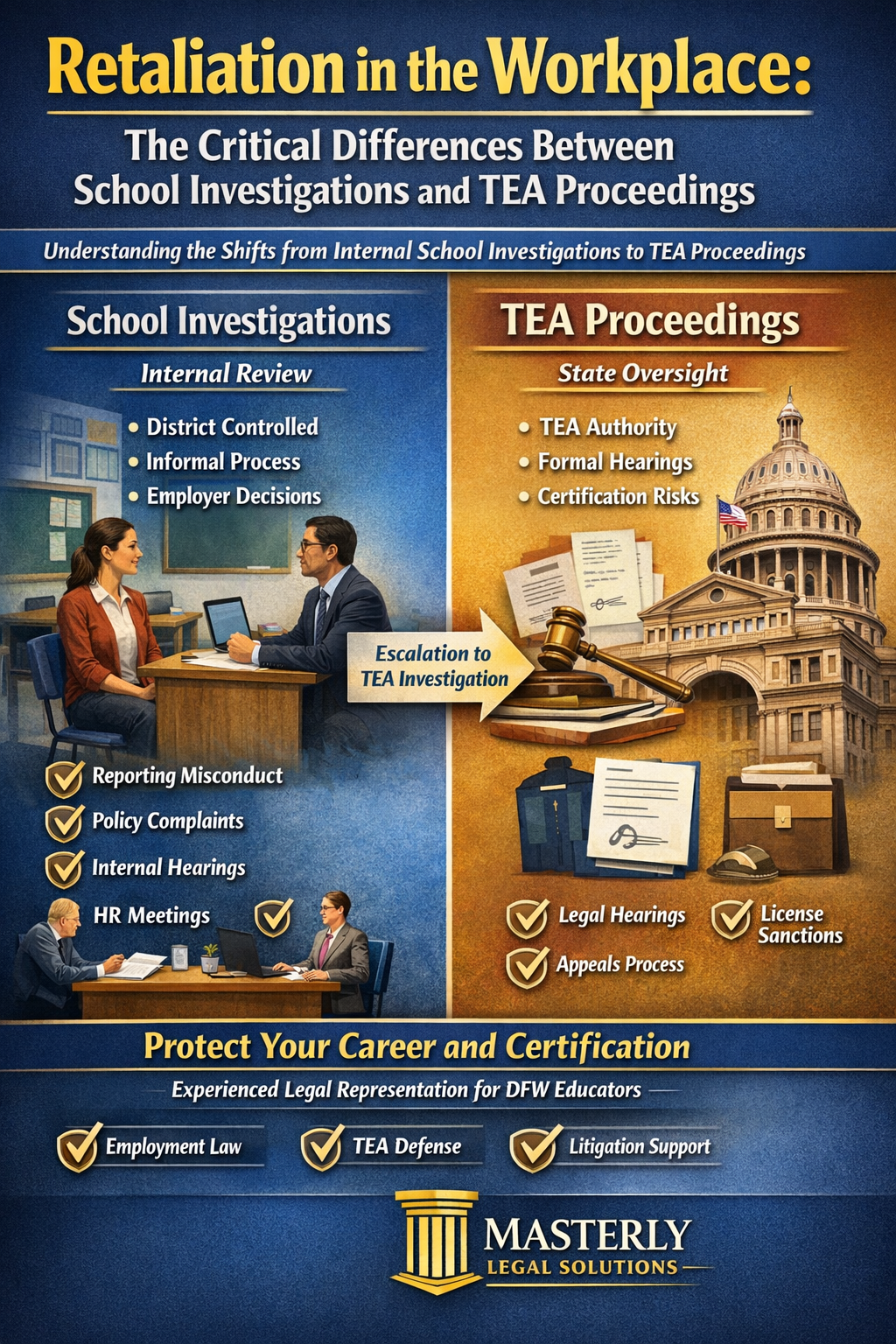
Infographic showing the differences between school investigations and Texas Education Agency (TEA) proceedings in workplace retaliation cases, highlighting informal district processes versus formal state-level legal hearings, certification risks, and escalation steps for educators.


The Value of Trial Experience


Importance of Trial Lawyers

Having experienced trial lawyers can make a significant difference in the outcome of a case.


Our team includes seasoned trial attorneys who are prepared to advocate for our clients in any court setting.


Serving the North Texas Community


Local Knowledge Matters

Our deep roots in north texas, including fort worth and surrounding areas, allow us to provide informed and effective representation.


Dedicated to Businesses and Individuals

We work with both individuals and businesses, ensuring that every client receives high-quality legal support.


Contact Masterly Legal Solutions for Guidance

If you are facing retaliation in the workplace or are involved in a school investigation or TEA proceeding in the Frisco school district, you do not have to navigate the process alone. The legal landscape can shift quickly, and having the right attorneys by your side can make all the difference.


At Masterly Legal Solutions, our firm is committed to helping clients across north texas understand their rights and protect their future. We offer initial consultations designed to give you clarity and direction without unnecessary pressure. There is no complicated consultation fee structure—just straightforward, honest guidance tailored to your situation.


Whether your case involves internal school investigations, administrative proceedings, or full-scale litigation, our team is ready to provide the support you need. Contact us at (972) 236-5051 for a free consultation so we can answer your questions and help you take the next step with confidence.


Disclaimer: This article is for informational purposes only and does not constitute legal advice. Every case involves unique circumstances, and you should consult a qualified lawyer to discuss your specific situation before making any legal decisions.

(972) 236-5051
Employee experiencing retaliation at work after reporting workplace misconduct.
May 29, 2026
Learn how to protect against retaliation in the workplace. Review employee rights, employer obligations, workplace retaliation law, harassment, and claims.
Education law attorneys assisting students and schools.
May 29, 2026
Find an education attorney or lawyer for school and education law matters. Compare top-rated education law attorneys, view ratings, and schedule a consultation.
CPS attorney defending parents during investigations.
May 29, 2026
Need a CPS attorney or CPS lawyer? Defend against CPS investigations and Child Protective Services actions. Protect your rights and your family—contact us today.
May 29, 2026
The First Call From CPS: What Every Parent Should Do Next Few phone calls create as much fear and uncertainty as hearing that Child Protective Services wants to speak with you about your child. For many parents, the moment feels unreal. One minute life seems normal, and the next, a CPS investigator is asking questions about your family, your home, and your ability to provide care for your children. The reality is that the first contact from CPS can have a lasting impact on the entire investigation. What parents say during that initial conversation, how they respond to requests, and whether they seek legal guidance can influence the direction of the case from the very beginning. Unfortunately, many families do not realize the significance of that first call until it is too late. At Masterly Legal Solutions , we help parents throughout Texas navigate Child Protective Services investigations with clarity and confidence. Our approach is proactive, strategic, and focused on protecting families before situations become more complicated. Understanding what to do after that first call may help protect your parental rights, your family, and your future. Why the First Call From CPS Matters Many parents assume the first phone call is simply a routine conversation. They believe that if they cooperate fully and answer every question immediately, the matter will quickly disappear. In reality, the first conversation often serves as the foundation for the entire CPS investigation. The information gathered during that initial contact may influence future interviews, home visits, assessments, and recommendations. Investigators often begin forming impressions based on these early interactions. While cooperation can be important, parents should also understand that they have rights. Knowing how to respond thoughtfully can make a significant difference throughout the investigation process. Understanding the Role of Child Protective Services Child Protective Services is part of the Texas Department of Family and Protective Services. The agency is responsible for investigating reports involving child abuse, neglect, exploitation, abandonment, and other concerns affecting children. The primary mission of child protective services is to protect children from harm and assess whether a child's safety may be at risk. When a report is received, CPS evaluates the information and determines whether an investigation should begin. Many people mistakenly assume that CPS only becomes involved in severe situations involving physical abuse. In reality, reports can involve a wide range of concerns relating to supervision, living conditions, medical care, educational issues, or allegations of neglect. What Triggers a CPS Investigation A CPS investigation may begin after someone submits a report regarding concerns about a child. Reports can come from many different sources. Common reporting sources include: Teachers Medical professionals School administrators Social services providers Family members Friends Neighbors Mandated reporters In some situations, the person making the report genuinely believes a child may be in danger. In others, misunderstandings or inaccurate information may result in allegations that ultimately prove unfounded. The Emotional Impact of Receiving a CPS Call Most parents experience immediate anxiety when CPS makes contact. Even parents who know they have done nothing wrong often feel overwhelmed. The thought of being investigated by a government agency can be intimidating. Many families fear losing custody of their children or being unfairly judged based on incomplete information. These emotions are completely understandable. However, decisions made during moments of panic can create additional challenges. Remaining calm and seeking guidance can help families avoid unnecessary mistakes. What CPS Is Looking For During Initial Contact The first call is often designed to gather basic information about the child, the family, and the reported concerns. Investigators may attempt to: Verify identities Confirm household members Discuss allegations Schedule interviews Arrange home visits Obtain relevant information Assess immediate danger concerns The agency is trying to determine whether additional investigation is necessary and whether there are any immediate safety risks that require urgent attention. Why Parents Should Take Every Report Seriously Many families assume that false allegations will quickly disappear once CPS learns the truth. Unfortunately, the process is often more complicated. Every report must generally be evaluated according to agency procedures. Even if allegations appear unreasonable, investigators are still required to conduct an assessment. Ignoring CPS communication rarely helps. Taking the matter seriously while responding strategically is usually the best approach. The Biggest Mistake Parents Make During the First Call One of the most common mistakes is speaking too much before understanding the nature of the allegations. Parents often become defensive and begin explaining events before learning exactly why CPS is involved. In an effort to appear cooperative, they may provide information that is incomplete, inaccurate, or easily misunderstood. The first conversation is not the time to panic. It is the time to become informed about the process and consider obtaining legal guidance. Understanding Child Abuse and Neglect Allegations Many CPS investigations involve allegations of child abuse or neglect. These terms often have broader meanings than parents realize. Child abuse may involve physical abuse, emotional abuse, sexual abuse, exploitation, or other actions that place a child at risk of harm. Neglect may involve inadequate supervision, failure to provide care, unsafe living conditions, or failure to meet a child's health needs. Not every allegation is supported by evidence. However, every allegation should be taken seriously because of the potential consequences involved. How Child Protective Services CPS Evaluates Reports When child protective services CPS receives a report, the agency reviews available information and determines the appropriate response. The agency may assess: The nature of the allegations The child's safety Prior CPS history Household conditions Available evidence Statements from involved individuals The goal is to determine whether the reported concerns require further investigation or intervention. Why Early Statements Matter Every statement made during a CPS investigation can become part of the agency's records. Parents sometimes believe they are simply having an informal conversation. In reality, investigators may document comments and observations that later become relevant during assessments or court proceedings. An experienced attorney can advise families on how to communicate effectively without creating unnecessary complications. Home Visits and Early Investigations In many cases, CPS may request a home visit shortly after making contact. Home visits allow investigators to observe living conditions, speak with household members, and evaluate potential safety concerns. These visits can feel stressful, especially for parents who are unfamiliar with the process. Understanding your rights before a home visit can help families make informed decisions and avoid misunderstandings. What Happens During Interviews Interviews are a critical component of many CPS investigations. Investigators may seek to speak with: Parents Children Guardians Teachers Medical providers Relatives Friends The information gathered during these interviews often influences the agency's assessment and recommendations. Why Children Are Often Interviewed One of the most concerning aspects of a CPS investigation for many parents is learning that investigators want to speak directly with their children. The agency often interviews children to gather information about their living situation, relationships, supervision, and overall well-being. Parents should understand how these interviews are conducted and what rights may apply during the process. Understanding Immediate Danger Assessments CPS investigators frequently evaluate whether a child faces immediate danger. An immediate danger finding may lead to more aggressive intervention measures. Investigators assess factors such as supervision, physical safety, medical needs, and environmental conditions. Fortunately, not every report results in findings of immediate danger. However, understanding how investigators assess risk can help parents prepare. The Importance of Child Safety Evaluations Protecting children is the primary responsibility of Child Protective Services. During every investigation, the agency evaluates a child's safety and attempts to determine whether concerns are substantiated. This evaluation often involves reviewing information from multiple sources. Parents who understand this focus can better navigate communications with the agency. How Medical Information May Affect a Case Medical records often play an important role during CPS investigations. Questions regarding a child's health, treatment history, or medical needs may become part of the assessment. In some situations, misunderstandings regarding medical conditions can contribute to allegations. Providing accurate and complete information can help ensure a more balanced review. School Involvement in CPS Cases Schools frequently become involved in CPS investigations. Teachers and school personnel are often mandated reporters who are legally required to report suspected child abuse or neglect. A school may also provide records or participate in interviews, and in some situations school districts or educators themselves may need education law and professional license defense representation . Understanding the school's role can help families better understand how investigations develop. The Risk of Overexplaining Many parents believe that providing lengthy explanations will help resolve concerns quickly. Unfortunately, overexplaining can sometimes create confusion. Additional details may raise new questions or lead to misunderstandings. An attorney can help parents determine how to respond appropriately while protecting their interests. Why You Should Not Assume CPS Believes You Are Guilty Being investigated does not mean you have been found responsible for abuse or neglect. CPS investigations are designed to gather information and assess concerns. The agency is tasked with determining whether allegations have merit. Parents should avoid assuming that an investigation automatically means adverse findings will occur. The Role of an Attorney During a CPS Investigation An attorney serves as a guide throughout the investigation process. Legal counsel can: Explain your rights Review allegations Advise on communication strategies Assist with documentation Prepare for interviews Protect parental rights Early involvement often helps families avoid common mistakes that can complicate investigations. Why Waiting Can Create Additional Risks Many parents delay contacting an attorney because they hope the investigation will quickly resolve itself. Unfortunately, early stages are often when the most important decisions are made. Waiting too long may limit available options or make it more difficult to address concerns. Taking proactive action can help protect your family and improve your ability to respond effectively. Understanding Court Involvement Not every CPS case results in court involvement. However, some investigations may eventually lead to court proceedings. A court order may be sought when the agency believes intervention is necessary to protect children. These situations often involve complex legal issues requiring immediate attention. Having legal guidance before matters reach court can be extremely valuable. Protecting Parental Rights Throughout the Process Parents have important parental rights during CPS investigations. Understanding those rights allows families to make informed decisions regarding interviews, requests, documentation, and agency interactions. Protecting parental rights does not mean refusing to cooperate. It means responding strategically while understanding the legal implications of each step. How Masterly Legal Solutions Assists Families At Masterly Legal Solutions, we understand how frightening a CPS investigation can be. Our team helps families understand the process, assess potential risks, and respond appropriately to agency requests. We provide strategic guidance designed to protect children while also protecting the rights of parents and guardians, drawing on our broader legal and business services for individuals and organizations . Every client receives individualized attention based on the specific facts of their situation. Why Knowledge Creates Better Outcomes Fear often causes families to make decisions without fully understanding the consequences. Knowledge allows parents to act confidently and make informed choices. Understanding how CPS operates can reduce uncertainty and improve communication throughout the investigation. Being informed is one of the strongest tools families have when dealing with Child Protective Services. The Importance of Acting Quickly The first days of a CPS investigation are often the most important. Information is gathered quickly. Assessments begin immediately. Decisions regarding interviews, home visits, and documentation may occur within a short period of time. Seeking legal guidance early may help save families from avoidable mistakes and strengthen their ability to respond effectively, and it can also be an opportunity to address broader planning needs such as essential legal documents for families before age 40 . What Families Should Expect Moving Forward Every investigation is different. Some cases are resolved quickly, while others require ongoing review. Parents should expect communication with the agency, requests for information, and possible follow-up interviews. Remaining organized and informed can help reduce stress throughout the process, especially when families also take time to secure their futures through personalized estate planning, wills, and trusts .  Understanding what to expect allows families to approach the situation with greater confidence.
HR consultancy experts providing human resource solutions.
May 29, 2026
HR consulting services for business growth. Our HR consulting firm delivers human resource solutions, HR function support, and expert consultant services nationwide.
Dallas-Fort Worth school districts and campuses
May 28, 2026
Explore Fort Worth ISD, a leading Texas school district in the Dallas-Fort Worth area, offering top-rated schools and independent school district programs.
.Child protection law firm attorney helping families
May 28, 2026
Protect your child with experienced child protection lawyers. Our law firm offers family law consultation for DYFS and new child protection cases in New Jersey.
Compliance report review and regulatory reporting process.
May 28, 2026
Our compliance report reviews the reporting process, regulatory adherence, and policies and procedures to strengthen compliance every step of the way for businesses.

Looking for Legal & Business Solutions? Contact Us Now

Fill in the form or call us to set up a meeting

(972) 236-5051
A black and white drawing of a straight line on a white background.