Texas Educators' Code of Ethics: What It Requires and Who It Applies To
The Texas Educators' Code of Ethics is the set of enforceable professional standards that apply to Texas educators and to candidates for certification. It is adopted by the State Board for Educator Certification (SBEC) in 19 Texas Administrative Code Chapter 247. The current text discussed here is the TEA "currently in effect" version labeled August 2026 Update, including the amendment to section 247.2 that became effective August 2, 2026 (51 TexReg 4867). TEA notes that the rules posted on its site are for information and that the formally published Texas Administrative Code is available through the Secretary of State.
This article explains what Chapter 247 requires, how the three groups of enforceable standards are organized, and who the code applies to. It is general information about Texas law and administrative rules, not legal advice about any particular educator or case, and it does not promise a particular outcome.

Texas Educators Code of Ethics: Scope and Ethical Behavior
The Texas educators code of ethics is the formal title used in 19 TAC Chapter 247. Section 247.1 states that the State Board for Educator Certification adopts the Educators' Code of Ethics, as set forth in section 247.2, under Texas Education Code section 21.041(b)(8). The chapter applies to teachers, administrators, and other educators, and to candidates for certification. Classroom teachers are included whenever they are required to hold a certificate. An "educator" is a person who is required to hold a certificate issued under Texas Education Code Chapter 21, Subchapter B. The rules set expectations for ethical behavior in the classroom, in the school community, and in dealings with the Texas Education Agency and the State Board. Teachers, including classroom teachers, are expected to follow the same standards as other certified educators. SBEC has the authority to apply Chapter 247 in certification matters.
Section 247.1(b) describes the professional expectations behind the code: the educator is to follow standard practices and ethical conduct toward students, professional colleagues, school officials, parents, and members of the community; respect and obey the law; demonstrate personal integrity; and exemplify honesty and good moral character. "Good moral character" is defined in section 247.1(e) as virtues shown by patterns of personal, academic, and occupational behavior that, in SBEC's judgment, indicate honesty, accountability, trustworthiness, reliability, and integrity.
SBEC is solely responsible for enforcing the Educators' Code of Ethics for purposes related to certification disciplinary proceedings. The commissioner of education is not the body that enforces Chapter 247 in those certification cases. Those proceedings follow 19 TAC Chapter 249(Disciplinary Proceedings, Sanctions, and Contested Cases). This article stays with the conduct standards in Chapter 247: what the code says, how its sections are organized, and who it applies to.
A "complaint," as defined in section 247.1, is a written statement submitted to TEA staff that contains essential facts alleging improper conduct by an educator, applicant, or examinee, plus the complainant's verifiable contact information, and that provides grounds for sanctions. In other words, the filing has to be a written statement supported by those essential facts. The definition also covers an applicant or examinee who is alleged to have engaged in improper conduct. A sanction can include a restriction, reprimand, suspension, revocation of a certificate, or a surrender in lieu of disciplinary action. Those definitions describe what the rules mean. They are not a prediction of what will happen in any case.
Professional Ethical Conduct, Practices, and Performance
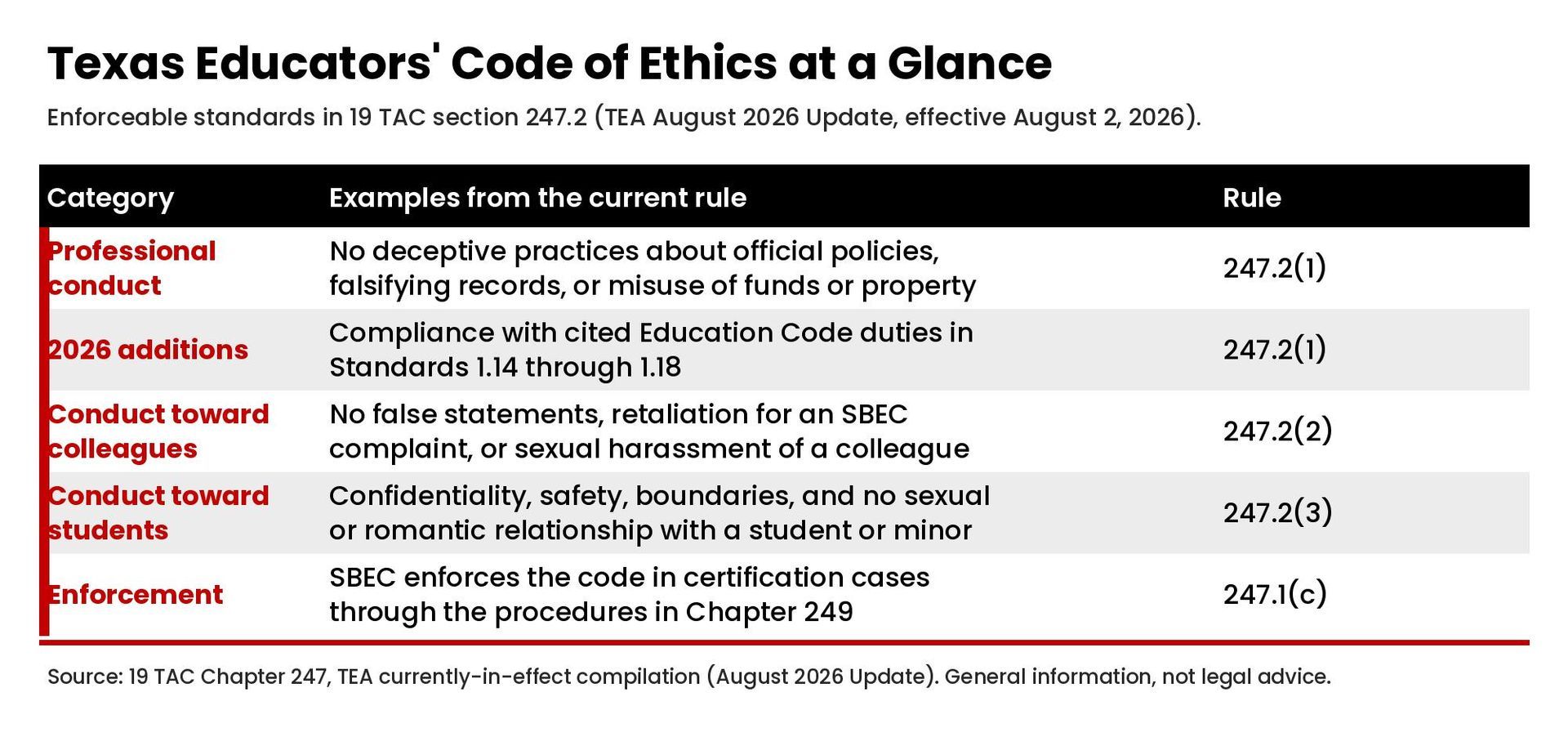
Section 247.2 groups the enforceable standards into three parts. The first part addresses professional ethical conduct, practices, and performance.
Among other things, an educator shall not:
- intentionally, knowingly, or recklessly engage in deceptive practices regarding official policies of the school district, educational institution, educator preparation program, TEA, or SBEC and its certification process (Standard 1.1);
- intentionally, knowingly, or recklessly misappropriate, divert, or use monies, personnel, property, or equipment committed to the educator's charge for personal gain or advantage, including school resources placed in the educator's professional responsibility (Standard 1.2);
- submit fraudulent requests for reimbursement, expenses, or pay (Standard 1.3);
- use institutional or professional privileges for personal or partisan advantage (Standard 1.4);
- accept or offer gratuities, gifts, or favors that impair professional judgment or that are used to obtain special advantage, with a stated exception for gifts or tokens offered and accepted openly in recognition or appreciation of service (Standard 1.5);
- falsify records, or direct or coerce others to do so (Standard 1.6);
- fail to comply with state regulations, written local school board policies, and other state and federal laws (Standard 1.7);
- apply for, accept, offer, or assign a position or a responsibility on a basis other than professional qualifications (Standard 1.8);
- make threats of violence against school district employees, school board members, students, or parents of students (Standard 1.9);
- fail to be of good moral character and worthy to instruct or supervise the youth of this state (Standard 1.10);
- intentionally, knowingly, or recklessly misrepresent employment history, criminal history, or disciplinary record when applying for subsequent employment (Standard 1.11);
- illegally use, abuse, or distribute controlled substances, prescription drugs, or toxic inhalants (Standard 1.12); or
- be under the influence of alcohol, or consume alcoholic beverages on school property or during school activities when students are present (Standard 1.13).
The August 2, 2026 amendment added further professional-conduct standards that require compliance with specific Education Code provisions:
- Standard 1.14: comply with the prohibitions on diversity, equity, and inclusion duties in Texas Education Code section 11.005;
- Standard 1.15: comply with the prohibitions on assistance with social transitioning in section 11.401;
- Standard 1.16: comply with the restrictions on instruction regarding sexual orientation and gender identity in section 28.0043;
- Standard 1.17: comply with the requirements to provide full information to a parent concerning a student in section 26.008; and
- Standard 1.18: not promote, advocate, or encourage, in a manner that is reasonably accessible or visible to students, illegal conduct described by Texas Education Code section 22A.201(a), or illegal conduct directly related to student behavior or school property.
Those standards point to the cited Education Code sections for the underlying duties. This article does not analyze those statutes at length or forecast how SBEC will apply them in a particular investigation.
Chapter 247 does not use the phrase "role models," and it does not grade teachers on whether students succeed. It requires good moral character and worthiness to instruct or supervise the youth of this state. It also requires respect for the law, honesty, and integrity. Personal interest cannot be used as a reason to divert school resources or to use professional privileges for partisan advantage. Those conflicts are addressed in the professional-conduct standards, not as a separate "conflict of interest" form. The professional-conduct standards also cover conflicts involving school funds or property, professional privileges, and personal interest or partisan advantage.
An alleged paperwork error is not automatically a Standard 1.6 falsification issue; that standard addresses falsifying records, or directing or coercing others to do so. Whether a particular record problem rises to that level depends on the facts.
Ethical Conduct Toward Professional Colleagues
The second group of standards in section 247.2 addresses conduct toward colleagues. An educator shall not:
- reveal confidential health or personnel information concerning colleagues unless disclosure serves lawful professional purposes or is required by law (Standard 2.1);
- harm others by knowingly making false statements about a colleague or the school system (Standard 2.2);
- fail to adhere to written local school board policies and state and federal laws regarding the hiring, evaluation, and dismissal of personnel (Standard 2.3);
- interfere with a colleague's exercise of political, professional, or citizenship rights and responsibilities (Standard 2.4);
- discriminate against or coerce a colleague on the basis of race, color, religion, national origin, age, gender, disability, family status, or sexual orientation (Standard 2.5);
- use coercive means or a promise of special treatment in order to influence professional decisions or colleagues (Standard 2.6);
- retaliate against any individual who has filed a complaint with SBEC or who provides information for a disciplinary investigation or proceeding under Chapter 247 (Standard 2.7); or
- intentionally or knowingly subject a colleague to sexual harassment (Standard 2.8).
Standard 2.7 is especially important when a complaint is already in motion. The code itself prohibits retaliation against a person who files an SBEC complaint or provides information in the investigation. Decisions about hiring, evaluation, and dismissal of personnel, and decisions inside an educator preparation program, are also covered in the professional and colleague standards.
Ethical Conduct Toward Students
The third group of standards is the most detailed, and it is often the starting point when a student-related allegation is made. These rules apply to teachers and other educators in their work with students.
An educator shall not reveal confidential information concerning students unless disclosure serves lawful professional purposes or is required by law (Standard 3.1). That confidentiality duty is a recurring professional responsibility, and it also appears in Standard 2.1 as to colleagues. An educator shall not intentionally, knowingly, or recklessly treat a student or minor in a manner that adversely affects or endangers the learning, physical health, mental health, or safety of the student or minor (Standard 3.2), or misrepresent facts regarding a student (Standard 3.3). Those student-protection rules apply to classroom learners as well as to minors in other school settings.
Standard 3.4 provides that an educator shall not exclude a student from participation in a program, deny benefits to a student, or grant an advantage to a student on the basis of race, color, gender, disability, national origin, religion, family status, or sexual orientation.
Standard 3.5 prohibits intentional, knowing, or reckless physical mistreatment, neglect, or abuse of a student or minor. Standard 3.6 prohibits soliciting or engaging in sexual conduct or a romantic relationship with a student or minor. Standard 3.7 addresses furnishing alcohol or illegal or unauthorized drugs to a person under 21 years of age, or knowingly allowing a person under 21 to consume those substances in the educator's presence, with a stated exception when the educator is the parent or guardian of that child.
Standard 3.8 requires the educator to maintain appropriate professional educator-student relationships and boundaries based on a reasonably prudent educator standard. The rule lists factors that may be considered in context and on the totality of the circumstances, including physical contact beyond the professional role, contacting or meeting a student with no discernible professional purpose, transporting a student without a legal guardian's permission or in violation of policy (unless for an emergency), taking or possessing a photo or video of the student beyond the professional role or in violation of policy, and showing favoritism or isolation through gifts, rewards, or privileges. Standard 3.8 also warns against efforts to gain access to or time alone with a student with no discernible professional purpose, including inside a classroom or in other settings. Teachers and other educators are expected to protect confidentiality and to avoid communications that could be reasonably interpreted as inappropriate.
Standard 3.9 requires the educator to refrain from inappropriate communication with a student or minor, including electronic communication such as cell phone, text messaging, email, instant messaging, blogging, or other social network communication. The rule again lists factors that may be considered, including the nature, purpose, timing, and amount of the communication; whether it was concealed; whether it could be reasonably interpreted as soliciting sexual contact or a romantic relationship; whether it was sexually explicit; and whether it could be reasonably interpreted as threatening the student's welfare or safety.
How a Code of Ethics Issue Can Reach SBEC
A campus or district investigation and an SBEC certification case are not the same thing, even when they grow out of the same facts. A local complaint, a personnel investigation, or a report to Texas Education Agency staff can lead to a certification disciplinary proceeding under Chapter 249. Chapter 247 is the conduct standard SBEC uses in those proceedings. For a closer look at how a Code of Ethics issue can move from a local report to an SBEC matter, see our page on TEA ethics issues and teaching certificates. A related educator certification complaints guide explains how a written response is assembled. This article stays with what the code requires and does not predict how any particular matter will be decided.
Frequently Asked Questions
What is the Texas Educators' Code of Ethics?
It is the enforceable set of professional standards in 19 Texas Administrative Code Chapter 247, adopted by SBEC. Section 247.2 contains the standards. Section 247.1 covers purpose, scope, and definitions.
Who must follow the educator code of ethics in Texas?
Chapter 247 applies to educators and candidates for certification. That includes teachers, administrators, and other certified educators, as well as candidates for certification. An educator, for this chapter, is a person required to hold a certificate issued under Texas Education Code Chapter 21, Subchapter B.
What are the main categories of standards?
Section 247.2 has three groups: professional ethical conduct, practices, and performance; ethical conduct toward professional colleagues; and ethical conduct toward students.
Did the Educators' Code of Ethics change in 2026?
Yes. Section 247.2 was amended effective August 2, 2026. The current TEA compilation is labeled August 2026 Update and includes Standards 1.14 through 1.18, which require compliance with specified Education Code provisions. Educators should read the current official text rather than an older handbook excerpt.
Who enforces the code?
SBEC is solely responsible for enforcing the Educators' Code of Ethics for purposes related to certification disciplinary proceedings, through the procedures in Chapter 249. The commissioner of education is not the enforcement body for Chapter 247 in those certification cases. A local district may also have its own employment policies and investigation process.
Does a code of ethics complaint automatically cost an educator a certificate?
No. A complaint is a defined filing that can provide grounds for sanctions, and sanctions can include several types of certification action. A complaint does not, by itself, create a final sanction. Whether any particular complaint leads to a sanction depends on the facts, the record, and the Chapter 249 process. The charge has to be supported by the process in Chapter 249. This article does not predict that result.
Teaching assignments, classroom access to students, and a student's learning environment can all be part of the facts in a Chapter 247 matter. Those facts still have to be measured against the actual standard that is cited.
Talk With a Lawyer About Your Situation
If you have been asked to respond to a Chapter 247 allegation, or you want help understanding how the current Educators' Code of Ethics may apply to a notice you have received, contact Masterly Legal Solutions to request a consultation. Early legal review can help you understand the standards and your professional responsibility in the process. It is not a promise about the result. This article provides general information about Texas law and administrative rules and is not legal advice. Reading it does not create an attorney-client relationship, and no particular result is promised.
Andrew Rhoden, Esq. is a lawyer with Masterly Legal Solutions, 3838 Oak Lawn Avenue, Suite 1000, Dallas, Texas 75219, licensed in Texas, North Carolina, and the District of Columbia.




Looking for Legal & Business Solutions? Contact Us Now
Fill in the form or call us to set up a meeting