

Is Texas an At-Will State? What At-Will Employment Means for Employees and Employers
Yes. People who ask "is Texas an at will state" are asking about the default rule of Texas employment law. Texas is an at will employment state, and at will employment is still the starting point as of November 2026. Under Texas law, if there is no statute or express employment agreement to the contrary, either the employer or the employee may end the employment relationship at any time, for any reason or for no particular reason, with or without advance notice. The Texas Workforce Commission describes this as the basic rule of Texas employment law, and it applies to all phases of the relationship, not only the final day of work.
That rule is often summarized as "an employer can fire you for any reason." The short version is incomplete, and employees should not assume that a firing is unlawful solely because it felt unfair. At-will employment describes the default. It does not cancel other legal protections. Texas and federal law still prohibit workplace discrimination, certain kinds of retaliation, and other unlawful practices. An employment contract or a sufficiently definite employment agreement can also change the terms of the relationship.
This article explains what at-will employment means in Texas for employees and employers, the main exceptions, and how contracts, policies, and Texas law fit together. The topics below cover the questions employees and employers raise most often. It is general information about Texas employment law, not legal advice about any particular job, termination, or business.

What At-Will Employment Means in Texas
Texas did not create at-will employment in a single labor code section. It is a long-standing common law rule. In East Line & R.R.R. Co. v. Scott , 72 Tex. 70, 10 S.W. 99 (1888), the Texas Supreme Court held that employment for an indefinite term may be terminated at will and without cause. The Court has repeated that rule many times since, including in Sabine Pilot Service, Inc. v. Hauck , 687 S.W.2d 733 (Tex. 1985), and Montgomery County Hospital District v. Brown , 965 S.W.2d 501 (Tex. 1998).
In practical terms, at-will employment usually means all of the following, unless a statute or an express agreement says otherwise:
- An employer may terminate an employee for a good reason, a bad reason, or no stated reason.
- An employee may quit a job at any time, with or without notice.
- An employer may generally change job duties, schedules, work locations, titles, and other terms of the job.
- Neither side has to prove "cause" before ending the relationship.
The same default applies to employees and employers across Texas, including in Houston, Austin, San Antonio, and smaller communities. Local office custom may affect how companies in Houston, Austin, or San Antonio handle a termination in practice, but it does not replace the statewide rule. For example, an employer may still require two weeks' notice as a policy, even though Texas employment law does not generally require that notice.
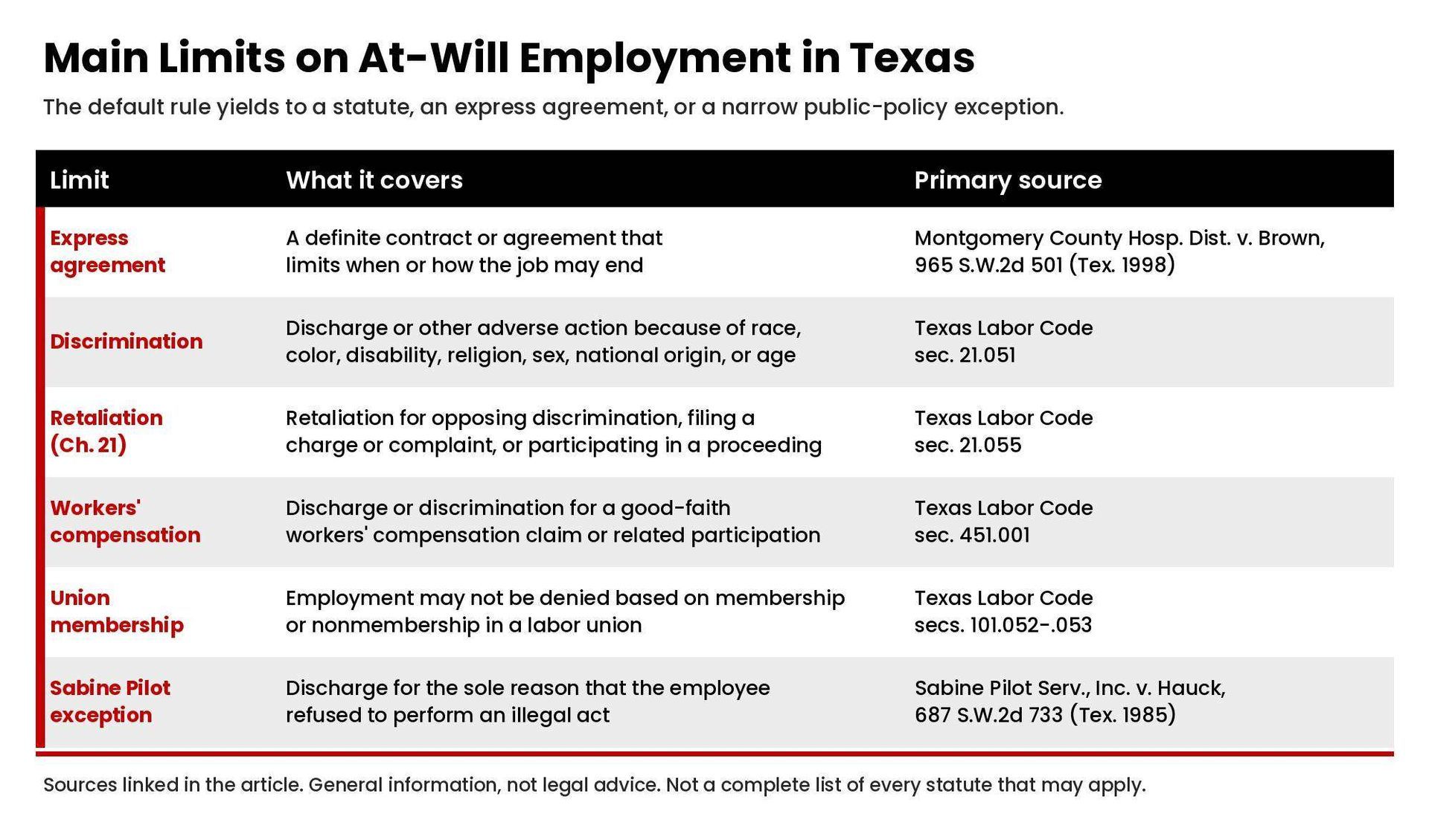
At-will employment is also different from Texas's right-to-work laws. Right-to-work rules address union membership. Under Texas Labor Code sections 101.052 and 101.053, a person may not be denied employment based on membership or nonmembership in a labor union, and a contract that requires or prohibits union membership as a condition of work is void. Those provisions do not, by themselves, require an employer to have cause before ending a job.
What At-Will Employment Does Not Mean
At-will status does not place a worker outside the law, and it does not give a business a free hand to ignore statutes that protect employees while they are employed.
Wage and hour rules still apply to employers. An employer may not use at-will status to pay less than the required federal minimum wage, skip overtime that the law requires, or withhold pay that Texas payday law requires the employer to pay. Workplace safety duties still apply. Other labor and employment statutes can apply as well, depending on the facts, the size of the company, and whether the person is an employee or an independent contractor.
Classification matters. At-will employment describes an employment relationship. An independent contractor is not an employee, and is considered a party to a contract rather than an at-will employee. The written contract and the actual working relationship, not a job title alone, usually control that analysis. Misclassification questions are separate from the at-will rule and should be reviewed on their own facts.
In short, at-will employment answers a narrow question: in the absence of a statute or express agreement, may either side end the relationship without proving cause? It does not answer every question about pay, leave, safety, discrimination, or contract rights.
Employment Contracts and Other Express Agreements
The at-will rule yields to an express agreement that limits it. The most direct example is a written employment contract that sets a term of employment, lists the reasons the employer may terminate the employee, or requires notice, a process, or severance in defined circumstances. Some commissioned, executive, or union relationships are also governed by a written employment agreement or a collective bargaining agreement.
The agreement has to be definite. In Montgomery County Hospital District v. Brown , 965 S.W.2d 501 (Tex. 1998), the Texas Supreme Court held that general oral assurances do not modify at-will status. The Court explained that the employer must unequivocally indicate a definite intent to be bound not to terminate the employee except under clearly specified circumstances. Comments that an employee will not be discharged as long as the work is satisfactory, or that the employee will be discharged only for "good cause" when the parties never agreed on what that term means, were not enough.
Employees and employers who are relying on a conversation, an offer letter, or a short email should read the actual document and consider whether it is specific enough to be an agreement. Note that general comments about job security are usually not enough. A vague promise of job security is generally not a substitute for a clear contract.
Employee Handbooks and Workplace Policies
Many companies issue an employee handbook that describes attendance, discipline, complaints, and termination procedures. A handbook is an important workplace tool. It tells employees the standards the company expects them to follow, and it helps employers apply those standards consistently. The Texas Workforce Commission advises employers to use clear written policies that employees can actually read.
A handbook does not automatically create a contract. Texas courts have generally required a clear and specific agreement before a policy manual changes at-will employment. Many handbooks also contain an express disclaimer stating that the handbook is not a contract and that employment remains at will. Whether a particular handbook limits an employer's right to terminate depends on the language of that handbook and the surrounding facts. It is not a question with a single answer for every workplace.
Employers who are writing or updating policies should review them carefully so the document says what the company intends, and so it does not conflict with statutory protections. Our employee handbook page explains the handbook work Masterly Legal Solutions offers for businesses that want that review.
Statutory Exceptions: Discrimination and Retaliation
The most widely used exceptions to at-will employment come from statutes, not from the common law. Chapter 21 of the Texas Labor Code, often called the Texas Commission on Human Rights Act, is the state's main employment discrimination law. It is administered by the Texas Workforce Commission, and one of its stated purposes is to provide for the execution of the policies of Title VII of the Civil Rights Act of 1964 and related federal protections.
Under Texas Labor Code section 21.051, an employer commits an unlawful employment practice if, because of race, color, disability, religion, sex, national origin, or age, the employer fails or refuses to hire an individual, discharges an individual, or discriminates in any other manner in connection with compensation or the terms, conditions, or privileges of employment. The same chapter also covers related practices by employment agencies and labor organizations.
Retaliation is a separate statutory protection. Section 21.055 makes it an unlawful employment practice for an employer, labor union, or employment agency to retaliate or discriminate against a person who, under Chapter 21, opposes a discriminatory practice, makes or files a charge, files a complaint, or testifies, assists, or participates in an investigation, proceeding, or hearing.
These protections do not mean that every termination that feels unfair is unlawful discrimination. They do mean that an employer may not use at-will status as a reason to fire someone because of a protected characteristic or because the person engaged in protected activity under Chapter 21. Federal employment discrimination laws can apply as well, depending on the employer and the claim. A person who believes a termination involved discrimination or retaliation should look promptly at filing deadlines, which can be short, and may choose to consult a lawyer before those deadlines pass.
Workers' Compensation and Other Statutory Protections
Other Texas statutes also limit what an employer may do, even in an at-will relationship.
Texas Labor Code section 451.001 prohibits a person from discharging or otherwise discriminating against an employee because the employee has filed a workers' compensation claim in good faith, hired a lawyer to represent the employee in a claim, instituted a good-faith workers' compensation proceeding, or testified or is about to testify in such a proceeding. Section 451.002 provides for reasonable damages and, for a discharged employee, reinstatement in the former position. The employee has the burden of proof.
Other statutes can also apply in particular cases, such as protections tied to union membership or nonmembership under Chapter 101, or other Texas or federal provisions that forbid retaliation for using a protected right. The list in this article is not a complete catalog of every labor statute that might apply to a given job. The point is narrower: at-will employment is the default, and the Texas Legislature has carved out specific, written exceptions.
The Sabine Pilot Exception
Apart from statutes and express agreements, Texas recognizes a narrow public-policy exception to at-will employment. In Sabine Pilot Service, Inc. v. Hauck , 687 S.W.2d 733 (Tex. 1985), the Texas Supreme Court held that an employee may bring a claim if the employee was discharged for the sole reason that the employee refused to perform an illegal act. The Court described the exception as a very narrow one, grounded in public policy as expressed in state and federal laws that carry criminal penalties.
The plaintiff's burden is also narrow. The employee must prove by a preponderance of the evidence that the discharge was for no reason other than the refusal to perform an illegal act. A dispute that involves mixed motives, poor performance, or other stated reasons is not automatically a Sabine Pilot case. The Texas Workforce Commission describes this public-policy exception as the significant common-law exception to employment at will, beyond statutes and express agreements.
The opinion in Sabine Pilot is still the leading Texas case on this issue. Later decisions have discussed how far the exception extends, including questions about good-faith inquiries into whether an act is illegal. Those details are fact-specific. What the Supreme Court made clear in 1985 remains the core rule: Texas does not generally recognize a broad "wrongful discharge" claim for being fired in a way that seems unfair, but it does recognize this limited refusal-to-commit-a-crime exception.
Wrongful Termination in an At-Will State
People often use "wrongful termination" to mean that a firing felt unjust. In Texas, a viable wrongful termination theory usually has to fit into one of the categories above: a statute, an express contract or employment agreement, or the Sabine Pilot exception. Being fired without a warning, without a performance improvement plan, or without a reason the employee considers fair does not, standing alone, change at-will status. A termination can still have immediate consequences for a worker and that worker's family, which is one reason these questions come up quickly.
That does not mean an employee has no questions worth asking after a termination. Several things are often worth reviewing. The analysis often includes:
- whether a written contract, offer letter, or employment agreement limited the employer's right to terminate;
- whether the stated or apparent reason implicates discrimination or retaliation under Chapter 21 or federal law, including leave or other rights the employee had been using;
- whether the termination followed a workers' compensation claim or another protected activity;
- whether the employee was asked to perform an illegal act and was fired for refusing; and
- whether final pay, benefits, or a severance agreement raises separate issues.
Employers have a corresponding set of responsibilities. Clear policies, consistent documentation, and a careful review before a termination can reduce the risk that a lawful at-will decision is later described as something else. The steps that make sense in one workplace may not fit another. Our labor and employment page outlines the employment counsel Masterly Legal Solutions provides to businesses and to individuals who need to understand their options.
Frequently Asked Questions
Is Texas an at-will state?
Yes. Texas is an at-will employment state. Unless a statute or an express agreement says otherwise, either the employer or the employee may end the relationship at any time, for any reason or for no particular reason, with or without notice.
Can a Texas employer fire an employee for any reason?
An employer may generally terminate an at-will employee without proving cause. An employer may not fire an employee for a reason that Texas or federal law prohibits, such as discrimination because of race, color, disability, religion, sex, national origin, or age, retaliation under Chapter 21, or retaliation for a good-faith workers' compensation claim. The Sabine Pilot exception also applies when the sole reason for the discharge is the employee's refusal to perform an illegal act.
Does an employee handbook protect me from being fired?
Not automatically. A handbook can set expectations and describe a usual process, but Texas courts generally require a clear and specific agreement before a policy manual modifies at-will employment. The language of the particular handbook, including any at-will disclaimer, matters.
What is the difference between at-will employment and right to work?
At-will employment is about whether either side may end the job without cause. Right to work is about union membership. Texas Labor Code sections 101.052 and 101.053 prohibit denying employment, or enforcing a contract, based on membership or nonmembership in a labor union.
Do I have a wrongful termination case if I was fired without warning?
Not necessarily. In an at-will relationship, an employer generally does not have to give a warning or follow a performance process before ending the job, unless a contract or a specific law requires it. A person who is concerned about discrimination, retaliation, a contract right, or a Sabine Pilot issue should consult a lawyer promptly, because some claims have short filing windows.
Are the rules different in Houston, Austin, or San Antonio?
No. The at-will rule and the main statutory exceptions are matters of Texas law and, where they apply, federal law. They are not different in each city. A local policy, a union contract, or a particular employer's handbook can add terms, but the default statewide rule remains the same.
Talk With a Lawyer About Your Situation
At-will employment is the starting point in Texas, not the end of the analysis. If you were recently let go, or if your company is writing termination policies and wants them reviewed against Texas law, contact Masterly Legal Solutions to request a consultation. Speaking with a lawyer can help you understand the next steps, including any instructions for preserving documents, and does not require you to continue a dispute. This article provides general information about Texas law and is not legal advice. Reading it does not create an attorney-client relationship, and no particular result is promised.
Andrew Rhoden, Esq. is a lawyer with Masterly Legal Solutions, 3838 Oak Lawn Avenue, Suite 1000, Dallas, Texas 75219, licensed in Texas, North Carolina, and the District of Columbia.






Looking for Legal & Business Solutions? Contact Us Now
Fill in the form or call us to set up a meeting