

Living Will in Texas: The Directive to Physicians Explained
In Texas, a living will is a Directive to Physicians and Family or Surrogates. It is a written (or, in limited cases, nonwritten) instruction about whether to administer, withhold, or withdraw life-sustaining treatment if you have a terminal or irreversible condition. The rules are in Texas Health and Safety Code Chapter 166.
A living will is not the same document as a medical power of attorney Texas residents often sign at the same time. The difference is practical: the living will is a legal document with instructions about life sustaining treatment in a terminal or irreversible condition, while the medical power of attorney names a healthcare agent (a named agent) to make healthcare decisions if you are unable to make them. This article explains the Texas living will form, the witness and notary options, how a living will can be revoked, and what happens if no living will exists. It is general information about Texas law, not legal advice about any particular person, and it does not promise a particular outcome.

Living Will Texas Rules and What the Document Does
Section 166.031 defines a "directive" as an instruction made under section 166.032, 166.034, or 166.035 to administer, withhold, or withdraw life-sustaining treatment in the event of a terminal or irreversible condition. A "qualified patient" is a patient with a terminal or irreversible condition that has been diagnosed and certified in writing by the attending physician.
Section 166.002 treats a directive as one kind of advance directive. The other two advance directives in that definition are an out-of-hospital do-not-resuscitate order and a medical power of attorney. Families sometimes use "living will," "advance directive," and "medical directive" as if they were the same thing. In Texas law, those advance directives are related, but they are not identical. An older guide to advance directives can help place the living will among the other advance directives a family may sign. Advance directives, including a living will, are planning documents. They do not take the place of a conversation with family members and healthcare providers.
The statute also defines the two medical conditions that trigger a directive:
- A terminal condition is an incurable condition caused by injury, disease, or illness that, according to reasonable medical judgment, will produce death within six months, even with available life-sustaining treatment provided in accordance with the prevailing standard of medical care. A patient admitted to a licensed hospice program is presumed to have a terminal condition for purposes of Chapter 166.
- An irreversible condition is a condition, injury, or illness that may be treated but is never cured or eliminated, that leaves a person unable to care for or make decisions for the person's own self, and that, without life-sustaining treatment provided in accordance with the prevailing standard of medical care, is fatal.
Life-sustaining treatment is treatment that, based on reasonable medical judgment, sustains the life of a patient and without which the patient will die. The term includes life-sustaining medications and artificial life support, such as mechanical breathing machines, kidney dialysis, and artificially administered nutrition and hydration. It does not include pain management medication, a procedure needed to provide comfort care, or other medical care provided to alleviate a patient's pain.
Those definitions matter because a Texas living will is not a general permission slip for every future medical decision. It is tied to a terminal or irreversible condition and to life-sustaining treatment, sometimes written as life sustaining treatment, as the statute defines those terms. The statutory form also asks the person to think about medical treatment preferences, including what burden of treatment the person is willing to accept. Treating physicians still have to apply the statute and the patient's present desire.
How a Competent Adult Executes a Written Directive
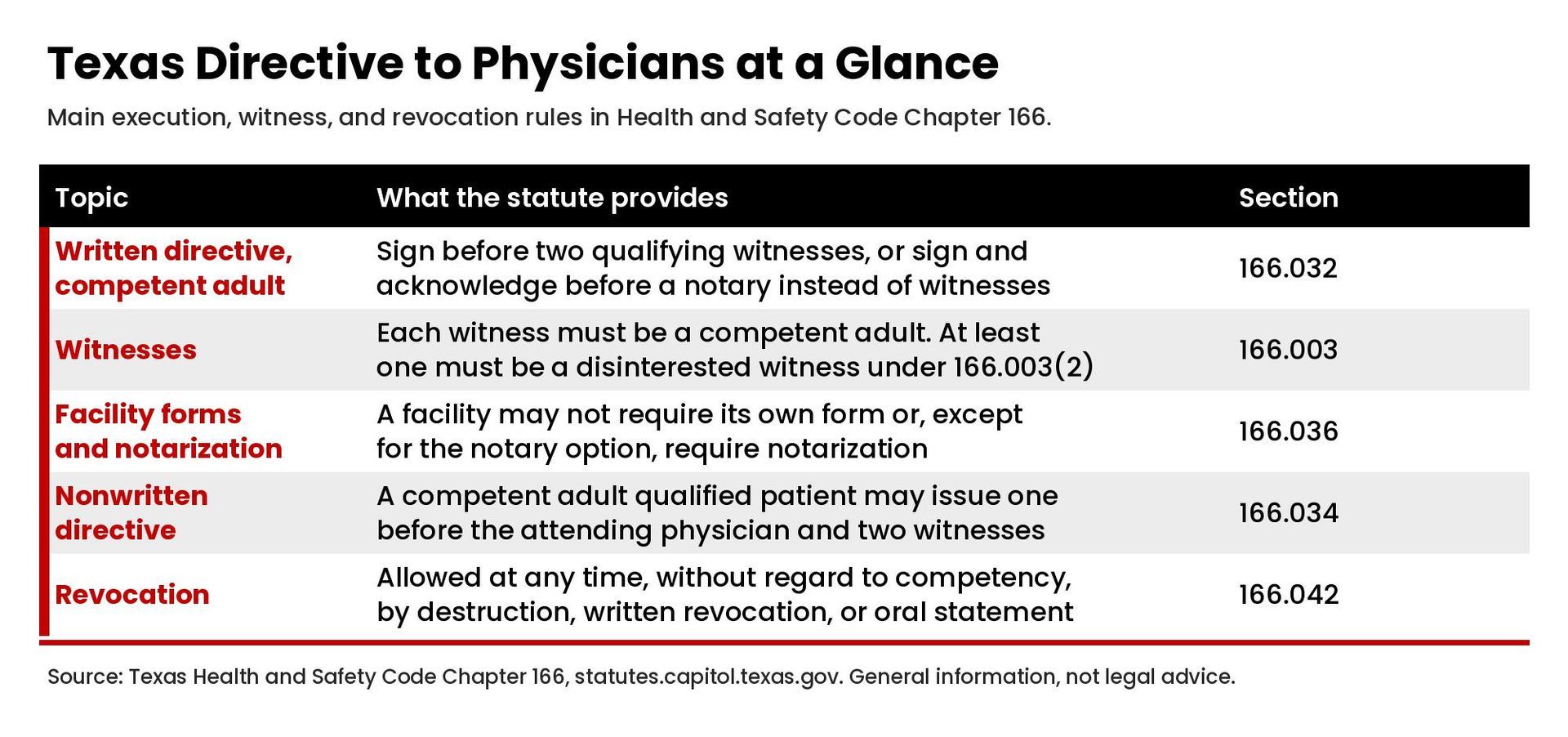
Section 166.032 allows a competent adult to execute a written directive at any time. "Competent" means the person can, based on reasonable medical judgment, understand and appreciate the nature and consequences of a treatment decision, including significant benefits, harms, and reasonable alternatives.
There are two ways to complete the written directive:
- The declarant signs in the presence of two witnesses who qualify under section 166.003. At least one of those witnesses must also qualify under section 166.003(2). Both witnesses must sign the directive.
- In lieu of signing in the presence of witnesses, the declarant may sign the directive and have the signature acknowledged before a notary public. That is the option in section 166.032(b-1).
A declarant may include directions other than those in the statutory form and may designate a person to make a health care or treatment decision if the declarant becomes incompetent or otherwise mentally or physically incapable of communication. The declarant should notify the attending physician that the written directive exists. If the declarant cannot communicate, another person may give that notice. The attending physician must make the directive a part of the declarant's medical record.
Witness Qualifications Under Section 166.003
When Chapter 166 requires witnesses, each witness must be a competent adult. In addition, at least one witness must be a person who is not:
- a person designated by the declarant to make a health care or treatment decision;
- a person related to the declarant by blood or marriage;
- a person entitled to any part of the declarant's estate after the declarant's death under a will or codicil executed by the declarant or by operation of law;
- the attending physician;
- an employee of the attending physician;
- an employee of a health care facility in which the declarant is a patient, if that employee is providing direct patient care to the declarant or is an officer, director, partner, or business office employee of the facility or of any parent organization of the facility; or
- a person who, at the time the written advance directive is executed (or a nonwritten directive is issued), has a claim against any part of the declarant's estate after the declarant's death.
The second witness may be a person who would not meet that "disinterested" list, as long as that person is still a competent adult. The statute's point is that at least one witness stands outside the family, the estate, the designated decision-maker, and the treating team.
The Statutory Texas Living Will Form
Section 166.033 sets out a written form titled "Directive to Physicians and Family or Surrogates." A written directive may be in that form. The statutory form is an official starting point, not the only wording the law allows. As section 166.032(c) provides, a declarant may include other directions.
Section 166.036 is easy to miss and often important in a hospital or clinic setting. Except when the declarant uses the notary option in section 166.032(b-1), a written directive executed under section 166.033 or 166.035 is effective whether or not it has been notarized. A physician, health care facility, or health care professional may not require that a directive be notarized, and may not require that a person use a form provided by that physician, facility, or professional.
A common set of medical directive mistakes is failing to tell the attending physician about the written document, leaving an outdated copy in the medical record, or assuming a hospital's preferred form is required. Hospitals and other facilities may offer their own forms, but the statute does not make a facility's private forms a condition of a valid living will. Family members should keep a signed copy and make sure the attending physician has notice of it.
Nonwritten Directives and Directives for Minors
A written living will is the usual path for a competent adult who is planning ahead. Chapter 166 also covers two other situations.
Section 166.034 allows a competent qualified patient who is an adult to issue a directive by a nonwritten means of communication. The declarant must issue that nonwritten directive in the presence of the attending physician and two witnesses who qualify under section 166.003, at least one of whom must qualify under section 166.003(2). The physician must make the existence of the directive a part of the medical record and enter the names of the witnesses.
Section 166.035 addresses a qualified patient younger than 18. The following persons may execute a directive on that patient's behalf: the patient's spouse, if the spouse is an adult; the patient's parents; or the patient's legal guardian.
Section 166.037 then adds a rule that applies even after a directive is in place: the desire of a qualified patient, including a qualified patient younger than 18, supersedes the effect of a directive. In other words, a current, communicated desire of a qualified patient controls over the document.
How Long a Directive Lasts and How to Revoke It
Section 166.041 states that a directive is effective until it is revoked as prescribed by section 166.042. Section 166.042 allows a declarant to revoke a directive at any time, without regard to the declarant's mental state or competency, in any of these ways:
- the declarant, or someone in the declarant's presence and at the declarant's direction, cancels, defaces, obliterates, burns, tears, or otherwise destroys the directive;
- the declarant signs and dates a written revocation that expresses the intent to revoke the directive; or
- the declarant orally states the intent to revoke the directive.
A written revocation takes effect only when the declarant or a person acting on the declarant's behalf notifies the attending physician of its existence or mails the revocation to the attending physician. An oral revocation takes effect only when the declarant or a person acting on the declarant's behalf notifies the attending physician. In both cases, the physician or the physician's designee must record the notice in the medical record and enter the word "VOID" on each page of the copy of the directive in the medical record.
Section 166.043 allows a declarant to reexecute a directive at any time under the procedures in section 166.032, including after a diagnosis of a terminal or irreversible condition.
If There Is No Directive
If an adult qualified patient has executed a directive and later cannot communicate, section 166.038 tells the attending physician how to proceed, including with a person the declarant designated in the directive.
If an adult qualified patient has not executed or issued a directive and is incompetent or otherwise incapable of communication, section 166.039 applies. The attending physician and the patient's legal guardian, or an agent under a medical power of attorney, may make a treatment decision that may include a decision to withhold or withdraw life-sustaining treatment. If the patient does not have a legal guardian or an agent under a medical power of attorney, the attending physician and one person, if available, from the following categories, in this priority, may make that decision:
- the patient's spouse;
- the patient's reasonably available adult children;
- the patient's parents; or
- the patient's nearest living relative.
A treatment decision under section 166.039 must be based on knowledge of what the patient would desire, if known. Additional documentation and concurrence rules apply in the statute, including when no person on that list is available. The fact that the patient never signed a directive does not create a presumption that the patient does not want a decision to withhold or withdraw life-sustaining treatment.
That is one reason many people complete both a living will and a medical power of attorney, and place both in a broader estate plan. A durable power of attorney, which is a financial document rather than a health care document, is a separate instrument and is not a substitute for the Directive to Physicians.
Before life-sustaining treatment is withheld or withdrawn under this subchapter, section 166.040 requires the attending physician to certify the declarant as a qualified patient on diagnosis of a terminal or irreversible condition, and to determine that the steps proposed are in accord with the subchapter and the patient's existing desires.
Key Takeaways
- A living will in Texas is the Directive to Physicians and Family or Surrogates under Health and Safety Code Chapter 166. Physicians use that living will, together with any other advance directives in the medical record, to understand the patient's wishes.
- Advance directives in Texas also include a medical power of attorney and an out-of-hospital DNR order.
- A competent adult can complete a signed living will with two qualifying witnesses, or can sign and acknowledge the living will before a notary.
- At least one witness must be a disinterested competent adult under section 166.003(2), which covers, among other people, certain family relationships, estate takers, and some facility employees, including a business office employee of the facility.
- A living will can be revoked at any time, without regard to mental state or competency, including by oral revocation after the attending physician receives notice.
- If there is no living will, section 166.039 gives family members and a healthcare agent a statutory process. That process is not a promise about what doctors will honor.
Advance directives should be reviewed when medical treatment preferences change, when family relationships change, or when a person wants different instructions about life sustaining treatment. Extra facility forms are optional. What matters is a valid, signed living will whose wishes physicians can find when they are needed. Those wishes belong in the document itself, not only in an informal conversation.
Frequently Asked Questions
Is a living will the same thing as a Directive to Physicians in Texas?
In ordinary conversation, yes. The legal name in Health and Safety Code Chapter 166 is a directive, and the statutory form is titled "Directive to Physicians and Family or Surrogates."
Do I need a notary for a Texas living will form?
Not necessarily. A competent adult may sign in the presence of two qualifying witnesses, or may sign and acknowledge the directive before a notary instead of using witnesses. Except for that notary option, a written directive is effective without notarization, and a facility may not require notarization or its own form.
Who can witness a Directive to Physicians in Texas?
Each witness must be a competent adult, and at least one must be a person who is not in the list in section 166.003(2). That list includes, among others, the designated decision-maker, close relatives, people who take under the estate, the attending physician, and certain facility employees.
Can I revoke a Texas living will?
Yes. Section 166.042 allows revocation at any time, without regard to mental state or competency, by destroying the document in the manner the statute describes, by a signed and dated written revocation, or by an oral statement of intent to revoke. Written and oral revocations take effect when the attending physician is notified, as the statute provides.
What if I never sign a living will?
Section 166.039 sets a decision-making process for an adult qualified patient who has no directive and cannot communicate. A legal guardian or an agent under a medical power of attorney has the first role, followed by a statutory priority list of family members. That process is not a reason to assume the result will match what the patient would have written.
Does a living will replace a medical power of attorney?
No. They address different problems. The living will records wishes about life-sustaining treatment in a terminal or irreversible condition. A medical power of attorney appoints an agent for a broader set of health care decisions, sometimes called healthcare decisions, if you cannot make them.
How do I make a living will in Texas?
Start with the statutory form in section 166.033 or another written document that meets section 166.032. A living will Texas adults complete must be signed either before two qualifying witnesses or before a notary. Give notice to the attending physician, keep signed copies, and review the living will after a major change in health or family circumstances.
Talk With a Lawyer About Your Situation
A Texas living will is only as useful as the wishes it records and the people who know it exists. Family, including a loved one who may be asked to speak at the hospital, should know where the signed living will is kept. If you want help reviewing a Directive to Physicians, coordinating it with a medical power of attorney, or placing both advance directives in an estate plan after a loved one has raised the issue, contact Masterly Legal Solutions to request a consultation. A loved one can also request a consultation about documents that were never signed or never given to the attending physician. Section 166.045 addresses liability when a physician has no knowledge of a directive or does not follow the procedure in the subchapter. That is not a promise that every doctor will honor every request. This article provides general information about Texas law and is not legal advice. Reading it does not create an attorney-client relationship, and no particular result is promised.
Andrew Rhoden, Esq. is a lawyer with Masterly Legal Solutions, 3838 Oak Lawn Avenue, Suite 1000, Dallas, Texas 75219, licensed in Texas, North Carolina, and the District of Columbia.








Looking for Legal & Business Solutions? Contact Us Now
Fill in the form or call us to set up a meeting