

Texas Payday Law: Final Paychecks, Pay Deadlines and How Wage Claims Work
The Texas payday law is the set of rules in Texas Labor Code Chapter 61 that requires private employers to pay employees in full, on time, and on scheduled paydays. It also sets the deadlines for a final paycheck after a job ends and gives unpaid workers a way to file a wage claim with the Texas Workforce Commission.
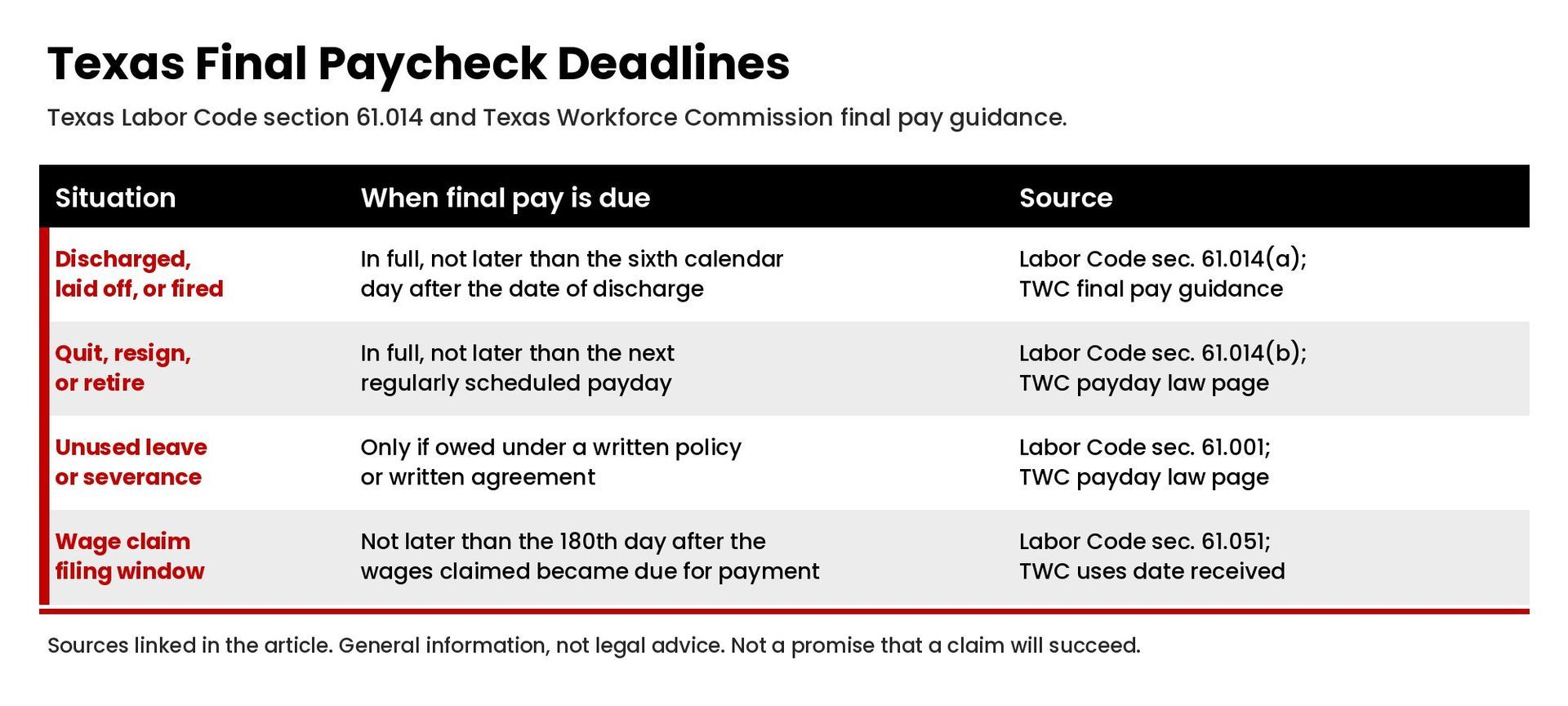
If you were fired, laid off, or otherwise discharged, the employer must pay you in full not later than the sixth calendar day after the date of discharge. If you quit, resign, or otherwise leave other than by discharge, the final paycheck is due not later than the next regularly scheduled payday. Those deadlines come from Texas Labor Code section 61.014 and are restated on the Texas Workforce Commission payday law page and TWC's final pay guidance.
This article explains what the Texas payday law covers, when a final paycheck is due, what counts as wages, how deductions work, and how a wage claim Texas filing proceeds. It is general information about Texas law, not legal advice about any particular paycheck, employer, or claim, and it does not promise that a claim will succeed.

What the Texas Payday Law Covers
Chapter 61 applies to private employers and their employees. "Wages" include compensation for labor or services, whether computed on a time, task, piece, commission, or other basis. The definition also includes vacation pay, holiday pay, sick leave pay, parental leave pay, or severance pay, but only when those amounts are owed under a written agreement with the employer or under a written policy of the employer. That definition is in section 61.001.
The TWC payday law page makes the same point: an employer is required to pay for unused benefits such as vacation, holiday, sick leave, parental leave, or severance only if the employer's written policy or agreement provides for them. Paid sick leave is not automatically due under the payday law simply because the employee accrued time.
The chapter does not apply to everyone. Section 61.003 states that Chapter 61 does not apply to the United States, this state, or a political subdivision of this state. The definition of "employee" also excludes an independent contractor and a person related to the employer or the employer's spouse within the first or second degree. Government workers and close family employees may have other remedies, but the Texas payday law wage-claim process is written for covered private employment.
The payday law is also not a substitute for every other wage rule in employment law. Federal overtime law under the Fair Labor Standards Act, the federal minimum wage, and other Texas labor laws can still apply to a job. The Texas payday law answers when and how covered wages must be paid, and how a wage claim may be filed if they are not.
Texas also has a separate Texas Minimum Wage Act. Under Texas Labor Code section 62.051 and the Texas Workforce Commission minimum wage page, Texas adopts the federal minimum wage rate, which is $7.25 per hour. The Fair Labor Standards Act overtime rules generally require that non-exempt employees receive one and one-half times their regular rate for hours worked over 40 in a workweek. Those amount-of-pay rules are separate from the Chapter 61 timing rules.
Regular Paydays for Texas Employers
For work that is still ongoing, Texas employers must designate paydays and post notices of those paydays in conspicuous places in the workplace. Under section 61.011:
- An employer shall pay wages to each employee who is exempt from the overtime pay provisions of the Fair Labor Standards Act at least once a month.
- An employer shall pay wages to an employee other than an exempt employee, including non exempt employees, at least twice a month.
- If wages are paid twice a month, each pay period must consist as nearly as possible of an equal number of days.
If an employer fails to designate paydays, section 61.012 provides that the employer's paydays are the first and 15th day of each month. If an employee is not paid on a payday for any reason, including absence on payday, section 61.013 requires payment on another regular business day at the employee's request.
Form of payment is also regulated. Section 61.016 generally requires payment in United States currency, by a negotiable written instrument, or by electronic transfer to an account the employee designates or to a payroll card account the employer establishes.
Texas Final Paycheck Law: Fired Versus Quit
The Texas final paycheck law turns on how the job ended.
Under section 61.014(a), an employer shall pay in full an employee who is discharged from employment not later than the sixth day after the date the employee is discharged. TWC's final pay page treats a layoff, a firing, and other involuntary separations the same way: final payment is due within six calendar days of the last day. TWC also notes that if the sixth day falls on a day the employer is normally closed, the employer may wait until the next regular workday.
Under section 61.014(b), an employer shall pay in full an employee who leaves employment other than by discharge not later than the next regularly scheduled payday. That is the rule when an employee quits, resigns, or retires. TWC describes the same deadline as the next regularly scheduled payday after the effective date of resignation.
TWC explains that whether a separation is voluntary or involuntary generally follows the same ideas used in unemployment cases. If the employee initiates the separation and leaves while continued work is still available, the separation is generally treated as voluntary. If the employer initiates the separation, it is generally treated as involuntary. "Mutual agreement" separations are generally regarded as involuntary, although TWC cautions that the result depends on the facts.
These deadlines apply to employees in Houston, Austin, San Antonio, and the rest of Texas. The payday law is statewide.
Commissions, Bonuses, and Fringe Benefits in Final Pay
A final paycheck includes regular wages and, when they are owed, fringe benefits payable under a written policy or written agreement. TWC's final pay guidance says it is important to know which part of the pay is due at which time.
Commissions and bonuses are due according to the terms of an agreement between the employee and employer, or an applicable union contract or other collective bargaining agreement. Section 61.015 also requires the employer to pay those amounts in a timely manner as required for other wages. If a commission or bonus plan provides for payment on a specific date or interval, TWC states that the plan or policy will determine that deadline.
Employees and Texas employers should look at the actual written policy or written agreement rather than assuming that unused vacation or a bonus is automatically part of final pay.
Deductions and Holding a Final Check
An employer may not withhold or divert any part of an employee's wages unless the employer meets one of the three conditions in section 61.018:
- the employer is ordered to do so by a court of competent jurisdiction, such as a court order for child support;
- the employer is authorized to do so by state or federal law, such as required tax withholding; or
- the employer has written authorization from the employee to deduct part of the wages for a lawful purpose.
TWC states that authorizations may not be too general or too broad, and that deductions for out-of-pocket loans require written permission even if there was an oral agreement to repay.
A common question is whether an employer may hold a final check because the employee still has company property or has not signed a timesheet. TWC's final pay page says it is not legal to hold a final paycheck past the deadline for reasons such as failure to return company property or failure to sign timesheets. If the company knows or should know what the pay should be, it must deliver the final pay no later than the deadline. Recovering property, unless a lawful deduction is authorized in writing, by court order, or by law, generally has to be handled by other means.
The same principle appears on the TWC payday law page: if an employee quits while in possession of company property and is due a final paycheck, the employer cannot hold wages to recover the property unless authorized by law, required by a court, or authorized in writing by the employee.
How a Wage Claim Works in Texas
If wages were not paid when they were due, a covered employee may file a wage claim with the Texas Workforce Commission. TWC suggests talking with the employer first, because some problems can be solved without a formal claim. Talking first is not a legal requirement for filing.
Under section 61.051, a wage claim must be filed not later than the 180th day after the date the wages claimed became due for payment. The 180-day deadline is a matter of jurisdiction. TWC uses the date the wage claim is received when deciding whether the claim is timely. If part of the unpaid wages were due more than 180 days ago and part within 180 days, TWC says to file only for the part that is still within the deadline.
A claim must be filed in a manner and on a form prescribed by TWC and must be verified by the employee. TWC accepts claims online or on a paper form. The paper form may be mailed or faxed to the Wage and Hour Department at 101 E. 15th St., Rm. 514, Austin, TX 78778-0001, or faxed to 512-322-2885. The claim should identify each type of unpaid wage and how the amount was calculated, and it should include enough information to identify and contact the employer. TWC asks claimants not to send original documents.
If the employer has filed for bankruptcy, TWC states that it cannot investigate the claim and that the employee may need to file directly with the bankruptcy court.
After a timely claim is filed, a TWC examiner analyzes the claim and, if it alleges facts actionable under Chapter 61, investigates and issues a preliminary wage determination order dismissing the claim or ordering payment of wages determined to be due and unpaid. Either party may request a hearing on that preliminary order. The details of hearings, appeals, and collection are set out in Chapter 61 and on TWC's wage-claim pages. None of those steps is a promise of a particular result.
Section 61.053 allows an administrative penalty, in addition to unpaid wages, if an examiner, appeal tribunal, or the commission determines that an employer acted in bad faith in not paying wages. A penalty may also be assessed if an employee acted in bad faith in bringing a claim. The penalty may not exceed the lesser of the amount of the wages in question or $1,000. Separate from the administrative process, section 61.019 also describes criminal penalties in limited situations involving an intent to avoid payment of wages after demand. Those provisions are fact-specific and are not a prediction about any case.
Practical Notes for Employees and Employers
Employees who believe they are owed a final paycheck or other unpaid wages should gather pay stubs, the written policy or written agreement, and the dates the wages were due, and should calendar the 180-day filing window from the original due date. The analysis often also includes whether the person was an employee or an independent contractor, and whether a contract, handbook, or other workplace policy promised a benefit.
Texas employers can reduce payday law risk by posting designated paydays, putting fringe-benefit rules in a clear written policy, getting lawful written authorization before deductions, and issuing final pay within the six-day or next-payday deadline. An employee handbook is often where those pay and deduction rules are written down. Broader questions about a termination, discrimination, or a wage dispute strategy are discussed in our labor and employment services and in the firm's general counsel playbook on termination, discrimination, and wage disputes.
Frequently Asked Questions
What is the Texas payday law?
The Texas payday law is Chapter 61 of the Texas Labor Code. It requires covered private employers to pay employees in full on scheduled paydays, sets final paycheck deadlines, limits deductions, and authorizes wage claims at the Texas Workforce Commission.
When is a final paycheck due if I was fired in Texas?
If you were discharged, laid off, or otherwise involuntarily separated, the employer must pay you in full not later than the sixth calendar day after the date of discharge. That is the rule in section 61.014(a).
When is a final paycheck due if I quit?
If you leave employment other than by discharge, including when an employee quits or resigns, the employer must pay you in full not later than the next regularly scheduled payday. That is the rule in section 61.014(b).
Does Texas require payout of unused vacation or sick leave?
Only if a written agreement or the employer's written policy provides for that payout. Section 61.001 includes vacation pay, holiday pay, sick leave pay, parental leave pay, and severance pay in "wages" only when they are owed under such a writing.
How long do I have to file a wage claim in Texas?
A wage claim must be filed not later than the 180th day after the date the wages claimed became due for payment. TWC uses the date the claim is received. The deadline is jurisdictional, so a late claim can be dismissed.
Can my employer hold my final check until I return a laptop or uniform?
TWC states that an employer may not hold a final paycheck past the deadline to recover company property unless the deduction is authorized by law, required by a court, or authorized in writing by the employee.
Talk With a Lawyer About Your Situation
Final pay and wage claims turn on the documents, the dates, and the type of wages involved. If you are owed a final paycheck, or if your company needs to review its payday and deduction policies under Texas law, contact Masterly Legal Solutions to request a consultation. This article provides general information about Texas law and is not legal advice. Reading it does not create an attorney-client relationship, and no particular result is promised.
Andrew Rhoden, Esq. is a lawyer with Masterly Legal Solutions, 3838 Oak Lawn Avenue, Suite 1000, Dallas, Texas 75219, licensed in Texas, North Carolina, and the District of Columbia.








Looking for Legal & Business Solutions? Contact Us Now
Fill in the form or call us to set up a meeting