
Intestate Succession in Texas: Who Inherits When There Is No Will
Intestate succession Texas applies under Texas Estates Code Chapter 201. Those intestate succession laws decide who inherits when a person dies without a valid will. They do not ask what the family thinks the person would have wanted. Heirs follow a statutory order as to the property that is subject to intestacy. The statute does not turn on a family's desire for peace after a death.
Dying without a will in Texas is more common than many families expect. The result depends on whether the person left a surviving spouse, children, or both, and on whether the property is community property or separate property. This article explains who inherits in the main situations the statute covers. It is general information about Texas law, not legal advice about any particular estate, and it does not promise a particular outcome.

What Intestate Succession Means
A person dies intestate when there is no valid will that disposes of the property. Some assets still pass outside intestacy because of the way they are titled or because of a beneficiary designation, such as a life insurance policy, a payable-on-death account, or property held with a right of survivorship. Intestate succession governs the estate property that does not pass that way.
Section 201.103 states that the estate to which an intestate had title at death descends and vests in the intestate's heirs as if the intestate had been the original purchaser. In plain terms, title passes to the heirs by law. Proving who those heirs are, and getting a third party to accept that proof, is a different process. Families often use an affidavit of heirship in Texas or, in limited cases, a small estate affidavit. Those tools are about how heirs document and collect property, not about changing who inherits.
Community Property and Separate Property
Texas is a community property state. That distinction matters in almost every married intestate estate, because Chapter 201 treats the community estate and the separate estate differently.
Under Texas Family Code sections 3.001 and 3.002, a spouse's separate property generally includes property owned or claimed before marriage, property acquired during marriage by gift, devise, or descent, and certain recoveries for personal injuries. Community property is, with those exceptions, the property acquired by either spouse during the marriage. The surviving spouse already owns that spouse's own half of the community estate. Intestate succession decides what happens to the deceased spouse's interest.
Getting the character of an asset wrong can lead a family to use the wrong line of the intestate succession chart. When the history of an asset is unclear, it is worth slowing down before anyone signs an affidavit or transfers title.
If There Is No Surviving Spouse
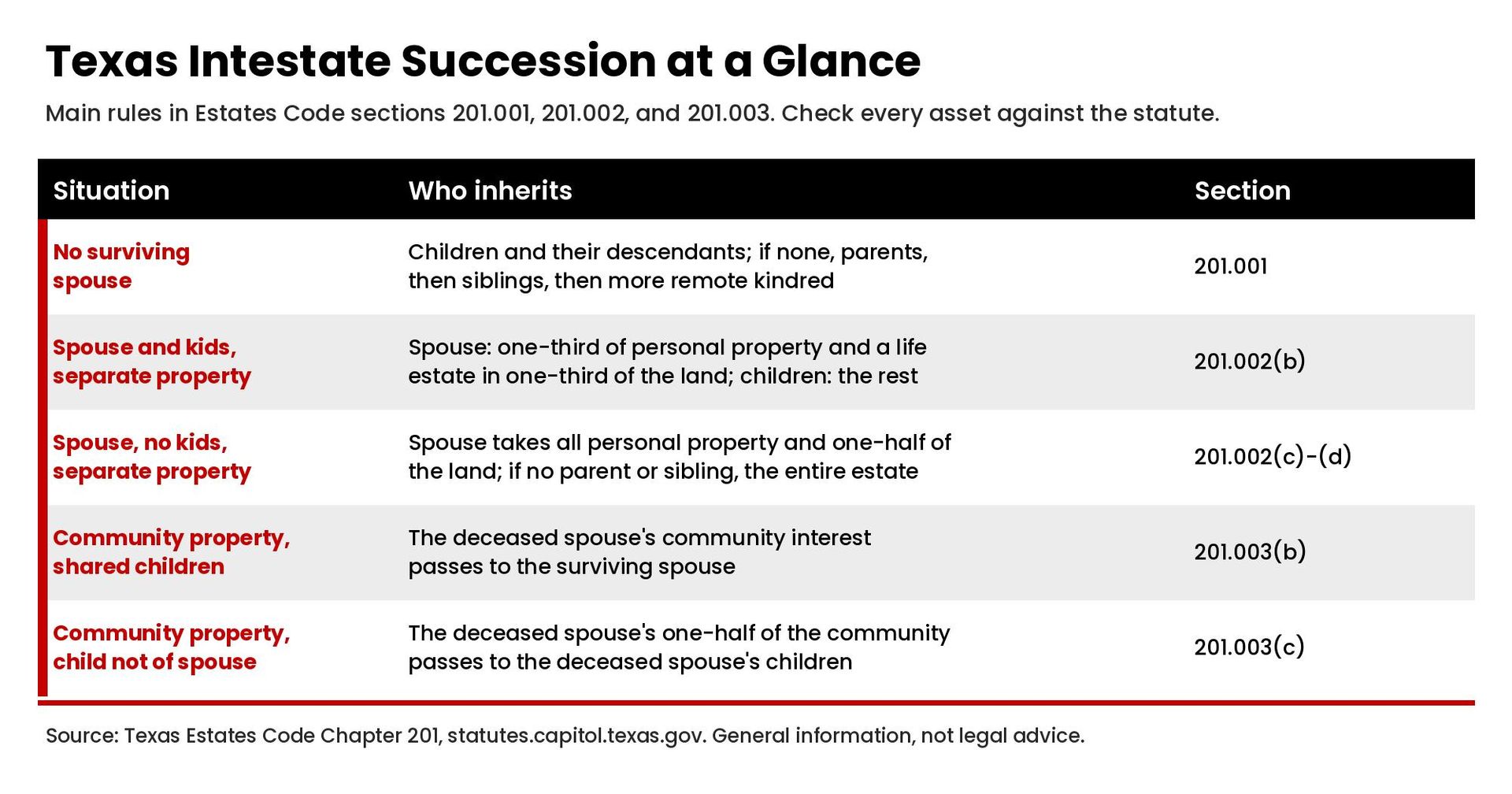
Section 201.001 controls when a person dies intestate and does not leave a spouse. The estate passes in this order:
- To the person's children and the children's descendants.
- If no child or child's descendant survives, in equal portions to the person's father and mother.
- If only one parent survives, one-half passes to the surviving parent and one-half to the person's siblings and the siblings' descendants. If there is no sibling or sibling's descendant, the surviving parent inherits the entire estate.
- If neither parent survives, the entire estate passes to the siblings and the siblings' descendants.
- If none of those kindred survive, the estate is divided into two shares, one for the paternal kindred and one for the maternal kindred, and each share passes to grandparents and then to more remote relatives in the order the statute describes.
Descendants of a predeceased child or sibling generally take the share that child or sibling would have taken. The statute is detailed on remote kindred. Most families never reach that part of the chart because a child, parent, or sibling survives.
If There Is a Surviving Spouse: Separate Property
Section 201.002 governs the separate estate when the intestate leaves a surviving spouse.
If the person has one or more children or a descendant of a child:
- the surviving spouse takes one-third of the personal estate;
- two-thirds of the personal estate descends to the children and their descendants; and
- the surviving spouse is entitled to a life estate in one-third of the person's land, with the remainder descending to the children and their descendants.
If the person has no child and no descendant of a child, then except as provided in the next paragraph:
- the surviving spouse is entitled to all of the personal estate;
- the surviving spouse is entitled to one-half of the person's land without a remainder to any person; and
- one-half of the person's land passes according to the rules of descent and distribution.
If that person also does not leave a surviving parent or one or more surviving siblings, or their descendants, the surviving spouse is entitled to the entire separate estate.
A life estate is not full ownership of the land. It is the right to use the land for the spouse's life. The remainder interest belongs to the children or other descendants named in the statute. That split is one of the most common surprises in a Texas intestate estate that includes a house acquired as separate property.
If There Is a Surviving Spouse: Community Property
Section 201.003 governs the community estate of the deceased spouse.
The community estate of the deceased spouse passes to the surviving spouse if:
- no child or other descendant of the deceased spouse survives the deceased spouse; or
- all of the surviving children and descendants of the deceased spouse are also children or descendants of the surviving spouse.
If the deceased spouse is survived by a child or other descendant who is not also a child or other descendant of the surviving spouse, the deceased spouse's undivided one-half interest in the community estate passes to the deceased spouse's children or other descendants. In every case, the community estate passes charged with the debts against the community estate.
In practical terms, if all of the deceased spouse's children are also the surviving spouse's children, the surviving spouse generally receives the deceased spouse's community interest as well, and therefore the entire community estate. If children of the deceased spouse from another relationship also survive, that fact changes the result for the deceased spouse's half of the community property. Children of the deceased spouse who are not also children of the surviving spouse take the deceased spouse's community interest under section 201.003(c). Families should not assume that a long marriage, by itself, leaves the surviving spouse with all community assets.
Adopted Children and Other Heirship Questions
Section 201.054 treats an adopted child as the child of the adoptive parent or parents for purposes of descent and distribution. The adopted child and that child's descendants inherit from and through the adoptive parent or parents and their kindred as if the adopted child were the natural child of the adoptive parents. The adoptive parents and their kindred inherit from and through the adopted child in the same way.
The statute also addresses inheritance between an adopted child and the child's natural parents. The natural parents and their kindred may not inherit from or through the adopted child, but the adopted child inherits from and through the child's natural parents, except as provided by Section 162.507(c) of the Family Code. Those details can matter in blended families and should be read against the current statute and the adoption order.
Chapter 201 also contains rules on maternal and paternal inheritance, gestational agreements, and when a lifetime gift is treated as an advancement against an heir's share. Those sections are fact-specific. They are a reminder that the basic chart is the starting point, not a complete answer for every family.
How Families Prove Heirship and Why a Will Still Matters
Once the statute identifies the heirs, the family still has to prove that list to a court, a title company, or a financial institution. An affidavit of heirship is one common method of recording who the heirs are. A small estate affidavit is a limited probate alternative that is available only when the estate qualifies under Chapter 205. Neither procedure changes the intestate shares in Chapter 201.
A will, and a broader estate plan, is how a person chooses a different distribution, names an executor, and reduces the chance that a house or a bank account is left in a statutory split the family did not expect. Intestate succession is the backup plan the law provides when that work was not done, or when a will is not valid.
Texas Intestate Laws and the Probate Process
Texas intestate laws, also called Texas intestacy laws, are the written rules in Estates Code Chapter 201. If no valid written will exists, estate property is distributed under those laws. The result is not based on what relatives believe the person intended.
If administration of the estate is needed, a probate court typically appoints an administrator, because no executor was named in a will. Not every intestate estate goes through a full probate process. Some assets pass outside probate, and some modest estates may qualify for a small estate affidavit.
When no closer family exists, more distant relatives may be the rightful heirs. Identifying potential heirs, and documenting their inheritance rights, can take more work in those cases. Texas recognizes an adopted child as the child of the adoptive parents under section 201.054. Stepchildren generally do not have inheritance rights under these laws unless the child was adopted.
A will can also name a guardian for a minor child. Intestate succession does not do that. If a minor child is involved, guardianship of the person or estate may have to be addressed in a separate court proceeding. People who want that choice, or who want assets distributed in a different way, need a valid will rather than the default chart.
These laws are a starting point for families after a loved one dies without a will. Knowing who the heirs are still depends on the character of each asset and on a complete list of relatives.
Other Texas estate rules can also affect what a family actually receives, even after Chapter 201 names the heirs. Homestead rights, exempt personal property, and the debts charged against the community estate can change the practical result. Those topics are outside the basic descent chart and have to be analyzed separately.
The following examples are illustrative only. They apply Chapter 201 to simplified facts and do not account for non-probate assets, debts, or homestead rights.
- A unmarried parent dies with two children and no will. Under section 201.001, the estate passes to the children (and, if a child had already died leaving descendants, to those descendants).
- A married person dies, and the only children are also children of the surviving spouse. Under section 201.003, the deceased spouse's community interest generally passes to the surviving spouse.
- The same married person also owned a tract of land as separate property. Under section 201.002, the surviving spouse takes a life estate in one-third of that land, and the children take the remainder, along with two-thirds of the separate personal estate.
Those examples show why the first questions are usually: Was there a surviving spouse? Were there children, and were they also children of the surviving spouse? Was the asset community property or separate property?
Frequently Asked Questions
What is intestate succession in Texas?
It is the statutory process, in Estates Code Chapter 201, that names the heirs and their shares when a person dies without a valid will as to property that is subject to intestacy.
Who inherits if a married person dies without a will in Texas?
It depends on whether the property is community or separate, and on whether the deceased spouse left children. The result for a surviving spouse, children, or both turns on those facts. If all of the deceased spouse's children are also children of the surviving spouse, the surviving spouse generally receives the deceased spouse's community interest. Separate property is divided under section 201.002, which can leave children with a large share of personal property and a remainder interest in land.
What if there is no spouse and no children?
Section 201.001 passes the estate to the parents, then to siblings and their descendants, and then to more remote kindred, in the order the statute sets out.
Does an adopted child inherit under Texas intestacy law?
Yes. Section 201.054 regards an adopted child as the child of the adoptive parent or parents for descent and distribution.
Does an affidavit of heirship decide who inherits?
No. The affidavit is a way to document the heirs. Who inherits is decided by Chapter 201, or by a valid will.
Is there a simple Texas intestate succession chart?
A chart can summarize the main branches of sections 201.001 through 201.003, and the table in this article does that. Every line still has to be checked against the statute and against the character of the property. Unusual family facts can take the analysis outside the simple chart.
Talk With a Lawyer About Your Situation
Intestate estates turn on family facts and on whether an asset is community property, separate property, or non-probate property. If you are sorting out an estate after a loved one died without a will, or you want a plan that does not rely on the default chart, contact Masterly Legal Solutions to request a consultation. This article provides general information about Texas law and is not legal advice. Reading it does not create an attorney-client relationship, and no particular result is promised.
Andrew Rhoden, Esq. is a lawyer with Masterly Legal Solutions, 3838 Oak Lawn Avenue, Suite 1000, Dallas, Texas 75219, licensed in Texas, North Carolina, and the District of Columbia.




Looking for Legal & Business Solutions? Contact Us Now
Fill in the form or call us to set up a meeting