The Hidden Consequences of Ignoring a Civility Policy Violation Notice
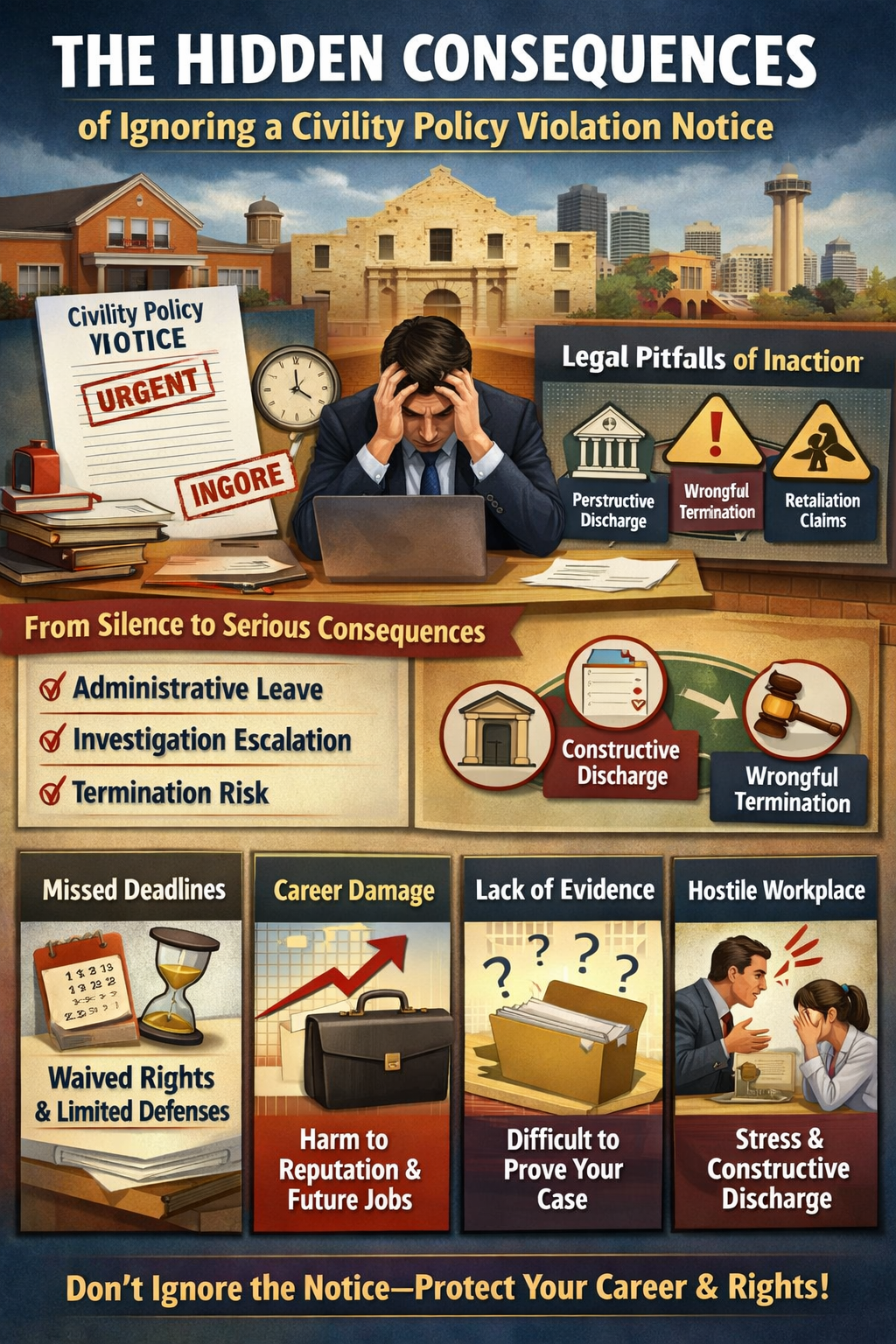
When a civility policy violation notice lands on your desk, it can feel overwhelming. Many employees in San Antonio Texas school districts assume that silence will make the issue disappear. Others believe that if they wait long enough, the employer will simply move on. Unfortunately, ignoring the notice can create consequences that extend far beyond the original allegation.
At Masterly Legal Solutions, we regularly see how delays, missed deadlines, and a lack of response can turn a manageable concern into a serious employment law dispute. What begins as an internal policy matter can quickly escalate into adverse employment actions, including administrative leave, paid administrative leave, or even termination. Understanding the risks early is critical to protecting your career, reputation, and statutory rights.
Understanding Civility Policies in San Antonio Texas School Districts
Civility policies are designed to promote professionalism and respectful conduct among employees. In San Antonio Texas school districts, these policies often address communication standards, interactions with a co worker, supervisor, parent, or administrator, and expectations for maintaining a productive employer employee relationship. They may also overlap with broader employment discrimination policies.
While these policies are intended to create a positive working environment, they are still enforceable rules. A violation notice signals that the employer believes certain conduct fell short of those standards. Even if you disagree with the accusation, ignoring it does not protect you.
What a Civility Policy Violation Notice Really Means
A violation notice is more than a warning. It often marks the beginning of a formal process that can affect your employment record. In some cases, it becomes part of a personnel file that may later be used to justify termination or other discipline.
If left unanswered, the employer may interpret silence as an admission. This can influence how a supervisor, vice president, or human resources agency views the situation. Failing to respond also limits your ability to establish your version of events while memories are fresh and evidence is available.
The Danger of Silence in Employment Disputes
Silence can be powerful in some situations, but in employment disputes, it often works against the employee. When you do not respond, you lose the opportunity to present strong evidence or clarify misunderstandings. Over time, that silence can be used to support an arbitrary or irrational reason for discipline.
Courts and agencies frequently look at the circumstances surrounding a dispute. If an employee never objected, never reported concerns, and never provided documentation, it becomes more difficult to prove retaliation, discrimination, or wrongful termination later. The record may suggest that the discipline was voluntary or uncontested.
Missed Deadlines and Their Lasting Impact
Most school districts impose strict deadlines for responding to policy violation notices. These deadlines are not suggestions. Missing them can lead to immediate consequences such as administrative leave or further investigation.
If you later attempt to challenge a termination, the court may determine that you waived certain rights by failing to act during the required period. Under employment law principles, timely action often determines whether a claim survives. A missed deadline can weaken a potential plaintiff’s position before the case even begins.
How Delays Can Escalate to Administrative Leave
In many cases, a civility complaint triggers an internal investigation. During that period, an employee may be placed on administrative leave. While paid administrative leave may seem less severe, it still signals that the employer views the matter seriously.
Extended delays in responding can increase the likelihood of removal from the workplace. Being placed on administrative leave may affect professional relationships, future promotion opportunities, and the perception of your conduct among colleagues. Even if you return, the reputational damage can linger.
From Notice to Termination: The Slippery Slope
Ignoring a civility notice can start a chain reaction. If the employer concludes that the employee failed to cooperate, that finding may become a substantial motivating reason for termination. The record may show insubordination or refusal to participate in the investigation.
In San Antonio Texas school districts, where policies are closely monitored, termination may follow quickly. Once an employer fired you, rebuilding your professional standing becomes far more challenging. A termination based on alleged policy violation can also complicate future employment.
The Risk of Constructive Discharge
Not all separations are labeled as termination. Sometimes, working conditions deteriorate to the point that an employee quits. Constructive discharge means that the circumstances were so intolerable that a reasonable person would feel forced to resign.
If a civility violation notice is mishandled, and the employer creates a hostile environment, the worker’s resignation may be viewed as constructive termination or constructive dismissal. However, proving constructive discharge requires strong evidence that the discharge caused the resignation and that the conduct contravenes fundamental public policy.
Constructive Discharge and Missed Opportunities to Document
Employees who delay responding often fail to document worsening working conditions. Without written records, emails, or witness statements, it becomes difficult to prove that the environment was truly hostile.
Courts analyze whether a reasonable person would have felt compelled to resign. If there is no documentation of emotional distress, discrimination, retaliation, or illegal conduct, the claim may not succeed. Silence during the early stages weakens later arguments of constructive discharge.
Wrongful Termination and Wrongful Discharge Claims
Wrongful termination and wrongful discharge claims often depend on the reason behind the employer’s decision. If the termination contravenes fundamental public policy, such as punishing an employee for reporting illegal activity, a claim may exist.
However, if the personnel file reflects unanswered violation notices and missed deadlines, the employer may argue that the termination was justified. Establishing that the employer acted for an unlawful reason becomes significantly harder when the employee did not contest earlier allegations.
The Role of Public Policy in Employment Law
Under common law and certain statute protections, employees cannot be terminated for reasons that violate fundamental public policy. For example, refusing to participate in illegal activity or reporting misconduct to a government agency may be protected conduct.
If a civility violation notice is issued in retaliation for reporting illegal conduct, the employee must act promptly. Delays may obscure the link between the reporting and the adverse employment actions. Courts examine timing and evidence carefully when determining whether retaliation occurred.
Retaliation and Reporting Concerns
Retaliation can arise when an employer takes adverse employment actions because an employee exercised a statutory right. This might include reporting discrimination, sexual harassment, or employing undocumented workers. Retaliation
If you receive a civility notice after raising concerns, silence can be misinterpreted. By failing to respond, you may unintentionally undermine your ability to prove that retaliation was a substantial motivating reason for discipline. Prompt legal guidance helps preserve your claim.
Employment Discrimination and Civility Allegations
Civility allegations sometimes mask deeper issues of employment discrimination. Accusations of inappropriate tone or communication style may disproportionately target individuals based on race, gender, disability, or other protected characteristics.
Disability discrimination, sex discrimination, and sexual harassment claims can intersect with civility policy enforcement. If the enforcement is inconsistent or based on an irrational reason, it may reflect unlawful discrimination. Failing to respond leaves these patterns unchallenged.
Hostile Environment and Emotional Distress
A hostile environment can develop when repeated allegations, investigations, and disciplinary measures create constant stress. Emotional distress is not just personal; it can become part of a legal claim if the conduct rises to the level of tortious discharge or other violations.
When an employee quits due to unbearable pressure, documentation is critical. If no response was ever filed to earlier notices, it becomes more difficult to establish that the employer’s conduct was extreme. Courts look closely at the sequence of events and the employee’s reactions.
At Will Employee Status and Its Limits
Texas generally follows the at will employee doctrine. This means that, generally, an employer may terminate employment for almost any reason. However, there are limits when termination contravenes fundamental public policy or statutory protections.
Even as an at will employee, you retain certain rights. Ignoring a civility notice does not strengthen your position. Instead, it can provide the employer with a documented basis for termination that appears legitimate on its face.
Arbitrary or Irrational Reasons in Discipline
Employers are not permitted to discipline employees for arbitrary or irrational reasons that violate law or public policy. However, proving that a decision was based on an irrational reason requires careful documentation.
If you fail to respond to a notice, the employer may claim that the discipline was based on your noncompliance. This can shift attention away from the original allegation and toward procedural failures, making it harder to challenge the underlying fairness.
Constructive Termination and Forced Resignation
Constructive termination often arises when employees feel forced to resign. A forced resignation or worker’s resignation may not be truly voluntary if working conditions were intolerable.
Still, to prove constructive dismissal, the plaintiff must demonstrate that the discharge caused the resignation. Silence in response to early notices can undermine that argument, suggesting that the employee accepted the employer’s actions.
Common Law Claims and Statutory Protections
Both common law and statutory protections may apply in employment disputes. Claims such as tortious discharge, retaliation, or discrimination often rely on showing that the employer’s conduct violated a statute or public policy.
Each statute has specific deadlines and procedural requirements. Missing these deadlines can prevent a claim entirely. Acting promptly after receiving a violation notice preserves more options.
The Importance of Establishing Strong Evidence
Strong evidence can include emails, witness statements, performance evaluations, and timelines. Without early documentation, it becomes difficult to prove that the employer acted for an unlawful reason.
An employment case often depends on whether the employee can establish that the employer’s stated reason was pretext. Silence and delay weaken the ability to prove pretext. Courts evaluate the totality of the circumstances, not just isolated facts.
Liability and Punitive Damages
In certain cases, employers may face liability for discrimination, retaliation, or wrongful discharge. If the conduct is particularly severe, punitive damages may be available.
However, punitive damages require clear proof of illegal conduct or reckless disregard of statutory rights. If an employee ignored early notices and failed to engage in the process, the employer may argue that the situation does not warrant such damages.
The Impact on Future Employment
A record reflecting policy violations and termination can affect future job opportunities. A former employer may disclose limited information, but the circumstances of separation often become known within professional networks.
If the termination was avoidable, early intervention could have preserved your reputation. Once labeled as terminated for policy violation, rebuilding trust can be difficult.
Special Concerns in Education Settings
In San Antonio Texas school districts, educators and staff members are held to high standards. Allegations of incivility can influence certification, contract renewal, and public perception.
Given the sensitive nature of educational environments, even minor allegations may escalate quickly. Acting swiftly and strategically is essential to protect both your career and your professional license.
How Masterly Legal Solutions Can Help
At Masterly Legal Solutions, our founding partner and experienced employment law team understand the complexities of these disputes. We analyze whether the employer’s actions align with statutory requirements and public policy.
We help clients determine whether a claim for wrongful termination, constructive discharge, or employment discrimination may exist. Our goal is to protect your interests while navigating the legal process with clarity and confidence.
Early Legal Guidance Changes Outcomes
Seeking guidance early can change the direction of a case. Instead of reacting after termination, proactive support can help you respond appropriately to the violation notice.
We assist in drafting responses, preserving evidence, and advising on communication with supervisors and human resources. Early action often prevents escalation and protects your statutory rights.
Practical Steps After Receiving a Notice
If you receive a civility policy violation notice, consider taking the following steps:
- Review the allegations carefully and note any deadlines
- Gather documentation and identify witnesses
- Avoid emotional or impulsive responses
- Consult with an employment law attorney before submitting a written reply
These steps can help establish a clear record and demonstrate professionalism.
Protecting Your Rights in Complex Circumstances
Every case is unique. Whether the issue involves discrimination, retaliation, illegal activity, or alleged misconduct, the circumstances matter. A careful review can determine whether the employer’s conduct supports a legal claim.
The earlier you act, the more options you retain. Delays narrow those options and may permanently affect your ability to pursue relief.
Contact Masterly Legal Solutions for Guidance
If you are employed in San Antonio Texas school districts and have received a civility policy violation notice, do not wait and hope it resolves itself. Silence, missed deadlines, and delayed action can have lasting consequences on your employment, reputation, and future opportunities.
At Masterly Legal Solutions, we are committed to protecting employees facing complex workplace disputes. We invite you to contact us at (972) 236-5051 for a free consultation so we can answer your questions and evaluate your situation. Taking one informed step today can make a meaningful difference in your tomorrow.
This article is provided for educational purposes only and does not constitute legal advice. Every situation is different, and you should consult directly with a qualified attorney to obtain guidance tailored to your specific circumstances.


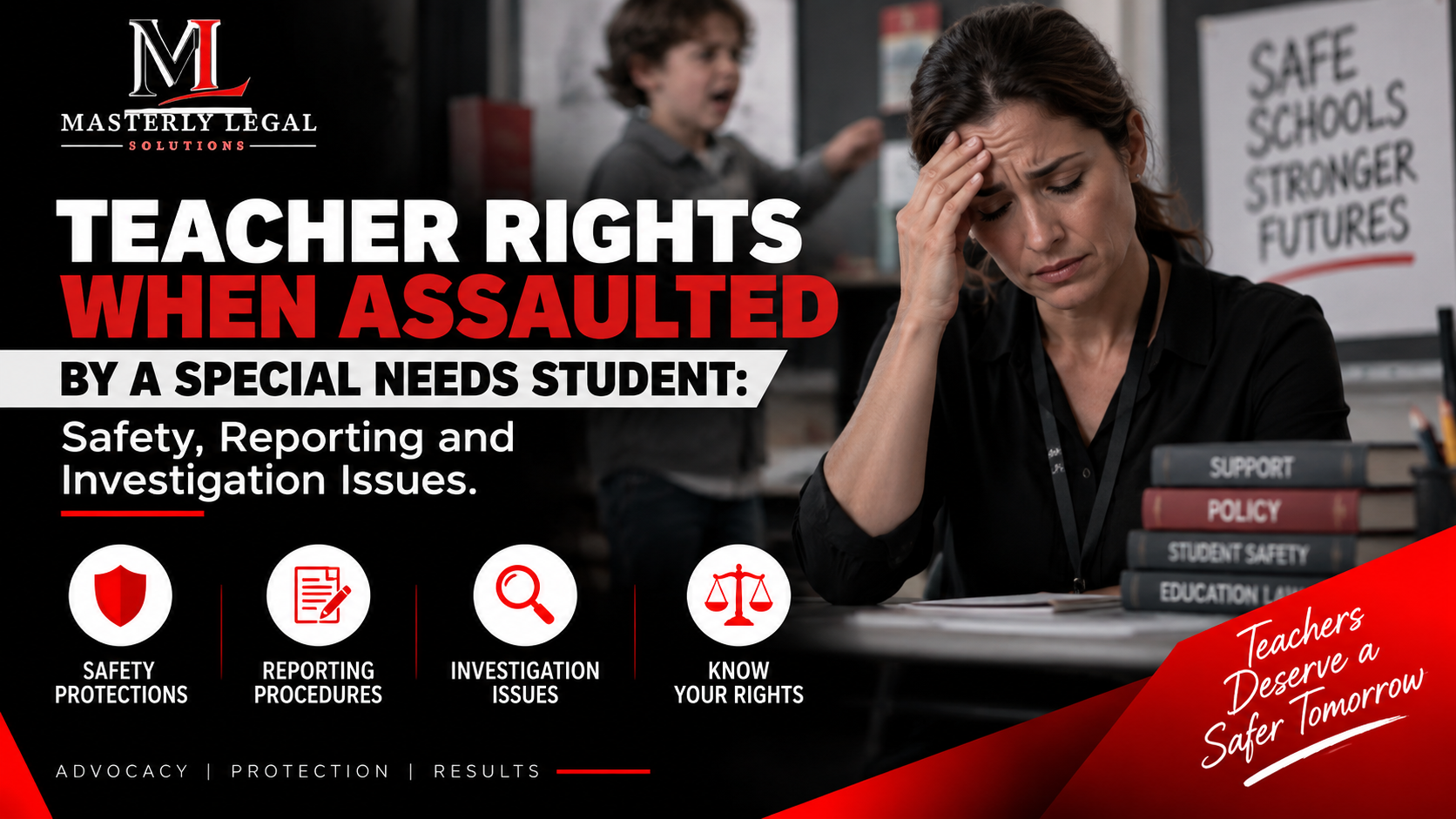
Teacher Rights When Assaulted by a Special Needs Student: Safety, Reporting and Investigation Issues



Looking for Legal & Business Solutions? Contact Us Now
Fill in the form or call us to set up a meeting