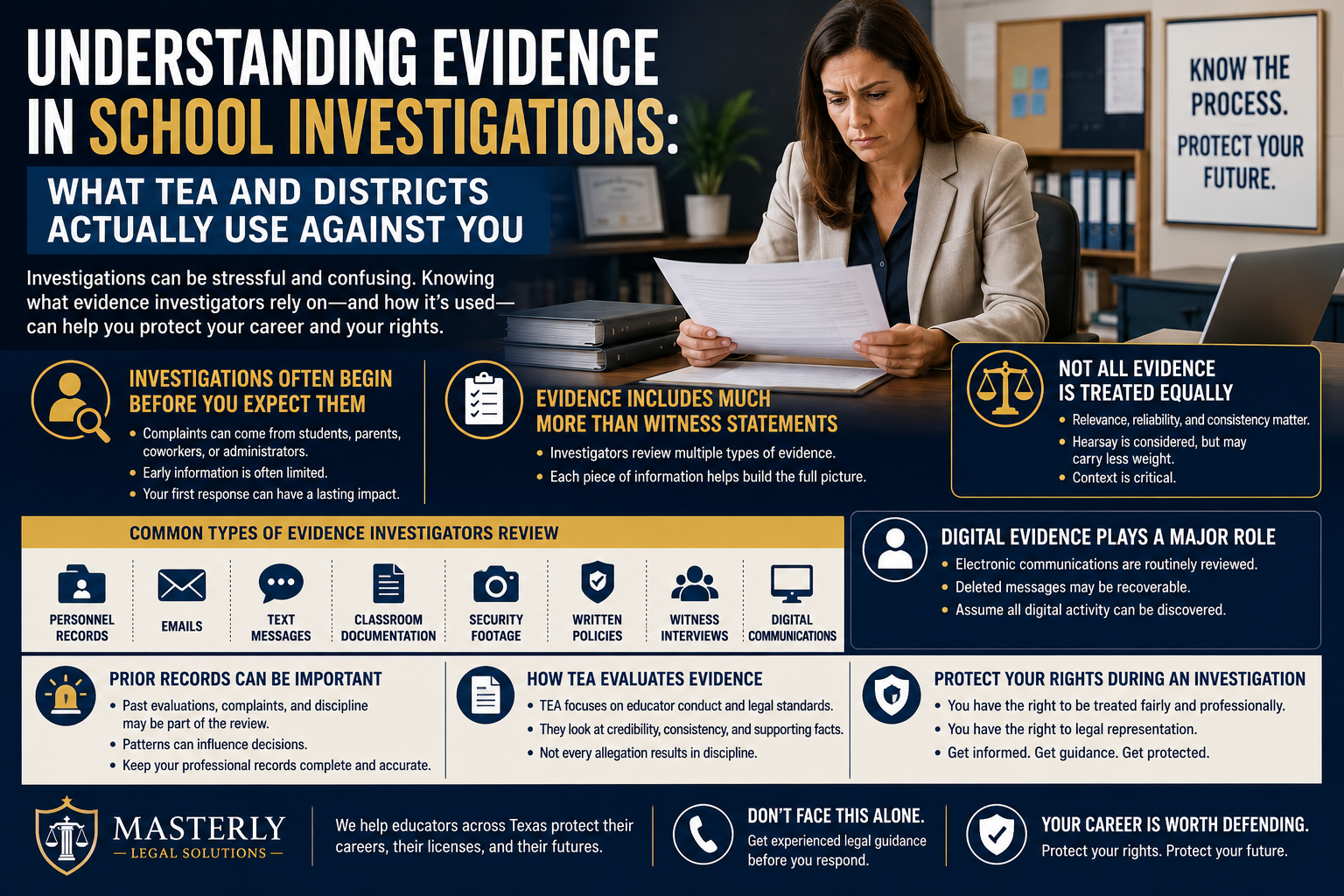
Understanding Evidence in School Investigations What TEA and Districts Actually Use Against You
Few moments are more stressful for an educator than learning they are the subject of a school district investigation. Questions begin almost immediately. What information are investigators reviewing? Who is providing statements? Could one misunderstanding affect a teaching career that took years to build? While every case is different, understanding how evidence is gathered and evaluated can help teachers approach the process with greater confidence instead of relying on assumptions or rumors.
At Masterly Legal Solutions, we regularly assist educators facing employment investigations, certification matters, and workplace disputes. Many teachers believe that only dramatic evidence determines the outcome of an investigation, but the reality is often much more detailed. Emails, witness interviews, personnel records, digital communications, written policies, and employment documentation may all become part of the review. Knowing how investigators evaluate information allows educators to make better decisions before responding to important questions.
Educators also frequently ask whether a school district investigation automatically leads to disciplinary action or whether they can a job force you to resign before the investigation is complete. While every situation depends on its specific facts, understanding the investigative process helps teachers recognize the difference between employment decisions, certification reviews, and legal rights. Taking informed action early may help protect both your professional reputation and your future career.
This article explains the types of evidence commonly reviewed during school investigations, how districts and the Texas Education Agency (TEA) evaluate information, and why obtaining experienced legal guidance before responding can make an important difference. Although no article can replace personalized legal advice, understanding the process is an important first step.
School Investigations Often Begin Before Teachers Expect Them
Many investigations begin with a complaint from a student, parent, coworker, or administrator. Sometimes the educator receives very little information when first notified that concerns have been raised. Although this uncertainty can be frustrating, it is important to recognize that investigators are often still gathering facts during the earliest stages.
A teacher's first response can have a lasting impact on the overall investigation. Remaining calm and understanding the process is often more beneficial than reacting emotionally.
Investigations Usually Start With Information Gathering
The early stages often involve collecting documentation, reviewing policies, and interviewing individuals who may have relevant knowledge.
Investigators are generally attempting to understand what occurred before reaching any conclusions.
Every Investigation Is Different
Some matters involve employment policies, while others concern student safety, professional conduct, or certification issues.
The specific facts determine how the investigation develops.
Evidence Includes Much More Than Witness Statements
Many educators assume investigations depend almost entirely on witness testimony. While witness interviews can certainly be important, they represent only one category of evidence.
Investigators often evaluate multiple sources before determining whether additional action is appropriate.
Common Types of Evidence
Evidence reviewed during school investigations may include:
- Personnel records
- Emails
- Text messages
- Classroom documentation
- Security footage
- Written policies
- Student records when appropriate
- Digital communications
- Prior employment documentation
Each piece of information contributes to the overall review.
Documentation Creates Context
Documents often help investigators establish timelines, identify communications, and compare statements with written records.
Well-organized documentation may become extremely valuable throughout the investigative process.
Employment Records Frequently Receive Careful Review
Personnel files often contain information that investigators consider relevant to employment decisions.
Performance evaluations, disciplinary notices, professional development records, attendance history, and prior correspondence may all become part of the review.
Performance History Matters
Investigators frequently evaluate whether previous employment records demonstrate consistent performance or identify recurring concerns.
Employment history helps provide important context for current allegations.
Prior Documentation May Influence Decisions
Although every investigation focuses on current facts, previous documentation sometimes helps investigators better understand the overall employment relationship.
Digital Communications Can Become Important Evidence
Today's workplace relies heavily on email, messaging platforms, and electronic communication.
Many educators underestimate how frequently these communications become part of workplace investigations.
Electronic Messages May Be Reviewed
Depending on the circumstances, investigators may examine:
- District email accounts
- Internal messaging systems
- Meeting invitations
- Digital calendars
- Other work-related communications
Electronic records often help establish timelines and verify factual details.
Professional Communication Matters
Maintaining professional communication habits every day—not only during investigations—can help reduce misunderstandings later.
Thoughtful communication protects both employees and employers.
Witness Interviews Help Investigators Understand Events
Witnesses often provide valuable perspectives regarding workplace events.
Investigators typically compare witness statements with documentation and other available evidence before reaching conclusions.
Witness Credibility Is Evaluated
Not every statement carries identical weight.
Investigators frequently consider consistency, firsthand knowledge, documentation, and supporting evidence when evaluating witness testimony.
Multiple Interviews May Occur
Several interviews may be conducted before investigators complete their review.
Additional interviews sometimes become necessary as new information develops.
Administrative Leave Does Not Automatically Determine the Outcome
Many educators worry that being placed on administrative leave means investigators have already reached conclusions.
In reality, administrative leave often provides districts time to gather information without disrupting school operations.
Paid and Unpaid Leave Are Different
Some educators are placed on paid administrative leave, while others may face unpaid employment actions depending on applicable policies and circumstances.
Understanding the distinction is important before making assumptions.
Leave Allows Investigations To Continue
Administrative leave often gives investigators time to review evidence carefully while preserving the integrity of the process.
It should not automatically be interpreted as a final employment decision.
School Districts and TEA Review Different Questions
A school district employment investigation is not always the same as a TEA certification review and investigation process.
Although the two processes may involve similar facts, each serves a different purpose.
Employment Reviews Focus on Workplace Issues
District investigations generally examine employment policies, professional responsibilities, and workplace conduct.
These reviews often influence employment decisions.
Certification Reviews Protect Professional Standards
TEA evaluates whether educators continue meeting certification requirements established under Texas law, and Texas TEA investigations and teacher certification help is often crucial when questions arise.
Certification proceedings follow separate administrative procedures.
Evidence Should Be Viewed Within Its Full Context
Individual documents rarely tell the entire story.
Investigators generally compare multiple sources of information before determining what likely occurred.
Looking Beyond Individual Statements
One email, one witness, or one report seldom determines the final outcome.
Instead, investigators evaluate how multiple pieces of evidence fit together.
Context Reduces Misunderstandings
Reviewing complete documentation often helps investigators distinguish misunderstandings from actual policy violations.
Careful evaluation promotes fairer decision-making.
Preparing Before Interviews Can Make a Difference
Many educators feel pressure to respond immediately after learning an investigation has begun.
Taking reasonable time to understand the purpose of interviews and organize relevant information often results in more accurate responses.
Preparation Supports Better Communication
Being prepared allows educators to answer questions thoughtfully while avoiding unnecessary speculation.
Preparation should never be confused with refusing to cooperate.
Early Legal Guidance Can Be Valuable
Consulting experienced legal counsel before significant interviews may help educators better understand their rights, responsibilities, and available options before important employment decisions are made.
Investigators Compare Information From Multiple Sources
One of the most important aspects of a school investigation is that investigators rarely rely on a single piece of information. Instead, they compare documents, interviews, electronic communications, employment records, and other available materials to determine whether the facts support an allegation.
This careful comparison helps investigators identify inconsistencies, clarify timelines, and better understand the events surrounding a complaint.
Consistency Often Matters
When multiple sources support the same sequence of events, investigators may place greater confidence in the available evidence.
Likewise, conflicting information often leads to additional interviews or requests for further documentation before conclusions are reached.
Every Detail Can Provide Context
Small details that appear insignificant at first may later help explain misunderstandings or clarify disputed events.
Providing complete and accurate information remains one of the best ways to assist the investigative process.
School Investigations Can Affect Employment Decisions
Even before an investigation reaches a final conclusion, employment-related decisions may occur. Depending on the circumstances, an educator may experience changes in work assignments, administrative responsibilities, or employment status while the review continues.
Understanding that these decisions may occur separately from certification proceedings helps reduce confusion during the process.
Employment Reviews Serve Different Purposes
A district may evaluate workplace policies, employee conduct, or operational concerns while TEA separately reviews certification issues.
Although these processes sometimes involve the same facts, they are not identical proceedings.
Avoid Making Assumptions
Receiving notice of an investigation does not automatically predict the final outcome.
Allowing the investigation to proceed while preserving documentation is often the most productive approach.
Employment Laws May Provide Important Protections
Teachers and school employees may have legal protections depending on the circumstances surrounding an investigation. Federal and state employment laws address issues involving discrimination, retaliation, protected activity, leave rights, and other employment-related matters.
Because multiple legal standards may apply, every situation deserves careful evaluation.
Protected Activity May Receive Legal Protection
Reporting concerns, participating in investigations, or engaging in other legally protected activities may provide employees with certain legal protections.
Whether a particular action qualifies depends on the applicable laws and the specific facts.
Retaliation Claims Require Careful Review
Not every unfavorable employment decision constitutes unlawful retaliation.
Investigators and attorneys generally examine documentation, timing, policies, and employer explanations before reaching legal conclusions.
Documentation Helps Protect Your Interests
Well-organized records often become one of the strongest resources available during an employment investigation.
Keeping copies of emails, meeting notices, performance evaluations, written communications, and policy documents may help clarify events if questions arise later.
Maintain Accurate Records
Consider preserving:
- Employment correspondence.
- Evaluation documents.
- Meeting notices.
- Policy manuals.
- Relevant emails.
- Investigation communications.
Maintaining accurate documentation often makes it easier to explain events if additional questions develop.
Avoid Altering Information
Records should remain complete and accurate throughout the investigation.
Preserving original documents helps ensure investigators evaluate reliable information.
Understanding the Evidence Is One of the Best Ways to Protect Your Career
An investigation can feel overwhelming, especially when you do not know what information is being reviewed or how decisions will be made. While every case follows its own path, understanding the types of evidence commonly considered by school districts and TEA allows educators to approach the process with greater confidence. Thoughtful preparation, organized documentation, and careful communication often place teachers in a stronger position than reacting based on fear or uncertainty.
At Masterly Legal Solutions, we believe every educator deserves clear information before making decisions that could affect a professional license or future employment. Investigations are rarely based on a single document or conversation. Instead, they typically involve a careful review of multiple sources of information gathered over time. Understanding that process can help reduce unnecessary stress while allowing educators to focus on protecting their professional interests.
If you have questions about an ongoing investigation or believe your employment rights may be affected, seeking experienced legal guidance before important decisions are made can provide valuable clarity. Taking proactive steps today may help protect the career you have worked so hard to build for tomorrow.
Communication During an Investigation Matters
How an educator communicates throughout an investigation may influence how others perceive the situation.
Remaining respectful, cooperative, and professional helps reduce unnecessary conflict while allowing investigators to complete their work.
Think Before Responding
Answer questions honestly without speculating about issues you do not know.
Careful communication often prevents misunderstandings that may complicate the investigation later.
Limit Informal Discussions
Avoid discussing confidential investigation details with coworkers, students, or parents unless specifically authorized.
Protecting confidentiality helps preserve the integrity of the process.
Experienced Legal Guidance Can Help Before Important Decisions
Many educators wait until after interviews or disciplinary meetings before seeking legal advice.
By that point, important opportunities for preparation may already have passed.
Preparation Supports Better Outcomes
Speaking with an employment attorney before significant meetings allows educators to understand the process, organize documentation, and prepare thoughtful responses.
Preparation often helps reduce unnecessary stress while improving communication.
Every Investigation Is Unique
No two employment investigations involve identical facts.
Experienced legal counsel can evaluate your specific circumstances instead of relying on general assumptions.
Understanding Employment Rights During School Investigations
Every reasonable employee should understand that an investigation may involve more than reviewing documents or interviewing witnesses, especially Texas educators who may need legal help to survive a TEA investigation and protect a license. If retaliation occurs after an educator reports discrimination, harassment, or engages in related protected activity or other related protected activity, employment laws may provide important protections that help prohibit retaliation. Depending on the facts, actions such as reassignment to a less desirable position, denial of advancement to a desirable position, or another adverse action could have a negative impact on both the individual employee and employee morale, while also affecting overall employee morale throughout a campus.
A possible violation of employment laws should be carefully reviewed before conclusions are reached, especially when concerns involve co workers, a supervisor, a manager, or another representative of the company. In some situations, educators may also have questions about constructive discharge, workplace benefits, wages, or whether a matter should be reported to the Equal Employment Opportunity Commission (EEOC), commonly referred to as the EEOC, or even the police if criminal conduct is alleged, particularly when recent events and Texas teachers in trouble and related scandals highlight how quickly issues can escalate. Every business, school district, or educational institution has a responsibility to maintain a professional workplace that supports employees and respects applicable employment laws, often with support from HR consulting and employment law training services.
At Masterly Legal Solutions, our firm provides experienced education lawyer legal services to help educators understand investigations, evaluate evidence, and determine the right steps based on their individual circumstances. Whether you need to speak with an experienced employment lawyer about a potential lawsuit, concerns involving personal injury, or another employment challenge, our team is available to help, and our broader education law attorney services can address related school and workplace issues. For example, an educator may need guidance before participating in an interview, responding to investigators, or making decisions that could affect their career or family. If you have questions about your personal situation, we encourage you to contact our office by phone to discuss your concerns and learn more about your legal options.
Contact Masterly Legal Solutions for a Free Consultation
If you are facing a school district investigation, a TEA certification matter, or questions about your employment rights, understanding the evidence being reviewed can make a meaningful difference. Many educators ask whether can a job force you to resign after an investigation begins or whether employment decisions can occur before all facts are known. Because every case is unique, obtaining experienced legal guidance early may help you better understand your options before making important decisions.
At Masterly Legal Solutions, we represent teachers, administrators, and school employees involved in investigations, employment disputes, certification proceedings, and retaliation concerns as part of our focused legal support for educators facing school investigations. Our team understands how evidence is gathered, how employment decisions are made, and how multiple agencies may become involved during the same matter, and our Texas education lawyers regularly guide clients through those overlapping processes. We work closely with our clients to explain the process, answer questions, and help them prepare for each stage of the investigation.
Whether you have been placed on administrative leave, received notice of a district investigation, or are concerned about how evidence may affect your teaching career, we are here to help. We proudly represent educators throughout Texas and remain committed to protecting the professional interests of those who serve students every day.
Contact Masterly Legal Solutions today at (972) 236-5051 for a free consultation. We are available to discuss your concerns, explain your legal options, and help you make informed decisions before responding to investigators or employment officials.
Legal Disclaimer: This article is provided for general informational purposes only and should not be interpreted as legal advice or legal guidance. Every employment matter, school investigation, and TEA certification case involves unique facts and legal considerations. Reading this article does not create an attorney-client relationship with Masterly Legal Solutions. If you have questions regarding your specific situation, you should consult with a qualified attorney who can evaluate yo r circumstances and provide legal advice tailored to your individual case.




Looking for Legal & Business Solutions? Contact Us Now
Fill in the form or call us to set up a meeting