

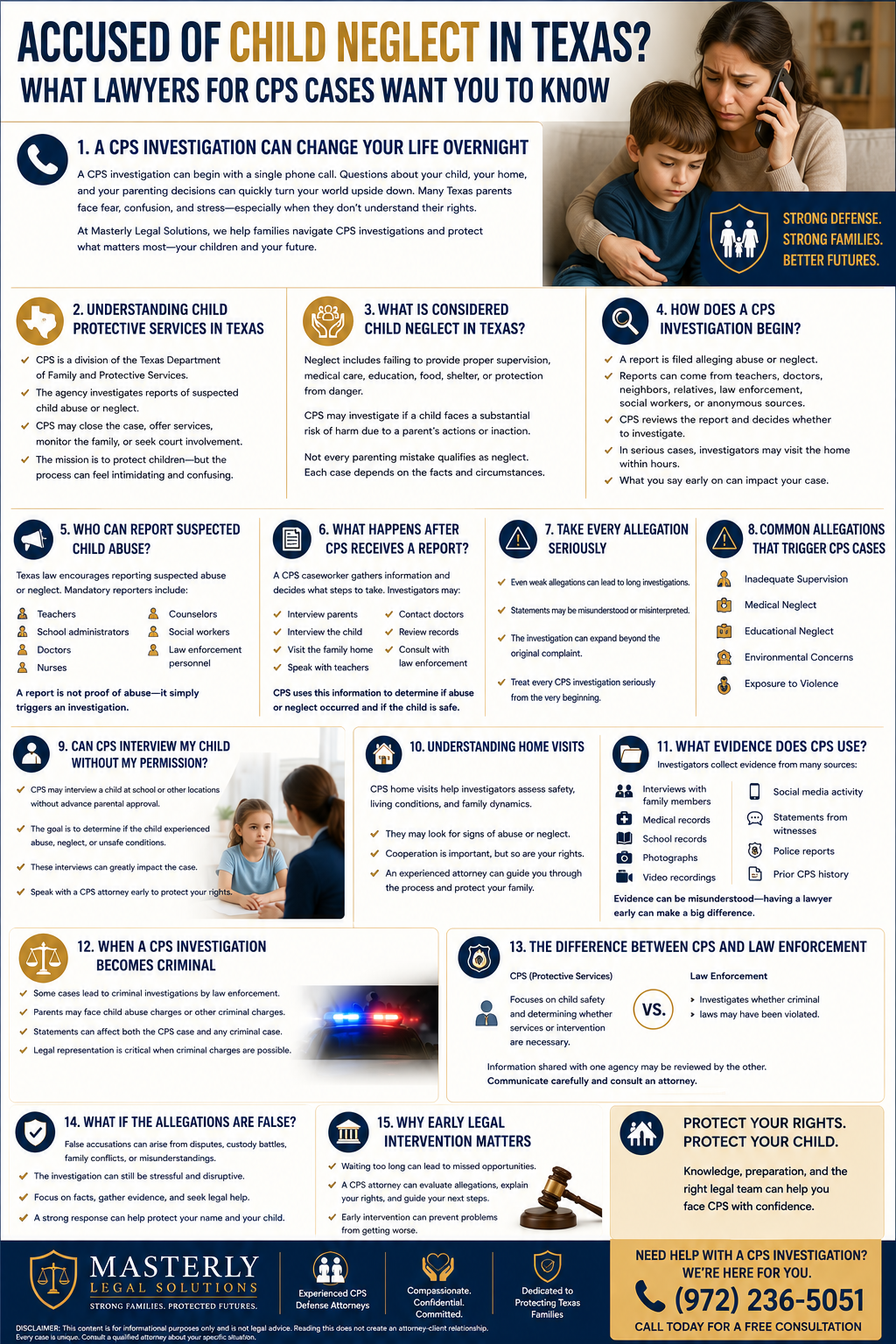
Accused of Child Neglect in Texas? What Lawyers for CPS Cases Want You to Know
A CPS Investigation Can Change Your Life Overnight
Most parents never expect to receive a phone call from Child Protective Services. One moment life seems normal, and the next, a CPS investigation has begun. Questions are being asked about your child, your home, and your parenting decisions. Suddenly, your family is under scrutiny, and you may feel like everything you say or do is being examined.
For many Texas parents, the experience is overwhelming. The fear of losing custody, facing allegations of abuse or neglect, or having a child removed from the home creates enormous stress. Unfortunately, many people make critical mistakes during the early stages of a CPS investigation because they do not understand the process or their rights.
At Masterly Legal Solutions, our attorneys regularly help parents facing CPS investigations throughout Texas. We understand how frightening these situations can become and how quickly an investigation can affect a family's future. Knowing what CPS is looking for and understanding how to respond can significantly improve your ability to protect yourself and your child.
Understanding Child Protective Services in Texas
Child Protective Services is a division of the Texas Department of Family and Protective Services. The agency investigates reports involving suspected child abuse and child neglect. Its primary responsibility is ensuring the child's safety while evaluating whether intervention is necessary.
When child protective services receives a report, the agency must determine whether abuse or neglect may have occurred. Depending on the facts, CPS may close the case, recommend services, monitor the family, or seek court involvement.
While the agency's mission is to protect children, parents often discover that the process can feel intimidating and confusing. Even when allegations are ultimately proven false, the investigation itself can create significant emotional and legal challenges.
What Is Considered Child Neglect in Texas?
Many people assume child neglect only involves extreme situations. In reality, Texas law recognizes several forms of neglect that may trigger a CPS investigation.
Neglect can include failing to provide adequate supervision, medical care, education, food, shelter, or protection from dangerous situations. CPS may also investigate if it believes a child faces a substantial risk of harm due to a parent's actions or inaction.
Not every parenting mistake qualifies as neglect. However, CPS often examines whether a parent's decisions placed a child in circumstances that could threaten the child's safety.
Because every case is unique, determining whether neglect occurred requires a detailed review of the facts and circumstances involved.
How Does a CPS Investigation Begin?
A CPS investigation usually starts when someone files a report alleging abuse or neglect. Reports can come from teachers, doctors, neighbors, relatives, law enforcement officers, social workers, or anonymous sources.
After CPS receives a report, the agency evaluates the information and determines whether the allegations require investigation. Some reports are screened out immediately, while others trigger immediate action.
In serious situations involving allegations of child abuse or neglect, investigators may arrive at a home within hours. In other cases, the process may move more slowly.
Regardless of how the investigation begins, parents should understand that statements made during these early interactions can significantly impact the outcome of the case.
Who Can Report Suspected Child Abuse?
Texas law encourages individuals to report suspected child abuse and child abuse and neglect whenever concerns arise. Certain professionals are mandatory reporters and must notify authorities when they suspect a child may be in danger.
Mandatory reporters often include:
- Teachers
- School administrators
- Doctors
- Nurses
- Counselors
- Social workers
- Law enforcement personnel
A report does not automatically mean abuse occurred. It simply means the agency believes the allegations deserve further review.
Unfortunately, some reports are based on misunderstandings, incomplete information, or false accusations. Even so, CPS is required to investigate.
What Happens After CPS Receives a Report?
Once CPS receives a report, a cps caseworker is assigned to review the allegations. The cps worker will gather relevant information and determine what investigative steps are necessary.
The investigator may:
- Interview parents
- Interview the child
- Visit the family home
- Speak with teachers
- Contact doctors
- Review records
- Consult with law enforcement
The agency uses this information to determine whether abuse or neglect occurred and whether ongoing safety concerns exist.
Many parents are surprised by how quickly investigators begin gathering information. Understanding your rights before these interviews occur is often critical.
The Importance of Taking Every Allegation Seriously
Some parents assume the allegations are so absurd that CPS will immediately dismiss them. Unfortunately, that assumption can create serious problems.
Even weak allegations can result in lengthy investigations. Statements made during interviews may be misunderstood or interpreted differently than intended.
An investigation may also expand beyond the original complaint if additional concerns arise during the process.
For this reason, parents should treat every CPS investigation seriously from the very beginning.
Common Allegations That Trigger CPS Cases
Many CPS cases begin because someone believes a child may be unsafe. Common allegations include:
Inadequate Supervision
CPS may investigate situations where a child was left alone, unsupervised, or under the care of an inappropriate caregiver.
Medical Neglect
Failing to obtain necessary medical treatment may trigger concerns regarding the child's safety and well-being.
Educational Neglect
Repeated school absences or failure to ensure educational participation can lead to an investigation.
Environmental Concerns
Unsafe living conditions, hazardous environments, or allegations involving drug activity within the home may attract agency attention.
Exposure to Violence
CPS often investigates situations where a child may have witnessed domestic violence or other dangerous conduct.
Can CPS Interview My Child Without My Permission?
Many parents are surprised to learn that CPS may attempt to interview a child without advance parental approval under certain circumstances.
Investigators often speak with children at school or other locations where they feel comfortable discussing concerns. Teachers and school personnel may become involved in facilitating these interviews, and educators sometimes need legal support for school investigations and TEA license issues when CPS or administrative inquiries overlap.
The purpose of these conversations is to determine whether the child has experienced abuse, neglect, or exposure to unsafe conditions.
Because statements made by a child often become central to the investigation, parents should seek guidance from a cps attorney as early as possible.
Understanding Home Visits During a CPS Investigation
A home visit is one of the most common investigative tools used by CPS. During the visit, the investigator may assess the home's condition, observe interactions between family members, and evaluate overall safety concerns.
The investigator may look for signs of abuse or neglect, dangerous living conditions, access to food, sleeping arrangements, and other factors related to the child's welfare.
Parents often feel nervous during these visits. While cooperation is important, it is equally important to understand your rights.
An experienced attorney can explain what CPS may request and help ensure your rights remain protected throughout the process, especially when working with a firm that offers tailored legal solutions for families and educators.
What Evidence Does CPS Use?
Evidence plays a major role in every CPS investigation. Investigators attempt to gather information from multiple sources before reaching conclusions.
Common sources of evidence include:
- Interviews with family members
- Medical records
- School records
- Photographs
- Video recordings
- Social media activity
- Statements from witnesses
- Police reports
- Prior CPS history
The agency uses this information to determine whether abuse or neglect occurred and whether intervention is necessary.
Because evidence can sometimes be misunderstood or taken out of context, having a lawyer involved early can be extremely beneficial, particularly when that lawyer is supported by a firm experienced in internal investigations and complex legal reviews.
When a CPS Investigation Becomes a Criminal Investigation
Not every CPS case involves criminal charges. However, some allegations are serious enough to trigger a criminal investigation by law enforcement.
When police become involved, the stakes increase dramatically. Parents may face potential child abuse charges, criminal charges, or other legal consequences beyond the CPS case.
In these situations, statements made to investigators can affect both the CPS proceeding and any related criminal case.
Whenever allegations involve possible criminal conduct, obtaining legal representation immediately becomes especially important.
The Difference Between CPS and Law Enforcement
Many parents assume CPS and police perform the same function. While they often work together, their roles are different.
The agency focuses primarily on child safety and determining whether services or intervention are necessary. Law enforcement investigates whether criminal laws may have been violated.
Information shared with one agency may eventually be reviewed by the other. This is why parents should carefully consider how they communicate during an investigation.
An attorney can help navigate interactions with both CPS and police while protecting your legal interests.
What If the Allegations Are False?
False accusations occur more often than many people realize. Disputes involving divorce, custody battles, family conflicts, and personal disagreements sometimes result in unfounded reports.
Even when allegations are false, the investigation can still create significant stress and disruption.
Parents should avoid reacting emotionally or attempting to confront the reporting party. Instead, focus on gathering evidence, documenting facts, and working with a lawyer who understands CPS cases.
A strong response often helps expose inaccuracies and demonstrate that the child remains safe within the home.
Why Early Legal Intervention Matters
One of the biggest mistakes parents make is waiting too long to contact an attorney. By the time they seek help, critical interviews may have already occurred, documents may have been signed, and important opportunities may have been lost.
Early intervention allows a cps attorney to evaluate the allegations, explain your rights, and help you make informed decisions.
The earlier legal guidance is obtained, the greater the opportunity to address concerns before they escalate into larger legal problems.
For many families, early legal involvement helps reduce confusion and provides a clearer path forward during a difficult time.
Can CPS Remove a Child From the Home?
One of the biggest fears parents face is the possibility that CPS removes their child from the home. While removal is not the outcome in most investigations, it can occur under certain circumstances.
Generally, the agency must believe there is an immediate threat to the child's safety before seeking removal. The goal is to prevent serious harm while the investigation continues.
In some emergency situations, CPS may take action before obtaining a court order. However, a judge will typically review the circumstances shortly thereafter.
Because removal cases move quickly, parents should contact a lawyer immediately if they learn that CPS is considering taking custody of their child.
Understanding Protective Custody
Protective custody occurs when a child is temporarily removed from a parent or guardian because the agency believes the child faces immediate danger.
These situations often involve allegations of severe abuse, serious neglect, substance abuse, abandonment, or unsafe living conditions.
While removal can be temporary, the decisions made during the first few days often have long-term consequences. The court will examine the facts and determine whether the child remains outside the home during the investigation.
An attorney can help challenge unsupported allegations and advocate for reunification whenever possible.
What Happens After an Emergency Removal?
If CPS removes a child, the court process usually begins almost immediately. A hearing may be scheduled within a short period to review the removal.
During this hearing, CPS must present information supporting its decision. The judge will review the allegations and determine whether continued removal is necessary.
Parents have the right to appear, present information, and challenge the agency's position.
The outcome of this early hearing can significantly influence the direction of the entire case.
Understanding Temporary Custody Orders
Following removal, the court may issue temporary custody orders while the investigation continues.
These orders may address where the child will live, visitation arrangements, required services, and other conditions.
The judge will attempt to balance the child's safety with the parent's rights. Every decision should be based upon the specific facts presented during the case.
Having an experienced attorney involved during these proceedings can make a substantial difference.
What Is a Case Plan?
In many CPS cases, parents are asked to complete a case plan designed to address concerns identified during the investigation.
A case plan may include:
- Counseling
- Parenting classes
- Substance abuse treatment
- Psychological evaluations
- Anger management programs
- Additional social services
The agency often views successful completion of the case plan as evidence that progress has been made.
However, parents should understand their obligations and how compliance may affect future court proceedings.
Can Parents Challenge CPS Findings?
Yes. Parents are not required to simply accept every finding made by CPS.
In many cases, allegations are based on incomplete information, misunderstandings, or assumptions. The agency's conclusions can often be challenged through evidence, witness testimony, and legal arguments.
A cps attorney can evaluate the investigation and identify weaknesses in the agency's position.
Parents who believe CPS reached the wrong conclusion should seek legal assistance as soon as possible, especially if the case involves school-related issues that may require an education law attorney for teachers and administrators.
How Social Workers Influence CPS Cases
A social worker often plays a significant role during the investigation and throughout ongoing proceedings.
The social worker may conduct interviews, make recommendations, coordinate services, and prepare reports for the court.
Judges frequently consider recommendations from social workers when making decisions regarding custody and services.
For this reason, parents should remain professional and cooperative while ensuring their rights remain protected.
The Importance of Documentation
Documentation can become one of the most valuable tools available during a CPS investigation.
Parents should consider maintaining records of:
- Communications with CPS
- Medical appointments
- School attendance
- Counseling participation
- Service completion
- Visitation compliance
Well-organized documentation may help establish facts, correct misunderstandings, and support the parent's position.
The ability to present relevant information often becomes critical during hearings and agency reviews.
How CPS Evaluates Risk
One of the agency's primary objectives is to determine whether a child faces an ongoing risk of harm.
Investigators examine numerous factors when evaluating safety concerns. They may review prior reports, family history, current living conditions, and the seriousness of the allegations.
The agency must determine whether intervention is necessary to protect the child.
In some situations, the agency concludes the concerns can be addressed without removing the child from the home.
What Role Do Family Members Play?
Family members often become involved during CPS investigations.
Relatives may provide information to investigators, offer temporary placement options, or participate in hearings.
When removal occurs, courts frequently consider whether placement with relatives is appropriate before foster care is considered.
Strong family support can sometimes help stabilize a situation and provide additional options for keeping a child connected to loved ones, and proactive steps like establishing a power of attorney to protect children’s care can further clarify who may make decisions in an emergency.
Understanding Foster Care Placements
If the court determines removal is necessary and no suitable relatives are available, the child may enter foster care.
The goal of foster care is to provide a safe environment while the family addresses concerns identified by CPS.
In many cases, reunification remains the primary objective. Parents who actively participate in services and comply with court requirements often improve their chances of reunification, and some families also turn to trust-based estate planning to provide long-term stability once the crisis passes.
Every case is different, and outcomes depend heavily on the specific circumstances involved.
What Happens During a Court Hearing?
Court hearings are a critical part of many CPS cases.
During a hearing, the judge reviews evidence, hears testimony, and evaluates recommendations from CPS and other professionals.
The court may address issues involving custody, visitation, services, and long-term planning.
Parents should arrive prepared and understand that statements made during hearings can significantly affect future decisions.
Why Having a Lawyer Matters
Many parents initially attempt to handle a CPS case on their own. Unfortunately, they often discover that the process is far more complicated than expected.
A lawyer understands the procedures, deadlines, and legal standards involved in CPS cases.
More importantly, a lawyer can identify issues that may not be obvious to someone unfamiliar with the system.
The sooner legal representation becomes involved, the more opportunities exist to protect both the parent and the child.
How a CPS Attorney Helps Protect Your Rights
A cps attorney serves as an advocate throughout the investigation and court process.
The attorney can review documents, attend hearings, challenge allegations, negotiate with the agency, and develop strategies tailored to the specific facts of the case.
When abuse allegations threaten a parent's future, professional legal assistance can be invaluable.
Many parents feel overwhelmed by the system. Having someone focused on protecting their interests often provides clarity and confidence during an extremely stressful time.
Avoiding Common Mistakes During a CPS Investigation
Several mistakes repeatedly create problems for parents facing CPS scrutiny.
These include:
- Ignoring agency communications
- Missing hearings
- Failing to complete required services
- Providing inaccurate information
- Posting about the case on social media
- Speaking without first consulting an attorney
Even small decisions can affect the direction of a case. Careful planning and sound legal advice often help avoid unnecessary complications.
What Makes Every CPS Case Different?
No two CPS investigations are exactly alike.
The allegations, evidence, family history, safety concerns, and agency recommendations all influence how a case develops.
A recent case involving educational neglect may require a different strategy than one involving child abuse allegations or medical concerns.
Because every investigation is unique, personalized legal guidance is often essential, and some parents also benefit from comprehensive estate planning to safeguard their children’s future beyond the CPS case.
Protecting Your Family's Future
When parents are investigated by CPS, the process often feels deeply personal. Questions about parenting decisions, household conditions, and family relationships can create significant emotional strain.
Despite these challenges, parents should remember that allegations are not findings. An investigation does not automatically mean abuse occurred, neglect occurred, or parental rights will be terminated.
The most effective response usually involves understanding the process, protecting your rights, gathering evidence, and working with an experienced attorney who understands Texas law and offers client-centered legal services for families and businesses.
Taking proactive steps early may help protect your child, your family, and your future.
Speak With Masterly Legal Solutions About CPS Defense Attorneys
Receiving notice of a CPS investigation can leave parents feeling scared, frustrated, and uncertain about what comes next. The decisions you make during the early stages of the case may affect your family for years to come.
At Masterly Legal Solutions, our firm represents clients facing CPS investigations, child abuse allegations, child abuse charges, neglect claims, emergency removals, custody disputes, and complex court proceedings throughout Texas. We understand the challenges families face when protective services become involved and work aggressively to protect our clients and their children.
If you have questions about a CPS investigation, allegations of abuse or neglect, a pending hearing, a case plan, or concerns involving Child Protective Services CPS, do not wait until the situation becomes more difficult. Contact Masterly Legal Solutions today at (972) 236-5051 for a free consultation. Our attorneys are prepared to listen to your concerns, explain your options, and help you move forward with confidence.
Disclaimer: This article is provided for educational and informational purposes only. It is not legal advice and does not create an attorney-client relationship. Every CPS case involves unique facts and legal issues that should be evaluated individually. If you are facing a CPS investigation, child abuse allegations, neglect accusations, custody issues, or related legal matters, consult a qualified attorney regarding your specific situation.





Looking for Legal & Business Solutions? Contact Us Now
Fill in the form or call us to set up a meeting