

Do Teachers Have Legal Protection After Reporting Abuse, Fraud, or Policy Violations?
Speaking Up Isn’t Easy, But It Matters
For many educators, deciding to report wrongdoing is not a simple choice. Whether it involves abuse, fraud, or violations of school workplace policies, teachers often act out of a good faith belief that something needs to be addressed. Still, even when doing the right thing, there are real concerns about retaliation, job security, and long-term career impact. These concerns are not unfounded, especially when employer retaliation or subtle changes in treatment begin to surface after a report is made.
Many teachers hesitate because they have seen what can happen to other employees who speak up. From shifts in responsibilities to negative feedback about job performance, the fear of consequences can feel overwhelming. However, both federal law and state law provide protections when an employee engaged in a protected activity like reporting misconduct, and understanding the legal protection for teachers and their rights and options can be an important part of that process. Understanding these protections can help educators move forward with confidence.
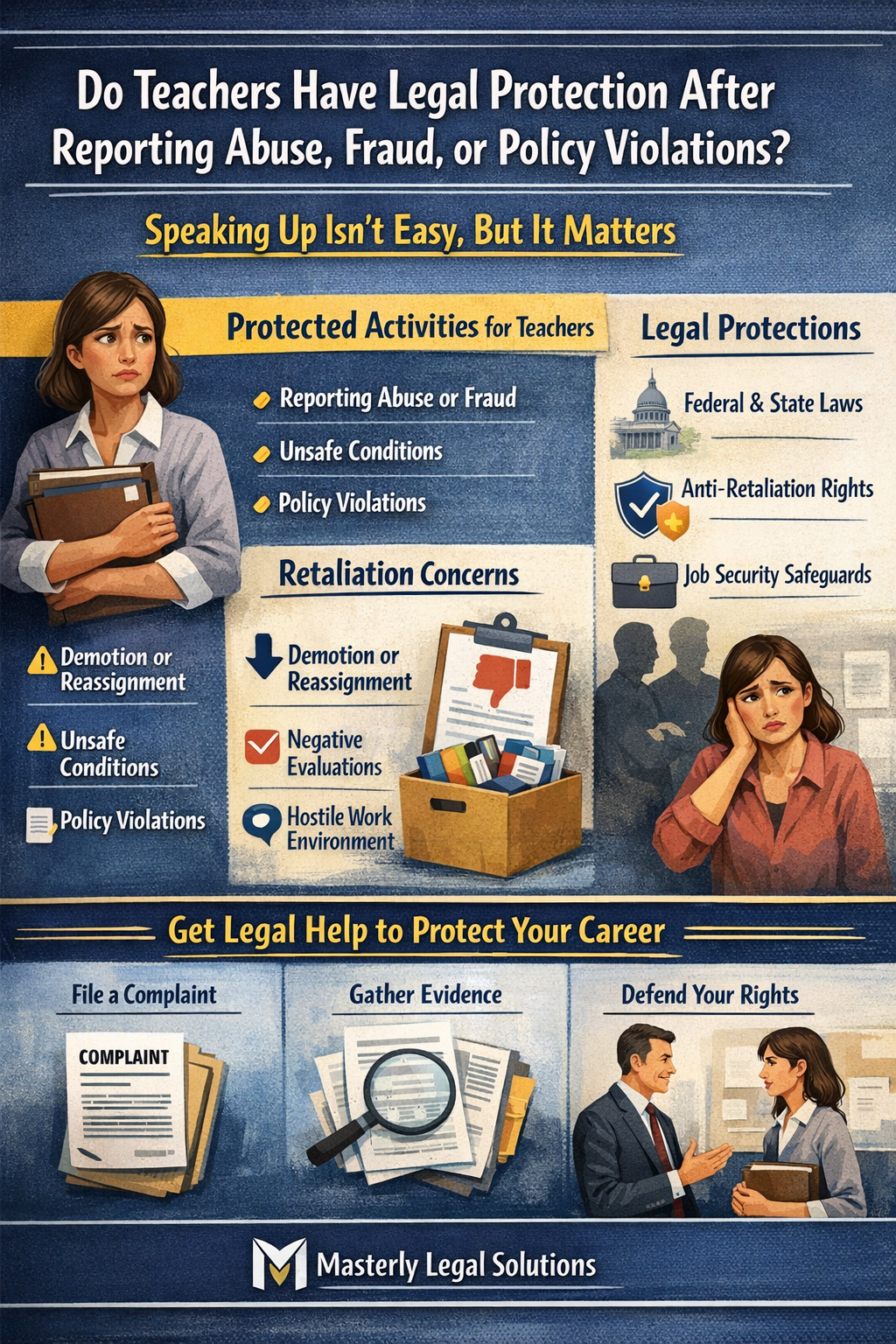
What Counts as a Protected Activity for Teachers
Reporting Misconduct in Good Faith
When a teacher reports suspected abuse, fraud, or unethical behavior, they are typically engaging in a protected activity. This includes raising concerns about illegal acts, unsafe conditions, or violations involving students or staff. Even if the concern is later found to be unsubstantiated, the key factor is whether the report was made with a good faith belief that wrongdoing occurred.
Under most anti discrimination laws, protections extend to those who report issues internally or to federal agencies. This means a teacher does not need to prove misconduct immediately to be protected. The law recognizes that employee's protected activity should not result in punishment simply for speaking up.
Participation in Investigations and Proceedings
Teachers are also protected when they participate in investigations, whether initiated by the school, a state law authority, or agencies like the equal employment opportunity commission. This includes providing statements, cooperating with inquiries, or supporting a colleague’s claim, or even filing labor or retaliation complaints through formal channels when necessary. In these situations, discrimination participating or assisting in a case still qualifies as a protected activity.
If an employer participating in an investigation begins to treat a teacher differently, this could raise concerns about unlawful retaliation. Legal guidance becomes critical in identifying when normal workplace decisions cross the line.
Understanding Workplace Retaliation in Schools
How Workplace Retaliation Happens
Workplace retaliation can take many forms, some obvious and others more subtle. It often begins shortly after a teacher reports misconduct or participates in an investigation. While not every negative change is illegal, patterns of behavior can point to a problem.
Examples of adverse employment action include:
- Demotion or reassignment to a less favorable role
- Unjustified disciplinary action
- Negative performance reviews unrelated to actual job performance
- Exclusion from meetings or opportunities
- Sudden changes to schedules or duties
When an employer retaliated in response to a protected activity, these actions may support a retaliation claim.
Hostile Work Environment and Subtle Retaliation
Not all retaliation is direct. In some cases, teachers experience a hostile work environment after reporting concerns. This could involve isolation, increased scrutiny, or tension with a co worker or supervisor.
Over time, these conditions can make it difficult to continue working effectively. Even without formal discipline, a toxic environment can still qualify as workplace retaliation under employment law.
Legal Protections Available to Teachers
Federal and State Laws That Apply
Teachers are protected by a combination of federal and state laws, including the Civil Rights Act, the Texas Labor Code, and other anti discrimination law provisions. These laws prohibit retaliation and ensure that employees are not punished for reporting wrongdoing, and legal insights for teachers and education professionals can clarify how these protections apply in practice.
The civil rights act and related statutes also address employment discrimination based on sexual orientation, age discrimination, and other protected characteristics. These protections extend to federal employees, public school educators, and private school staff alike.
Protections Under the Texas Labor Code
The Texas Labor Code plays a key role in protecting teachers who report violations. It provides remedies when an employer engages in retaliatory acts or takes an adverse employment action against an employee for reporting misconduct, and working with an experienced education lawyer in Texas who supports teachers and school law issues can help you pursue those remedies effectively.
These protections often apply when a report involves:
- Unsafe conditions in schools or medical care institutions
- Financial misconduct or fraud
- Violations of student safety policies
Understanding how the Texas Workforce Commission enforces these rules can be critical when pursuing a legal claim.
Filing a Retaliation Claim as a Teacher
Steps to File a Complaint
When a teacher believes they have experienced workplace retaliation, the next step may involve filing a formal complaint based on the circumstances. This can be done internally through human resources or externally through agencies like the equal employment opportunity commission or the Texas Workforce Commission, often with guidance from a dedicated retaliation lawyer focused on workplace law and employment attorney help.
It is important to act quickly, as many claims are subject to very short deadlines. Waiting too long can limit legal options and make it harder to pursue a retaliation claim.
Building a Viable Retaliation Claim
To establish a viable retaliation claim, certain elements must be present. These often include proof that:
- The employee engaged in a protected activity
- The employer took an adverse employment action
- There is a connection between the two
An employment lawyer can help gather evidence, analyze the following factors, and determine whether the case meets legal standards.
Proving Unlawful Retaliation
What Evidence Matters Most
Proving unlawful retaliation requires strong documentation and a clear timeline. Teachers should keep records of communications, performance reviews, and any changes in treatment after reporting concerns.
Evidence may include:
- Emails or written complaints
- Witness statements from other employees
- Comparisons to similarly situated employees
- Documentation of changes in duties or evaluations
This information helps a workplace retaliation attorney build a compelling case, and firms with extensive experience as retaliation lawyers handling workplace investigations and claims can use this evidence to advocate on your behalf.
Connecting the Protected Activity to Employer Actions
To prove retaliation, there must be a link between the protected activity and the adverse employment action. Timing often plays a significant role, especially if negative changes occur shortly after the report.
An experienced employment lawyer understands how to demonstrate this connection and challenge the employer's discrimination or retaliatory motives.
Common Situations That Lead to Retaliation Claims
Reporting Discrimination and Harassment
Teachers who engage in reporting discrimination or raising concerns about sexual harassment often face increased scrutiny. In some cases, the employer retaliated by isolating the teacher or questioning their credibility, which is when education law attorneys who help protect teacher rights can become especially important.
These situations may also involve broader workplace discrimination, including unfair treatment tied to protected characteristics. When these issues overlap, they can strengthen a retaliation claim.
Medical Leave and Accommodation Issues
Teachers dealing with a medical condition may need to request leave under the medical leave act or seek a reasonable accommodation. When an employer responds negatively to these requests, it may lead to claims involving unlawful retaliation, and education law services that explain why every teacher needs a lawyer for legal protection can be valuable in these situations.
Issues involving medical leave, fmla leave, or adjustments to responsibilities should be handled carefully. Legal guidance ensures that rights are protected throughout the process.
Wage and Policy Violations
Reports involving wage issues, such as minimum wage concerns, or violations of school policies can also lead to workplace retaliation. Teachers who raise these issues are protected under employment law, even if the report creates tension within the organization.
Why Legal Representation Makes a Difference
The Role of an Experienced Employment Attorney
Navigating these situations without legal support can be challenging. An experienced employment attorney understands the complexities of employment law matters and can guide teachers through every step, much like education law attorneys who protect rights for students and teachers throughout investigations and disciplinary proceedings.
From the initial report to potential legal action, having representation ensures that the teacher’s rights are protected. A knowledgeable retaliation lawyer can also anticipate tactics used by employers and respond effectively, including when questions arise about whether an employer can force you to resign or quit your job.
Choosing the Right Workplace Retaliation Lawyer
When selecting a workplace retaliation lawyer, it is important to choose a law firm with experience handling cases involving educators. At Masterly Legal Solutions, we bring several decades of combined experience to each case.
Our team understands the unique challenges teachers face and works closely with clients to build strong, personalized strategies.
Local Support for Dallas Workers
For Dallas workers, having access to a retaliation lawyer Dallas can make a significant difference. Local knowledge of courts, agencies, and procedures can help streamline the process and improve outcomes.
Working with a workplace retaliation attorney who understands the local landscape ensures that your case is handled with precision and care.
Taking Legal Action When Necessary
When to Move Forward With a Lawsuit
If internal complaints and agency filings do not resolve the issue, teachers may need to pursue legal action. This step involves filing a lawsuit against the employer for unlawful retaliation or related claims.
An employment lawyer will evaluate the case, determine whether there is a strong basis for a claim, and guide the teacher through the litigation process.
Protecting Your Career and Future
Taking action is not just about resolving a single issue. It is about protecting your long-term career and ensuring that workplace retaliation does not define your professional path.
Teachers who act promptly and seek legal guidance are better positioned to recover and move forward with confidence.
Moving Forward With Confidence After Reporting Misconduct
Overcoming Legitimate Fears
It is natural for teachers to have legitimate fears about speaking up. Concerns about being isolated, reassigned, or even terminated can feel very real. However, understanding your rights under federal law, the Texas Labor Code, and other laws can provide reassurance.
Building a Safer Workplace for Everyone
When teachers report wrongdoing, they contribute to a safer and more ethical environment for students and staff. Addressing misconduct helps prevent future issues and promotes accountability.
With the support of a trusted law firm, teachers can take action while minimizing risk.
Talk With a Retaliation Lawyer About Your Situation
If you believe you are experiencing workplace retaliation after reporting abuse, fraud, or policy violations, it is important to speak with a professional as soon as possible. Delays can affect your ability to file a retaliation claim and pursue your rights.
At Masterly Legal Solutions, we understand how difficult these situations can be. Our team is here to listen, evaluate your case, and provide clear guidance tailored to your needs.
Understanding Key Laws That Protect Teachers in the Workplace
Several important laws, including the employment act, play a role in protecting teachers from unfair treatment. These laws support individuals bringing discrimination claims and ensure that rights are upheld under statutes like the disabilities act, which provides safeguards for those facing challenges related to a medical condition. When violations occur, teachers may have grounds for claims such as wrongful termination, especially if they were dismissed after engaging in a protected activity. Courts and agencies often evaluate adverse employment decisions to determine whether the employer acted lawfully or crossed into prohibited conduct. Having an experienced legal team helps ensure that these protections are fully enforced.
Why Acting Quickly Can Protect Your Rights
Timing is critical in any employment-related matter. When an employee waits too long to take action, they may miss important deadlines that affect their ability to pursue a claim. This is especially true for full time employees who rely on their positions for financial stability and long-term career growth. Speaking with a legal professional dallas sooner rather than later can help preserve evidence, strengthen your position, and ensure that your rights are protected from the start. Early guidance can make a meaningful difference in how a case develops and how effectively it is resolved.
Contact Us for a Free Consultation
If you are dealing with employer retaliation, facing a hostile work environment, or unsure whether you have a viable retaliation claim, we are here to help. Speaking with a retaliation lawyer can give you clarity and confidence about your next steps.
Call (972) 236-5051 today to schedule your initial consultation. The sooner you reach out, the sooner we can begin protecting your rights and helping you move forward.
This article is for educational purposes only and does not constitute legal advice. For guidance specific to your situation, please contact a qualified attorney.






Looking for Legal & Business Solutions? Contact Us Now
Fill in the form or call us to set up a meeting