

Extended School Year in Texas: What Parents Should Know About ESY
Author: Andrew Rhoden, Masterly Legal Solutions
Extended school year (ESY) services provide special education and related services beyond the regular school year at no cost to eligible families. In Texas, a student's Admission, Review, and Dismissal (ARD) committee determines whether these services are necessary based on the student's individual educational needs and applicable special education requirements.
For many parents, the end of the school year brings concerns about their child's educational progress. A long summer break may create a gap in support and affect a child’s ability to keep making progress on important skills developed during the academic year.
When a school district determines that extended services are unnecessary, parents may question whether the decision accurately reflects their child's needs. ESY is intended to prevent regression, not to teach new skills.
Masterly Legal Solutions helps Texas families understand their special education rights, review extended school year decisions, and address disagreements with school districts regarding educational services.
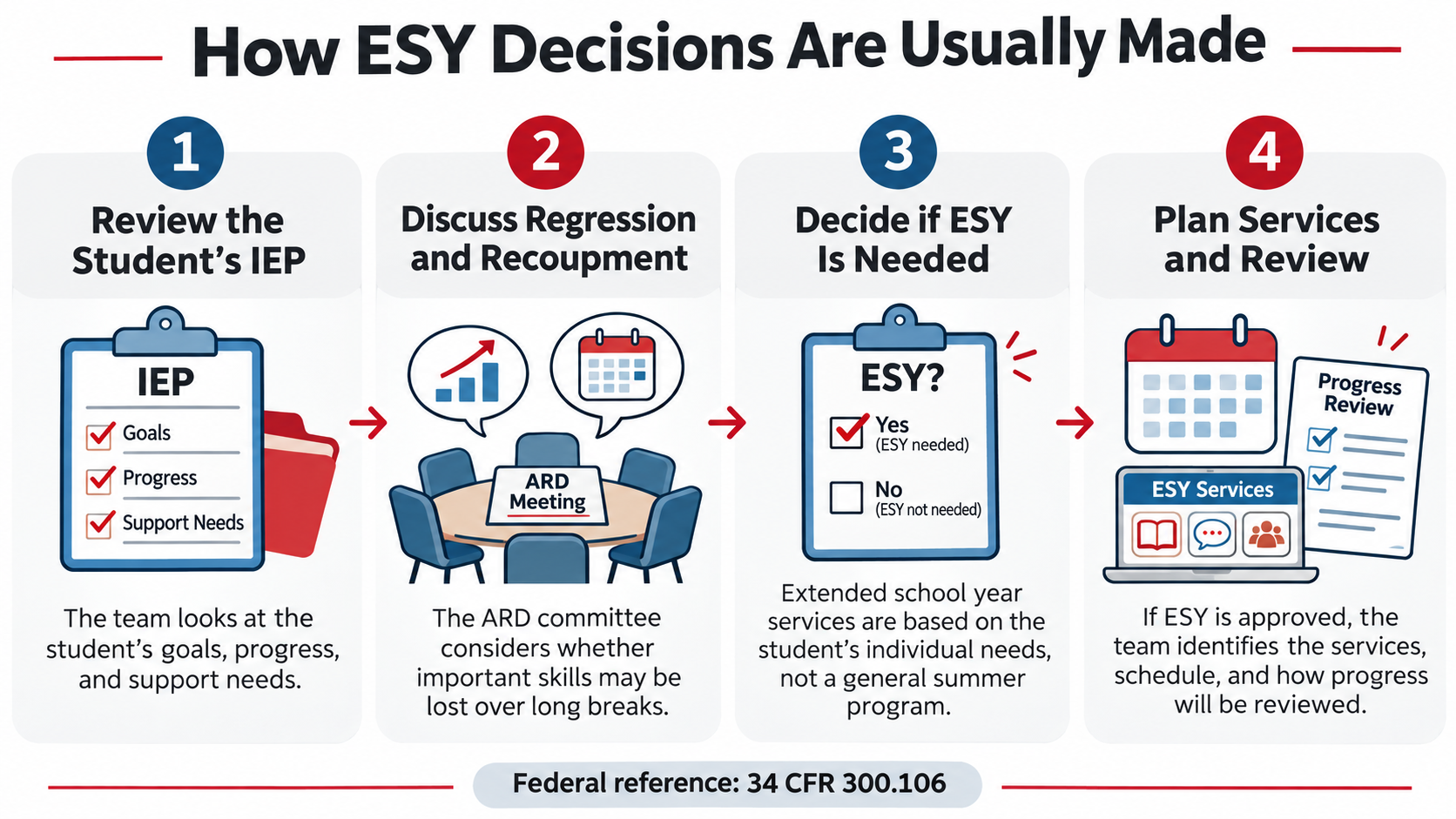
What ESY Services Are and What They Are Not
Extended school year services are individualized special education and related services provided outside the regular academic calendar. Although these services often take place during summer break, the services offered may also be provided during winter break, spring break, or track-out periods.
Under the Individuals with Disabilities Education Act (IDEA), specifically 34 CFR 300.106, public schools must make ESY services available when they are necessary for a student to receive a free appropriate public education (FAPE).
The federal regulation requires ESY decisions, including the services offered, to be based on the child’s IEP and individualized educational needs rather than a standard policy that applies to every student receiving special education services.
School districts cannot restrict eligibility to specific disability categories or impose automatic limits on the type, amount, or duration of services.
What Extended School Year Services May Include
Depending on the student's individualized education program (IEP), iep goals, and specific goals, ESY services may include what the student needs rather than follow a standard esy program:
- Specialized academic instruction.
- Speech Therapy and language services.
- Occupational therapy.
- Physical therapy.
- Behavioral and educational support.
- Instruction related to essential functional skills.
- Services addressing communication and independent living skills.
The services provided during an extended school year may involve different staff, settings, or service formats than those used during the regular school year. Their scope depends on the student's individual educational requirements.
ESY Services Are Different From Traditional Summer School
Traditional summer school programs often focus on academic improvement, credit recovery, enrichment, or preparation for the next grade level for other students.
ESY special education services serve a different purpose. They are not the same as district-wide extended calendars designed to increase total instructional days for all students, and they address disability-related educational needs only when services beyond the regular school calendar are necessary for FAPE.
A student does not automatically qualify for ESY because of low grades, a particular disability diagnosis, or participation in special education.
Similarly, a student should not be automatically excluded because the school district offers a general summer school program or follows a traditional calendar.
Understanding this distinction can help parents identify whether the school is addressing their child's individual educational needs.
How the ARD Committee Determines Extended School Year Eligibility
[CONFIRM] Under 19 Texas Administrative Code § 89.1065, the ARD committee functions as the student’s iep team for this decision, and extended school year eligibility is determined annually by that team on an individual basis.
The committee considers information collected by the school district and parents, including data from the beginning of the school year and from before and after breaks, to determine whether the student needs continued educational services outside the regular academic year while taking account of the student’s needs.
The decision involves more than reviewing academic performance. It also considers the student's existing IEP, previously acquired skills, educational progress, and the potential impact of extended breaks.
In some states, such as Maryland, the iep team determines eligibility using four factors that can include significant interfering behaviors, while Texas follows its own legal standard through the ARD process.
Understanding Regression and Recoupment
Two important terms that parents may hear during an ESY discussion are regression and recoupment.
Regression refers to the loss of previously acquired skills following an interruption in educational services, and ESY is meant to prevent regression by maintaining those skills rather than teaching new skills.
Recoupment refers to the time a student needs to regain those skills after instruction resumes.
[CONFIRM] Texas regulations require the committee to consider whether a student has experienced, or is reasonably expected to experience, a significant loss of critical skills that cannot be regained within a reasonable period.
The appropriate recovery period depends on the student's individual needs and cannot exceed eight weeks under the Texas rule. In making that decision, the committee may compare the student's vulnerability to regression with other students while still focusing on the student's disability-related needs. Certain serious circumstances may justify services without considering the recovery period.
A student does not necessarily need to experience an actual loss of skills before ESY eligibility can be considered.
Why Individual Educational Needs Matter
Students with similar disabilities may have very different educational needs. One student may maintain previously acquired skills during a school break, while another may experience substantial difficulties when regular instruction stops.
The ARD committee may consider academic progress, communication abilities, self-care, independence, and other essential skills addressed in the student's IEP, including whether the student is making progress on those iep goals. An autism diagnosis alone does not decide ESY eligibility; the decision turns on the child's individual educational needs.
A decision based only on a disability label or the availability of a standard summer program may raise legal concerns.
Parents who are unfamiliar with this decision-making process can read our article about ARD meetings in Texas.
What Parents Can Bring to the ARD Meeting and Ask
Parents play an important role in discussions about extended school year services. Their observations may provide information that school staff do not have, particularly regarding changes in the student's abilities during extended school breaks.
Relevant information may include previous evaluation reports, IEP progress reports, teacher communications, educational records, and observations of skill loss following school holidays. Parents can also request progress-monitoring data in writing from the school, including information showing the student's performance before and after school breaks.
Information from outside service providers may also help the committee understand the student's educational circumstances. If ESY has not been addressed early enough, parents can ask the school to schedule an ESY-specific IEP meeting to discuss eligibility and the child's IEP in more detail.
Questions Parents May Want the Committee to Address
When discussing ESY services, families may have concerns about:
- What data the committee used to determine eligibility.
- Whether previous school breaks, such as winter break or spring break, affected the student's progress.
- Which critical skills may be affected by interrupted instruction.
- How the committee evaluated regression and recoupment.
- What services would be available if the child qualifies and what the child receives under that plan.
- Why the committee determined that ESY services were unnecessary.
- Whether another ARD/IEP meeting should be scheduled if circumstances change.
These discussions can help parents understand the reasoning behind the school's decision and whether additional information should be considered.
What Happens When the School Determines ESY Is Unnecessary?
A decision not to provide extended school year services does not automatically mean the school has violated special education law.
However, parents may have legitimate concerns when relevant information is overlooked, individual educational needs are not adequately considered, or the decision appears to rely on a general district policy.
[CONFIRM] Texas regulations require the ARD committee to revisit ESY eligibility in the student's annual IEP review and related iep meetings each year, based on the student's individual needs and available data. A previous decision may also need to be reconsidered when the team later receives information showing a qualifying need. Schools may face logistical or financial challenges in implementing services, but those concerns do not replace the legal duty to make an individualized decision.
Families who are uncertain about their child's educational protections may benefit from understanding the differences between an IEP and a 504 plan.
When Families Talk With an Education Attorney About ESY Services
When parents disagree with an extended school year decision, understanding the legal requirements can be challenging. School districts may rely on assessment results, progress reports, and educational records that contain unfamiliar terminology.
An education attorney can examine these documents and explain whether the decision raises concerns under federal or Texas special education law.
Legal assistance may be particularly valuable when a school district refuses to consider relevant information, applies general eligibility restrictions, or fails to address concerns about the loss of critical educational skills.
How Masterly Legal Solutions Helps Texas Families
Masterly Legal Solutions provides professional legal guidance to families facing disputes involving special education and extended school year services.
Depending on the circumstances, our legal services may include:
- Reviewing ESY eligibility decisions and supporting documentation.
- Evaluating IEPs, educational assessments, and student progress records.
- Reviewing compliance with federal and Texas special education requirements.
- Assisting with communications involving school districts.
- Providing legal guidance regarding ARD committee decisions.
- Evaluating available dispute resolution options.
- Providing legal representation when appropriate.
Our firm focuses on the legal and procedural issues affecting your child's education while respecting the responsibilities of qualified educational professionals.
When disagreements remain unresolved, families may have additional legal options. Our article on special education due process in Texas provides further information about formal dispute resolution.
Frequently Asked Questions About Extended School Year Services
Who Decides if a Student Gets Extended School Year Services?
[CONFIRM] In Texas, the student's ARD committee, acting as the child’s IEP team, determines extended school year eligibility each year based on individual educational needs, relevant documentation, and applicable special education regulations.
Parents participate as members of the team and may share information about their child's educational progress and concerns, including how services align with the child's IEP.
Eligibility is not determined solely by a disability diagnosis or academic performance.
Is Extended School Year the Same as Summer School?
No. Summer school generally provides academic instruction, enrichment, or opportunities to recover course credits.
Extended school year services are individualized special education and related services provided beyond the regular academic calendar when necessary for a student to receive FAPE. They are intended to maintain skills tied to the student’s iep goals, not to provide enrichment or teach new skills.
Eligible students receive these services at no cost to their parents.
Can Parents Request ESY at an ARD Meeting?
Yes. Parents can raise concerns about extended school year eligibility and ask the school to schedule ARD or iep meetings early enough to discuss ESY eligibility before summer services would need to begin.
Parents may share relevant records, observations, and concerns, including data from teachers or outside providers such as speech therapy, showing the child's progress, regression, and recovery after breaks.
A request does not automatically establish eligibility. The committee must evaluate the student's circumstances under applicable special education requirements.
Request a confidential consultation with Masterly Legal Solutions
When a school district's extended school year decision leaves you concerned about your child's educational progress, professional legal guidance can help you understand your rights and available options.
Masterly Legal Solutions assists Texas families with ESY eligibility disputes, IEP reviews, ARD committee concerns, and special education legal matters. Our firm provides personalized legal support focused on your child's individual educational needs.
Call (972) 236-5051 to discuss your child's extended school year services and available legal options.








Looking for Legal & Business Solutions? Contact Us Now
Fill in the form or call us to set up a meeting