

How Informal School Complaints Turn Into Formal TEA Cases
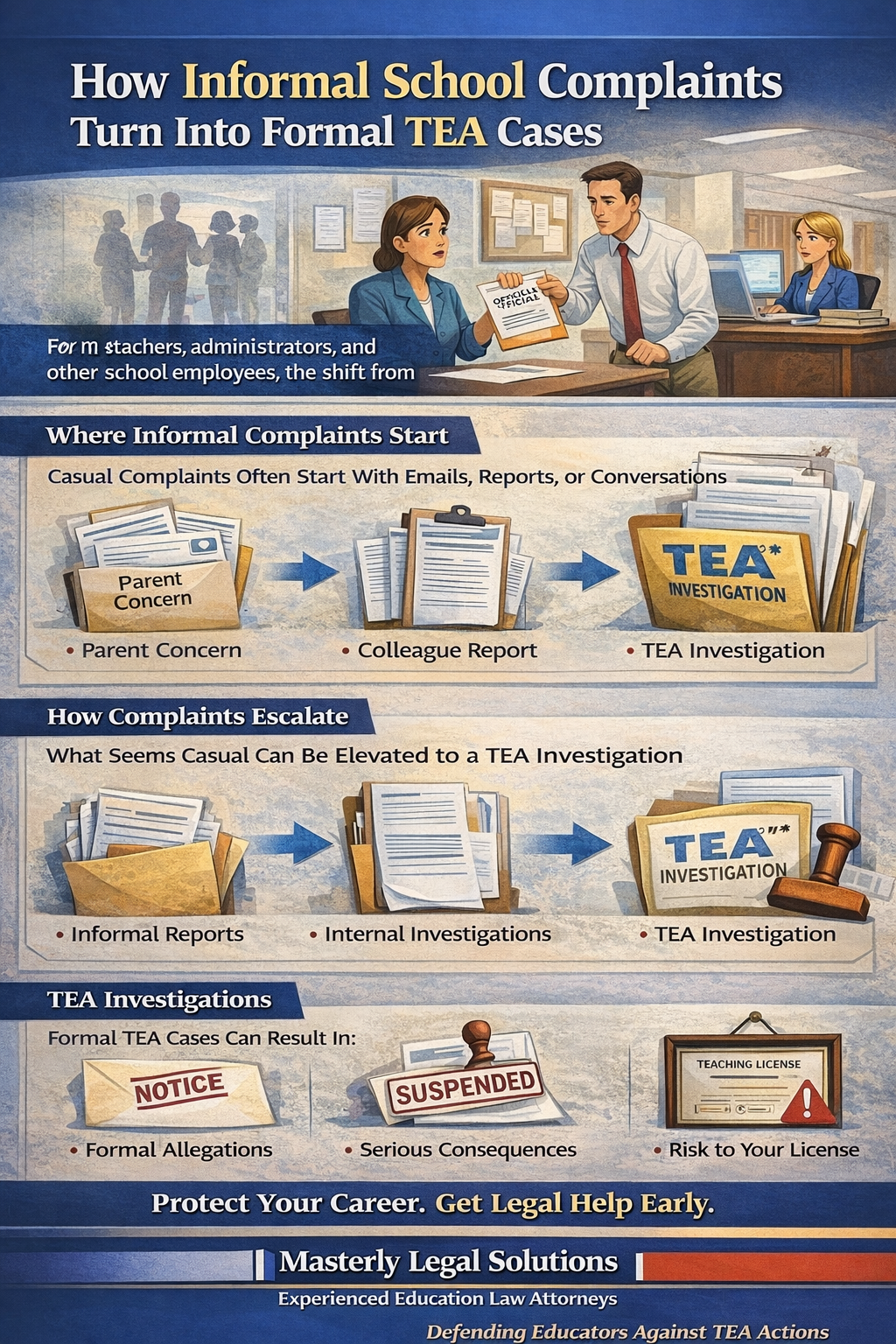
Most teachers never imagine that a casual concern raised by a parent or colleague could evolve into a serious legal matter. In many schools, informal complaints begin quietly, often as emails, conversations, or internal reports meant to address small issues. Yet within the education system, these early concerns can quickly escalate into formal investigations handled by the Texas Education Agency. At Masterly Legal Solutions, we regularly represent educators who are blindsided when an informal issue suddenly becomes a high-stakes legal case.
For teachers, administrators, and other school employees, the shift from informal complaint to formal TEA case can feel abrupt and unfair. What makes this process even more troubling is that educators are often unaware of when that line is crossed. Understanding how these situations unfold is essential for protecting careers, certifications, and reputations within public education.
The Nature of Informal Complaints in Schools
Where Informal Complaints Usually Begin
Informal complaints often start within a school district at the most basic level. A parent may raise a concern to a principal, or a colleague might report an issue to human resources. These complaints are typically framed as internal matters meant to be resolved quickly.
In the educational setting, such concerns are often treated as routine administrative matters. Teachers are frequently reassured that the issue will remain internal and will not affect their employment.
Why Informal Does Not Mean Harmless
Although informal complaints seem minor, they are often documented. Emails, meeting notes, and internal reports become part of an employee’s record. Over time, these records can be used to justify disciplinary action or further investigation.
In many cases, teachers are not given full access to these records. This lack of transparency can become a serious problem if the issue escalates.
How School Districts Escalate Complaints
Internal Reviews and Documentation
Once a complaint is raised, the school system may conduct an internal review. Administrators often interview staff members and collect statements. Even if no immediate action is taken, the information is preserved.
School districts are increasingly cautious about liability. This leads them to document extensively, sometimes without informing the teacher of the potential consequences.
When Internal Issues Leave the School
If administrators believe an issue could involve violations of education law, civil rights, or student safety, they may report it externally. This is often the moment when a matter transitions from informal to formal.
Teachers may not be notified that the texas education agency has been contacted until much later. By that point, the process has already advanced.
The Role of the Texas Education Agency
How TEA Receives Complaints
The texas education agency receives complaints from many sources. These include school districts, parents, staff members, and sometimes anonymous reports. Once received, TEA evaluates whether the complaint falls under its authority.
Complaints involving professional conduct, special education, or potential abuse are more likely to move forward. This is where informal concerns take on serious weight.
TEA’s Authority Over Educators
TEA has broad authority over teachers and educators in texas education. This includes the power to investigate, impose sanctions, and refer cases for disciplinary proceedings. For teachers, this authority directly impacts licensure and employment.
Once TEA becomes involved, the process is no longer controlled by the local school district. The stakes increase significantly.
Common Triggers That Lead to Formal TEA Cases
Allegations Involving Student Safety
Complaints involving physical or sexual abuse, sexual harassment, or neglect are among the fastest to escalate. Even unproven allegations may trigger immediate reporting obligations.
Schools are required to act cautiously in these situations. Unfortunately, caution often results in swift escalation without full context.
Special Education and Disabilities Issues
Concerns involving special education, disabilities, or special education services frequently become formal complaints. Issues related to IEP meetings, accommodations, or special needs children are closely regulated.
Parents are often encouraged to escalate concerns externally if they feel ignored. This can place teachers under scrutiny even when acting in good faith.
The Impact on Teachers and Educators
Sudden Shift in Treatment
Once a complaint becomes formal, teachers often notice immediate changes. They may be placed on administrative leave or removed from certain duties. Communication from administrators becomes limited or guarded.
This shift can feel isolating and alarming. Educators often describe feeling presumed guilty before any findings are made.
Emotional and Professional Stress
Formal TEA cases place immense stress on teachers. Concerns about employment, certification, and reputation can affect mental health and job performance. The fear of long-term consequences is constant.
Without legal support, many educators struggle to navigate this pressure.
Administrative Leave and Disciplinary Action
Why Administrative Leave Is Used
Administrative leave is commonly used once a complaint reaches TEA. While sometimes necessary, it can feel punitive to teachers who have not been found at fault.
Extended administrative leave can damage professional standing and create uncertainty about future employment.
Disciplinary Proceedings and Hearings
Formal cases may lead to disciplinary hearings or administrative hearings. These proceedings are governed by strict rules and timelines. Teachers may be required to respond to allegations without fully understanding the process.
Legal representation is critical at this stage to protect teachers rights and ensure due process.
The Legal Framework Behind TEA Cases
Education Law and Civil Rights
Education law intersects with civil rights in many TEA cases. Allegations may involve discrimination, title ix, or violations of students rights. These legal issues are complex and highly regulated.
Missteps in responding to these claims can have lasting consequences.
Employment Law Implications
Many TEA cases also involve employment law. Decisions made during investigations can affect contracts, evaluations, and future opportunities. Teachers often face parallel processes at the district and state levels.
Navigating both requires skilled legal professionals with experience in education law matters.
The Importance of Early Legal Guidance
Why Timing Matters
The earliest stages of a complaint are often the most important. Statements made during informal investigations can later be used in formal proceedings. Teachers who assume the issue is minor may unknowingly harm their own case.
Consulting education law attorneys early can prevent costly mistakes.
Protecting Rights From the Start
Legal support helps ensure that teachers understand their rights and obligations. Attorneys can advise on communication, documentation, and strategy before the situation escalates.
This proactive approach can make all the difference in outcomes.
Representation for Teachers and School Employees
Representing Teachers and Other School Employees
Education attorneys regularly represent teachers, administrators, and other school employees facing complaints. Each role within the public school system carries different responsibilities and risks.
Tailored legal services ensure that representation fits the specific circumstances of the educator involved.
Advocating Within the Education System
A skilled lawyer understands how the education system operates. This includes working with school districts, charter schools, and universities. Effective advocacy requires familiarity with internal policies and external regulations.
This knowledge allows attorneys to protect educators more effectively.
Students, Parents, and the Broader Impact
The Role of Parents in Escalation
Parents play a significant role in how complaints evolve. When concerns are not resolved at the school level, parents may seek external intervention. While advocacy for children is important, escalation can have unintended consequences.
Clear communication and early resolution benefit all parties.
Balancing Best Interests and Due Process
Schools and agencies often cite the best interests of children. However, protecting children does not require sacrificing fairness for educators. Both goals can coexist when processes are followed correctly.
Legal guidance helps maintain this balance.
Special Education Complaints and Due Process
IEP Meetings and Documentation
Disputes arising from IEP meetings are common sources of formal complaints. Documentation from these meetings is closely examined during investigations.
Teachers must be careful in how concerns and decisions are recorded.
Due Process Hearings and Appeals
Some cases lead to due process hearings or grievance hearings. These proceedings require detailed preparation and understanding of procedural rules. Errors can limit appeal options later.
Education lawyers guide clients through these complex steps.
From TEA to District Court and Beyond
When Cases Escalate Further
In some situations, TEA decisions are challenged in district court. The appeal process is demanding and requires extensive experience. Not all cases reach this stage, but those that do are particularly complex.
Preparation from the earliest stages is critical.
Long-Term Career Consequences
Even when educators ultimately prevail, the process itself can leave lasting effects. Gaps in employment, damaged reputations, and emotional tolls are common.
Early intervention can reduce these long-term impacts.
Why Skilled Legal Representation Matters
Experience Makes All the Difference
An education law firm with extensive experience understands how informal complaints evolve. Recognizing warning signs allows attorneys to intervene before damage is done.
Skilled lawyers anticipate how agencies and districts respond.
Protecting Educators and Institutions
Effective representation protects not only individual teachers but also the integrity of educational institutions. Clear legal guidance promotes fair processes and better outcomes.
This benefits schools, students, and educators alike.
Our Commitment at Masterly Legal Solutions
Dedicated Education Law Attorneys
At Masterly Legal Solutions, our education law attorneys focus on protecting educators at every stage. We understand how informal complaints can spiral into formal TEA cases. Our team brings clarity, strategy, and support to clients facing new challenges.
We are committed to advocacy that protects careers and professional futures.
Personalized Legal Support for Educators
Every case is unique. We tailor our legal services to the specific needs of teachers, school employees, and administrators. Our goal is to protect legal interests while minimizing disruption to personal and professional lives.
Our clients are never treated as just another case file.
Representing Students in Complex Special Education Matters
Representing students requires a deep understanding of how special education law protects a child’s rights within the education system. Texas education lawyers frequently handle special education cases involving IEP disputes, accommodations, and access to appropriate services. These matters often involve complex legal issues where a child’s educational progress and well-being are directly affected. Skilled advocacy ensures that students receive the support they are legally entitled to while protecting their interests throughout the process.
Contact Us for a Free Consultation
If you are a teacher or educator facing an informal complaint that may escalate, early legal guidance can make all the difference. Understanding your rights before a matter becomes formal is critical within the education system. At Masterly Legal Solutions, we help clients navigate education law with confidence and clarity.
We invite you to contact our law firm at (972) 236-5051 for a free consultation. Our attorneys are ready to listen, answer questions, and provide the legal support you need during this challenging time.
Disclaimer: This article is for informational purposes only and does not constitute legal advice. Reading this content does not create an attorney-client relationship. For legal advice specific to your situation, consult a qualified attorney.
Teacher Rights When Assaulted by a Special Needs Student: Safety, Reporting and Investigation Issues





Looking for Legal & Business Solutions? Contact Us Now
Fill in the form or call us to set up a meeting





