

How TEA Investigations Trigger Workplace Retaliation Against Teachers
Teachers enter the profession to educate, mentor, and protect students, not to navigate hostile workplaces. Yet when a TEA investigation begins, many educators experience a sudden shift in how they are treated at work. What starts as a regulatory inquiry can quietly evolve into retaliation at work, leaving employees isolated, anxious, and unsure of their rights. At Masterly Legal Solutions, we have seen clear patterns showing how inaction during early stages can expose teachers to escalating harm.
For many employees, the most damaging consequences do not come from the investigation itself, but from how employers react once scrutiny begins. Administrative decisions that appear neutral on the surface often mask deeper motives. Understanding how retaliation develops, and why it thrives when left unchallenged, is critical for protecting careers, income, and personal dignity.
Understanding TEA Investigations in the Workplace
Why TEA Investigations Change Workplace Dynamics
A TEA investigation places a school district under pressure, and administrators often react defensively. Supervisors may fear liability, negative publicity, or future audits. This pressure can lead to rushed employment decisions that disproportionately affect the teacher under investigation.
Once an investigation starts, teachers are often treated as liabilities rather than professionals. This shift sets the stage for workplace discrimination and retaliation.
The Hidden Consequences for Employees
While investigations are meant to be neutral, employees frequently experience changes in job assignments, evaluations, and access to resources. These actions may not be openly hostile, but they can still qualify as adverse actions under employment law. Over time, these subtle changes compound and affect employee morale and career stability.
What Retaliation Looks Like After a TEA Investigation
How Retaliation Begins
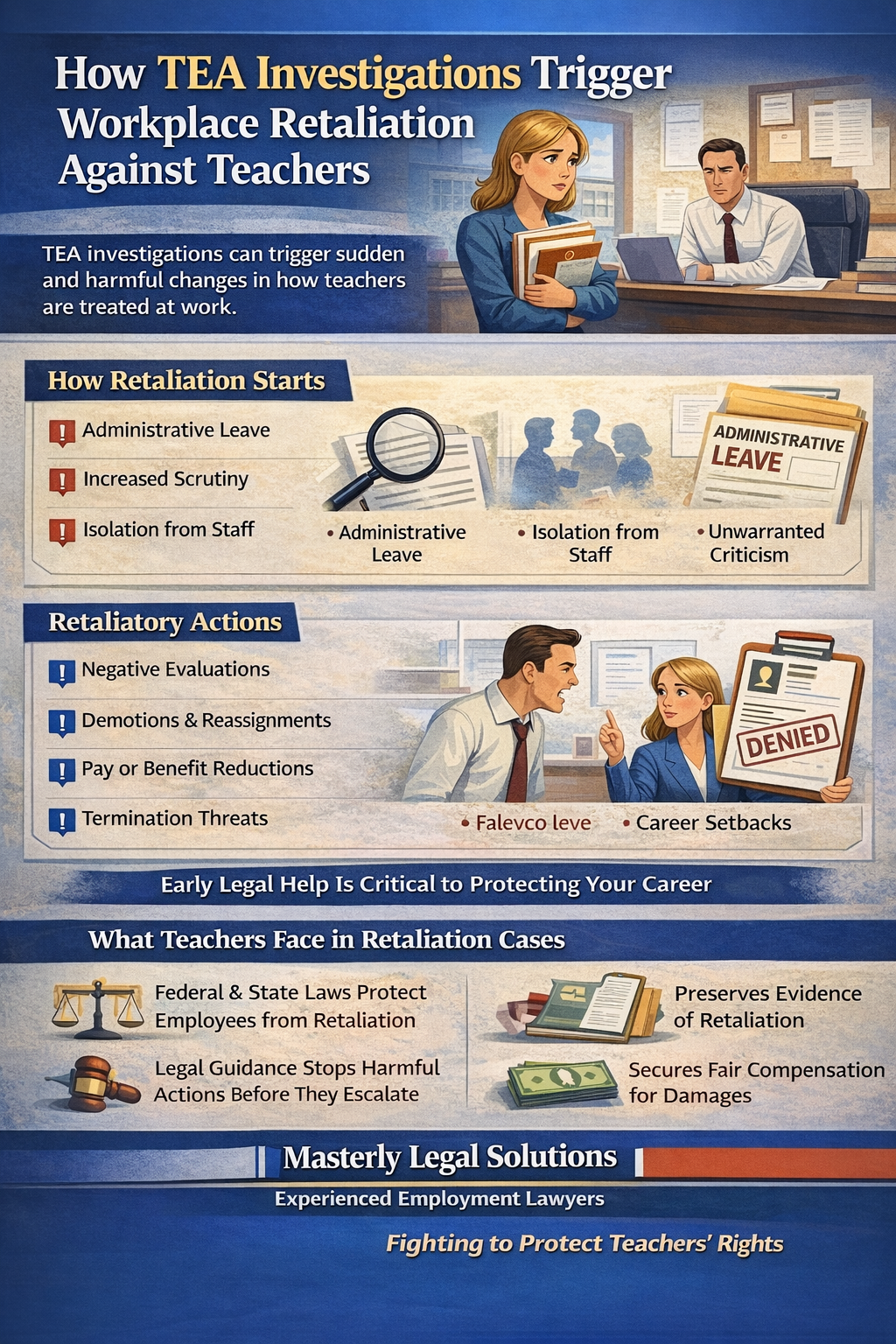
Retaliation often begins quietly. Teachers may be placed on paid administrative leave without clear explanations. While administrative leave can be appropriate in limited situations, repeated or prolonged use often signals deeper issues.
When retaliation occurs, it is rarely announced. Instead, it unfolds through policy changes, shifting expectations, and selective enforcement of rules.
Common Retaliatory Patterns Seen in Schools
In real cases, we frequently see the same employment practices repeated:
- Sudden changes to work hours or job assignments
- Increased scrutiny from a supervisor
- Exclusion from meetings or decision-making
- Negative performance reviews without prior issues
- Isolation from co worker collaboration
Each example alone may seem minor. Together, they form a pattern that employment lawyers recognize as retaliation.
Why Administrative Leave Is Often Misused
The Overuse of Paid Administrative Leave
Paid administrative leave is supposed to be temporary and neutral. However, after TEA investigations, it is often used excessively. Employees may be placed on administrative leave multiple times or for extended periods without updates.
This misuse creates stress, uncertainty, and reputational harm. Even though pay continues, the damage to professional standing is real.
When Administrative Leave Becomes Punitive
Administrative leave crosses a legal line when it functions as punishment. Removing employees from the workplace without cause can affect future employment decisions. It may also discourage others from reporting concerns or exercising protected rights.
Federal law and state laws prohibit using administrative leave as retaliation.
The Legal Framework That Protects Teachers
Laws That Protect Employees From Retaliation
Multiple laws protect employees who are subject to investigations or who report concerns. These laws protect employees from retaliation tied to complaints, cooperation with investigations, or protected activity.
Key protections come from:
- Federal and state laws
- State and local laws
- Title VII of the Civil Rights Act
- The Disabilities Act
- Whistleblower laws
These laws protect employees regardless of whether the underlying allegation is proven.
Federal and State Enforcement Agencies
The equal employment opportunity commission plays a central role in enforcing workplace protections. Other federal agencies also oversee employment rights for federal employees and public sector workers. These agencies investigate retaliation complaints and discrimination claims.
Failing to act early can limit available remedies.
Workplace Discrimination Linked to TEA Investigations
How Discrimination Manifests After Scrutiny
TEA investigations often expose teachers to discrimination unrelated to job performance. We see workplace discrimination tied to national origin, sexual orientation, age discrimination, and sex discrimination.
Once labeled as “problematic,” employees may face future discrimination that has nothing to do with the original investigation.
Direct and Indirect Discrimination
Direct discrimination includes overt actions like demotion or wrongful termination. Indirect discrimination includes policies that disproportionately harm certain employees, such as denying reasonable accommodations or altering pay structures.
Both forms are prohibited under the law.
The Role of Human Resources in Retaliation
When HR Protects the Employer Instead of Employees
Human resources departments are often positioned as neutral, but their primary role is to protect the employer. During investigations, HR may document actions in ways that justify later adverse actions.
This documentation can later be used to deny retaliation occurred.
Why Teachers Should Be Cautious With Internal Complaints
Filing an internal complaint is often encouraged, but without legal help, it can expose employees to additional risk. Statements may be used to justify disciplinary action or future employment decisions.
Legal guidance ensures complaints are framed correctly and protected.
Retaliation Through Pay and Benefits Decisions
Subtle Changes That Have Major Impact
Changes to pay, overtime pay, or paid time off are common retaliation tools. Employers may claim budget issues or restructuring, but timing often tells a different story.
Even small reductions can have lasting financial consequences.
Leave Policies Used Against Employees
FMLA leave, job protected leave, and medical leave act protections are frequently misunderstood or ignored. Eligible employees who take protected leave may later face scrutiny or denial of opportunities.
These actions violate federal law and state laws.
How Family Responsibilities Become a Target
When Personal Life Is Used Against Teachers
Family responsibilities and caregiving obligations often become leverage points. Employees caring for a family member may be labeled unreliable or burdensome.
This treatment disproportionately affects women and caregivers, leading to gender discrimination.
Immigration Status and Vulnerable Employees
In some cases, immigration status is used to intimidate or silence workers. Even when irrelevant to employment eligibility, it may be raised indirectly to discourage complaints.
Such tactics are unlawful and deeply harmful.
The Psychological Toll of Retaliation
Fear, Isolation, and Stress
Teachers who face retaliation often experience fear of future discrimination. They may withdraw from colleagues or avoid speaking up. This isolation increases emotional strain and can impact physical health.
Harassment and hostile environments amplify this harm.
Long-Term Career Damage
Retaliation does not end when the investigation closes. Employment discrimination cases show that teachers often struggle to find future positions due to damaged reputations.
Early action can prevent long-term consequences.
Why Inaction Makes Retaliation Worse
How Silence Is Interpreted
When employees do nothing, employers often assume actions are accepted. Retaliation escalates when there is no resistance. Each unchallenged action becomes precedent for the next.
Inaction signals vulnerability.
The Risk of Missing Legal Deadlines
Many claims have strict filing deadlines. Waiting too long can eliminate options for legal relief, including punitive damages or reinstatement.
Timing matters.
The Importance of Legal Representation
How Employment Lawyers Protect Teachers
Employment lawyers understand how retaliation develops and how to document it properly. Legal representation ensures evidence is preserved and complaints are filed strategically.
Labor and employment lawyers also communicate directly with employers to stop ongoing harm.
Building a Strong Retaliation Complaint
A well-prepared retaliation complaint connects cause and effect. It shows how protected activity led to adverse actions. This clarity is essential for enforcement agencies and courts.
Strong documentation protects individual employees.
Real-World Examples of Retaliation Patterns
Example of Escalating Administrative Leave
One example involves a teacher placed on administrative leave after cooperating with a TEA investigation. After returning, the teacher faced repeated leave placements, reduced pay opportunities, and exclusion from meetings.
Each action alone seemed defensible. Together, they showed retaliation.
Example of Discriminatory Job Assignments
Another example involved altered job assignments following a complaint. The teacher was given less favorable duties, impacting evaluations and future advancement.
These patterns are common and preventable.
Protecting Yourself During and After an Investigation
Steps Teachers Should Take Immediately
Employees should document all interactions, save emails, and track changes in treatment. Speaking with a lawyer early helps prevent missteps.
Do not assume fairness will prevail without action.
Knowing When to Seek Legal Help
Legal help is critical when retaliation or harassment begins. Early intervention can stop ongoing harm and protect rights before damage becomes permanent.
A defense strategy is most effective at the first warning signs.
Our Commitment to Defending Educators
Dedicated Advocacy for Teachers
At Masterly Legal Solutions, our firm is committed to protecting educators from retaliation and discrimination. We understand employment law, labor protections, and the realities teachers face.
Our clients receive focused, strategic support.
A Proven Track Record of Protection
We have helped teachers defend against wrongful termination, harassment, and discriminatory pay practices. Our proven track record reflects our commitment to justice and accountability.
We fight to protect careers and livelihoods.
Contact Us for a Free Confidential Consultation
If you are a teacher facing retaliation after a TEA investigation, waiting can make the situation worse. Retaliation thrives when employees feel powerless or unsure of their rights. At Masterly Legal Solutions, we help teachers understand their legal protections and take action before damage becomes irreversible.
We invite you to contact our firm at (972) 236-5051 for a free consultation. Our team will listen, answer questions, and explain your options with clarity and care.
Disclaimer: This article is for informational purposes only and does not constitute legal advice. For more information about higher education law services, consult a qualified attorney. Reading this content does not create an attorney-client relationship. For legal advice specific to your situation, consult a qualified attorney.

Teacher Rights When Assaulted by a Special Needs Student: Safety, Reporting and Investigation Issues







Looking for Legal & Business Solutions? Contact Us Now
Fill in the form or call us to set up a meeting