

Massive Retaliation in School Investigations: What Teachers Should Do When the District Turns Against You
A school investigation can feel like an earthquake in a teacher’s life. One day you’re doing your job, managing students, meeting deadlines, and trying to keep up with the constant demands of the workplace. The next day, you’re being called into meetings, asked uncomfortable questions, and suddenly treated like you’re the problem. For many teachers, the most shocking part is not the investigation itself—it’s the way the district’s attitude changes almost overnight.
If you have ever thought, “I tried to do the right thing, and now they’re coming after me,” you are not imagining it. When teachers file a complaint, participate as a witness, or cooperate with investigators, retaliation can follow quickly. Sometimes it starts small, like a cold tone from a supervisor, but it can grow into something far more serious. In the worst cases, teachers experience massive retaliation, where multiple actions pile up until the teacher feels trapped, isolated, and pressured to resign.
At Masterly Legal Solutions, we help teachers respond strategically when a school district turns against them. This article explains what retaliation looks like during school investigations, why it happens, and what teachers can do to protect their career, their income, and their future.
Why School Investigations Feel So Personal for Teachers
Teachers do not work in a typical office environment. Your job is public, your work is visible, and your reputation matters every day. A school investigation can spread rumors quickly, even when the district insists it is “confidential.” A teacher can be treated differently before any facts are confirmed, and that shift can damage trust with co workers and administrators.
Investigations also create emotional pressure because teaching is not just a paycheck. Many teachers care deeply about their students, their classroom, and their professional identity. When a district starts questioning your integrity, it can feel like an attack on who you are, not just what you do. That emotional weight is one reason retaliation hits educators so hard.
How Retaliation Often Begins After a Complaint or Report
Retaliation frequently starts after a teacher makes a report or raises concerns about a possible violation of policy. Teachers may report unsafe conditions, misconduct, or workplace discrimination, expecting the district to correct the issue. Instead, the district may shift focus from the underlying problem to the person who spoke up. This is a common pattern, especially when leadership is worried about liability.
Retaliation can also begin after a teacher participates in an investigation as a witness. Even if you were not the person who started the complaint, your cooperation can make you a target. A teacher’s participation can be framed as disloyalty, even when it is honest and necessary. In many retaliation cases, the district treats the teacher like a risk rather than a professional.
Understanding Protected Activity in School Investigations
A key legal concept in retaliation cases is protected activity. Protected activity refers to actions that the law shields from punishment, such as reporting discrimination, participating in an investigation, or requesting workplace accommodations. Teachers often engage in protected activity without realizing it, especially when they speak to HR or file internal reports.
Protected activity is important because many laws prohibit retaliation against employees who engage in it. This protection exists under federal and state laws, including Title VII and related workplace statutes. Even if a district claims it is “just following procedure,” retaliation may still exist if the timing and treatment suggest punishment. Knowing whether your actions qualify as protected activity can help determine your legal options.
What Retaliation Looks Like in a School District Workplace
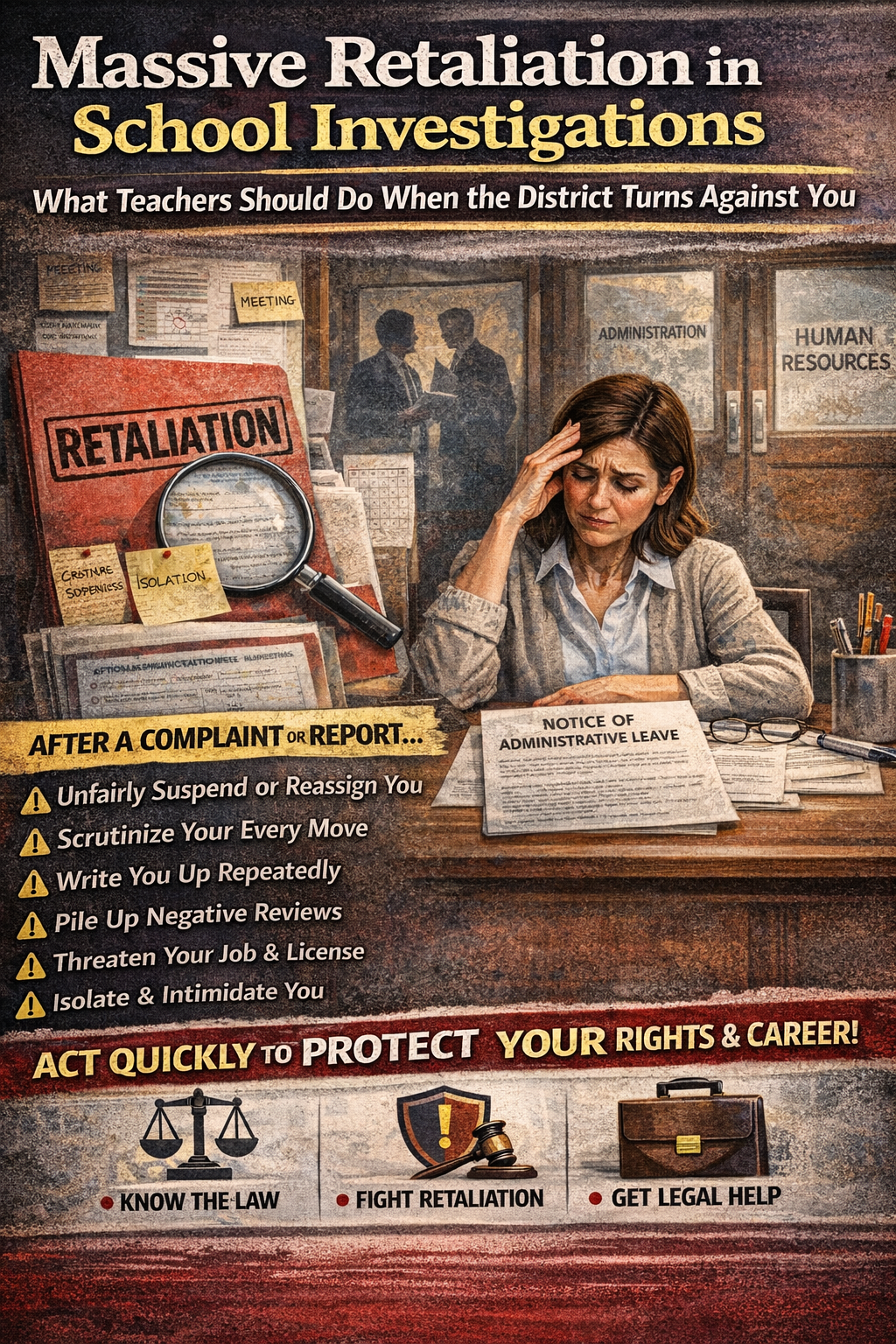
Retaliation does not always show up as termination. In schools, retaliation often appears as a series of negative changes that slowly destabilize the teacher’s career. These actions may be framed as routine personnel decisions, but they often have a clear negative impact on the teacher. The goal may be to create enough pressure that the teacher quits or accepts discipline without fighting back.
Common examples of retaliation in schools include:
- Sudden write-ups or disciplinary memos after years of positive performance
- Unfair job assignments or schedule changes
- Increased scrutiny from a supervisor, including frequent observations
- Negative performance reviews that do not match past evaluations
- Exclusion from meetings, committees, or leadership opportunities
- Isolation from co worker communication and support
Even one retaliatory act can be harmful, but when multiple actions stack up, it can become overwhelming. That is when teachers often describe it as massive retaliation.
When Retaliation Occurs Alongside Workplace Discrimination
Retaliation often overlaps with workplace discrimination. A teacher may face discrimination based on sex, age, disability, or national origin, and then experience retaliation after reporting it. Discrimination can be direct, obvious, and aggressive, or it can be subtle and persistent. Either way, it can become more intense during an investigation.
Teachers may face age discrimination, gender discrimination, or sex discrimination when administrators make assumptions about competence, attitude, or “fit.” Teachers may also experience discrimination tied to sexual orientation or national origin, especially when workplace culture becomes hostile. When discrimination is reported, retaliation may follow as punishment for speaking up.
Direct Discrimination and Subtle Discrimination in Schools
Direct discrimination is when a teacher is treated unfairly because of a protected characteristic. This can include being denied opportunities, disciplined more harshly, or subjected to different standards than others. Direct discrimination is sometimes easy to recognize because it is openly biased or inconsistent. But many teachers experience more subtle discrimination that builds over time.
Subtle discrimination may include being excluded from leadership roles, denied training, or assigned more difficult classes. It can also involve microaggressions, dismissive comments, or a supervisor’s repeated negative tone. Over time, these patterns can create a hostile environment that damages employee well being. Teachers should not dismiss subtle discrimination just because it is not loud.
How Title VII Protects Teachers During Investigations
Title VII is one of the most important legal protections for employees facing discrimination and retaliation. Title VII is part of the civil rights act, and it prohibits discrimination based on race, color, religion, sex, and national origin. It also prohibits retaliation when employees report discrimination or participate in investigations. Many teachers do not realize how much Title VII can apply to school employment.
Title VII is not limited to private employers. Public school districts are employers, and teachers are employees under many legal standards. If a teacher reports discrimination and then faces retaliation, Title VII may become part of the legal analysis. Understanding Title VII can help teachers see that they have rights, even when districts act like they have total control.
The Role of the Disabilities Act and Reasonable Accommodations
Teachers with medical conditions or disabilities may have protections under the disabilities act. These laws can require an employer to provide reasonable accommodations so that employees can perform their job. Reasonable accommodations may include modified duties, adjusted schedules, or support tools. In some cases, teachers are denied accommodations or punished for requesting them.
A district may claim an accommodation creates undue hardship, but that does not automatically make the denial lawful. The district must often show evidence and consider alternatives. If a teacher requests accommodations and then faces retaliation, it may strengthen a legal claim. Teachers should document requests and responses carefully to protect themselves.
Why Administrative Leave Becomes a Weapon in School Investigations
One of the most common tactics districts use during investigations is placing a teacher on administrative leave. Sometimes the leave is described as neutral, but teachers often feel branded as guilty. The district may claim the leave protects students, staff, or the investigation process. In reality, administrative leave can be used to isolate the teacher and control the narrative.
Administrative leave can be paid or unpaid, but either way it can harm the teacher’s career. A teacher may lose access to classroom materials, communication channels, and support networks. They may be told not to speak with coworkers, not to enter campus, and not to discuss the matter publicly. That isolation can feel like punishment, even before any findings are made.
Paid Administrative Leave and the Illusion of Safety
Many teachers assume paid administrative leave is not a big deal because they are still receiving pay. But paid leave can be part of a larger strategy to remove the teacher quietly while the district builds a case. A teacher may be kept on leave for weeks, then brought back under strict monitoring. In some situations, the teacher never returns to their original role.
Paid leave can also affect your professional reputation. Parents, colleagues, and even students may assume wrongdoing simply because you were removed. This can damage trust and make future employment harder. Even when you are being paid, your career may be losing ground every day.
The Emotional and Financial Impact of Administrative Leave
Administrative leave can disrupt a teacher’s life in ways people outside education may not understand. Teachers often rely on predictable schedules, steady income, and professional stability. Leave can interfere with your ability to plan childcare, manage family responsibilities, and maintain your personal life. The stress can also affect your health and mental well being. If you need guidance about administrative leave, support is available.
Even when the district continues your pay, leave can affect overtime opportunities, stipends, coaching pay, and supplemental income. A teacher may lose extra work hours or lose access to paid time that supports their household. Financial strain can build quickly, especially when the teacher is unsure how long the investigation will last.
How Employer Denies Retaliation While Still Doing It
In many cases, an employer denies retaliation even when the evidence suggests otherwise. The district may claim it is simply enforcing policy, addressing performance, or protecting students. They may use professional language to justify actions that feel punitive. Teachers often feel gaslighted, as if their concerns are being dismissed.
Denial is common because retaliation is unlawful under many laws. Districts know they must frame their actions as legitimate employment decisions. That is why documentation and timing matter so much. A teacher’s timeline often reveals patterns the district cannot explain.
Adverse Action and How It Shows Up in Schools
Retaliation often involves adverse action, meaning negative treatment that affects employment. In education, adverse action can include demotion, suspension, termination, or reassignment. It can also include subtle actions that reduce opportunities or make the job unbearable. Teachers should understand that adverse action does not always require firing.
Examples of adverse action may include removing a teacher from their grade level, cutting leadership responsibilities, or placing them on performance plans. It may also include restricting classroom resources or changing job assignments in a way that harms the teacher’s reputation. When adverse action follows protected activity, it can support a retaliation claim.
The “Paper Trail” Problem: How Retaliation Gets Documented Against Teachers
Many teachers experience retaliation through documentation tactics. The district may suddenly begin writing memos, documenting minor issues, and collecting statements. A teacher may be criticized for things that were previously ignored or handled informally. This is often a sign that the district is building a case.
Performance reviews can also become a weapon. A teacher may receive negative evaluations that do not reflect reality or past success. The district may then use these reviews to justify discipline or termination. Teachers should take documentation seriously and respond carefully, because these records can affect future employment.
Harassment During Investigations and the Hostile Environment Effect
Harassment often increases when investigations begin. Teachers may face hostile comments, isolation, and aggressive communication. Harassment can be verbal, procedural, or relational, and it often becomes more intense when the teacher is viewed as a problem. A teacher may be excluded from meetings, ignored in communications, or criticized publicly.
Harassment can also come from coworkers, not just administrators. A co worker may treat the teacher differently out of fear, loyalty to leadership, or misinformation. Over time, harassment can create a hostile environment that affects mental health and job performance. Teachers should document harassment and seek legal guidance early.
Why Laws Protect Employees During School Investigations
Many teachers are surprised to learn how many laws protect employees during investigations. These protections exist because retaliation and discrimination have long harmed workers across industries. Teachers are workers, and they deserve the same respect and protection as anyone else. The law recognizes that employees must be able to report wrongdoing without fear.
Laws protect employees by limiting how employers can respond to protected activity. These laws are meant to prohibit retaliation and discourage retaliation tactics. They also provide legal remedies when retaliation causes harm. Teachers should understand that these protections exist for a reason, and they can be enforced.
Federal Law and State Laws That May Apply
Teacher retaliation cases often involve federal law and state laws working together. Federal law includes protections under Title VII and the civil rights act. State laws may also protect teachers from retaliation and discrimination in specific ways. The combination of federal and state protections can strengthen a teacher’s legal position.
In some situations, federal agencies may become involved. Teachers may interact with the Equal Employment Opportunity Commission or other enforcement bodies. The involvement of federal agencies can add complexity and urgency. That is why early legal guidance is often essential.
Reporting Discrimination Without Losing Your Career
Teachers often hesitate to report discrimination because they fear retaliation. They worry about being labeled as difficult or disloyal. They worry that reporting will make their workplace worse. These fears are understandable, especially in school environments where relationships matter.
But reporting discrimination is often necessary to protect yourself and others. The key is doing it strategically, with documentation and guidance. Teachers should avoid emotional outbursts or informal complaints that are not recorded. Instead, careful reporting can preserve legal protections and reduce risk.
Employment Contracts and What Teachers Need to Review
Teachers may have employment contracts that shape their rights during investigations. Contracts can affect job security, grievance procedures, and disciplinary steps. Some teachers also have additional agreements tied to coaching, leadership roles, or supplemental duties. These documents matter when the district begins making employment decisions.
Teachers should not assume the district will interpret the contract in the teacher’s favor. Contracts are often written to protect the employer. That is why legal review can be helpful. Understanding your contract can help you respond confidently instead of guessing.
Eligible Employees and Workplace Protections
Not every worker has the same protections under every law. Some laws apply to eligible employees based on job status, length of employment, or employer size. Teachers should understand whether they qualify for certain protections, such as job protected leave. Eligibility can affect what options are available.
A teacher may also have rights tied to union agreements or district policies. Even when the district denies wrongdoing, internal rules may still apply. Knowing your status and rights helps you protect your career. This is where experienced legal support becomes valuable.
Job Protected Leave and FMLA Leave Issues
Some teachers may need job protected leave for medical reasons or family responsibilities. FMLA leave can apply in certain situations, providing protections for employees who need time off for serious health conditions or caregiving. Teachers sometimes face retaliation after requesting leave, especially if the district views them as inconvenient.
A district may claim the leave disrupts operations or creates hardship. They may pressure the teacher to return early or treat the leave as a performance problem. Teachers should document leave requests and responses carefully. Leave rights can be critical when retaliation intersects with health and family needs.
Immigration Status and Additional Vulnerabilities
For some teachers and school workers, immigration status can create additional stress during investigations. While immigration status should not be used as leverage in employment disputes, some employees fear it will be used against them. This fear can prevent workers from reporting discrimination or retaliation.
Legal protections can still apply, and teachers should not assume they have no rights. A district cannot lawfully retaliate against an employee for protected activity. Teachers should seek legal guidance if they feel immigration concerns are being used to intimidate them. No one should be pressured into silence through fear.
Family Responsibilities and Retaliation Pressure
Teachers often carry heavy family responsibilities, including caring for children or a family member. Retaliation can disrupt schedules, pay, and stability, making it harder to meet these responsibilities. A district may change work hours, increase duties, or assign harder schedules. These changes can feel targeted, especially when they follow a complaint.
Family responsibilities also affect a teacher’s ability to respond quickly to legal deadlines. Teachers may be overwhelmed and exhausted, which can lead to mistakes. That is why early legal support can reduce pressure. Protecting your job protects your family, too.
National Origin and Cultural Bias in School Workplaces
Discrimination based on national origin can occur in school environments, sometimes subtly and sometimes openly. Teachers may face biased assumptions about communication style, professionalism, or “fit.” During investigations, these biases can become more pronounced. A teacher may be treated unfairly based on stereotypes.
Teachers may also experience discrimination tied to language, accent, or cultural background. If a teacher reports it and then faces retaliation, legal protections may apply. Title VII can be relevant in these situations. Teachers should not ignore cultural bias, especially when it affects employment decisions.
Sexual Orientation and Workplace Retaliation
Teachers may face discrimination tied to sexual orientation, especially in environments where leadership is hostile or biased. Even when discrimination is not openly stated, it can show up through exclusion, gossip, or unequal discipline. If a teacher reports it, retaliation may follow quickly. This can create fear and isolation.
Teachers deserve safe and fair workplaces. Retaliation for reporting discrimination is not acceptable. Legal protections exist to address these issues, but they must be enforced properly. Teachers should not carry this burden alone.
Wrongful Termination and Forced Resignation Tactics
Some retaliation cases end in wrongful termination, where the teacher is fired unfairly. Others end in forced resignation, where the teacher is pressured to quit. The district may present resignation as the “best option” or imply termination is inevitable. Teachers often feel trapped and confused.
Wrongful termination can have long-term consequences. It can affect future employment, certifications, and professional reputation. Teachers should not resign under pressure without understanding the consequences. Legal guidance can help protect options and prevent irreversible mistakes.
Settlement Negotiations and Protecting Your Future
Not every retaliation case ends in court. Many cases involve settlement negotiations, where the teacher and district reach an agreement. Settlement may include compensation, resignation terms, neutral references, or reinstatement. These negotiations can protect the teacher’s future, but they must be handled carefully.
Teachers should not assume the district’s first offer is fair. Districts often have legal teams and experience negotiating these situations. A teacher without representation may accept terms that limit future opportunities. Legal support can help ensure the teacher is protected and respected.
Employment Discrimination Cases and Why Timing Matters
Employment discrimination cases often depend on timing, documentation, and consistency. Teachers may have strong facts, but if they wait too long, evidence may be lost. Deadlines may also apply for certain claims. That is why teachers should not delay seeking help.
Timing also matters because retaliation often escalates. What begins as small actions can grow into massive retaliation. Early intervention can stop the pattern before it becomes irreversible. Teachers should not wait until they are on the edge of termination.
The Equal Employment Opportunity Commission and Enforcement
The equal employment opportunity commission is a federal agency that handles discrimination and retaliation matters. Teachers may file claims with the EEOC in certain cases, especially those involving Title VII protections. The process can be complex and time-sensitive. A teacher’s approach must be careful and consistent.
Teachers should understand that EEOC filings require clear documentation and accurate timelines. Statements made to the EEOC may later be used in litigation. This is why legal guidance matters. A teacher’s case should be built thoughtfully, not rushed in panic.
Federal Agencies, State Agency Processes, and Teacher Rights
Some teacher cases involve interactions with federal agencies or a state agency. These processes can include investigations, hearings, or administrative reviews. The agency determines outcomes based on evidence and legal standards. Teachers should not assume the agency will automatically side with them.
Agency processes require careful preparation. Teachers should organize evidence, document timelines, and maintain consistency. Agency decisions can shape the future of the case. Legal representation can help ensure the teacher is prepared and protected.
How Retaliation Affects Employee Morale and School Culture
Retaliation does not just harm the targeted teacher. It damages employee morale across the school. Other employees may become afraid to speak up, report problems, or cooperate with investigations. The entire workplace can become tense and distrustful. This environment harms students, staff, and long-term school success.
When teachers see retaliation happening, they often feel helpless. They may avoid reporting issues even when students are at risk. This creates long-term harm and future discrimination risks. Districts that allow retaliation create toxic culture. Teachers deserve better.
How Teachers Can Protect Themselves During an Investigation
Teachers often ask what they should do when the investigation begins. The best approach is calm, strategic, and documented. Teachers should avoid emotional reactions that can be used against them. Instead, they should focus on protecting their rights and preserving evidence.
Here are steps teachers can take to protect themselves:
- Keep copies of key emails, directives, and meeting notices
- Write down dates, times, and details of important events
- Identify potential witnesses who observed key interactions
- Request clarification in writing when instructions are unclear
- Avoid discussing the case casually with coworkers
- Seek legal guidance early, before signing anything
These steps help protect the teacher without escalating conflict unnecessarily. They also strengthen the teacher’s position if retaliation becomes more severe.
Why Early Legal Representation Matters
When a teacher faces retaliation, early legal support can change the outcome. Waiting often allows the district to build documentation and control the narrative. Early legal guidance helps teachers respond correctly and avoid mistakes. It also helps teachers understand what rights apply and what options exist.
Employment lawyers can evaluate whether retaliation is happening and whether legal protections apply. They can also guide how to respond to HR meetings, investigation interviews, and documentation requests. Teachers deserve professional advocacy during high-stakes moments. Your career is too valuable to gamble on guesswork.
How Masterly Legal Solutions Supports Teachers Facing Retaliation
At Masterly Legal Solutions, we understand how quickly school investigations can turn into career-threatening situations. We help teachers respond to administrative leave decisions, retaliation patterns, and discrimination concerns. We also help teachers protect their documentation and communicate strategically. Our goal is to protect the teacher, not just react to the district.
We know that many teachers feel overwhelmed, embarrassed, and exhausted during these moments. We take those emotions seriously, while staying focused on legal strategy. Teachers deserve to be treated fairly, even when the district is under pressure. We are here to help you stand your ground with confidence.
Contact Masterly Legal Solutions for a Free Consultation
If you believe you are facing massive retaliation during a school investigation, do not wait until the district makes the next move. Retaliation often escalates quietly, and teachers are frequently pressured into decisions before they understand their rights. Whether you were placed on administrative leave, targeted after filing a complaint, or punished for cooperating with investigators, early action can protect your career and your future.
At Masterly Legal Solutions, we offer free consultations to help teachers understand what is happening and what steps to take next. We can help you evaluate whether workplace discrimination, retaliation, or unlawful employment practices are affecting your situation. Call (972) 236-5051 today to schedule your free consultation and get clear answers before the pressure becomes permanent.
Disclaimer: This article is for educational and informational purposes only and does not constitute legal advice or legal guidance. Reading this article does not create an attorney-client relationship. For legal advice about your specific situation, contact Masterly Legal Solutions directly.



Teacher Rights When Assaulted by a Special Needs Student: Safety, Reporting and Investigation Issues



Looking for Legal & Business Solutions? Contact Us Now
Fill in the form or call us to set up a meeting