
School Investigations Gone Wrong: The Hidden Risks of Retaliation in the Workplace
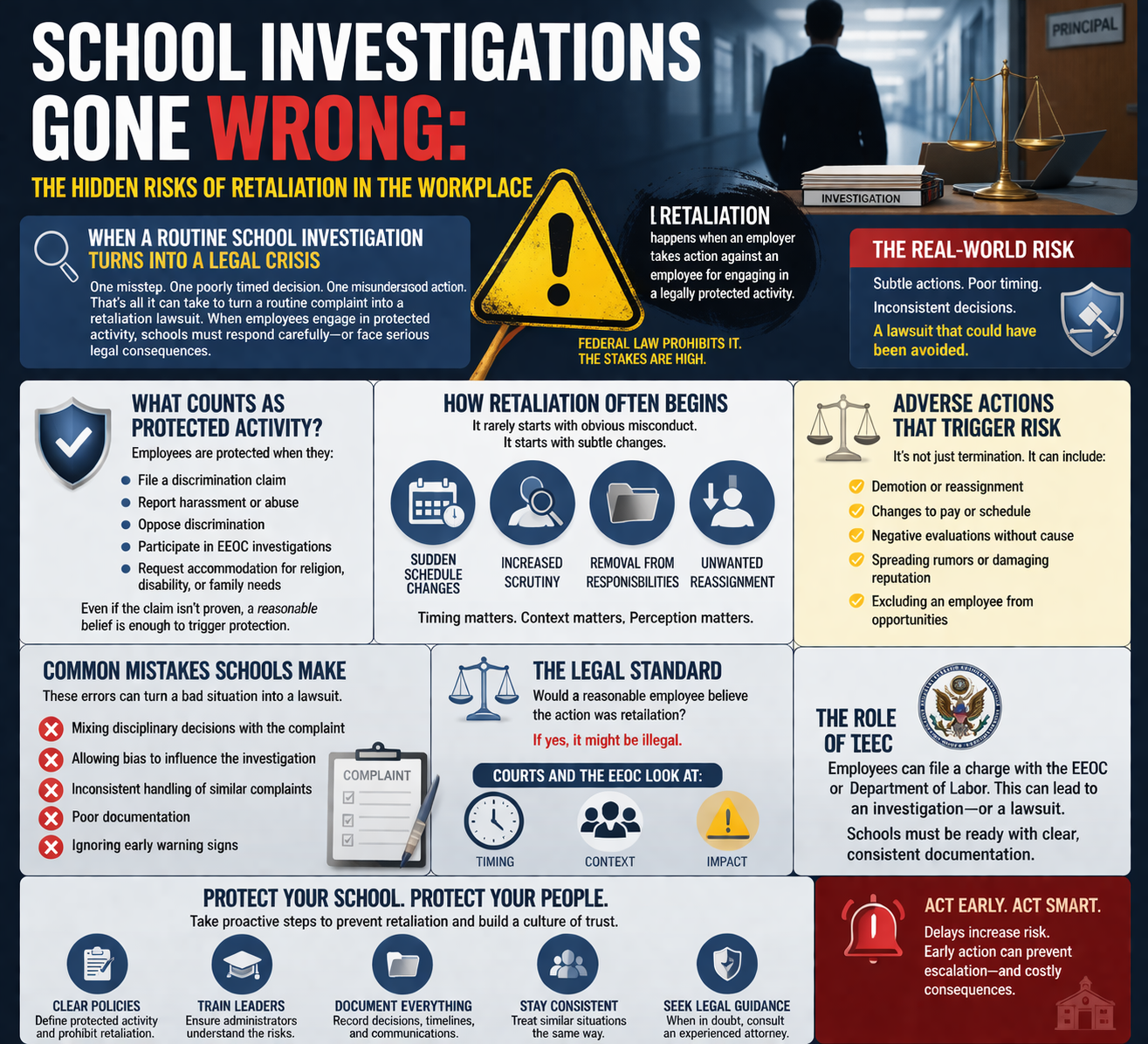
When a Routine School Investigation Turns Into a Legal Crisis
At first glance, most school investigations appear manageable. A complaint is filed, an administrator gathers information, and leadership expects a quick resolution. However, what many schools fail to recognize is how quickly these situations can shift. One misstep, one poorly timed decision, or one misunderstood action can lead to serious claims involving retaliation in the workplace.
For school administrators and decision-makers, the stakes are high. Investigations often involve sensitive issues such as discrimination, harassment, or policy violations. When an employee comes forward and engages in protected activity, the school must respond carefully. If not handled properly, even routine actions can be interpreted as an adverse action, opening the door to legal exposure.
Understanding Retaliation in the Workplace Within School Systems
Retaliation occurs when an employer takes action against an employee because they engaged in a legally protected activity. In schools, this often involves a teacher or staff member filing a complaint, participating in an employer investigation, or opposing discrimination, situations where experienced retaliation and education law attorneys can provide critical guidance.
Federal law, including Title VII and other federal laws, clearly prohibit retaliation. These protections extend to a wide range of actions, including reporting discrimination, assisting in employment discrimination proceedings, or requesting accommodation for a disability or religious practice. When schools fail to understand these protections, they expose themselves to serious liability.
What Counts as Protected Activity in a School Setting
Not every workplace complaint qualifies as protected activity, but many do. Schools must understand what actions trigger legal protections under federal and state laws.
Protected activity can include:
- Filing a discrimination claim related to employment discrimination
- Reporting alleged harassment or verbal or physical abuse
- Opposing discrimination based on national origin, disability, or other protected categories
- Participating in EEOC investigations or employment discrimination proceedings
- Requesting accommodation for religious practice or family responsibilities
Even if the claim is not ultimately proven, an employee only needs a reasonable belief that a violation occurred. This standard makes it easier for retaliation claims to arise.
How Retaliation Often Begins in School Investigations
Retaliation rarely starts with obvious misconduct. Instead, it often develops through subtle employer acts that follow a complaint. These actions may appear neutral but can still be interpreted as retaliatory.
For example, an employee who files a complaint may suddenly face increased scrutiny. Their performance evaluation may become more critical, or their work schedule may change. In some cases, they may be reassigned to a less desirable position. While these actions may have non discriminatory reasons, timing and context matter.
Real-World Example of Retaliation in Schools
Consider a situation where a teacher reports alleged harassment involving sexual advances. Shortly after the complaint process begins, the teacher is reassigned and removed from leadership responsibilities. The school may argue that the decision was unrelated, but the timing creates suspicion.
In another example, an employee uncovers potentially discriminatory wages and shares salary information with co workers. After doing so, the employee faces disciplinary action. Even if the employer claims policy violations, the employee may argue retaliation occurred.
These examples show how quickly situations can escalate into a lawsuit.
The Legal Standard: What a Reasonable Employee Would Believe
Courts and agencies like the Equal Employment Opportunity Commission evaluate retaliation claims based on how a reasonable employee would interpret the situation. If an action would discourage a reasonable employee from engaging in protected activity, it may qualify as retaliation, and working with a dedicated workplace retaliation lawyer can help schools and employees understand these standards.
This standard is broad and favors the employee. Schools must recognize that even small actions can meet this threshold. What seems minor internally can have significant legal consequences externally.
Common Mistakes Schools Make During Investigations
School investigations often fail due to preventable mistakes. These errors can strengthen a discrimination claim and increase the likelihood of a lawsuit.
Common mistakes include:
- Failing to separate disciplinary decisions from the complaint
- Allowing bias to influence the employer investigation
- Inconsistent handling of similar complaints
- Poor documentation of decisions and timelines
- Ignoring early warning signs of retaliation
Each of these issues can undermine the credibility of the investigation.
The Role of Timing in Retaliation Claims
Timing is one of the most critical factors in retaliation cases. When an adverse action closely follows protected activity, it creates a strong inference of retaliation.
For example, if an employee files a complaint and is terminated shortly afterward, the connection may appear obvious. Even if the employer had legitimate reasons, the lack of clear documentation can make it difficult to defend.
Adverse Actions That Trigger Legal Risk
An adverse action does not have to involve termination. Many actions can qualify if they negatively affect the employee’s position or working conditions.
Examples of adverse action include:
- Demotion or reassignment to a less desirable position
- Purposefully changing a work schedule to create hardship
- Spreading false rumors or damaging a person’s work reputation
- Reducing pay or altering salary information
- Increasing scrutiny without justification
These actions can create a negative impact and lead to claims under federal law.
The Overlap Between Retaliation and Discrimination Claims
Retaliation claims are often linked to broader issues of discrimination. An employee may initially file a discrimination claim and later experience retaliation for doing so. In many cases, the retaliation claim becomes stronger than the original allegation.
This overlap increases legal exposure. Schools must address both issues carefully to avoid compounding the problem.
Federal Laws That Govern School Investigations
Several federal laws regulate how schools handle complaints and investigations. Title VII of the Civil Rights Act is one of the most significant, as it addresses employment discrimination and retaliation.
Other relevant laws include:
- The Fair Labor Standards Act
- Federal laws related to disability accommodations
- Regulations enforced by the EEOC
These laws are designed to protect employees from unfair treatment and prohibit retaliation in various forms.
The Role of the EEOC in Retaliation Cases
The EEOC plays a central role in investigating retaliation claims. Employees can file complaints with the EEOC or the Department of Labor, which may lead to an employer investigation or even a lawsuit, especially in matters involving retaliation and labor complaints.
Once a claim is filed, the process becomes more formal and complex. Schools must be prepared to respond with clear evidence and documentation.
How Retaliation Can Affect Employee Morale
Beyond legal consequences, retaliation can damage overall employee morale. When workers believe they are not protected from retaliation, they may hesitate to report issues.
This creates a culture of silence, where problems go unaddressed. Over time, this can lead to larger systemic issues within the school.
The Hidden Risk of Subtle Retaliation
Not all retaliation is obvious. In many cases, it takes subtle forms that are harder to detect but equally harmful.
Examples include:
- Excluding an employee from meetings
- Assigning undesirable tasks
- Ignoring contributions or achievements
- Providing negative performance evaluations without clear justification
These actions may seem minor but can still support a retaliation claim.
When Retaliation Extends Beyond the Employee
Retaliation can also affect individuals connected to the employee. For example, an employer may take action against a family member or treat a person’s spouse negatively. These actions can still be considered retaliation under certain circumstances.
This expands the scope of potential liability for schools.
The Importance of Proper Documentation
Documentation is essential in defending against retaliation claims. Schools must record every step of the investigation, including decisions, communications, and timelines.
Without documentation, it becomes difficult to prove that actions were based on non retaliatory reasons. This can weaken the school’s defense significantly.
The Danger of Inconsistent Policies
Inconsistent enforcement of policies can create the appearance of retaliation. If similar situations are handled differently, it raises questions about fairness.
Consistency is critical in maintaining credibility and reducing legal risk.
How Retaliation Claims Turn Into Lawsuits
Retaliation claims often begin with an internal complaint but can quickly escalate. If the issue is not resolved, the employee may file with the EEOC or pursue a lawsuit.
Once litigation begins, the stakes increase significantly. Schools may face financial penalties, reputational damage, and long-term consequences.
The Role of Leadership in Preventing Retaliation
Leadership plays a key role in preventing retaliation. Administrators must set clear expectations and ensure that investigations are handled fairly.
Training and awareness are essential. Leaders must understand the risks and take proactive steps to mitigate them.
Recognizing Early Warning Signs
Schools must be able to identify early signs of retaliation. These may include sudden changes in behavior, increased scrutiny, or negative feedback following a complaint.
Addressing these issues early can prevent escalation.
Why Legal Guidance Is Critical During Investigations
School investigations involve complex legal terminology and requirements. Without proper guidance, schools may unintentionally violate federal laws, which is why many institutions rely on an experienced education lawyer for teachers and schools to navigate these issues.
Legal counsel can help navigate these challenges and ensure compliance.
The Cost of Getting It Wrong
The consequences of mishandled investigations can be severe. Schools may face lawsuits, financial penalties, and damage to their reputation.
These costs can far exceed the effort required to handle the investigation properly from the start.
Taking Proactive Steps to Reduce Risk
Schools should take proactive steps to reduce the risk of retaliation claims. This includes implementing clear policies, providing training, and seeking legal guidance when needed.
A proactive approach can prevent issues before they arise.
When Immediate Action Is Necessary
Certain situations require immediate action. Delays can increase risk and make the situation more difficult to manage.
Schools must be prepared to act quickly and decisively.
Discrimination Resisting Sexual Advances in School Investigations
In many school investigations, issues arise when an employee is subjected to discrimination after resisting sexual advances. When a teacher or staff member rejects inappropriate conduct, any negative response from the employer can be seen as retaliation. These situations are especially sensitive and often lead to serious legal concerns if not handled properly. Schools must ensure that individuals who take a stand against misconduct are protected and not subjected to adverse treatment.
Alleged Harassment Refusing Participation in Misconduct
Cases involving alleged harassment refusing participation in inappropriate behavior can quickly escalate. When an employee refuses to engage in or tolerate misconduct, they are engaging in protected activity. Any employer response that appears punitive can create legal exposure. Schools must be careful to separate legitimate disciplinary actions from responses that could be interpreted as retaliation.
Immigration Status and School Employment Decisions
Immigration status can complicate school investigations, especially when employees fear retaliation for raising concerns. Federal laws provide protections that prevent employers from using immigration status as a tool for intimidation. Schools must ensure that all employment decisions are based on lawful and fair criteria, not on an individual’s background or perceived vulnerability.
Reporting Immigration Status as a Form of Retaliation
In some cases, reporting immigration status may be used as a retaliatory tactic. This type of behavior can significantly increase legal risk and may violate federal laws designed to protect workers. Schools must understand that such actions are taken seriously by enforcement agencies and can lead to severe consequences.
The Risk of Future Discrimination Claims
When retaliation is not addressed properly, it can lead to future discrimination claims. Employees who feel targeted may continue to document behavior and pursue further legal action. Schools must recognize that one mishandled investigation can create ongoing liability.
Harassment Answering Questions During Investigations
Employees who participate in investigations by harassment answering questions are engaging in protected activity. If they experience negative treatment afterward, it may be viewed as retaliation. Schools must ensure that individuals who cooperate in investigations are treated fairly and without bias.
Identifying a Possible Violation Early
Recognizing a possible violation early in the investigation process is critical. When schools identify risks quickly, they can take corrective action before the situation escalates. Delayed responses often lead to increased legal exposure.
When a Family Member Is Negatively Affected
Retaliation can extend beyond the employee, especially when a family member is negatively impacted by employer decisions. Actions that indirectly harm an employee through their family connections can still be considered retaliatory. Schools must be cautious in how decisions affect not just the employee but those connected to them.
The Risk of Decisions That Terminate Workers
Decisions that terminate workers shortly after a complaint is filed are highly scrutinized. Even when there are legitimate reasons, the timing can create the appearance of retaliation. Schools must ensure that such decisions are supported by clear, well-documented evidence.
Protecting Job Applicants During Investigations
Retaliation protections can also apply to job applicants. If an applicant previously engaged in protected activity and is denied employment as a result, it may lead to a legal claim. Schools must ensure fair hiring practices that comply with federal laws.
Lawsuit Communicating Risks to School Leadership
When issues escalate, lawsuit communicating risks becomes a reality for school leadership. Legal action often arises when concerns are not addressed properly during the investigation phase. Schools must take early warnings seriously to avoid litigation.
Retaliation Can Take Many Forms
Retaliation can appear in many forms, some of which are subtle and difficult to detect. It may involve changes in responsibilities, exclusion from opportunities, or shifts in workplace dynamics. Understanding these forms is essential for preventing claims.
Recognizing Other Acts of Retaliation
In addition to obvious actions, other acts of retaliation can include indirect behavior that affects an employee’s position or reputation. Schools must be aware of these less visible forms of retaliation to ensure compliance with legal standards.
Other Related Protected Activity in School Settings
Employees may engage in other related protected activity beyond filing formal complaints. This can include assisting co workers, providing testimony, or raising concerns informally. Schools must recognize and respect these actions as protected under the law.
Understanding Related Protected Activity During Investigations
Related protected activity often occurs throughout the investigation process. Employees who participate, cooperate, or provide information are protected from retaliation. Schools must ensure that all participants are treated fairly to avoid legal consequences.
Speak With Masterly Legal Solutions Before It Escalates
If your school is dealing with a complaint, an investigation, or concerns involving retaliation in the workplace, waiting can make the situation worse. What may seem like a manageable issue today can quickly turn into a lawsuit tomorrow. The decisions you make early in the process can define the outcome.
At Masterly Legal Solutions, we understand how school investigations unfold and where institutions are most vulnerable. We work with administrators and organizations to navigate complex situations, protect against retaliation claims, guide respondents through the Title IX investigation process, and ensure compliance with federal laws.
Contact us at (972) 236-5051 for a free consultation. Let us help you assess your situation, answer your questions, and take the right steps before such consequences become unavoidable.
Disclaimer: This content is provided for informational purposes only and does not constitute legal advice. Every situation is different, and you should consult with a qualified attorney to receive guidance tailored to your specific circumstances.


Teacher Rights When Assaulted by a Special Needs Student: Safety, Reporting and Investigation Issues


Looking for Legal & Business Solutions? Contact Us Now
Fill in the form or call us to set up a meeting