

Administrative Leave in Texas Schools: What Teachers Should Do Immediately After Being Removed from the Classroom
When the Call Comes, Panic Is Usually the First Reaction
For many educators, being told to leave the classroom and go on administrative leave feels like the floor just disappeared. One moment, you are teaching, grading, planning, and managing students. The next, you are being escorted out, told not to discuss the matter, and left wondering whether your career is about to collapse. That emotional shock is real, and it can make even experienced teachers say or do the wrong thing in the first few hours.
At Masterly Legal Solutions, we know that administrative leave in texas schools often creates confusion, fear, and serious risk. Teachers worry about termination, their certificate, their reputation, their income, and what other people will say. They also worry about whether the employer already believes the worst. That fear is understandable, but the first steps after removal can make a major difference in what happens next.
This article is designed for teachers who need clear direction right away. The goal is not just to explain policy in a general way, but to help educators protect their license, their job, and their future if they are removed from the classroom. If you work in san antonio texas school districts or anywhere else in texas, the same core message applies: do not panic, do not guess, and do not assume the district is looking out for your interests.
Administrative Leave Does Not Always Mean You Have Been Found Guilty
Many teachers hear “administrative leave” and immediately assume termination is next. That is not always true. In some cases, a district places an employee on leave while it investigates a complaint, reviews student safety concerns, or responds to allegations involving conduct, communication, or policy issues. Administrative leave may be paid or unpaid, and the details matter.
Even so, teachers should never treat administrative leave like a harmless pause. The employer is often collecting statements, reviewing records, and deciding how to frame the situation internally. While the district may present leave as routine, the process can lead to adverse actions, reporting to regulators, contract issues, or future termination. That is why a fast and careful response is so important.
The fact that you were removed does not automatically prove misconduct. It also does not mean the district has followed every regulation or policy correctly. In many cases, the district is acting quickly to protect itself, not necessarily to protect the employee. A teacher must understand that the employer and the employee do not always share the same interests once an investigation starts.
The First Hours Matter More Than Most Teachers Realize
What you do on the first day can affect everything that follows. A stressed employee may call coworkers, post online, delete messages, or try to explain the situation to parents. Those choices can create new problems. They may give the employer more material to review, more statements to compare, and more reasons to question judgment.
The better approach is to slow down and act with discipline. Preserve documents. Write down what happened. Ask for written confirmation of your leave status. Avoid emotional outbursts. Do not guess about what the district is investigating if you have not been told. Early mistakes can hurt a future claim, weaken your credibility, and make it easier for the employer to justify termination later.
Teachers often want to “clear things up” immediately. That instinct is understandable, but it can be dangerous. Before giving statements, turning over devices, or answering detailed questions, you need to understand what the district is asking and why. You also need to know whether the issue could lead to reporting, termination, a wrongful termination claim, or even accusations tied to public policy or state or federal law.
What Administrative Leave Usually Means in a School Setting
Administrative leave in a school setting often means the district has decided to remove the teacher from active duties during an investigation or review. The leave may involve student allegations, coworker complaint issues, reporting concerns, safety concerns, policy violation accusations, or conduct questions. Sometimes the district acts because of one incident. Other times it acts after a pattern of concerns.
In many districts, a teacher on leave is instructed not to return to campus, not to communicate with students, and not to discuss the matter with staff. The employer may limit access to email, technology, and lesson materials. The district may also begin collecting witness statements and reviewing video, emails, texts, classroom records, and prior complaint files.
A teacher should never assume that leave is temporary just because the district uses calm language. The employer may already be considering termination, contract nonrenewal, reporting obligations, or other adverse actions. That is why each employee needs a plan focused on protecting legal rights, preserving evidence, and reducing the risk of wrongful discharge or forced resignation.
Ask for the Terms of Leave in Writing
One of the first things a teacher should do is request written confirmation of the leave terms. You need to know whether the leave is paid, how long it may last, whether you are allowed to access email, whether you may go to campus, and whether you are being directed not to contact certain individuals. If the employer refuses to provide clear instructions, that gap can create confusion later.
Written terms also help establish a timeline. If the district changes its story or claims you violated an instruction that was never clearly given, your records matter. In employment disputes, details that seem small at first can become very important when filing a claim, challenging termination, or defending against accusations tied to conduct or policy violation.
This is also the moment to stay polite and careful. You do not need to argue about the leave on the spot. You need to gather information. A measured response shows professionalism and helps avoid extra problems while the employer is already evaluating your judgment.
Write Down Everything You Remember While It Is Fresh
Memory changes quickly under stress. As soon as you are able, write down what happened in as much detail as possible. Include the date, time, who spoke to you, what was said, whether you were given paperwork, whether you were asked to surrender keys or devices, and whether anyone mentioned a complaint, reporting issue, policy violation, harassment allegation, discrimination concern, or student safety matter.
This personal record is not a formal legal claim by itself, but it can become important later. A teacher may need to explain what happened to an employment attorney, to a licensing defense lawyer, or during filing with an agency. A clear account also helps if the employer changes its explanation over time, which happens more often than many employees realize.
Be factual, not dramatic. Avoid exaggeration. If you do not know something, say you do not know it. A careful written record protects your interests and helps you stay consistent if the district later asks for a statement.
Do Not Resign Just to Make the Pressure Stop
One of the biggest mistakes teachers make is resigning too quickly. Some districts do not directly say “resign now,” but they strongly imply it. They may suggest that resigning looks better than termination. They may hint that leaving quietly is in your best interests. They may create pressure so intense that the employee feels forced to walk away before understanding the risks.
That kind of pressure can create serious problems. Resigning may affect your ability to challenge later termination decisions, pursue unemployment benefits, or protect your license. In some situations, a teacher may believe resignation will end the problem, only to learn that reporting still occurs and future employers still ask questions. An employee's resignation does not always erase the record.
In more serious cases, a resignation may not be truly voluntary. It may amount to forced resignation, constructive discharge, or constructive dismissal if the employer made working conditions or the process so unreasonable that a reasonable person would feel forced to resign. Those facts can matter in a wrongful termination claim or constructive discharge claim, but only if the case is handled carefully from the start.
Why Forced Resignation Can Be a Major Legal Issue
Districts do not always use the same words, but the pressure can feel the same. A teacher may hear that resignation is “the best option,” that the board will be harsher if the matter continues, or that future job prospects will improve if the teacher leaves quietly. Those statements may be designed to protect the employer, not the employee.
Constructive discharge happens when circumstances become so intolerable that a reasonable person would feel forced to resign. A constructive discharge claim is fact-specific, and not every resignation qualifies. Still, when an employer creates intense pressure, withholds fair process, threatens immediate public humiliation, or uses fear of certificate harm to force a teacher out, the issue deserves close review.
Teachers often assume they have no choice. That is exactly why they should pause before making a decision. A resignation signed under pressure can damage future options, including a wrongful termination claim, unemployment benefits, and other legal action. If you believe you are being forced out, get advice before you resign.
Preserve Documents Before Access Disappears
School districts often shut off access quickly. That means your work email, lesson platforms, and records may disappear before you can review them. A teacher who has already been removed from the classroom should preserve any lawfully accessible records that may help explain events, show performance history, or document communication with a supervisor or the employer.
Examples may include evaluations, positive emails, directives, leave notices, accommodation records, reporting communications, policy manuals, and meeting notices. The point is not to take confidential student records or violate district rules. The point is to preserve materials tied to your own employment, your own defense, and your own legal rights.
This step matters because performance issues are often framed differently after an investigation starts. What looked like a strong record on Monday can suddenly be described as concerning by Friday. Preserved documents can help a teacher prove that the employer changed its narrative, ignored context, or used the leave process as a path toward wrongful discharge.
Keep a Timeline of Every Contact From the District
Once you are on leave, communication often becomes scattered and stressful. You may get a call from HR, an email from a supervisor, a request for a statement, or notice of an interview. Each event should be logged in a timeline. Record who contacted you, what was requested, when the deadline was given, and how you responded.
A timeline helps show whether the district followed its own procedure and whether it respected due process. It may also show retaliation, sudden changes, or suspicious delays. If the district appears motivated by protected activity, discrimination, whistleblower protections, or a violation of public policy concern, those details may support a later legal claim.
Do not rely on memory alone. District investigations can move fast, and teachers under stress often forget dates and sequence. A good timeline helps you explain events clearly to counsel and can make your case stronger if filing becomes necessary.
Be Careful What You Say to Coworkers and Parents
Teachers are part of close communities. After removal, the natural reaction is to call trusted coworkers, explain the story, and defend yourself. That can be risky. Coworkers may be interviewed. Parents may repeat statements. Text messages may be screenshotted. The employer may later compare what you said publicly with what you said in a formal statement.
This does not mean you have to isolate yourself completely. It means you should be strategic. Choose very limited support, avoid discussing details, and never encourage others to interfere with the investigation. The district may interpret even innocent conversations as witness tampering or lack of professionalism.
A teacher should also avoid posting on social media. Even vague posts about betrayal, false accusations, or unfair treatment can be used against you. When your job, certificate, and future employment are in play, silence is often safer than trying to manage public opinion.
Understand the Difference Between Investigation and Termination
Administrative leave is not the same as termination, but it can become the first stage of termination. The employer may still be deciding what to do. In some cases, the district returns the teacher to work with no discipline. In others, the district imposes reprimands, contract actions, reporting, or termination. The challenge is that teachers often do not know which direction the matter is heading.
Because of that uncertainty, teachers should prepare as if the case may become serious. That means protecting records, preserving communications, and avoiding statements that could later support terminating the employee. It also means recognizing that the employer may be evaluating more than the original allegation. The district may begin reviewing older complaint files, emails, and performance concerns once the process begins.
This is why the first days are so important. A teacher who treats leave casually may lose the chance to respond effectively. A teacher who acts promptly has a better chance to protect the license, challenge inaccurate claims, and reduce the risk of wrongful termination.
If You Are Asked for a Statement, Slow Down
A written statement can shape the whole case. Teachers often feel pressured to respond immediately, especially if the district gives a short deadline. But a rushed statement can contain guesswork, omissions, emotional language, or unnecessary admissions. Those mistakes can be hard to fix later.
Before giving a statement, understand the accusation as clearly as possible. Ask what policy or conduct issue is under review. Ask who is requesting the statement and when it is due. If the issue could affect your license, your job, or your future employment, consider getting legal guidance first.
A statement should be accurate, calm, and limited to what you know. It should not speculate, accuse others without basis, or try to explain every possible angle. In many employment cases, the employer already has documents and witness statements. Your role is not to panic and fill silence. Your role is to protect your interests while responding carefully.
Watch for Issues That Trigger Reporting Beyond the District
Some administrative leave situations stay internal. Others can lead to reporting outside the school district. Depending on the accusation, the district may consider state reporting obligations, child-related concerns, or other compliance duties. The teacher who assumes this is “just an HR issue” may be badly mistaken.
That is why even a single complaint involving student contact, boundaries, documentation, discipline, or safety can create larger risks. The employer may act quickly to show it followed regulation and public policy. Whether the accusation is strong or weak, the teacher needs to understand the full picture before making decisions.
When outside reporting becomes possible, the stakes increase sharply. Your response needs to account for future job applications, certificate questions, and possible enforcement consequences, and many educators choose to work with a Texas firm focused on educator license protection at that stage. A careful approach early on can make it easier to protect yourself later.
Administrative Leave Can Affect Your License Even Before Termination
Many teachers focus only on keeping the current job. That makes sense, but it is not enough. In texas schools, a teacher’s certificate and career mobility often matter just as much as the current position. If the leave process creates a record suggesting misconduct, that record may follow you long after the district’s investigation ends.
Future employers may ask why you left. They may review application answers, references, and public records. Even if the district never formally terminated you, the shadow of the investigation can affect future employment. That is why teachers need to protect both the present job and the long-term career.
License protection starts with disciplined action. It also starts with avoiding panic choices like resigning too soon, destroying records, or making broad admissions. The teacher who acts carefully has a better chance to explain circumstances, challenge inaccurate reporting, and move forward with less damage.
Do Not Ignore Potential Wrongful Termination Issues
Teachers are sometimes told that because texas often follows at will employment principles, they have no rights if the employer removes them. That is an oversimplification. First, school employees may have contract rights, policy protections, or procedural rules that matter. Second, even under at will employment laws, an employer cannot lawfully terminate for illegal reasons.
Wrongful termination can involve retaliation, discrimination, protected activity, whistleblower protections, violation of public policy, or other unlawful motives, and teachers often need legal protection for teachers to navigate those risks. A wrongful termination claim depends on facts, timing, documents, and legal standards. The point is not that every leave leads to wrongful termination, but that teachers should not assume the employer is untouchable.
If the district is using administrative leave as a path to wrongful discharge, the teacher needs to spot that early. A rushed resignation, careless statement, or missed deadline can weaken a later claim. Understanding the difference between ordinary discipline and a possible wrongful termination claim is an essential part of protecting your career.
Public Policy Matters More Than Many Teachers Think
Public policy is not just an abstract legal phrase. In real cases, public policy can matter when an employer punishes an employee for doing something the law protects or for refusing something unlawful, and understanding how public policy and statutory protections apply can be critical. A violation of public policy may be relevant if a teacher was removed after reporting illegal activity, refusing improper conduct, or raising concerns tied to student safety or compliance.
For example, imagine a teacher who documented testing irregularities, special education concerns, or reporting failures and was then placed on leave. That does not automatically prove a violation of public policy, but it raises questions that should not be ignored. In another example, a teacher may have complained about discrimination, harassment, or failure to follow regulation, only to face fast removal soon after. Timing can matter.
A violation of public policy claim is highly fact-dependent, but the concept appears more often than employees realize. Public policy can also overlap with whistleblower protections, protected activity, reporting duties, and other statutory rights. If your leave began soon after you raised concerns, do not assume the timing is meaningless.
Whistleblower Protections Can Apply in the Right Case
Teachers sometimes speak up because they believe something wrong is happening. They may report document manipulation, safety failures, special education problems, test issues, financial misconduct, or other illegal activity. When an employee is punished after reporting, whistleblower protections may become relevant depending on the facts and the applicable jurisdiction.
Not every complaint is protected, and not every report creates a valid claim. Still, teachers should not dismiss the issue just because the district describes the leave as routine. If you engaged in protected activity and then faced adverse actions, the employer’s explanation deserves careful review.
The same is true if the district seems motivated by your reporting rather than the stated reason for leave. A teacher in that position may have legal rights under state law, federal law, or other statutory protections. Early documentation helps preserve that possibility.
Discrimination and Harassment Allegations Require Special Care
Some teachers are placed on leave because they reported discrimination or harassment. Others are placed on leave because they are accused of it. Both situations require careful handling. A district may move quickly to protect itself and may not give the employee much information at first.
If you believe employment discrimination played a role in your treatment, note the timing, the language used, and any differences in how others were treated. If you raised concerns about discrimination, retaliation may become part of the case. If you are accused of harassment, do not assume the district already knows the full story. You still need to respond carefully and protect your interests.
These cases are emotionally difficult because they affect reputation as well as employment. They also often involve conflicting accounts. A measured response, supported by records and good legal advice, is far more effective than emotional denials or broad accusations.
Be Honest About the Facts, but Do Not Volunteer More Than Necessary
Truth matters. Teachers should not lie, hide evidence, or invent explanations. That will almost always make the case worse. At the same time, honesty does not require reckless over-disclosure. An employee under pressure may start talking too much, offering theories, making guesses, or trying to be helpful in ways that actually damage the case.
A careful response means telling the truth about what you know and stopping there. If you do not remember something, say that. If you need to review documents before answering, say that. If the district is asking for a written statement about serious allegations, it is reasonable to want time to respond thoughtfully.
This balance matters because credibility becomes central in many employment disputes. If the case later goes before an agency, hearing officer, court, or jury, consistency will matter. A truthful but disciplined approach protects both credibility and legal interests.
Consider Whether the District Is Building a Resignation Narrative
Some districts do not want to terminate immediately. Instead, they create pressure that pushes the teacher toward resigning. That strategy can reduce conflict for the employer and make the matter look voluntary from the outside. The employee, meanwhile, feels trapped.
Watch for signs of this pattern. The employer may delay information, isolate you, hint that resigning is in your best interests, or make you believe termination is certain even before the investigation is complete. In some cases, the district may create conditions that support an argument for constructive discharge or forced resignation rather than straightforward termination.
That distinction matters. A constructive discharge claim often requires proof that the working conditions or pressure were so severe that a reasonable person would feel forced to resign. Teachers facing that pressure should document each step rather than making a quick emotional decision.
What to Know About Unemployment Benefits
Teachers on administrative leave often worry about income right away. If the matter leads to termination or a forced resignation, unemployment benefits may become important. The employer’s stated reason for separation can affect eligibility, and the wording used in district records can matter.
That is one more reason not to resign blindly. A teacher who believes resignation will “look better” may find that it complicates unemployment benefits later. A district may also contest benefits by alleging misconduct. Preserving records and understanding the separation reason can make a difference if filing becomes necessary.
Benefits issues may not be the first thing on your mind when you are removed from the classroom, but they matter. Financial pressure can cause rushed choices. A thoughtful strategy looks at the full picture, including pay, benefits, future employment, and the strength of any possible claim.
If Health Is Affected, Take It Seriously
Administrative leave can trigger intense anxiety, panic, sleeplessness, and emotional distress. Some teachers experience chest pain, depression, or severe stress that affects daily functioning. Others delay medical care because they fear it will make them look weak or guilty. That is a mistake.
If you need medical care, get it. Your health matters. A teacher under extreme stress is more likely to make poor decisions, miss deadlines, or communicate badly with the employer. Medical records may also help explain the impact of what happened, especially if the district’s actions were extreme or tied to harassment, retaliation, or public policy concerns.
Taking care of yourself is not separate from protecting your career. It is part of it. Clear thinking, documented treatment, and emotional stability help you respond better during a difficult period.
Watch for Performance Issues Suddenly Appearing After Leave Begins
One common pattern is that once leave begins, the district starts talking about performance issues that were not previously emphasized. A teacher who had solid evaluations may suddenly hear about concerns with classroom management, documentation, communication, or judgment. Sometimes the employer is looking for additional support for terminating the employee.
That does not mean every performance concern is fake. It does mean teachers should compare the new narrative to the existing record. If the district previously praised your work and is now describing a long history of problems, that shift deserves attention. Preserved evaluations, emails, and commendations can be powerful in that situation.
In some cases, what looks like a conduct investigation turns into a broader attempt to justify wrongful discharge. If the district is building that type of record, you need to know it early. A strong response can expose inconsistencies and protect your position.
Understand the Broader Legal Framework Without Assuming Every Case Is the Same
Teachers often search online and find general information about employment, wrongful termination, at will employment, federal law, state law, or public policy. Some of that information is useful, but school cases are fact-specific. The same phrase can mean different things depending on contract language, district rules, statutory rights, and the actual circumstances.
For example, at will employment principles are generally discussed in private-sector employment, but school employees may also deal with contract rights, certification issues, and district procedures. A claim that sounds simple online may be much more complicated in practice. Legal rights do exist, but they need to be evaluated in the right context, often with help from an education law attorney who focuses on teacher protection.
That is why broad internet advice is not enough. A case involving retaliation, discrimination, violation of public policy, or constructive discharge may require careful review of dates, documents, witnesses, and jurisdiction-specific rules. What matters is not what happened in san francisco or another state. What matters is how texas law, district policy, and the facts apply to your situation.
The Employer’s Interests and the Teacher’s Interests Are Not the Same
Once administrative leave begins, the employer’s focus is often risk management. The district may be thinking about parent reaction, public image, media risk, regulation, reporting obligations, and internal politics. The employee, on the other hand, is focused on reputation, termination risk, pay, benefits, and future employment.
Those interests can collide quickly. The employer may want a fast statement, a quiet resignation, or a broad agreement that protects the district. The employee may need more time, more information, and a strategy that protects license and career interests. That difference is why teachers should be cautious about relying on the district’s framing of events.
A polite HR professional may still be working for the employer, not for you. A supervisor who says the process is routine may still support terminating you. The sooner teachers understand that reality, the better they can respond.
Early Legal Advice Can Prevent Expensive Mistakes
Teachers sometimes wait because they think hiring an employment attorney means they are escalating the matter too soon. In reality, early advice often prevents escalation. A good lawyer can help explain what documents to preserve, how to respond to statements, whether resignation is risky, and whether the facts suggest wrongful termination, constructive discharge, or another legal claim.
Early advice is especially important when the allegations could affect a certificate, future applications, or outside reporting. The cost of waiting can be high. By the time termination happens, the teacher may already have made statements, signed documents, or missed opportunities to protect important evidence.
An employment attorney can also help separate fear from fact. Not every leave becomes a lawsuit. Not every teacher should file immediately. But having informed guidance early from an education law attorney for teachers can protect your position, your rights, and your next move.
What Plaintiffs Often Need to Prove Later
Teachers do not usually think like plaintiffs when they are first removed from the classroom. They are thinking like educators in crisis. Still, it helps to understand that later legal action often depends on proof, not just feelings. Plaintiffs may need to show timing, motive, inconsistency, retaliation, public policy concerns, discrimination, or flaws in the employer’s explanation.
That is why documentation matters so much. If you later need to prove that the employer acted for illegal reasons, created a forced resignation, or engaged in wrongful termination, your records may matter more than your memory. If a jury believes the employer’s story because the teacher has no timeline or documents, the case becomes harder.
In some cases, plaintiffs must also prove damages, such as lost wages, emotional distress, benefits loss, or other harm. A jury may consider whether the employer acted deliberately, whether public policy was violated, and whether punitive damages should be considered. Those issues begin with the facts gathered in the first days.
Why a Jury and Court May See the Case Differently Than You Expect
Teachers often assume a case is obviously unfair, so a court or jury will automatically see that. The legal system does not work that way. A jury hears evidence, credibility, documents, and explanations from both sides. A court may focus on narrower legal questions than the employee expected.
That does not mean strong cases fail. It means strong cases are built. A jury believes what is supported by evidence and clear narrative, not just what feels morally wrong. If the employer can point to inconsistent statements, missing documents, or a resignation that looks voluntary, the teacher’s case becomes harder.
On the other hand, when the records show retaliation, discrimination, violation of public policy, or pressure so extreme that a reasonable person would resign, a jury may respond strongly. In some cases, punitive damages may even become part of the discussion if the conduct was serious enough. The key is preparation.
Teachers Should Be Careful With Settlement Pressure
Sometimes districts want the matter resolved quietly. They may offer an exit package, ask for a resignation, or propose terms that look appealing at first glance. A teacher under stress may want the nightmare to end and may sign too quickly without understanding the long-term effect.
Settlement can be useful in the right case, but only if the terms truly protect your interests. Does the agreement address future references, reporting, separation language, and application disclosures? Does it affect your ability to seek unemployment benefits or bring a future claim? Does it release more rights than you realize?
A quick agreement can sometimes save the employer money while leaving the teacher with long-term damage. If a district wants your signature while you are panicked, that is exactly when you should slow down and get advice.
Even Unusual Topics Can Become Distractions in an Investigation
Some investigations expand in odd ways. A district may start with one issue and then raise unrelated concerns to make the teacher look reckless or noncompliant. Topics that have little to do with classroom quality may suddenly appear in questioning if the employer is trying to justify harsh action.
For example, the district may start asking about side work, online conduct, policy awareness, or unfamiliar compliance issues. In extreme cases, an employer may even reference topics like employing undocumented workers or contact with undocumented workers if those issues relate to outside activities, campus vendors, or accusations made by others. The point is not that such allegations are common, but that investigations can broaden quickly once the employer starts looking for leverage.
When that happens, the teacher should stay calm and focused. Do not assume every new accusation is valid. Do not let shock push you into bad answers. A disciplined, documented response remains the best protection.
How Public Policy and Statutory Rules Can Shape the Case
Public policy and statutory rights often sound technical, but they can change the direction of a case. A statutory protection may apply when an employee engages in protected activity, requests certain rights, participates in reporting, or refuses illegal activity. Public policy may matter when the employer punishes conduct the law encourages or protects.
For teachers, these issues can arise in many forms. Reporting student safety concerns, refusing improper directives, raising compliance concerns, or speaking about protected rights may all become relevant depending on the facts. The district may deny any connection, but timing and documents can tell a different story.
A teacher does not need to master every legal doctrine alone. What matters is recognizing when the case may be bigger than a simple personnel problem. If public policy or statutory rules are in play, a careful legal review is worth it.
Teachers Should Plan for Future Applications While the Matter Is Still Pending
One of the most painful parts of administrative leave is not knowing what future employers will see. That uncertainty can make teachers freeze. But future planning should start early, not after termination. Think about how you will answer application questions, explain separation if it happens, and respond if a former employer is contacted.
The best strategy is usually honest, brief, and well prepared. Do not assume a future district will know the context. It may only know that you were placed on leave or that your job ended during an investigation. That is why preserving supporting records now can help later when you need to explain the circumstances professionally.
Teachers who handle the process carefully often put themselves in a stronger position for the next chapter. Teachers who panic, resign without thinking, or create inconsistent records often find that the issue follows them longer than expected.
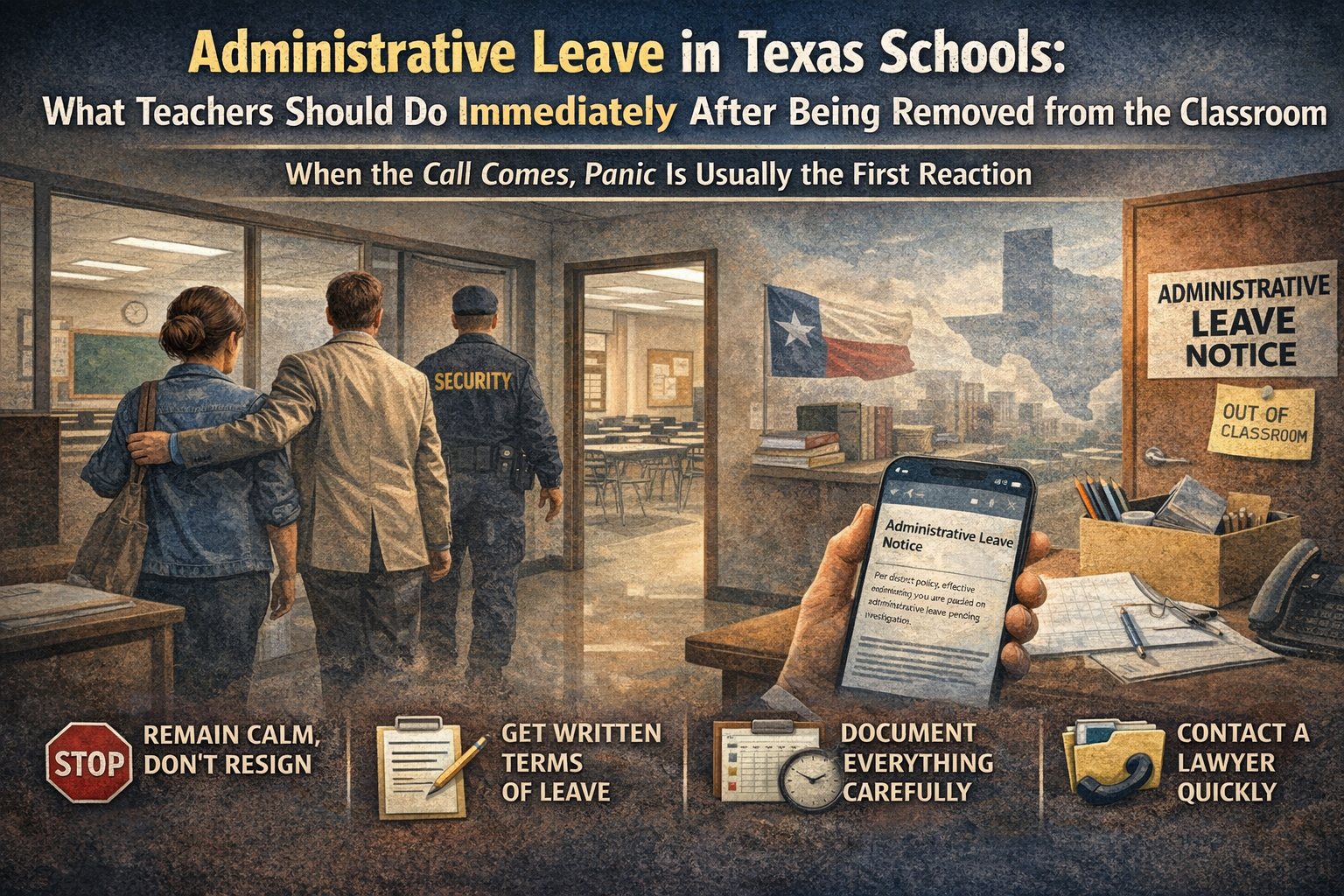
A Calm, Strategic Response Protects More Than Pride
Being removed from the classroom is deeply personal. Teaching is not just a paycheck for most educators. It is identity, purpose, and service. That is why administrative leave can feel humiliating and destabilizing in a way other job disputes may not. Still, the response needs to be guided by strategy, not pride.
The teacher who wants to “fight back” publicly may damage the case. The teacher who wants to resign immediately may give away important rights. The teacher who thinks the matter will disappear on its own may be unprepared when termination arrives. Calm action protects more than pride. It protects options.
At Masterly Legal Solutions, we help teachers move from panic to plan. We understand how fast an employer can shift from investigation to termination, and we understand how much is at stake for employees in texas schools, and our role as an education law attorney for teachers & administrators reflects that focus.
Why Masterly Legal Solutions Is a Strong Resource for Teachers
Our firm understands that school employment problems are not just about policies on paper. They are about real people whose careers, names, finances, and families are on the line. We know how quickly administrative leave can turn into reporting, resignation pressure, or wrongful termination. We also know that teachers need practical guidance, not vague reassurance.
Masterly Legal Solutions helps clients evaluate whether the employer is building toward termination, wrongful discharge, or constructive discharge, often serving as an experienced education lawyer for teachers and schools. We help teachers respond to statements, preserve records, and avoid the kind of panic decisions that can weaken a case. Where appropriate, we also help assess retaliation, discrimination, protected activity, and violation of public policy issues.
Most important, we focus on the teacher’s real interests. That includes current employment, future job opportunities, license protection, benefits, and long-term professional reputation. When the employer is protecting itself, you need someone protecting you.
Contact Masterly Legal Solutions for a Free Consultation
If you have been placed on administrative leave in san antonio texas school districts or anywhere else in texas, do not assume the problem will fix itself. The first steps you take after being removed from the classroom can affect your job, your certificate, your benefits, and your future employment. A rushed resignation, a poorly written statement, or a failure to document key facts can make the situation harder than it needs to be.
Masterly Legal Solutions works with teachers and other employees facing serious workplace problems, including termination risk, wrongful termination claim issues, constructive discharge, forced resignation, retaliation, discrimination, reporting concerns, and other employment disputes. We understand how employers investigate, how school cases can expand quickly, and how important it is to protect your career before the district finalizes its position.
Call (972) 236-5051 for a free consultation. We can explain your options, help you understand your legal rights, and discuss practical next steps designed to protect your interests. When your employer has already started building its case, you deserve a team that is ready to protect yours.
Disclaimer: This article is provided for informational purposes only and is not legal guidance. Reading this article does not create an attorney-client relationship with Masterly Legal Solutions. Every case depends on specific facts, jurisdiction, policy, and timing, so you should seek legal advice about your own situation.





Teacher Rights When Assaulted by a Special Needs Student: Safety, Reporting and Investigation Issues



Looking for Legal & Business Solutions? Contact Us Now
Fill in the form or call us to set up a meeting