Compliance Reports in CPS Investigations and What They Signal About Your Case
When you’re dealing with a CPS investigation, most parents don’t feel like they’re in a “process.” They feel like they’re in survival mode. Your phone rings, someone shows up at your door, and suddenly every decision you make feels like it could affect your child’s future.
In the middle of that pressure, you may hear a phrase that sounds formal, confusing, and honestly intimidating: compliance report. You might wonder why it matters, what it says about you, and whether it’s helping or hurting your case.
At Masterly Legal Solutions, we help families understand what CPS is looking for, what documentation really means, and what actions protect your rights. This article breaks down what compliance reports typically signal in CPS investigations, how they can impact your case, and what you should do next if you feel like your family is being judged on paperwork instead of the truth.
What a Compliance Report Really Means in a CPS Case
A compliance report is a written record that often reflects whether CPS believes certain expectations have been met. In many cases, it ties into services, safety rules, court requirements, or requested steps that CPS wants a parent to follow.
It’s important to understand that a compliance report is not always “final,” and it is not always a complete picture. Sometimes it’s based on limited observations, quick interviews, or incomplete records. But in real-world CPS investigations, the report can influence decisions that affect your home, your parenting time, and your case direction.
Why CPS Uses Compliance Reports During Investigations
CPS is expected to document what they observe and what they believe is happening inside the family system. That documentation becomes a key part of the official record.
During child protective investigations, a compliance reporting process may be used to show what actions CPS requested and how the parent responded. The reporting process is often meant to help create structure for the agency, but it can feel like a checklist being used to measure your family.
The problem is that a case involving real families does not always fit neatly into a form. Parents may be working, caring for children, dealing with stress, or trying to protect themselves legally while still cooperating.
Compliance Reports in CPS Investigations Are Not Just Paperwork
Some parents assume the report is just a note CPS keeps for internal files. But in many CPS investigations, a compliance report becomes part of the foundation for major decisions.
That can include whether CPS believes the child’s safety is at risk, whether a safety plan is needed, or whether the child’s home is “stable” enough for the case to close. It may also affect whether CPS recommends voluntary services or pushes for court involvement.
Even when CPS does not immediately remove a child, documentation can still build a narrative that impacts future steps.
The Difference Between Compliance and “Being a Good Parent”
This is one of the hardest truths for parents to face. CPS may not always measure your parenting in a fair, complete way. Instead, it may measure whether you followed instructions.
A parent can be loving, consistent, and protective, but still get labeled as “non compliant” because they missed a class, disagreed with a recommendation, or asked for legal counsel. That is why compliance status should never be treated as the only measure of what’s truly happening in your family.
Why These Reports Can Move Fast and Still Be Inaccurate
CPS workers often handle multiple cases at once. They are under pressure to document quickly, respond quickly, and meet deadlines. That reality can lead to misunderstandings, oversimplified summaries, and missing details.
A compliance report may rely on data collection that feels incomplete, such as:
- One interview without full context
- Statements from people with bias or conflict
- Limited home observations
- Incomplete service records
- Notes taken during high-stress conversations
Even when CPS intends to be fair, human error can affect the outcome.
What Compliance Reports Commonly Focus On
In most CPS investigations, compliance reports focus on whether you completed requested steps and whether CPS believes those steps reduced risk factors.
A report may address things like cooperation, attendance, communication patterns, and completion of services. It may also reference whether CPS believes there is a continued risk of abuse or neglect.
This can feel frustrating, because families are more complicated than compliance checkboxes. But understanding what the report looks for can help you respond strategically.
Compliance Reports and the CPS Process: Why Timing Matters
The cps process does not always move at the same pace for every family. But many parents don’t realize how much the investigation stage affects how a compliance report is written and interpreted.
Early in an investigation stage, documentation may focus on allegations and first impressions. Later, it may shift toward services and follow-through. That means the same actions could look different depending on when CPS is writing about you.
What a “Good” Compliance Status Might Signal
A positive compliance status usually means CPS believes you are engaging in services and meeting requested expectations. It can also signal that CPS believes you are taking the case seriously and attempting to address safety concerns.
However, even a good compliance status does not automatically mean your case will close quickly. Sometimes the report reads positively, but the agency still continues oversight due to policy, prior history, or unresolved allegations.
What a “Bad” Compliance Status Might Signal
A negative compliance status may signal that CPS believes you failed to complete services, refused to cooperate, or did not follow requested steps. This can increase the risk of escalation, including court involvement.
But a negative compliance status can also reflect confusion, miscommunication, or reasonable resistance. For example, a parent may refuse to sign something because it’s not legally safe to do so without review.
That’s why legal representation is so important. You should not have to choose between protecting your parental rights and being labeled uncooperative.
What CPS Might Consider “Non Compliance Issues”
Non compliance issues can show up in many forms, some serious and some minor. CPS may write negative observations even when the issue is not actually harmful to the child.
Common situations include missed appointments, inconsistent communication, incomplete service participation, or disagreements with requested actions. A parent may also be blamed for things outside their control, like service scheduling delays or limited transportation.
If a report feels unfair, it’s important to address it quickly and with documentation.
Understanding the Reporting Process Behind These Documents
Parents are rarely told how much of the reporting process is influenced by agency procedures. CPS often relies on internal documentation rules, required timelines, and standardized templates.
This is why the report’s content can feel robotic, repetitive, or overly formal. It may not reflect your full story, your child’s needs, or the reality of your home environment.
A strong legal strategy focuses on building your side of the record through evidence, organized facts, and careful communication.
How Data Collection Influences the Story CPS Tells
The compliance reporting process depends heavily on data collection. CPS may gather notes, service updates, witness statements, school records, medical records, and home visit observations.
Even when relevant data exists that supports you, it may not always get included. And if CPS relies on weak data sources, the report can lean in a direction that does not reflect the full truth.
This is why a careful legal approach involves identifying what’s missing and correcting inaccurate impressions early.
What Counts as “Relevant Data” in a CPS Compliance Report
Relevant data in a CPS compliance report can include anything CPS considers connected to the child’s safety, family stability, and protective capacity.
That may include:
- Service attendance records
- Parenting class documentation
- Counseling verification
- Substance testing results
- Medical notes
- School attendance reports
The problem is that relevant data can be interpreted differently depending on the person reviewing it. A missed appointment may be framed as “avoidance” when it was actually a scheduling conflict.
Why Protecting Sensitive Information Matters in Your CPS Case
In today’s world, family information is stored digitally more than ever. Case files, service records, and written notes can be shared across systems and agencies.
That’s why protecting sensitive information matters. Parents should be cautious about what they sign, what they release, and how their private data is handled. In some situations, parents have concerns about data privacy and whether records are being accessed or used appropriately.
In a legal setting, documentation should be handled carefully and strategically.
How Data Privacy Comes Up More Than Parents Expect
Many families do not expect data privacy issues to matter in a CPS case, but they can. Your case may involve records that include medical details, counseling notes, school issues, or mental health history.
Some records may be requested, transferred, or summarized without you fully understanding how they will be used. While CPS is not a private business, systems still involve data protection expectations and confidentiality standards.
A good legal plan includes awareness of how information is shared and how it can affect your case narrative.
Data Protection Laws and How They Connect to Records
Data protection laws exist to regulate how sensitive information is handled, stored, and disclosed. While CPS cases involve agency authority, parents still have legal interests tied to privacy and fairness.
It may also become relevant when records are shared with additional parties or systems. In certain cases, parents worry about data breaches or poor handling of confidential information that gets circulated beyond what feels necessary.
If you suspect errors or improper sharing, it’s worth speaking with an attorney to protect your position.
How Data Privacy Reports Can Show Up Indirectly
Parents sometimes see references that feel unusual, such as reports that mention secure documentation or protected records. Even if you never see a document labeled as “data privacy reports,” the underlying concepts show up when information is gathered and transferred across platforms.
Your case can include highly personal details. That is why it matters to keep your own records organized, accurate, and protected.
Compliance Reports and the Idea of “Ensures Accountability”
In many systems, compliance reports exist because they are supposed to document progress and ensures accountability. The idea is that if CPS asks you to complete a service, the report shows whether you did it and how it impacted safety concerns.
In reality, accountability can feel one-sided. Parents may feel judged without being heard, or pressured to comply without being allowed to question the process.
The key is learning how to protect your rights while still building a strong record.
How Safety Plans Tie Into Compliance Reporting
A safety plan is one of the most important parts of many CPS cases. Sometimes it is voluntary. Sometimes it feels forced. Either way, it often becomes a primary focus of compliance reporting.
CPS may treat the safety plan as a benchmark for whether they believe your child is safe in the child’s home. That can include supervision requirements, restrictions on certain individuals, and rules about where the child can stay.
If a safety plan is unrealistic or unfair, you may be set up to “fail” compliance even when your parenting is appropriate.
When a Safety Plan Can Become a Trap
Some families agree to a safety plan quickly because they feel pressured. They may not fully understand the consequences.
If you violate the plan, even unintentionally, CPS may treat it as proof that you cannot follow instructions. That could lead to increased scrutiny, additional services, or a push toward foster care placement.
Before agreeing to anything that affects your family structure, it’s smart to get legal counsel so you do not sign your rights away under pressure.
What CPS May Look for Regarding the Child’s Safety
Most CPS investigations are framed around one core question: is the child’s safety at risk?
CPS may look at environmental risks, supervision concerns, discipline allegations, household conflict, and risk factors connected to substance use or unsafe individuals. If CPS believes abuse or neglect exists, they may document concerns aggressively.
But not every allegation is accurate, and not every family situation should be treated like an emergency.
Allegations of Abuse or Neglect and Report Language
If the case involves allegations of abuse or neglect, compliance reporting may become more strict and more serious in tone.
The report may include summaries of interviews, concerns about household members, and references to alleged harm. Even if the allegations are unproven, the report may still use language that makes the situation sound settled.
This is one reason families should never assume “the truth will speak for itself.” Documentation must be defended.
Child Abuse Allegations: What Documentation Often Emphasizes
When child abuse allegations are present, documentation often focuses on risk assessment, alleged patterns, and protective steps CPS expects. A compliance report may list services, restrictions, and safety conditions.
Even if the allegation is false or exaggerated, a written narrative can still influence how decision-makers view your case. This can include recommendations about whether the child should remain in the child’s home.
A legal defense strategy must attack inaccurate assumptions early.
Sexual Abuse Allegations and the Importance of Immediate Legal Action
Sexual abuse allegations trigger some of the most intense CPS responses and documentation procedures.
A compliance report in these cases may include strict expectations, emergency protections, and strong wording about risks. Parents should never navigate this alone, because the consequences can include removal, criminal investigations, or long-term limitations on parental rights.
If your case includes allegations of sexual abuse, you should seek legal representation immediately.
The Role of Protective Services in CPS Investigations
Protective services are designed to prevent harm and stabilize families. But in practice, the agency’s approach can feel more like enforcement than help.
CPS protective services may push for programs, monitoring, restrictions, and follow-ups. While services can be helpful, they can also become tools that pressure families into compliance without individualized assessment.
Your goal should be to protect your child and protect your legal standing at the same time.
When Voluntary Services Are Not Truly Voluntary
CPS may offer voluntary services as a way to address concerns without court intervention. In theory, voluntary services allow families to cooperate while staying out of formal litigation.
But many parents feel they do not have a real choice. They fear that saying “no” will be interpreted as refusal and recorded as non compliance issues.
That is why you should speak to an attorney before agreeing to services you do not understand.
How Compliance Reports Can Impact Foster Care Decisions
Foster care is one of the biggest fears parents have in CPS cases. Compliance reports can play a role in whether CPS believes removal is necessary.
If CPS believes the child’s safety cannot be protected in the child’s home, they may recommend removal. If they believe you are not meeting expectations, they may argue that your compliance status reflects ongoing risk.
Even if removal does not happen immediately, these reports can influence future decisions and court actions.
Responsible Parties and Who CPS Holds Accountable
CPS often identifies responsible parties in their documentation, which may include parents, caregivers, household members, or other adults involved in the child’s environment.
Sometimes that identification is fair. Sometimes it’s overly broad or based on assumptions. A parent may be blamed for another adult’s actions simply because they share a residence or relationship.
It’s critical to clarify facts and protect your legal position before you are permanently labeled in the case record.
How Family Members Can Help or Hurt the Case
Family members can be a major part of CPS outcomes. Sometimes CPS asks relatives to supervise, support temporary placement, or provide stability.
Other times, family members become witnesses, reporters, or sources of conflict. Their statements may appear in compliance reports even if they are emotionally biased or motivated by personal disputes.
You should be cautious about what is said and documented, and keep your communications professional.
What a Comprehensive Compliance Report Might Include
A comprehensive compliance report is typically one that includes multiple categories of records, services, and observations. It may include timelines, summaries of interactions, and an overview of whether CPS believes progress is being made.
Some parents assume that “comprehensive” means fair. But it can also mean deeply detailed, and those details can be used to build a case narrative against you.
It’s better to treat the report as evidence that must be reviewed, not as neutral documentation.
What Detailed Compliance Reports Can Reveal
Detailed compliance reports may reveal how CPS views you as a parent, how they interpret your behavior, and whether they believe risks remain.
They can also expose inconsistencies in CPS documentation, missing information, and questionable conclusions. If the report contradicts itself or omits important facts, that can become a key point for your defense.
A good attorney reviews these reports like a blueprint for what CPS plans to argue next.
How “Audit Findings” Language Can Appear in CPS Context
Some compliance documents use language borrowed from other systems, including terms like audit findings. While CPS is not conducting a corporate audit, internal reviews sometimes resemble compliance review structures.
The purpose is to document gaps, failures, or concerns that CPS believes need correction. That can feel harsh, but understanding the language helps you respond effectively.
The goal is not to panic. The goal is to identify what is being claimed and challenge what is inaccurate.
Why Risk Assessment Is a Major Part of CPS Documentation
Risk assessment is often the backbone of CPS decision-making. CPS may document risk factors, safety threats, protective strengths, and whether they believe harm is likely to continue.
In many cases, risk assessment language becomes more important than the actual facts of the home, especially when the caseworker is making quick decisions.
That is why your record matters. Your evidence matters. And your legal strategy matters.
Risk Factors CPS Often Focuses On
Some risk factors show up repeatedly in compliance documentation. These may include household conflict, substance concerns, unsafe supervision, prior CPS history, or unstable housing.
Sometimes those factors are real. Sometimes they are assumed. And sometimes they are completely unrelated to the actual allegation.
If CPS is building a narrative around risk factors that don’t match your reality, you need a legal plan that corrects that record.
Risk Management and What It Means for Families
Risk management may sound like something that belongs in business operations, not family life. But CPS often operates with a risk-management mindset.
They are trained to reduce risk, limit future harm, and document actions taken. That means they may default to cautious decisions even when the situation could be handled with support instead of enforcement.
Understanding CPS risk management helps you anticipate what they might request and how they may document your responses.
What “Compliance Team” Language Can Signal
Sometimes families see references to a compliance team or internal reviewers. This may reflect CPS supervisors, internal reviewers, or those involved in recommending next steps.
These people may never meet you directly, but they can influence decisions about service requirements and case direction. Their view may be shaped entirely by written documentation.
That is why your attorney’s role is to make sure your written record reflects your truth, not just CPS assumptions.
Compliance Managers and How That Concept Relates Here
In business, compliance managers oversee rules and policies. In CPS, similar roles exist in the sense that agency staff may track compliance obligations and whether families follow service plans.
This does not mean your family is a business. But CPS often treats case steps like a system that must be completed.
The danger is that parents may be evaluated on completion instead of on real parenting ability and safety outcomes.
Why “Internal Controls” Concepts Show Up
Internal controls are typically used to reduce human error, track activity, and ensure accuracy in a compliance program. CPS agencies also use internal procedures meant to standardize their work.
However, internal controls do not always prevent mistakes. They can also create rigid checklists that fail to capture reality.
If you feel like your caseworker is treating your life like a form, you’re not imagining it. That’s how many systems operate.
Regulatory Requirements and Why CPS Must Document
CPS is influenced by regulatory requirements, agency rules, and oversight standards. These regulatory requirements often push CPS to document everything they do, everything you do, and every decision they make.
That means documentation may grow quickly, even when the facts are minimal. The agency may focus heavily on paperwork because that’s how they defend their actions later.
Your defense must also be documentation-driven, because written records often matter more than verbal explanations.
Regulatory Bodies and Outside Oversight
There are regulatory bodies that influence how agencies operate, especially regarding standards, timelines, and documentation expectations.
Even when CPS feels like a local issue, the system is shaped by broader accountability structures. That is why caseworkers may follow strict protocols even when families need flexibility.
Knowing this helps you understand why the system can feel rigid, and why legal representation becomes essential for balance.
Regulatory Adherence vs. Real Family Needs
Regulatory adherence may be the agency’s priority, but your child’s well-being and your parental rights are your priorities.
Sometimes CPS actions focus more on satisfying paperwork requirements than on supporting families. This can lead to delayed closure, unnecessary services, or pressure to “comply” with steps that don’t fit your actual situation.
A strong defense brings the focus back to real facts and reasonable solutions.
Organization’s Adherence and How It’s Documented
Terms like organization’s adherence or organization’s compliance status are common in corporate compliance, but similar ideas appear in CPS documentation through compliance posture and compliance status updates.
In other words, CPS documents may measure whether the family is following the system’s rules. But following rules is not the same as proving guilt or proving innocence.
Your attorney helps make sure the narrative stays grounded in evidence, not assumptions.
Compliance Posture and What CPS Might Be Building
Compliance posture is another term from formal compliance systems, but in CPS cases it can mirror how CPS is framing you overall.
Are you seen as cooperative or resistant? Are you seen as safe or risky? Are you viewed as improving or failing to change?
These impressions can become more powerful than the original allegation, especially over time.
Compliance Obligations vs. Your Legal Rights
Families often feel like they must do everything CPS requests. But compliance obligations do not automatically override your rights.
You have the right to understand what is being requested. You have the right to ask questions. You have the right to legal counsel. You have the right to protect yourself from unfair accusations.
The key is responding strategically instead of reacting emotionally under pressure.
Compliance Processes Are Not Always Transparent
Compliance processes in CPS can feel unclear because parents are rarely given full explanations. You might be told to attend services without being told how long, why, or what happens if the service provider reports something inaccurately.
You may also feel like you’re being judged without knowing what standards are being used. That uncertainty increases stress, which can lead to mistakes.
A legal plan helps you make decisions based on clarity, not confusion.
Effective Compliance Reporting and Why It Matters for Your Defense
Effective compliance reporting should provide clear, fair, and accurate documentation. Unfortunately, families often experience the opposite.
For your defense, it matters to create your own effective compliance reporting structure through organized records, proof of attendance, proof of communication, and written notes of interactions.
When CPS reports are vague, your documentation should be specific.
How to Ensure Accuracy in Your Own Records
Parents should take steps to ensure accuracy in everything they can control.
Here are simple habits that help:
- Save every email and message with CPS or service providers
- Keep dates and times of calls and visits
- Request written confirmation of completed services
- Document transportation or scheduling problems
- Write down what was discussed immediately after meetings
This is not paranoia. This is protecting your family.
Reporting Requirements: What Parents Often Miss
Reporting requirements often apply to CPS workers, but they also affect families. Sometimes CPS expects you to submit proof, confirmations, and updates consistently.
If you don’t know what CPS expects, you may accidentally appear unorganized or noncompliant. This is especially true when multiple service providers are involved and communication is scattered.
With legal representation, you can structure your response so it is clean, consistent, and documented.
The Role of Relevant Stakeholders in CPS Cases
In compliance language, relevant stakeholders are the people impacted by the case and involved in decision-making.
In CPS cases, this can include:
- Parents and caregivers
- Children
- CPS workers
- Service providers
- Attorneys and court personnel
- Sometimes schools, doctors, or counselors
The more people involved, the more opportunities for confusion and miscommunication.
What a “Comprehensive Overview” of Your Case Looks Like
A comprehensive overview of your CPS case should show the truth of what happened, not just allegations.
It should reflect real parenting behaviors, child well-being, home safety, and corrective actions if anything needed improvement. It should also include context—because context is often the missing piece in CPS paperwork.
A defense strategy is not just reacting. It’s building a full, credible record.
How the Report’s Content Can Be Misinterpreted
The report’s content may contain phrases that sound factual but are actually opinions or assumptions. Words like “appears,” “seems,” “likely,” and “suggests” can shape a narrative without proving anything.
This matters because the system may treat these statements as if they are confirmed truths.
You should never assume CPS documentation is automatically accurate. It must be reviewed carefully.
Valuable Insights You Can Gain From Reviewing These Reports
Even when a compliance report is frustrating, it can provide valuable insights about CPS expectations and concerns.
It can show:
- What CPS believes the main issue is
- What CPS expects you to complete
- What concerns are being repeated
- What actions CPS may take next
This information can be used to build a smart defense strategy instead of guessing what comes next.
How Risk Managers Think in Compliance Systems
In formal compliance, risk managers focus on limiting exposure and preventing future harm. CPS often follows that same logic.
Even if you believe the risk is low, CPS may overcorrect because their system prioritizes risk avoidance. That means parents may be pressured into services and restrictions even when evidence is limited.
Understanding that risk-management mindset helps you stay calm, strategic, and protected.
Why “Ongoing Process” Language Matters in CPS Cases
Some families believe CPS will show up once, ask questions, and disappear. But CPS often treats the case like an ongoing process until they feel confident the risk is resolved.
That means compliance reporting may continue over time, building a record that grows longer and more influential.
The longer the case lasts, the more important it becomes to avoid mistakes and control your narrative through documentation and legal guidance.
How Business Operations Concepts Can Creep Into Family Cases
You may see terms that sound like business operations language in CPS-related documentation or service programs. That happens because systems often borrow compliance terminology from corporate models.
Parents should not feel dehumanized by this. Your child is not a file, and your home is not a spreadsheet. If, as a parent, you ever face false accusations related to your child's circumstances, consider seeking guidance from a false accusation attorney to protect yourself and your family.
But because CPS systems work the way they work, your best defense is knowing how to respond effectively inside the system.
Financial Compliance Reports and Why They’re Mentioned Sometimes
Financial compliance reports are more common in corporate compliance settings, but sometimes similar concepts show up indirectly in CPS cases.
For example, CPS may want to know whether resources exist for housing stability, child care, or safe living conditions. While this does not mean CPS is auditing you, financial concerns may still affect how they view risk and stability.
If financial stress is being used against you unfairly, an attorney can help you push back.
Operational Compliance Reports and Family Stability
Operational compliance reports usually refer to whether systems are functioning safely and consistently. In CPS cases, “operations” may translate into daily home routines and structure.
CPS may focus on household stability, supervision routines, and whether the child’s home appears safe and consistent. Even when a home is imperfect, that does not mean it is unsafe.
Your defense should separate real safety issues from superficial judgments.
Compliance Initiatives and Why CPS Pushes Programs
CPS often relies on compliance initiatives like parenting education, counseling, anger management, or family support services.
Sometimes these programs help families. Other times they are pushed automatically without individualized need.
If CPS is demanding services that feel unreasonable, legal counsel can help challenge unnecessary requirements and keep your case from dragging out.
Compliance Efforts: What CPS Actually Wants to See
Compliance efforts usually mean consistent follow-through. CPS often wants to see stability, responsiveness, and proof that safety concerns are being addressed.
However, compliance does not mean silence or surrender. You can cooperate while still protecting your rights, and you can comply without admitting guilt.
This balance is what attorneys help families achieve.
The Role of Financial Reporting and Documentation
Financial reporting is not always central in CPS, but it can become part of the file when stability is questioned.
This can involve proof of employment, housing arrangements, or resource planning. CPS may also be looking for whether the family can meet basic needs.
If CPS documentation makes unfair assumptions about your finances, you may need legal support to correct the record.
Regulatory Changes and How They Affect CPS Decision-Making
Regulatory changes can affect how agencies operate, what documentation they require, and how quickly they move.
Parents often don’t realize that agency priorities shift over time depending on training updates, leadership, and enforcement emphasis.
Even when the law is the same, the agency’s behavior may change, which is why families need legal representation that stays focused on protecting parental rights.
When CPS Calls It a “Compliance Program”
Some service plans are structured like a compliance program, where parents are expected to complete steps in a specific order.
The risk is that the plan becomes the center of the case instead of the actual facts. A parent can become trapped in endless requirements that don’t match the original allegation.
A strong defense helps keep the case tied to facts and fairness.
When the Compliance Reporting Process Creates Pressure
Parents often feel like they’re being watched, measured, and judged nonstop. That pressure can make good parents look nervous, defensive, or overwhelmed.
CPS may misread stress as guilt. But stress is normal when someone is investigating your family.
Your goal should be calm documentation, respectful communication, and legal guidance that prevents mistakes.
Why Legal Representation Changes the Entire Dynamic
Legal representation is not just for court. It is protection during every stage of the CPS process.
When you have an attorney:
- Your communication becomes structured and safer
- You avoid accidental admissions
- You stop guessing what CPS wants
- You can challenge unfair documentation
- You protect your parental rights proactively
At Masterly Legal Solutions, we know how fast CPS narratives can form, and we know how to confront them strategically.
How Legal Counsel Helps You Respond Without Panic
When parents try to handle CPS alone, fear often drives decisions. Fear leads to over-sharing, signing documents too quickly, and agreeing to requirements without understanding consequences.
Legal counsel helps you slow down and respond intelligently. You don’t need to fight CPS aggressively, but you do need to protect your position.
The goal is to keep your child safe while also defending your future.
What Sarbanes Oxley Act Teaches About Compliance Thinking
You might wonder why the sarbanes oxley act ever comes up in discussions about compliance. It’s a corporate law, not a family law issue.
But it matters because it highlights how systems use internal controls, reporting standards, and documentation to prevent wrongdoing. CPS systems are not the same, but they often operate with similar logic: document everything, track compliance, and reduce risk.
Understanding that mindset helps families see why CPS paperwork can feel so strict and procedural.
Family and Community Resources Can Strengthen Your Case
CPS sometimes looks at whether families have support systems in place. Family and community resources may help demonstrate stability and protective capacity.
Community resources may include counseling programs, parenting support groups, childcare assistance, and family-based support networks. When these supports exist, it can reduce CPS fears about isolation or instability.
However, support should never become a reason for CPS to overreach. The goal is to strengthen families, not control them.
Community Resources That Help Without Increasing Risk
Parents often fear that getting help will “look bad.” But responsible use of community resources can show maturity and strength.
Examples include:
- Parent coaching or education programs
- Mental health counseling when appropriate
- Family support services through approved providers
- Faith-based or community-based parenting programs
When handled properly, these resources can protect your family rather than harm your case.
What Happens When CPS Starts Focusing on “Compliance Status” More Than Safety
One of the biggest frustrations families experience is when CPS seems more focused on compliance status than the child’s safety.
Parents may do everything right, but still feel like the case continues because CPS wants “more proof.” That’s when the process becomes exhausting and unfair.
Legal representation helps force the conversation back to actual evidence and reasonable standards.
Masterly Legal Solutions: Protecting Families When Documentation Becomes the Battlefield
At Masterly Legal Solutions, we know that CPS cases often turn into battles over paperwork, timelines, and impressions. Compliance reporting can be used to support families, but it can also be used to pressure them.
If you feel like your case is being shaped by incomplete records, unfair assumptions, or confusing expectations, you do not have to handle it alone.
Your family deserves a defense that is calm, strategic, and focused on keeping your child safe while protecting your rights.
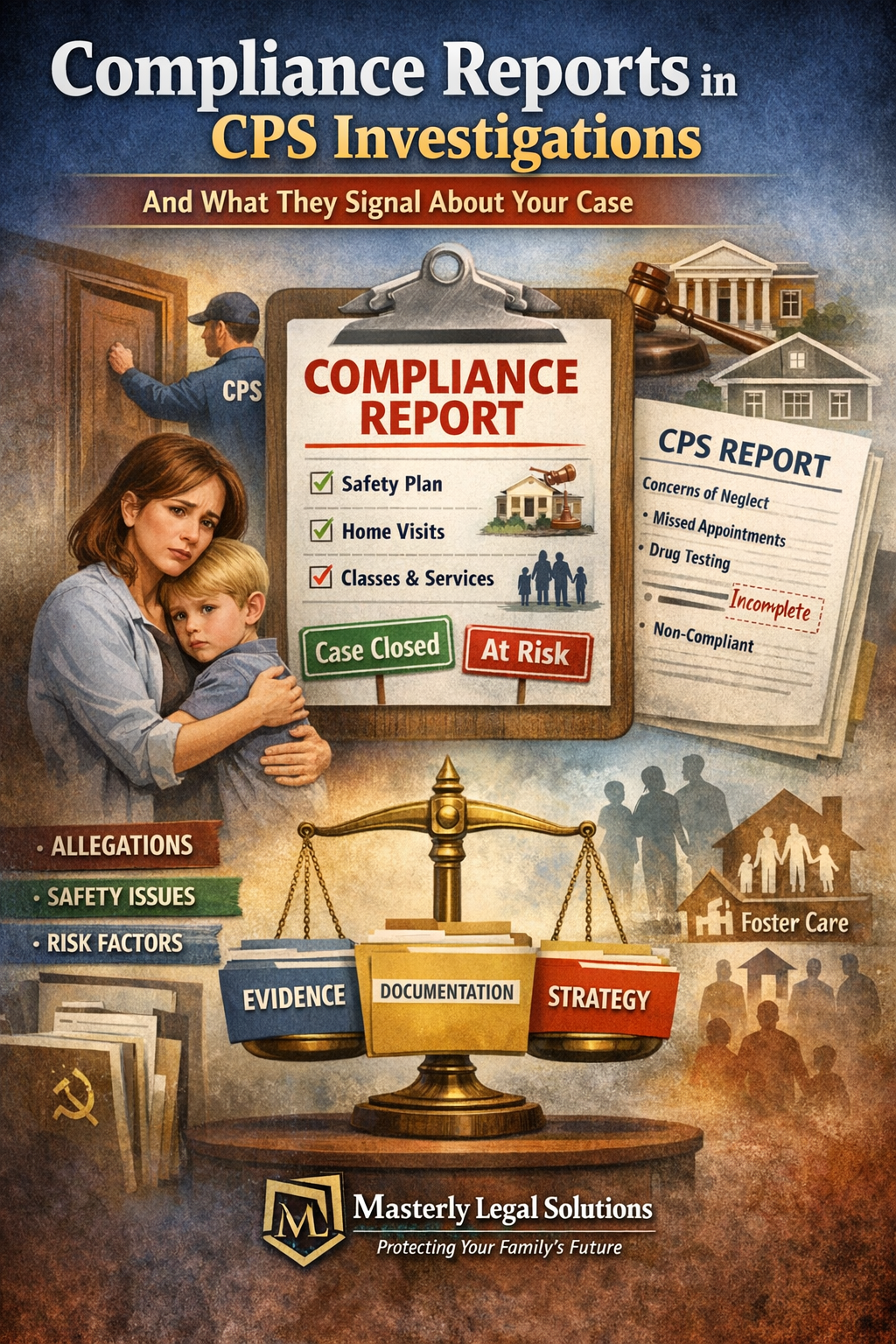
How Child Protective Services Approaches Compliance Documentation
Child protective services often relies on written records to track concerns, services, and decisions throughout a case. In many investigations, these documents are used to show what CPS requested, what actions were taken, and whether the agency believes safety concerns remain. Because the case file can influence next steps, it’s important to treat every interaction as something that may be documented. When child protective services cps is involved, even small misunderstandings can be recorded in a way that changes how your situation is viewed. That is why families benefit from responding calmly, keeping proof of follow-through, and getting legal guidance early so the written record reflects the full story.
What Your “Organization’s Compliance Posture” Signals in a CPS Case
In a CPS context, an organization’s compliance posture can describe how the agency views your overall willingness and ability to meet expectations, follow service plans, and address the concerns they listed. While your family is not a business, CPS documentation can still frame you as either “stable and responsive” or “resistant and high risk,” and that tone can shape the case trajectory. This is where significant issues may appear in writing even when they are based on assumptions or incomplete conversations. A strong legal strategy focuses on correcting the record and making sure your side is supported by documents, timelines, and credible evidence.
Why Data Security Matters When Your Family’s Records Are Shared
Data security is a real concern in CPS cases because case files can include highly personal information about your household, medical history, counseling, and child-related records. Families often don’t realize how many systems and vendors may be involved, and how quickly information can move between various departments and outside providers. When records are mishandled, the risk of errors increases, and sensitive information may be exposed or misunderstood. Protecting your information means being careful about what you sign, keeping copies of what you submit, and asking questions when disclosures seem broader than necessary.
How Case Information Moves Through Various Departments
During a CPS matter, information is rarely kept with one person. Notes, reports, and updates may circulate through various departments, including supervisors, legal teams, contracted service providers, and court-related personnel. This can create gaps in understanding, because someone making a recommendation may rely only on written summaries instead of hearing your full explanation. When documentation gets repeated without context, mistakes can harden into “facts” in the case narrative. This is why organized records and attorney-guided communication can help prevent misunderstandings from spreading across the system.
Investor Confidence and the System’s Pressure to Document Everything
In corporate compliance, investor confidence depends on clear reporting and risk controls, and that same mindset—proving accountability through paperwork—can influence how agencies document CPS cases. CPS systems are often built to show oversight, prove actions were taken, and justify decisions in a way that can withstand scrutiny. The result is that documentation may grow quickly, and families can feel like they’re being evaluated on forms rather than real parenting. Understanding this pressure helps you stay focused on what matters: building a clear record that demonstrates safety, stability, and responsible decision-making.
Contact Masterly Legal Solutions for a Free Consultation
If you’re facing CPS investigations and you’re worried about what a compliance report says—or what it might say next—now is the time to get answers before small issues become big consequences. You deserve to understand your options, your risks, and how to protect your child’s home without falling into traps that can damage your case.
At Masterly Legal Solutions, we offer a free consultation to help you make sense of what CPS is documenting, what your compliance status may signal, and what steps can strengthen your position moving forward. Whether you’re dealing with abuse or neglect allegations, a safety plan dispute, or confusing reporting requirements, we’re here to help you respond the right way—not the rushed way.
Call (972) 236-5051 for a free consultation today.
Disclaimer: This article is for educational purposes only and does not constitute legal advice or legal guidance. Every CPS case is different, and you should speak with a qualified attorney about your specific situation.
Teacher Rights When Assaulted by a Special Needs Student: Safety, Reporting and Investigation Issues

Looking for Legal & Business Solutions? Contact Us Now
Fill in the form or call us to set up a meeting