
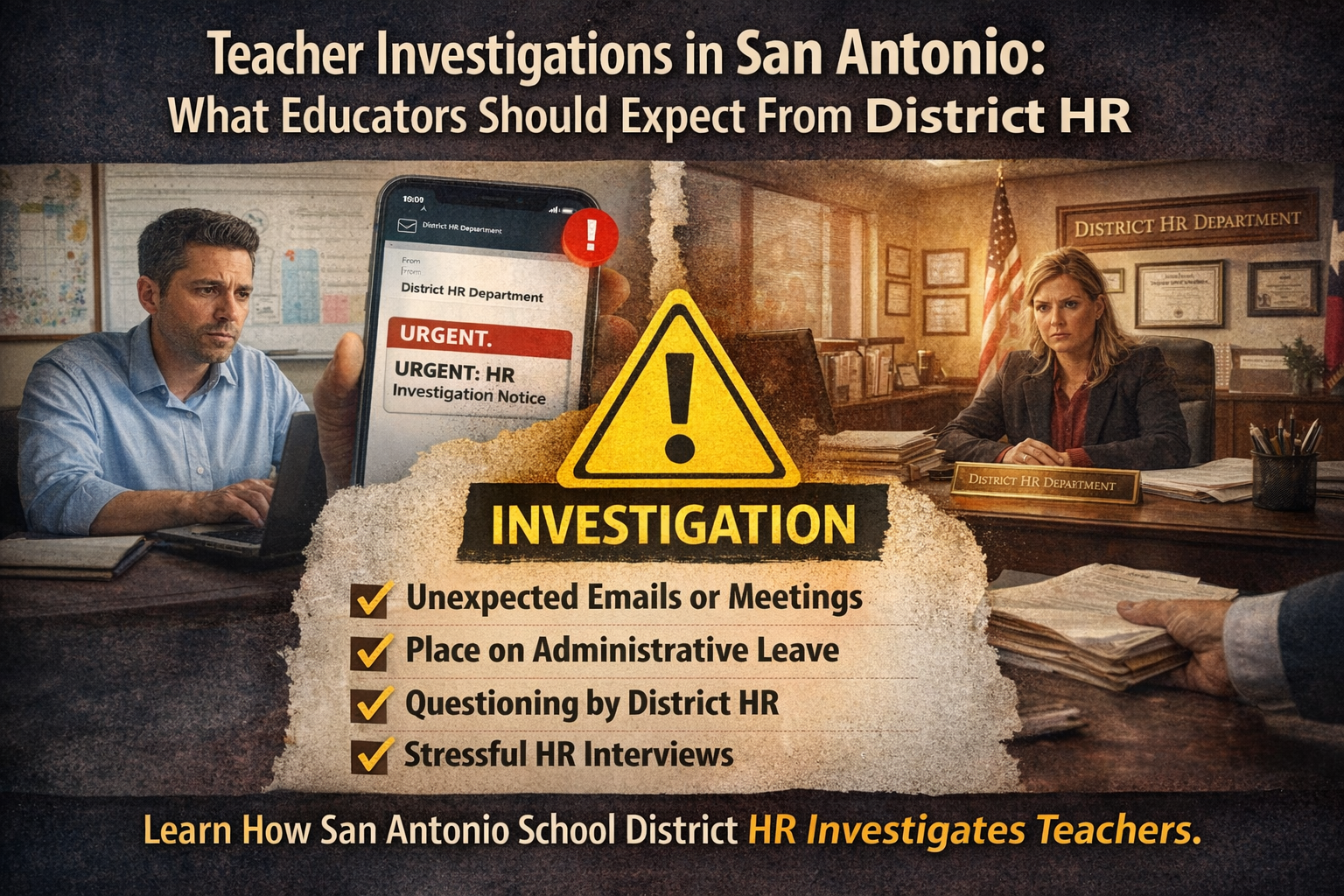
Teacher Investigations in San Antonio: What Educators Should Expect From District HR
The moment a teacher gets an unexpected email from human resources, most don’t think “investigation” right away. They think it’s a paperwork issue, a routine meeting, or maybe a minor complaint that will be cleared up quickly. But in real life, teacher investigations can shift rapidly—especially inside san antonio texas school districts, where district HR teams are trained to document, manage risk, and act fast when concerns are raised.
What makes these situations so difficult is that the early stage can feel quiet and confusing. You may be told to “just answer a few questions,” or you may be placed on administrative leave without a clear explanation. Even when you believe you did nothing wrong, the process can still threaten your employee's current position, your reputation, and even your future as an educator.
At Masterly Legal Solutions, we represent teachers facing district-level investigations and professional consequences. Our approach is calm, strategic, and investigation-focused. We guide educators through the reality of how HR investigations work, what risks to avoid, and what to do next to protect your rights, your income, and your professional future.
This article explains what educators should expect when HR gets involved, how administrative leave is used, and how these cases can lead to constructive discharge, wrongful discharge, or even wrongful termination if you don’t respond carefully.
The Truth About District HR Investigations in Education
In many districts, HR investigations are structured to protect the organization first. That does not automatically mean the district is unfair, but it does mean the process is rarely designed to protect the teacher’s side of the story. HR’s job often centers on personnel management, internal risk handling, and responding to complaints quickly.
Once a concern is filed, HR may begin internal reviews, request documentation, and interview other employees who were present. Your words, tone, and timing matter more than most educators realize. The investigation is not just about what happened—it is often about whether the district believes it has enough justification to act.
When HR starts documenting concerns, the teacher’s career can become vulnerable within days.
How Administrative Leave Becomes the First Big Warning Sign
For many educators, the first real “wake-up call” is being placed on administrative leave. Some districts use administrative leave as a neutral pause. Others use it as a strategic way to isolate the teacher and control the narrative.
Being placed on administrative leave can feel humiliating and sudden. Teachers often wonder if it means they are guilty or if they are about to be fired. The truth is that administrative leave is commonly used to manage internal exposure while the district investigates allegations.
Even if administrative leave is presented as standard practice, it is still a serious employment event that deserves immediate attention.
Paid Administrative Leave vs. Unpaid Administrative Leave
Teachers may be placed on paid administrative leave, placed on paid leave, or temporarily removed without full clarity about pay status. Schools sometimes describe it as an “investigative pause” or “temporary reassignment,” but the consequences can still be significant.
Paid administrative leave is often used to reduce conflict and protect workplace safety during a complaint review. But even when it is paid, it can still damage credibility and lead to long-term employment decisions. In other cases, leave may be reduced, restricted, or reclassified as “notice leave” depending on agency policies.
Whether paid or unpaid, administrative leave is not a break—it’s a legal and professional risk period.
Investigative Leave: What It Really Means for Teachers
Some districts use the phrase investigative leave instead of administrative leave. This may sound less severe, but the effect is usually the same. It means the employer has triggered a formal process to review alleged misconduct.
Investigative leave can be described as time limited, short term, or on a time limited basis, but it can still last longer than expected. Teachers may be kept on leave for brief periods or extended into multiple brief or short periods, depending on circumstances.
If you’re on investigative leave, you should assume the district is building a record that could support disciplinary action.
The District’s Mission: How HR Frames Investigations
Every school district has an agency's mission of student safety, accountability, and compliance. HR investigations are often framed as necessary to protect students and school environments. That framing can make teachers feel like they are being treated as a threat even when the complaint is minor.
HR may argue that administrative leave is required to protect students and maintain stability. They may also claim the action is consistent with internal policies meant to ensure fairness. But the teacher’s rights still matter, and the law still applies.
Understanding the district’s mission helps teachers recognize the system’s priorities—and respond intelligently.
What Triggers Teacher Investigations in San Antonio Texas School Districts
Teacher investigations are triggered in many ways, not only by serious allegations. A misunderstanding, a classroom incident, a student accusation, or a report from a co worker can trigger HR review. Sometimes the complaint is legitimate. Other times it is exaggerated, mistaken, or retaliatory.
Common triggers include:
- Allegations related to sexual harassment
- Claims of discrimination or unequal treatment
- Reports of classroom behavior or discipline concerns
- Accusations involving child abuse or suspected abuse
- Reports involving abuse or neglect concerns
- Complaints linked to workplace conflict or policy violations
Even when the teacher is innocent, the district may still treat the situation as high risk to protect itself.
Alleged Misconduct: The Words That Change Everything
The phrase alleged misconduct is often the turning point. Once HR uses that language, the district is no longer “checking in.” It is building a case file.
Alleged misconduct can include policy violations, professional conduct complaints, boundary concerns, or student contact issues. Even if the district later clears you, the investigation record can still follow you internally—and in some cases, you may be placed on administrative leave during the process.
Teachers should never treat alleged misconduct allegations as casual. They should be taken seriously, responded to carefully, and handled with legal counsel.
The Role of Agency Officials and Authorized Agency Officials
In some district investigations, decisions don’t come only from your campus principal. HR may coordinate with agency officials, district leadership, or authorized agency officials. In certain cases, other authorized agency officials may review or approve administrative actions.
This matters because the person making the final decision may never meet you. They may rely on documents, summaries, and internal reports. That is why your written communications and documented response are critical.
When agency officials are involved, the process becomes more formal and less flexible.
The Agency Head and the Power Behind Personnel Decisions
In district structures, the agency head (or the person acting in that role) may have the authority to approve leave, discipline, or termination recommendations. HR may claim the agency head must approve key steps, especially when legal exposure is involved.
Teachers should understand that these cases may involve “agency judgments” that prioritize institutional safety over individual fairness. Even when a teacher believes the complaint is weak, a cautious agency head may still push for discipline.
That is why strong evidence and careful strategy matter early.
Grant Administrative Leave: How Districts Make That Decision
When a district chooses to grant administrative leave, it usually happens because HR believes removing the teacher reduces risk. Sometimes this is reasonable. Sometimes it is a defensive move.
HR might say the leave is not disciplinary, but it often becomes part of the documentation used later. In many situations, grant administrative leave decisions are made rapidly and based on limited information.
A teacher should never assume administrative leave is harmless just because pay continues.
Administrative Leave Often Comes With Silence and Confusion
One of the most stressful parts of administrative leave is the lack of information. Teachers are often told not to contact students, not to discuss the case, and not to return to campus. That silence can feel like punishment.
Some educators feel pressure to resign simply to stop the stress and embarrassment. That is exactly how constructive discharge begins. When the working conditions are manipulated to push a reasonable employee into quitting, the district may later treat the resignation as voluntary—even if it wasn’t truly a choice.
Administrative leave can create emotional distress, isolation, and fear, especially when your career is on the line.
Notice Leave and Communication Restrictions
Some districts use the term notice leave to describe the period when an employee is notified of the investigation and removed from campus access. This may overlap with administrative leave or investigative leave.
The teacher may be directed to communicate only through HR or only through a supervisor. They may also be told to avoid speaking to other employees, which can make the teacher feel powerless.
Notice leave practices are often tied to agency policies and internal policies meant to control information flow. But teachers still have rights, and they should protect themselves immediately.
Excused Absence, Safety Leave, and “Officially Sponsored” Time Away
Some leave categories get confused in school employment systems. A teacher may be told they are on an excused absence, placed on safety leave, or placed on administrative leave that is described as officially sponsored time away.
In federal employment contexts, categories exist for things like blood donations or officially sponsored activities. But teacher investigations aren’t about those categories, even if the paperwork language seems similar.
The key is not the label—it’s the impact. If you’re removed from duty pending investigation, your employment status is at risk and must be treated seriously.
Working Conditions That Push Teachers Toward Resignation
A major risk in district investigations is when the district creates working conditions that become unbearable. This can include isolation, intimidation, threats of discipline, or repeated administrative leave actions that destroy the teacher’s confidence.
If conditions become extreme, teachers may experience an intolerable working conditions scenario. That can rise to an intolerable work environment, especially when the teacher is treated unfairly compared to other employees.
This is where constructive discharge becomes a legal issue, not just a workplace problem.
Constructive Discharge: When “Quitting” Isn’t Really a Choice
Constructive discharge happens when an employee resigns because the environment is so unreasonable that a reasonable person would feel forced to leave. Teachers often describe it as being “pushed out” without being officially fired.
Constructive discharge can be tied to humiliating administrative leave announcements, loss of duties, constant scrutiny, or misleading threats. It can also happen when a district offers “resign or be terminated” choices with little time to respond.
When constructive discharge occurs, the resignation may be treated as constructive termination or constructive dismissal. Those distinctions matter if you later consider a legal claim.
Constructive Dismissal and Constructive Termination Explained Simply
Teachers hear many legal terms during investigations. Constructive dismissal and constructive termination both refer to the idea that the teacher was effectively forced out, even without a formal termination letter.
In practical terms, this might look like a teacher being placed on administrative leave repeatedly, losing access to their role, or being told there is no path back. It can also involve a hostile work environment where the teacher is targeted by a supervisor or HR.
If an employee's resignation is driven by pressure, intimidation, or unfair treatment, the teacher may have grounds to discuss constructive discharge options.
Wrongful Termination and the Most Common Misunderstanding Teachers Have
Many teachers believe wrongful termination only means being fired without a reason. In reality, wrongful termination is more complex.
Texas is generally an at will employment state, meaning employers often have broad power to terminate. But at will employment laws do not allow termination for illegal reasons. If termination violates state law, public policy, or anti-discrimination protections, wrongful termination may apply.
Teachers may also face wrongful discharge actions disguised as resignations or “non-renewals,” in which case experienced education law attorneys can provide essential support.
Wrongful Termination Claim: When It Becomes a Real Option
A wrongful termination claim can arise when the district terminates employment in a way that violates legal standards, district policy obligations, or public protections.
Examples may include termination tied to discrimination, retaliation, or refusal to participate in wrongdoing. A wrongful termination claim may also apply when the district violates procedural rights or fails to issue internal policies consistent with required standards.
Wrongful termination cases depend heavily on documentation, timelines, and the legal structure surrounding employment decisions.
Wrongful Discharge in School Employment Settings
Wrongful discharge is often used to describe unfair termination or forced resignation scenarios, including constructive discharge. It can include retaliation-based discharge, discriminatory discharge, or termination tied to improper motives.
Teachers sometimes don’t realize they have a wrongful discharge situation because HR frames the separation as voluntary. That is why it is important to consult an experienced attorney before signing any resignation paperwork.
Wrongful discharge can also involve damages claims, including punitive damages in certain legal contexts.
Employment Discrimination and Workplace Discrimination in Teacher Investigations
Some teacher investigations are fueled by conflicts that have nothing to do with student safety. They may be rooted in employment discrimination or workplace discrimination, including unequal treatment, biased discipline, or selective enforcement of policy.
Discrimination can be based on protected characteristics or retaliation patterns. Teachers may notice that other employees are treated differently for similar conduct.
Employment discrimination often overlaps with hostile work environment claims, particularly if the teacher is repeatedly targeted by HR, a supervisor, or leadership.
Hostile Work Environment and the Role of HR
A hostile work environment can develop when ongoing harassment, bias, or intimidation makes the workplace unsafe emotionally or professionally. During investigations, teachers may feel the environment shift dramatically, especially after being placed on administrative leave.
HR may claim the investigation is neutral, but the teacher may experience blame, gossip, and isolation. This is especially painful in education settings where reputation is everything.
A hostile work environment can also support constructive discharge claims when the situation becomes intolerable.
Illegal Reasons for Termination and What Teachers Should Watch For
Even in at will employment states, employers cannot terminate for illegal reasons.
Warning signs include:
- Sudden discipline after reporting misconduct
- Retaliation after requesting reasonable accommodations
- Disparate treatment compared to other employees
- Termination tied to protected rights or complaints
- Pressure to resign after reporting safety concerns
If you suspect illegal reasons are influencing decisions, you should seek legal counsel immediately.
Public Policy Issues That Appear in Teacher Wrongful Termination Cases
Texas recognizes certain public policy protections that limit employer actions. While at will employment is broad, there are still situations where termination is unlawful due to public policy restrictions.
Public policy may apply if the district punishes a teacher for refusing to engage in illegal conduct or for reporting violations in good faith. Teacher investigations can become political and complicated, especially when a district wants to eliminate a “problem employee” quietly.
Public policy arguments often appear in wrongful termination cases and should be evaluated carefully with counsel.
Agency Policies, Internal Policies, and Internal Reviews
District HR investigations are shaped by agency policies and internal policies. The district may claim it must follow policies to ensure consistent outcomes.
But internal policies are not always applied equally. Sometimes internal reviews are rushed or influenced by leadership pressure.
Teachers should assume that HR is building a file that can justify disciplinary action. Even if HR says it’s “just an internal review,” the consequences can still be serious.
Administrative Leave Can Lead to Disciplinary Action Faster Than Expected
Many teachers assume administrative leave is a pause. But administrative leave often becomes the bridge to discipline.
Disciplinary action can include written reprimands, reassignment, contract non-renewal, or termination. HR may claim that administrative leave is not discipline, but the investigation record often supports discipline later.
The best protection is early strategy, early documentation, and strong legal guidance before the district locks in its narrative.
The Employer’s Goal vs. the Employee’s Reality
In investigations, the employer often wants to resolve matters quickly, reduce risk, and protect the district’s image. The employee wants fairness, due process, and a chance to continue teaching.
That tension is why these cases become so stressful. Teachers are not just defending a single event—they are defending their entire professional identity.
Your employer may not act maliciously, but HR decisions are often designed to protect the system, not the teacher.
Performance Issues and How They Get Used During Investigations
Sometimes HR investigations expand beyond the original allegation and start including performance issues. This can happen even when performance was not previously questioned.
HR might bring up classroom management concerns, documentation gaps, or evaluation feedback. This can be used to justify administrative leave extensions or support future termination.
Teachers should treat performance issues as potential legal evidence, not casual criticism.
The “Reasonable Employee” Standard and How It Affects These Cases
In many employment disputes, the behavior of a reasonable employee becomes part of the discussion. HR may argue that their actions were reasonable and that the teacher should have complied without conflict.
But teachers must also be treated fairly. If the district creates an environment that a reasonable person would find intolerable, the teacher may have constructive discharge arguments.
The question often becomes whether a reasonable person would feel forced to resign, or whether the teacher had realistic options.
The Reasonable Person Standard in Constructive Discharge Claims
A constructive discharge analysis often considers whether a reasonable person would have stayed or left under the same conditions.
Teachers often endure more pressure than most professionals because they fear losing certification, reputation, and future employment. HR and supervisors may exploit that vulnerability by creating high pressure and short deadlines.
If the district’s actions made staying unrealistic, constructive discharge could become part of the legal discussion.
Former Employer Issues: When Separation Doesn’t End the Damage
Even after a teacher leaves, a former employer can continue affecting the teacher’s career through references, documentation, and internal records.
Teachers may struggle to get hired elsewhere if the investigation remains unresolved. They may also face ongoing consequences if the district reports findings to outside entities.
That is why leaving quietly is not always the safest option. Separation should be strategic, not reactive.
Agency Determines Outcomes Using Agency Judgments
In teacher investigations, the district often acts like a decision-maker rather than a neutral observer. HR may make “agency judgments” about credibility, risk, and what the district believes happened.
Sometimes those judgments are fair. Sometimes they are based on incomplete facts, flawed interviews, or biased reporting. Agency determines outcomes by interpreting behavior through policy lenses, not through personal understanding.
This is why your documentation and representation matter.
Other Provision, Specifically Authorized, and the Paperwork Language Trap
District documentation can include legal-sounding language such as “other provision,” “specifically authorized,” or “policy authorized.” Teachers may feel intimidated by these terms.
Some terms come from broader employment systems, such as OPM regulations or opm guidance in federal contexts. They may also reference executive order language, presidential memorandum, or presidential directive structures in template form.
But for teachers, what matters is the district’s authority under law and policy, not scary wording. Do not sign anything without understanding consequences.
United States Code, State Law, and Employment Rules Teachers Overlook
Some investigations include references to compliance concepts such as United States Code, immigration law, or reporting requirements. This may come up in rare situations involving workplace verification or improper hiring conduct.
For example, allegations involving employing undocumented workers or undocumented workers can trigger serious investigation concerns in some environments. While teachers are not typically hiring employees, these issues may arise in district-level audits or departmental scrutiny.
When state law and district policy overlap, investigations become complex quickly.
Employing Undocumented Workers: A Rare but Serious District Concern
In certain cases, investigations may involve allegations about employing undocumented workers or improper staff verification processes. These claims can involve high-level HR reviews and expanded scrutiny.
Even if a teacher is not responsible, involvement in such investigations can create collateral damage and reputational harm. HR may become highly risk-averse and extend administrative leave or restrictions.
If you are pulled into an investigation involving these issues, legal counsel should be involved immediately.
Workplace Safety in School District Investigations
Districts often justify administrative leave by referencing workplace safety. They may claim the teacher’s presence could create conflict or exposure.
This can happen even when there was no real threat. It may also be used when the district wants to “cool down” a situation.
Workplace safety arguments can be legitimate, but they can also be used as a shield for unfair actions. A careful defense strategy challenges misuse without escalating tension unnecessarily.
Short Periods, Brief Periods, and Leave Extensions
Teachers are often told leave will last only a few days or “brief periods.” But investigations frequently expand.
Administrative leave may be extended into short periods repeatedly, leaving the teacher in limbo. This can create financial anxiety, reputation concerns, and emotional distress.
If administrative leave becomes indefinite, the risk of constructive discharge increases significantly.
Calendar Year Timing and How Districts Manage Investigations
Some investigations stretch across the school calendar year or fiscal periods. Districts may delay resolution to avoid disruption, manage staffing, or reduce conflict.
Teachers may feel trapped because they cannot plan their future or protect their employee's current position. The longer the timeline, the more opportunities for record-building against the teacher.
Early legal representation prevents the case from becoming an open-ended problem.
Supervisor Influence and the Risk of Internal Bias
A teacher’s supervisor may influence the direction of an investigation by framing facts, reporting concerns, or recommending discipline.
If a supervisor has conflict with the teacher, the investigation can become unfair quickly. Teachers may feel targeted, misunderstood, or punished for normal classroom challenges.
When supervisor bias exists, legal representation helps re-center the case on facts, evidence, and fair procedure.
Strong Evidence: What Teachers Should Start Collecting Immediately
Teachers should not wait until the final decision to gather support. Strong evidence is most effective when collected early.
Helpful evidence may include:
- Emails and communications with HR or supervisors
- Timeline notes of key events
- Witness statements from community members or staff
- Documentation showing compliance with policy
- Student performance and classroom records when appropriate
Strong evidence prevents HR from controlling the story through selective documentation.
Court-Like Pressure Without a Courtroom
Many educators say HR investigations feel like being “on trial” without a judge. That’s because district HR processes can be highly formal, even when there is no court.
Teachers may be questioned, evaluated, and removed from work through administrative leave procedures. The stakes feel massive, and the teacher often feels alone.
The best way to survive this process is not panic—it’s preparation and professional guidance.
How Masterly Legal Solutions Helps Teachers Respond Strategically
At Masterly Legal Solutions, we help teachers navigate investigations with professionalism and clarity. We understand that your career, reputation, and financial stability matter, and we treat your situation with urgency and respect.
We do not push fear-driven tactics. We focus on investigation strategy, documentation discipline, and protecting the teacher’s legal position. Whether you’re placed on administrative leave, threatened with termination, or pressured toward resignation, we help you respond in a way that protects your future.
If you believe you are being pushed out, targeted unfairly, or facing wrongful termination risks, we are ready to help you take control of your case.
Contact Masterly Legal Solutions for a Free Consultation
Teacher investigations can move quickly, especially inside san antonio texas school districts, where district HR teams may place educators on administrative leave before they fully understand what’s happening. If you’re on investigative leave, facing pressure to resign, or worried your situation could turn into constructive discharge or wrongful termination, this is not the time to “wait it out.” The decisions you make early can shape how your employer documents your case and whether your employee's current position can be protected.
At Masterly Legal Solutions, we help teachers respond strategically, protect their rights, and avoid avoidable damage to their careers. If you need clarity about what HR is doing, what options you have, or whether you may have a wrongful termination claim, we invite you to contact us right away for a free consultation.
Call (972) 236-5051 for a free consultation today.
Disclaimer: This article is for educational purposes only and does not constitute legal advice or legal guidance. Every employment investigation is different, and you should speak with a qualified attorney about your specific situation.




Teacher Rights When Assaulted by a Special Needs Student: Safety, Reporting and Investigation Issues



Looking for Legal & Business Solutions? Contact Us Now
Fill in the form or call us to set up a meeting