

How CPS Investigations Quietly Reshape Family Rights Before Court Is Ever Involved
The first time a CPS worker calls or shows up at your door, most parents assume it is only a “quick check” before everything returns to normal. You may believe that if you cooperate, answer questions, and show that your child is safe, the situation will end quietly. But many families discover something surprising: the most serious changes to family life can happen long before a judge ever reviews the situation.
In many cases, a CPS investigation creates immediate pressure that reshapes daily routines, limits choices, and alters access between a child and their parents. These early decisions can feel informal, but they often carry real weight. For many families, the hardest part is realizing that their parental rights may be affected even when “court” has not been mentioned.
At Masterly Legal Solutions, we help parents understand what is happening behind the scenes and why early decisions matter. This article explains the quiet administrative power of child protective services, the role of safety plans, and how restrictions can be introduced early. If you are facing an investigation, understanding these steps may help you protect your family before the situation grows.
What CPS Investigations Really Are Before Court Happens
Many people assume CPS only steps in once a court case has started. In reality, the system is built so that protective services can begin acting immediately, often based on a report alone. That means the process can reshape your family life before any formal legal process begins.
A CPS investigation generally begins when the agency receives a report of suspected child abuse or neglect. Sometimes the report comes from a neighbor, a school, or a medical provider. Sometimes it comes from a family dispute where emotions are high and facts are unclear.
Once the agency initiates contact, the rules are not always explained clearly. Many parents cooperate in good faith because they believe cooperation is the fastest path to resolution. But early cooperation can also lead to unexpected restrictions, misunderstandings, and new obligations.
Understanding the Administrative Power Behind CPS Actions
One of the most overlooked parts of child protective services cps involvement is the administrative power they hold. This is not the same as a judge’s power, but it still has real effects on family decisions. These actions can shape outcomes even before a court case is filed.
Administrative power includes the ability to conduct interviews, request home access, demand documentation, and create “voluntary” agreements. It also includes the ability to open a case under the agency’s internal jurisdiction and keep it active for weeks or months. Even without court involvement, these actions influence what happens to the child, the parents, and any involved family member.
Many parents don’t realize that an “informal” process can become a permanent record. This record can follow your family into future custody matters, adoption decisions, or other social services interactions. That is why early strategy is essential.
How a Report Can Trigger Immediate Change in a Family’s Life
A single report may be enough to start a CPS response. It can be based on partial information, misinterpretation, or a misunderstanding of a parenting decision. Even if the report is inaccurate, CPS may still open an investigation and begin investigating immediately.
It is common for CPS to respond quickly because they are trained to identify possible danger and reduce risk. From a parent’s perspective, it can feel sudden and unfair. You may feel like your family is being judged by someone who has not heard your full story.
During these early moments, the agency’s focus is often on preventing risk, not on proving guilt beyond doubt. That difference matters because it explains why restrictions can appear quickly. The goal of the system is to protect children, but parents can feel punished before the facts are verified.
Why “Voluntary” Agreements Often Do Not Feel Voluntary
CPS may propose a “voluntary” plan and present it as the easiest way to keep the child at home. But many parents feel they have no choice. The reality is that the pressure of the situation can make a voluntary agreement feel like a requirement.
Families often fear that refusing a plan will lead to removal or escalation. CPS workers may describe the plan as a way to avoid court. That creates a strong incentive to sign quickly, even if the plan contains restrictions that harm the parent’s relationship with their child.
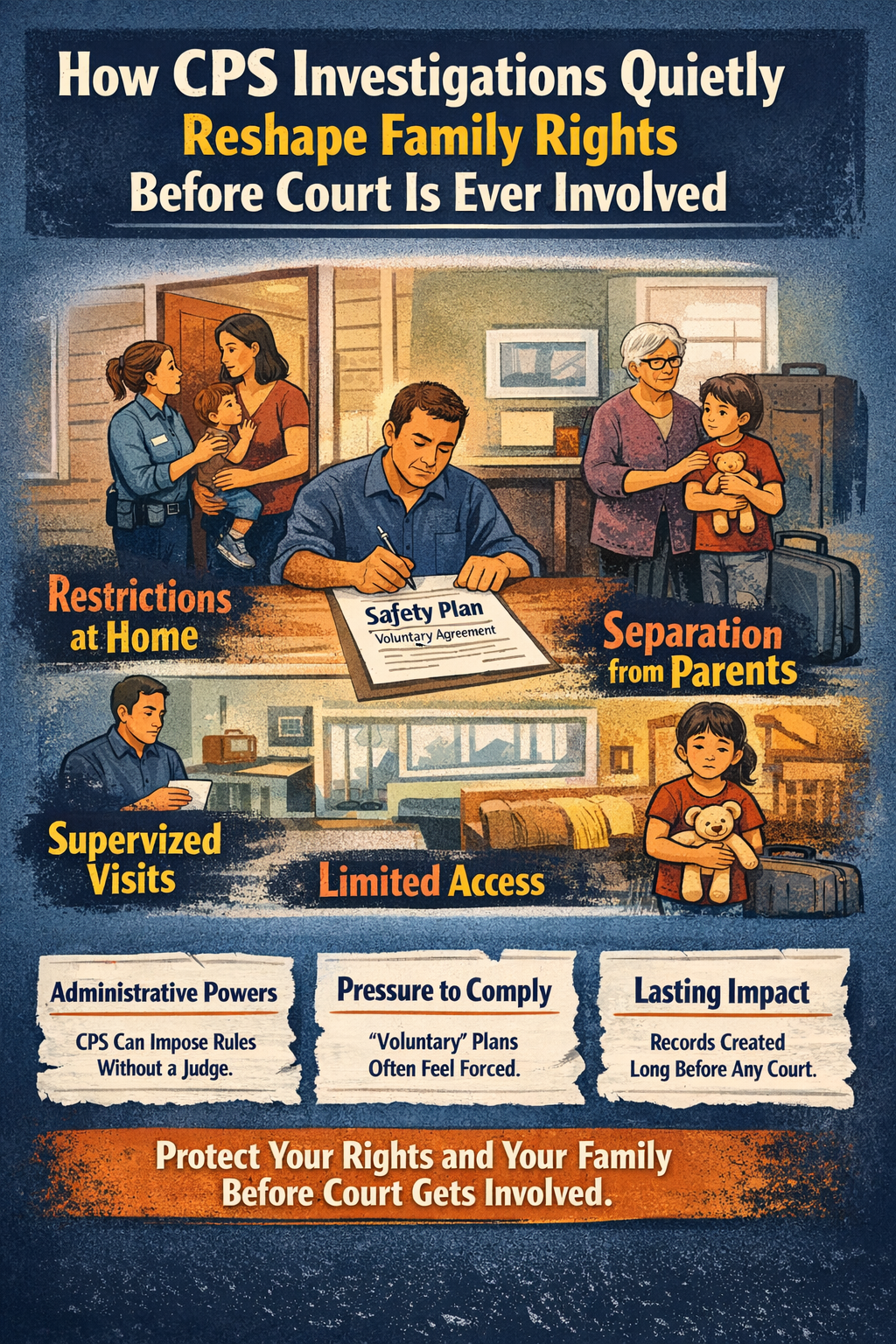
These “agreements” can quietly reshape daily life. They may restrict where a parent sleeps, who may be present in the home, or how contact is allowed. This is one reason we encourage parents to speak with an attorney early, before signing anything that changes access or routines.
The Hidden Role of Safety Plans in CPS Investigations
A safety plan is one of the most powerful tools used during a CPS investigation. It can be introduced immediately, sometimes during the first meeting. Safety plans can sound reasonable on paper, but they can also become long-term restrictions that redefine how a family operates.
Safety plans are often designed to reduce perceived risk. The concern might involve alleged child abuse, possible neglect, or other safety-related claims. CPS may view the plan as a way to manage risk while keeping the child out of foster care.
But safety plans can feel like punishment, especially when there is no proof yet. A plan can separate a parent from their home, limit contact, or require supervision. Even if the plan was meant to be temporary, it can set a pattern that shapes later decisions.
Why Safety Plans Can Limit Parenting Before Any Judge Steps In
Safety plans may affect parenting rights even without a court order. This is one of the most misunderstood parts of the CPS process. Parents assume rights can only be limited by a judge, but administrative action can still restrict access in practice.
For example, CPS may require that a parent cannot be alone with their child. They may require supervision by another adult, or they may require the parent to leave the home temporarily. In some cases, the plan may require the child to stay with another family member.
These limitations can feel like a custody order, even though no court has signed anything. Over time, the agency may treat the safety plan as evidence of “risk” continuing, even if you complied fully. That is why a safety plan should be reviewed carefully before signing.
Access Restrictions Often Start Quietly and Expand Quickly
Many restrictions begin with small requests. The agency may say, “Just for now,” or “Until we finish the investigation.” But these short-term limits can quietly expand. A parent who temporarily agreed to supervision may later be told supervision must continue.
Restrictions can affect:
- Where the child sleeps
- Who can provide transportation
- Whether a parent can attend school events
- Whether the parent can communicate directly with teachers
- Whether the parent can make medical decisions
These restrictions may not come from a judge, but they still shape real life. They also create a record of “compliance,” “concerns,” and “protective actions” that may later appear in court documents. In many cases, early limits become the foundation of later legal arguments.
How CPS Interviews Shape the Narrative Early
During a CPS investigation, interviews are not casual conversations. They are information-gathering events that shape a written narrative. The agency’s notes, summaries, and internal records can influence everything that happens next.
CPS may interview parents, the child, teachers, medical staff, and other people. Sometimes they will speak to the child at school, which can be shocking for the family. Parents often feel blindsided because they are not present to clarify misunderstandings.
Even innocent statements can be misunderstood. An exhausted parent might describe discipline poorly, or a child might repeat something without context. These details can become part of the official account, and later those accounts may be treated as facts.
The Emotional Impact on Parents During the Early Phase
The early phase is often the most emotionally intense. Many parents describe it as living under a microscope. They may feel like every decision they make is being evaluated, not just for parenting style but for character.
At the same time, parents are expected to comply quickly with requests. These requests can include paperwork, meetings, treatment referrals, drug testing, and changes to schedules. Parents may be juggling work, childcare, and fear of losing their child.
This stress can lead to mistakes. Some parents overshare and give confusing explanations. Others freeze and refuse to cooperate without realizing the consequences. Either reaction can increase risk. The best approach is often calm, strategic communication with legal guidance.
How CPS Uses “Services” to Control the Direction of a Case
CPS often relies on services to manage families under investigation. Providing services can be beneficial when there is a real need, but services can also become a form of control. When services are required early, refusal may be treated as noncompliance.
Examples of common CPS services include:
- Parenting classes
- Counseling
- Anger management
- Substance abuse evaluations
- Home assessments
- Education programs about discipline or supervision
These services may sound like support, but they also become evidence. CPS may use service participation to justify continued oversight. In some cases, a parent may complete every requirement but still face restrictions because the agency decides “risk” remains.
Why “Protective Services” Decisions Can Outpace Court
The CPS process can move faster than court scheduling. That means the most impactful decisions often happen while court is still a distant possibility. A family may already be operating under restrictions for weeks before a legal hearing is ever filed.
This is why many families feel like court was never the real starting point. By the time a judge is involved, the agency may present a long history of documented concerns and “safety planning.” The judge may see months of records that started with one hotline report.
If you wait until court begins to take action, you may already be behind. The earlier you understand the process, the more control you may have over what becomes part of the record.
How Neglect Allegations Can Be Interpreted Broadly
The term neglect is often used broadly, and it does not always mean a parent intended harm. A family may be investigated for neglect based on a parenting choice, a housing condition, or a misunderstanding about supervision. Sometimes neglect is alleged when a child has unmet medical needs, missed school, or experienced unsafe conditions.
Neglect claims can include:
- Lack of supervision
- Unsafe sleeping arrangements
- Exposure to unsafe individuals
- Failure to address health concerns
- Repeated school absences
Because neglect can be interpreted broadly, parents must be careful when responding. A well-meaning explanation may not match the agency’s definition of risk. That is why clear documentation and legal strategy matter early.
Child Abuse Allegations and the Immediate Shock to Family Stability
An allegation of child abuse is one of the most serious triggers for rapid CPS action. These allegations can cause immediate restrictions, even before an investigation is completed. Families often feel like they are treated as guilty before facts are confirmed.
Accusations may involve physical injury, emotional harm, or dangerous discipline practices. Sometimes allegations come from a third party, including another parent in a dispute. Sometimes allegations are raised after a child reports something without full understanding.
Because child abuse allegations carry high stakes, CPS may move quickly. That speed can create mistakes, rushed decisions, and confusion. Families need to respond with clarity and strong protection of their rights.
The Difference Between Suspected Child Abuse and Confirmed Abuse
One of the hardest things for parents to accept is that suspected child abuse can trigger major restrictions without proof. CPS is trained to act quickly when suspicion exists. Their role is prevention, not proof beyond a reasonable doubt.
This does not mean a parent has no rights. It means the parent must understand how suspicion operates within the system. In these situations, it is essential to document facts carefully, respond strategically, and avoid emotional reactions that can be misunderstood.
A strong response focuses on safety, truth, and clarity. Parents should not assume CPS will “figure it out” automatically. Early assumptions can become the narrative that later shapes the outcome.
Why Early Case Notes Can Become the Most Powerful Evidence Later
Even though the early stage may not involve a judge, it produces documentation. That documentation becomes the case file. Case files often contain summaries of interviews, home visit notes, service referrals, and descriptions of concerns.
A parent may think, “This is informal,” but the case file is treated seriously later. This is why the first few interactions matter so much. The language used by CPS can shape how others interpret the family situation.
If you believe something was documented incorrectly, it matters to address it promptly. Waiting too long can allow inaccurate information to become accepted as fact. Early corrections, clarifications, and organized documentation can protect your position.
How Home Visits Can Shift Authority Without a Court Order
Home visits often create a feeling that CPS has authority inside your home. Parents may feel pressured to allow entry immediately, answer every question, and accept every request. The fear of escalation makes many people comply even when they are uncertain.
During a home visit, CPS may look for hazards, ask about household routines, and evaluate overall safety. They may inspect sleeping arrangements, cleanliness, food availability, and general stability. These observations may be subjective, which creates risk for misunderstandings.
A parent can feel like they are being judged not by law but by preferences. That is why we encourage families to understand their rights, stay calm, and avoid unnecessary conflict. A respectful approach can protect your interests while preventing misinterpretation.
The Quiet Impact of “Temporary” Placement with a Relative
CPS may encourage a temporary placement with a relative instead of removing a child into foster care. This is often presented as a positive alternative. In some cases, it is helpful for safety and stability.
However, temporary placement still affects parental access and can become the new normal. If a child stays with someone else for an extended time, CPS may later argue that the placement should continue. The longer the placement lasts, the harder it can be to reverse.
Even when the child is placed with a safe family member, the parent may face restrictions on visits or communication. These restrictions can reshape the family relationship and affect how others view the parent’s role. Families should treat these decisions carefully, even when they appear temporary.
How Foster Care Can Become a Threat Even Without a Court Filing
Many parents fear foster care, and CPS sometimes uses that fear in discussions. When parents are told “sign this safety plan or we may have to remove the child,” it can feel like an impossible choice. To help prepare for such challenging situations and secure your future, consider creating essential legal documents for families before age 40.
Foster care is often described as a system designed to protect children, but it also creates separation and stress. The idea of placement into foster care can push parents to agree to restrictions quickly. This is why safety plans can become a major turning point.
Understanding the process helps parents remain calm. If CPS believes immediate safety risks exist, they may seek removal. But not every investigation automatically leads to removal. Strong legal guidance can help families respond in a way that reduces the risk of escalation.
What Federal Policy Has to Do With Local CPS Behavior
Many families don’t realize that CPS operations are shaped not just by local decisions but also by federal rules and funding structures. Over time, legislation has influenced how agencies prioritize certain actions. This creates an environment where administrative action can be encouraged early.
Some federal frameworks and policies have influenced how the system operates, including:
- The child welfare act
- The adoption promotion act
- The increasing adoptions act
- The safe families act
- The families safe act
- The stable families amendments
Even though families are not expected to know these laws, they influence what agencies consider “best practice.” They also shape how agencies measure success, risk, and compliance.
How the Prevention Services Act Changes the Early Focus of Cases
The prevention services act emphasizes early intervention and providing services to reduce removal risk. That sounds positive, and in many cases it is. But it also means families may be required to participate in services quickly.
Sometimes CPS treats early services as a default. Parents may be told to begin counseling or parenting classes immediately. While these services can help, they can also be used as evidence that a parent needed correction, even if the allegations were never proven.
Families should understand that accepting services is not always an admission of wrongdoing. But the record created by services must be handled carefully. Clear documentation and a strong strategy can ensure services do not become misrepresented later.
The Role of Foster Care Policy and Adoption Assistance in Agency Decisions
CPS does not operate in a vacuum. The system interacts with foster care policy, adoption efforts, and long-term placement frameworks. Some laws and programs were designed to promote permanency, but parents may experience them as pressure.
For example, adoption assistance programs exist to support permanency arrangements. That can be important for children who cannot return home safely. But when a family is working to reunify, any system focused on permanency can create tension.
In many cases, families believe the goal is reunification, while the agency may also be thinking ahead about placement options. Understanding this reality helps parents respond proactively. It also highlights why early legal advocacy matters.
Foster Children and the Long-Term Impact of Early Case Decisions
When a child enters the system, the experience can shape their well being for years. Foster children may experience multiple placements, stress, and disruption. Even when the system attempts to support stability, separation from parents is painful.
Families often assume that if removal happens, it will be short. In reality, cases can last months or longer depending on findings and agency decisions. Early documentation, safety plans, and compliance histories can determine whether reunification moves quickly or slowly.
This is why early restrictions matter so much. They do not just affect today’s routine. They can shape the long-term outcome for the child and the family. Parents should treat early stages with seriousness, even when court is not involved yet.
The Foster Care Independence Act and Youth Transition Planning
Some legal frameworks focus on youth aging out of care and building independence. The foster care independence act relates to services supporting youth transition needs. While this may apply more directly to older youth, it reflects the system’s broader role in long-term planning.
When CPS becomes involved, the agency often evaluates the child’s stability and environment. That includes school performance, emotional health, and support networks. For older youth, it may also include planning for independence skills, education, and career goals.
Families should understand that CPS looks at the bigger picture. Even if the concern began as a small allegation, the agency may expand evaluation into multiple life areas. Strong legal guidance can help ensure that the evaluation stays fair and evidence-based.
Fostering Connections and Keeping Children in Safer Family Settings
The concept of fostering connections involves strengthening relationships and finding stable placements when needed. Many policies aim to keep children connected to relatives and support networks rather than placing them with strangers.
When used properly, this can support a child’s stability. But for parents, it can also feel like authority is being transferred away from them. If a relative placement occurs, parents may lose daily involvement even if they were never found unfit.
The goal should always be promoting safe environments while preserving family relationships. Parents should advocate for fair boundaries and clear expectations. A legal strategy can help prevent unnecessary long-term separation.
Preventing Sex Trafficking Concerns Can Trigger Heightened Scrutiny
Some CPS cases involve concerns related to exploitation risks, especially for older youth. Policies focused on preventing sex trafficking have increased awareness and monitoring. While protection is important, these concerns may lead to increased scrutiny of family circumstances.
If CPS believes a youth is at risk for sex trafficking, they may implement restrictions quickly. They may evaluate who the youth associates with, where they travel, and what supervision exists. This can create conflict between parents, youth, and CPS.
Families facing these situations need guidance and calm communication. The goal should be safety without unnecessary disruption. It is important to protect the youth while ensuring parents are not unfairly blamed for external threats.
How Child Abuse Prevention Efforts Can Still Harm Innocent Families
Many CPS systems are designed around child abuse prevention, which is a critical goal. The intention is to reduce harm before it becomes severe. But prevention approaches can sometimes create aggressive early restrictions, even when allegations are questionable.
This is where families feel the system is unfair. Parents may be doing their best, struggling with stress, financial pressure, or lack of support. A misunderstanding or a false report can bring CPS into their lives suddenly.
While the system aims to prevent abuse, it can sometimes treat families as guilty before facts are confirmed. This is why having a legal advocate is so important. Parents deserve fairness, clarity, and protection of rights during the process.
Why CPS Sometimes Expands Investigations Beyond the Original Allegation
Families are often shocked when an investigation expands beyond the original complaint. CPS may start with one claim but then evaluate multiple areas. For example, an initial report about discipline may expand into questions about home conditions, school attendance, and caregiver relationships.
This expansion happens because CPS looks at “overall safety.” They may argue that if one risk exists, other risks might exist too. That can lead to more interviews, more service referrals, and broader restrictions.
Parents should not assume the investigation will stay limited. They should prepare for a broad review and keep detailed records of everything. A strategic response protects the family from unnecessary escalation.
How Schools and Social Services Become Part of the CPS Web
Schools often become involved because staff members are mandatory reporters. That means a school may file a report when they observe something concerning. Sometimes the concern is valid, but sometimes it is based on incomplete knowledge.
CPS may also coordinate with other social services agencies. This can include mental health programs, medical services, or community support programs. While coordination can help children, it also creates a larger record and more outside involvement.
Parents should be aware that communication between agencies can happen quickly. A small issue can create a network of scrutiny. Having a clear plan and legal guidance can help manage these interactions effectively.
The Department’s Role and How Authority Is Practiced Day to Day
The CPS department operates as an agency with policies, supervisors, and procedures. A caseworker’s decisions may be guided by internal policy and expectations. Sometimes workers have heavy caseloads, which can affect communication and timing.
The agency’s authority is often expressed through written plans, requests, and compliance requirements. Even if the plan is technically voluntary, it carries pressure. Families may feel like they must comply to avoid removal or a court case.
Understanding the department’s role helps parents avoid unnecessary conflict. Cooperation should be strategic, not blind. Parents should protect themselves by keeping records, staying calm, and seeking legal support early.
Why Parental Rights Can Shift Without a Court Order
Parents are often stunned by how much control CPS can exert without a judge. Even without court involvement, parents may find their rights limited through informal agreements. They may be told they cannot live in their own home or cannot be alone with their child.
These shifts happen because CPS often frames restrictions as safety measures. Parents may comply because they want to show responsibility. But compliance can also be interpreted as agreement that the restriction was necessary.
This creates a complicated reality: parents try to do the right thing, but doing the “easy thing” may lead to long-term consequences. Legal guidance helps parents balance cooperation with protection of rights.
How CPS Case Timelines Quietly Redefine Family Normal
Time is one of CPS’s most powerful tools. When restrictions remain in place for weeks, they begin to feel normal. Children adjust to new routines. Parents adjust to limited contact. Eventually, CPS may argue that this new arrangement is stable and should continue.
This is why early action matters. The longer a restriction lasts, the harder it can be to undo. Families should not assume time will resolve the problem automatically. Time often strengthens the agency’s position, not the parent’s.
If you are under CPS involvement, you should monitor every timeline, every requirement, and every promise of “temporary.” Temporary restrictions can quietly become the foundation of the entire case.
Investigating Methods That Parents Often Don’t Expect
CPS uses multiple methods when investigating. Parents often expect a home visit and maybe a short interview. In reality, an investigation can include record requests, third-party calls, and background checks.
A CPS worker may request:
- Medical records
- School records
- Police records
- Names of relatives and caregivers
- Work schedules
- Proof of housing stability
These requests can be overwhelming, especially for working parents. The best approach is to stay organized and respond carefully. Giving incomplete or inconsistent information can create new concerns even when the family is safe.
What Happens When CPS Says “We Need Support Services”
CPS often uses the word support to describe referrals. The idea is that families need assistance, not punishment. Sometimes this is true. But sometimes the “support” becomes a list of obligations that feel like penalties.
Support services can include counseling, treatment programs, or monitoring. Some families benefit from this structure. Other families feel forced into programs that do not fit their situation or do not address the real issue.
Parents should understand that support services create documentation. If you attend, the agency records your participation. If you don’t attend, the agency records noncompliance. That is why legal guidance is crucial to choose the right steps.
Why CPS Uses Risk Assessments to Determine “Next Steps”
CPS often uses risk assessments to determine how serious a case is. These assessments may include checklists, structured decision tools, and worker observations. They are designed to help agencies make consistent decisions, but they can still be subjective.
Risk tools may consider:
- Prior reports
- Household stability
- Substance use concerns
- Domestic conflict
- Child behavior and needs
- Housing and supervision conditions
Because these assessments influence decisions, parents should take them seriously. A misunderstanding can increase risk scoring. The more organized and prepared a parent is, the easier it is to correct inaccurate impressions early.
The Role of Allegations and How They Shape Everything
CPS cases often revolve around allegations, not proven facts. Allegations can come from many sources and may not be verified immediately. Still, CPS treats allegations seriously, especially when child safety is involved.
A single allegation can impact how CPS views the family. Multiple allegations, even if minor, can create a pattern in the file. That pattern may lead to stricter restrictions and longer involvement.
Parents should not dismiss allegations as “ridiculous” and assume they will disappear. Even false allegations must be addressed strategically. The record matters, and the narrative matters.
Maltreatment Findings and How They Influence Outcomes
The term maltreatment is often used in CPS systems to describe harm or risk of harm. Maltreatment findings may be formal or informal depending on how the case is documented. Even without court involvement, maltreatment can appear in internal case records.
This matters because maltreatment documentation can affect future decisions. It can influence custody disputes, future investigations, and access to certain services. Parents should treat maltreatment references seriously.
If you believe maltreatment is being inaccurately implied, you may need a legal strategy to address it. Early documentation and clear communication can prevent long-term harm to the family’s record.
How “Providing Services” Can Become the Standard Requirement
Parents are often told, “We just want to help.” That may be true, but help often comes with requirements. CPS may require classes, evaluations, and compliance steps as a condition of keeping the child at home.
Sometimes services are reasonable. Sometimes they are unnecessary. The difficulty is that refusal may be seen as lack of cooperation, which can increase CPS concern.
Families should seek advice from an attorney who understands the process. The right strategy may involve accepting some services while pushing back against others. The goal is to protect the child while also protecting the family’s rights and reputation.
When CPS Treats Cooperation as Responsibility and Silence as Risk
CPS often interprets cooperation as a sign of responsibility. Parents who comply may be seen as more stable. Parents who hesitate may be seen as hiding something. This creates pressure, especially for parents who want to protect their rights.
At the same time, over-cooperation can cause trouble. Parents may give too many details, make inconsistent statements, or agree to restrictions too quickly. In high-stress situations, people speak emotionally, and emotions can be misinterpreted.
The key is balanced cooperation. Be respectful, organized, and calm. Don’t guess at answers. Don’t argue in ways that escalate. And consider legal guidance early to protect your position.
How CPS Decisions Affect Custody Dynamics Inside the Home
Even when court is not involved, CPS actions can reshape household custody dynamics. A parent may be removed from the home voluntarily. A parent may be restricted from being alone with the child. A relative may become the daily caregiver.
These shifts create new routines. They also create new power dynamics that can be difficult to reverse. Parents may later be judged based on these new arrangements, even if the arrangement started under pressure.
This is why early restrictions should never be treated casually. They influence how everyone views the child’s “normal.” They can also impact long-term family stability and outcomes.
Why You Should Consider a CPS Defense Attorney Early
Many parents wait until they are served court papers to seek legal help. Unfortunately, by that point, the agency may already have months of documentation. Early intervention often creates the best opportunity to protect the family’s rights.
A cps defense attorney can help you understand what CPS can and cannot require. They can help you respond carefully, avoid harmful agreements, and document your side of the story. They can also help address inaccuracies before they become “facts” in a case file.
At Masterly Legal Solutions, we take this early stage seriously. We know that protecting a family often starts before court is involved. Early strategy may reduce restrictions and protect your long-term position.
How Legal Knowledge Helps Parents Avoid Common Case Traps
Parents often fall into traps because they do not have the legal knowledge to recognize what is happening. They may believe CPS is simply offering suggestions. They may not realize that signing a safety plan can limit contact and reshape parental authority.
Legal guidance helps you see the bigger picture. It helps you understand what language means, what risks exist, and what the agency may do next. It also helps you keep your focus on your child’s safety while protecting your rights.
When families have support, they make better decisions. They stay calmer, communicate more clearly, and reduce risk. That can change the direction of the case early.
How Laws and Legislation Influence CPS Practice
CPS operations are shaped by multiple laws and evolving legislation. Over time, federal and state systems have changed how agencies approach removal, adoption, and permanency. These rules affect how CPS measures success and risk.
Some policies encourage agencies to move quickly. Others encourage early prevention services. But in practice, families often feel that the system moves in one direction: increasing restrictions first, then sorting facts later.
Parents do not need to become experts in legislation. But they do need to understand that CPS behavior is influenced by systemic rules, not just individual workers. A skilled attorney can help families navigate this environment strategically.
Bills Introduced, System Shifts, and the Pressure Families Feel
Over the years, various bills introduced have shaped child welfare strategies and expectations. These developments influence agency training, internal goals, and response timelines. Families often feel the effects without ever hearing the names of the policies.
This can feel frustrating because parents experience pressure without explanation. They may feel forced into services, restrictions, and compliance measures without understanding why. The agency may be following policy, but families feel powerless.
When you understand the system, you can respond more effectively. You can protect your family’s dignity, reduce escalation, and present clear evidence of safety. That clarity can make a major difference.
Prevent Abuse Efforts and the Balance Between Protection and Overreach
The goal of CPS is to protect children and prevent abuse. That mission is important. But there is a real tension between prevention and overreach. Families can be harmed by aggressive early restrictions, even when allegations are weak.
The system often assumes it is safer to restrict first and evaluate later. For some families, that prevents harm. For others, it creates unnecessary trauma and disruption. That is why legal protection matters.
The best outcome is safety with fairness. Families deserve a process that protects children without destroying parental rights prematurely. Advocacy helps ensure the balance is respected.
Helping Children While Still Respecting Families
Every CPS system claims to be focused on helping children. But helping children should not mean damaging the family when the family is safe. Many investigations involve misunderstandings, poverty-related conditions, or false allegations.
Helping children means ensuring they have stability, support, and safe caregiving. It also means recognizing when families are doing their best and deserve resources, not separation. Sometimes the best solution is providing services without restricting access.
Parents should never assume CPS will automatically choose the least disruptive path. Families need to advocate for themselves. Legal guidance can help families present safe, structured solutions early.
Safe Families and Promoting Safe Outcomes Without Unnecessary Separation
Many policies talk about safe families, and that idea matters. A truly safe family environment supports children emotionally and physically. But safety should not be confused with perfection. Parents do not have to be perfect to be good parents.
A strong response to CPS focuses on promoting safe routines, consistent supervision, and stable care plans. That can include trusted relatives, structured schedules, and clear documentation. These steps can show CPS that risk is managed without removal.
A family under investigation can still be a safe family. The key is proving it effectively. A calm strategy backed by legal guidance often produces better outcomes than panic-driven compliance.
Keeping Children Connected to Parents When It Is Safe
One of the most important goals should be keeping children connected to their parents whenever safety allows. Children need stability and emotional connection, not sudden separation. Even short separations can create lasting stress and fear.
When CPS imposes early restrictions, families should request clear explanations and realistic alternatives. If supervision is required, families should push for workable terms. If placement with a relative happens, parents should advocate for consistent contact.
The earlier you address these issues, the better. Once a child adapts to a new routine, the agency may treat it as evidence of stability elsewhere. Parents must act early to protect the parent-child bond.
How Victims and False Accusations Can Exist in the Same System
CPS cases often involve real victims of abuse, and those situations must be taken seriously. But the same system can also impact innocent families through false accusations or misunderstandings. Both realities can exist at once.
Sometimes parents are victims too—victims of misinterpretation, system pressure, or false reporting. Families may feel like they are fighting a machine that assumes the worst. That experience can be isolating and terrifying.
If you are in this position, you are not alone. Families deserve fairness, clarity, and protection. Legal representation can help ensure you are not treated as guilty without evidence.
Treatment Requirements and How They Can Be Used Against Parents
CPS may request treatment or counseling even when there is no confirmed wrongdoing. Treatment can be beneficial if a parent needs support. But treatment can also be misinterpreted as proof of wrongdoing.
For example, a parent may attend anger management to show cooperation. Later, CPS might imply the parent has anger problems that justify restrictions. This is why documentation and language matter so much.
Parents should approach treatment decisions carefully. An attorney can help clarify whether participation is strategic or unnecessary. The goal should be to protect the family without creating misleading records.
Responsibility, Authority, and the Parent’s Role During CPS Involvement
Parents often feel like CPS takes over responsibility for their child. In reality, parents still have responsibilities even when their authority feels limited. Parents must continue meeting daily needs while navigating restrictions and fear.
This balance is difficult. Parents must show maturity, stability, and cooperation while defending themselves. They must demonstrate responsibility without becoming passive.
A strong approach shows that the parent is capable, consistent, and committed to safety. It also shows that the parent understands boundaries and respects the process. With proper guidance, families can protect their child while defending parental rights.
How Masterly Legal Solutions Helps Families Respond Early
At Masterly Legal Solutions, we understand that the earliest phase of a CPS investigation may be the most important. Early actions can shape the case file, create restrictions, and alter the parent-child relationship long before court becomes involved.
We help families:
- Understand what CPS is asking and why
- Respond strategically to interviews and requests
- Review safety plans before signing
- Document facts clearly and consistently
- Protect parental rights while keeping the child safe
Our goal is not to escalate conflict. Our goal is to protect families from unnecessary damage. We focus on strong advocacy, clear communication, and early defense strategies.
Child Protection Services and the Power of Early Agency Decisions
When people hear “CPS,” they often forget that child protection services is a broader system made up of policies, agencies, and professionals working under strict rules. That system can reshape family life quickly through safety plans, supervision demands, and access limits—often before any judge is involved. Because these steps can feel informal, many parents underestimate how much they matter and how long they can last. The smartest approach is to stay calm, document what is happening, and treat every early decision like it could later appear in a case file.
Interethnic Placement Provisions and What They Mean for Your Family
If a child is removed or temporarily placed outside the home, placement decisions can be shaped by rules that go beyond the immediate investigation—including interethnic placement provisions that limit how race and ethnicity may be used in placement decisions. Families are often surprised to learn that placement can involve multiple considerations that do not feel personal but still affect real outcomes. These provisions matter most when agencies are choosing between foster placements, relatives, or other options, and they can become relevant even when a placement is intended to be short-term. Understanding these rules helps parents respond with clear requests, accurate documentation, and a plan to keep family connections strong.
Justice and the Importance of Fair Process Before Court
Families often say the hardest part is feeling like the process is moving without fairness, but the idea of justice still matters even before a case reaches court. Justice includes transparency, accurate recordkeeping, and giving parents a meaningful chance to respond to allegations. When the early process is rushed or unclear, a family can feel like outcomes are being decided behind closed doors. That is why early advocacy matters—because fairness is not only something that happens in court, it should also shape how investigations are handled from the start.
Every Page Matters When CPS Is Building the Case File
Parents are often shocked by how much influence a single page of notes can have once CPS documents an interview, home visit, or safety plan. A short summary written early in the case can later be referenced as if it reflects the full truth, even when important details were left out. That is why families should keep their own records, save messages, and request written copies of anything they are asked to sign. If a parent assumes documentation is “just paperwork,” they may later discover that paperwork shaped the narrative.
How to Inform CPS Without Creating New Risks
Many parents want to inform CPS of the full story right away, but the early stage is not always the best time to explain everything without structure. Stress can cause parents to speak emotionally or provide details that sound inconsistent when written down later. A better approach is to share clear facts, provide documents when appropriate, and avoid guessing or speculating. When you communicate carefully, you reduce the chance that your words will be misunderstood or used out of context.
Why You Should Not Rely Solely on Verbal Assurances
Parents are often told, “This is temporary,” or “We’re just checking on things,” and they rely solely on those verbal statements. The problem is that verbal assurances do not control what gets documented, what restrictions continue, or what the agency decides later. Families should assume that if it is not in writing, it may not protect them. Written documentation, organized timelines, and clear communication are essential when the stakes involve a child’s daily life and parental access.
When a Lawyer Can Help Before Court Is Ever Involved
Many families wait until court papers arrive, but a lawyer can be most effective at the beginning—when safety plans are proposed, interviews are scheduled, and restrictions are being introduced quietly. Early legal support helps parents understand what CPS can request, what is optional, and what could create long-term consequences. A lawyer can also help you communicate clearly, correct inaccuracies in records, and avoid signing agreements that limit access without a strong reason. In CPS matters, the early stage often shapes the entire outcome, so legal guidance early can protect the family’s position.
Institutions That Influence CPS Cases Beyond the Agency Itself
CPS investigations often involve more than one agency because other institutions may contribute information, reports, or records. Schools, hospitals, counseling providers, and community programs can all become part of the paper trail, even if they were not involved in the original allegation. Parents are often surprised by how quickly information can move between institutions once an investigation begins. Understanding this network helps families stay organized, protect privacy where possible, and respond strategically when outside records become part of the case narrative.
Contact Masterly Legal Solutions for a Free Consultation
If CPS has contacted you, opened an investigation, or asked you to agree to a safety plan, it is important to take the situation seriously from the very beginning. Even when court is not involved yet, the steps taken during the early stage can affect your home, your access to your child, and your future rights as a parent.
At Masterly Legal Solutions, we help parents respond with clarity and confidence while protecting their family’s stability.
If you have questions about your situation, the allegations being made, or what CPS is asking you to do, we invite you to reach out today.
Call (972) 236-5051 for a free consultation, and let’s talk about what’s happening and what steps may help protect you and your child moving forward.
Disclaimer: This article is for educational purposes only and does not constitute legal advice or legal guidance. Every CPS case is different, and outcomes depend on specific facts and applicable laws. For advice about your situation, contact a qualified attorney.


Teacher Rights When Assaulted by a Special Needs Student: Safety, Reporting and Investigation Issues


Looking for Legal & Business Solutions? Contact Us Now
Fill in the form or call us to set up a meeting





