

That HR Email Wasn’t Routine: What Teachers Should Do Immediately
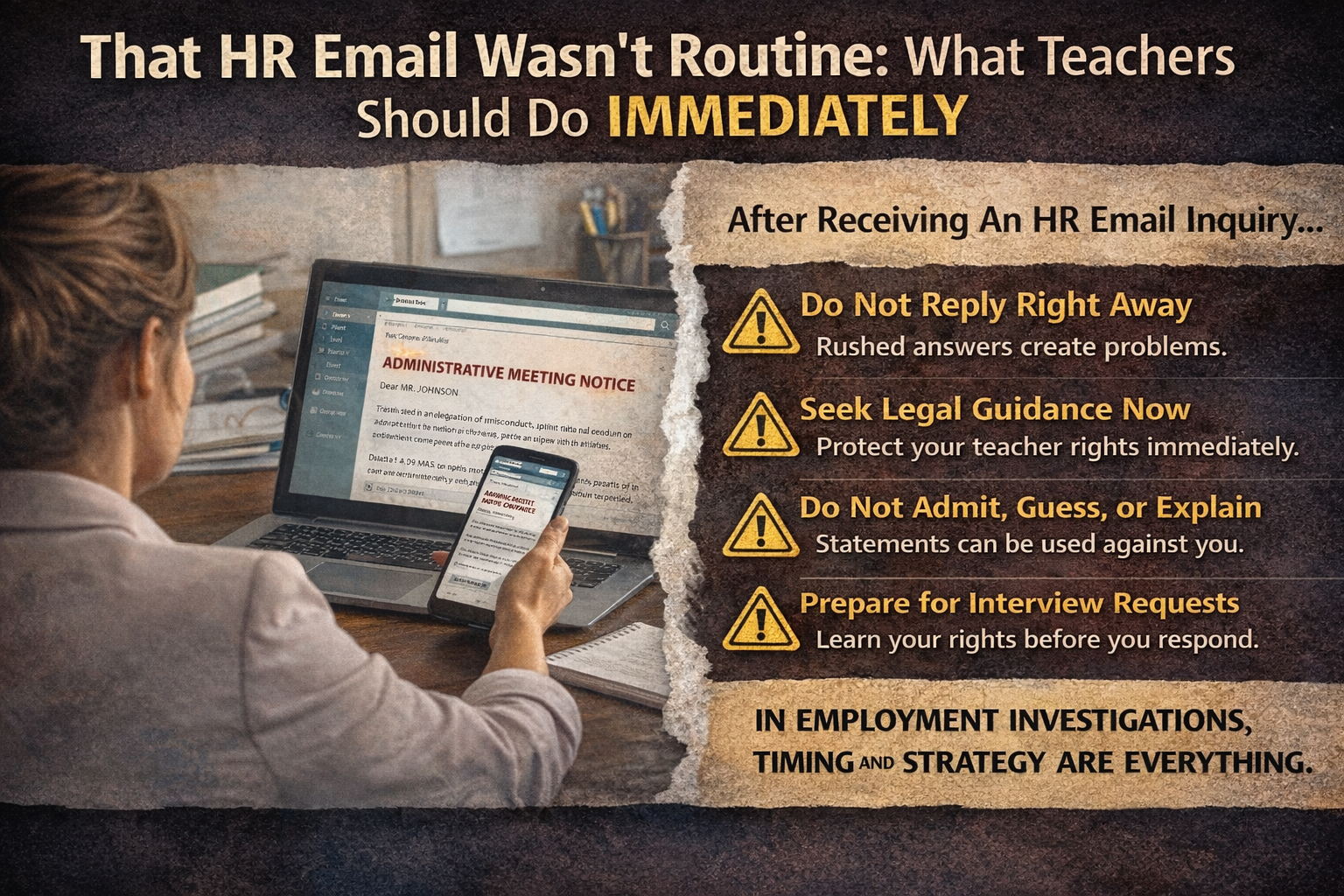
You know the email before you even open it. The subject line is short, vague, and oddly formal. It’s the kind of message that instantly pulls your stomach tight because it doesn’t sound like a normal campus update or a quick administrative reminder. It sounds like a problem—and deep down, you already know it.
For many teachers, an HR email is the first sign that something bigger is happening behind the scenes. It may mention “an allegation,” “a concern,” “a meeting,” or “an investigation,” but it rarely explains enough to make you feel secure. In that moment, your mind starts racing: Am I being accused of something? Are they building a case? Is my job at risk?
At Masterly Legal Solutions, we work with professionals who need clarity fast. When you’re a teacher under scrutiny, the stakes are serious: your paycheck, your reputation, and your future employment can all be impacted by one investigation. This article explains what teachers should do immediately after receiving that HR email, how to protect your legal rights, and when it’s time to speak with an employment lawyer before the situation gets worse.
The Email Is Not the Emergency—The Silence After It Is
Most teachers don’t lose their job the moment the email arrives. The real risk begins in the hours afterward, when teachers respond emotionally, overshare, or try to explain everything in writing. Even well-intentioned responses can create problems later if HR interprets them as admissions or inconsistencies.
HR investigations are rarely casual. They are structured, documented, and often designed to support the employer in case the situation escalates. What feels like a simple scheduling notice to you may actually be the start of a formal record.
When a teacher treats the email like a routine check-in, they often walk straight into a process they don’t understand.
HR Is Not a Neutral Referee in a Teacher Investigation
It’s common for teachers to assume human resources is there to “clear things up” or mediate misunderstandings. In reality, HR’s role is frequently focused on protecting the district’s interests. That doesn’t mean HR is automatically unfair, but it does mean the teacher should not approach the meeting as if it’s a friendly conversation.
HR may already have notes, statements, or background documentation before they ever contact you. Your job is not to guess what they know. Your job is to respond carefully and protect yourself.
If you want fairness, you need strategy—not a rushed explanation.
What Teachers Often Misread About HR Emails
A major mistake is assuming the email content reflects how serious the issue is. A message can sound mild and still lead to termination. It can sound “standard” and still become a damaging investigation record.
Teachers also misread timing. They may delay responding because the email didn’t sound urgent. But internally, HR might already be coordinating interviews with other employees, administrators, and witnesses.
The email is often the first visible sign, not the first step in the process.
The Fastest Way Teachers Lose Control: A Quick Reply
Teachers are trained to be responsive. That instinct can backfire in an investigation.
A quick reply like “I didn’t do that” or “This is ridiculous” can be used to frame you as defensive. A long reply with too many details can create inconsistencies or give HR new angles to investigate. Even a respectful reply can be risky if it admits facts that are later framed negatively.
The safest approach is calm, brief communication while you secure the right advice from an attorney.
The First Five Minutes After You Read the Email Matter Most
Before you reply, do this first: stop, breathe, and slow down. Your next move should be intentional, not emotional.
Teachers often panic because they feel blindsided. But your ability to stay steady in that moment can protect you later. Your first goal is to avoid giving HR free evidence against you.
This is where an employment attorney becomes a powerful asset, even early in the investigation.
When Paid Administrative Leave Is Mentioned, Assume It’s Serious
If the email includes removal from campus, restrictions, or a change in duties, you must treat it as a high-risk employment event. Some teachers are told they’re being placed on paid administrative leave as the investigation continues.
Even though it sounds like you’re being “protected,” that leave can also be used to isolate you, control the narrative, and remove you from your normal support system. Administrative action like this can quickly escalate into discipline or termination.
Don’t assume paid leave means the district believes you are innocent.
What HR May Already Be Doing Before They Contact You
HR may begin collecting statements from students, staff, and administrators. They may be reviewing video footage, email logs, classroom documentation, and incident reports. They may also be evaluating whether your situation fits into a policy violation category.
This means you are walking into a meeting where the other side may already have a storyline. You don’t need to fight the story with emotion. You need to defend yourself with evidence and precision.
This is why many employment law cases are won or lost based on early documentation.
The District’s File Is Not Your Friend
Your personnel file, emails, evaluations, and HR notes are often used to justify decisions later. Many teachers assume “my record speaks for itself.” But HR can interpret the record however it wants, especially when it’s building a case for discipline.
Once documentation enters the record, it may follow you to your next district. It may also shape the way future employers view your retaliation, resignation, or separation.
If you want to protect your career, you have to protect the record.
What Counts as a Negative Employment Action for Teachers
A negative employment action isn’t only termination. Teachers often think they don’t have a case unless they’re fired, but that isn’t always true under employment law.
Negative actions can include reassignment, reduction in duties, restricted access, formal write-ups, pay disruption, or conditions that pressure resignation.
Those actions may be used to build future termination justification or to punish teachers quietly.
When the employer’s actions change your work reality, that matters legally.
Understanding Retaliation in Teacher Investigations
Many teacher investigations involve more than a complaint—they involve retaliation.
Retaliation may happen after a teacher reports a problem, refuses to participate in wrongdoing, requests disability support, or files a complaint. If you engaged in a protected activity, like reporting discrimination or speaking up about unlawful conduct, the district may respond with adverse actions that feel “disciplinary.”
Retaliation in the workplace is often disguised as “performance concerns,” but timing and documentation reveal the truth.
When Workplace Retaliation Occurs, It Usually Looks “Justified”
Workplace retaliation occurs when an employer punishes an employee for doing something legally protected. But employers rarely admit retaliation directly. Instead, they offer a false reason for disciplinary decisions.
That false reason could be “professionalism,” “misconduct,” “policy violations,” or “student complaints.” The accusation may sound reasonable on paper, even if it is unfair in reality.
This is why a retaliation case often requires careful evidence and experienced legal review.
Retaliation Claims Teachers Should Take Seriously
Teachers should not dismiss the possibility of retaliation just because HR appears formal. Retaliation can take many forms, including schedule changes, sudden investigations, or disciplinary meetings after you reported concerns.
If you believe retaliation is happening, your next steps must be documented and strategic. Teachers who ignore retaliation early often lose the opportunity to prove it later.
Retaliation claims are strongest when supported by timelines, witnesses, and written proof.
The Difference Between Retaliation and “Normal Discipline”
Districts have legitimate reasons to investigate. But not every investigation is fair, and not every investigation is based on truth.
A key question is whether the action makes sense compared to how other employees are treated. Another question is whether the complaint came soon after a protected activity. When these patterns exist, retaliation becomes a serious legal concern.
A skilled employment lawyer can help you identify whether this is legitimate discipline or unlawful retaliation.
Unlawful Retaliation Is Not Rare—It’s Often Hidden
Unlawful retaliation is common in professional environments because it’s easier to disguise than discrimination. Retaliation can happen quietly through paperwork, internal conversations, and HR narratives.
Teachers often experience retaliation after they report harassment, refuse unsafe directives, or challenge unfair treatment. It may also happen after asserting employee rights, requesting accommodations, or documenting misconduct.
Unlawful retaliation can be proven, but it must be handled early and properly.
Reporting Discrimination Can Trigger a Backlash
Many teachers don’t realize how risky it can feel to speak up. Reporting discrimination should be protected, but in reality, it sometimes triggers subtle discipline.
A district may begin questioning your performance, isolating you, or increasing scrutiny. Over time, the teacher feels targeted and emotionally exhausted.
This environment can create the conditions for resignation—or worse, wrongful termination.
Discrimination Claims Teachers May Face or File
Discrimination in school environments can show up in hiring, discipline, evaluations, promotions, or workplace treatment. Teachers may face discrimination based on race, gender, national origin, disability, and other protected factors.
Teachers may also be falsely accused in ways that reflect bias. When the system treats you differently than other employees, it matters.
A discrimination claim should never be made lightly, but it should not be ignored when the facts support it.
Unlawful Discrimination in District Investigations
Unlawful discrimination may show up in the way HR frames credibility. It may show up in how leadership believes certain employees over others. It may also show up in unequal discipline for similar incidents.
HR may not say the quiet part out loud. But patterns matter, and the record matters.
If you suspect discrimination, an employment attorney can help protect your legal rights without escalating unnecessarily.
Workplace Harassment and the Investigation Trap
Harassment is another reason teachers contact legal support. Sometimes harassment comes from a supervisor, sometimes from a co-worker, and sometimes from systemic culture.
When harassment exists, the teacher may report it, and then suddenly an investigation begins against the teacher. This is one of the most common retaliation patterns we see.
Your defense must focus on documentation, timing, and evidence—not assumptions.
The Most Common Employer Strategy: Create a False Reason
Teachers often ask, “Why would they do this to me?” In many cases, the district doesn’t want conflict—it wants removal.
A false reason helps an employer justify discipline without admitting the real motivation. That false reason may sound professional and policy-based, even if it is built on exaggerations.
When false reasons appear, teachers should stop trying to “talk their way out.” They should protect themselves with legal strategy.
Wrongful Termination: When a Teacher Is Fired Unfairly
Wrongful termination doesn’t always mean you were fired for “no reason.” Texas employment rules can be complex, and wrongful termination often depends on motive, retaliation, or discrimination.
Teachers may be wrongfully terminated after reporting concerns, filing complaints, or refusing illegal directives. They may also be terminated based on flawed investigations or biased decision-making.
Wrongfully terminated teachers often discover too late that the district had a plan long before the final meeting.
How Retaliation Connects to Wrongful Termination
Retaliation often builds a path to termination. It starts with pressure, escalates through adverse actions, and ends with dismissal or forced resignation.
The employer may frame termination as “policy violations,” “professional standards,” or “loss of trust.” But if the real reason is protected activity or discrimination, the termination may be unlawful.
That’s why employment law focuses heavily on motive and timing.
Adverse Actions Teachers Should Recognize Early
Adverse actions can appear before termination. They often begin quietly and become severe over time.
Examples include limiting classroom access, changing assignments, creating formal write-ups, or restricting communication. An adverse action may also include threats about certification or job future.
Teachers should not wait until termination to take adverse actions seriously.
Retaliation Case Evidence Teachers Should Gather Immediately
If you suspect retaliation, your evidence must be real and organized. Strong evidence often includes emails, timelines, witness names, and copies of complaints.
It also includes what HR said, when it was said, and how quickly the employer shifted behavior. Teachers should keep everything, even if it seems minor at the time.
The earlier you build your defense file, the easier it is to protect your rights.
The Role of Federal Law in Teacher Retaliation and Discrimination
Teachers are often protected by federal law, especially in cases involving discrimination and workplace retaliation.
Federal protections may apply to harassment, retaliation claims, and discrimination based on protected status. Teachers should understand that a district cannot simply punish employees for asserting rights.
When federal law applies, legal strategy becomes more precise and time-sensitive.
State and Federal Laws Often Work Together
Many employment protections come from state and federal laws that overlap. A teacher may have rights under Texas rules and also under federal protections.
This matters because deadlines, standards, and filing pathways can differ. The wrong step can delay your options or weaken your claim.
That’s why working with an employment lawyer can prevent costly mistakes.
Texas Labor Code Protections Teachers Don’t Know They Have
The Texas Labor Code includes employment-related protections that may apply to specific situations. Teachers are sometimes shocked to learn they have options even in difficult cases.
However, Texas law can be strict, and not every unfair action becomes a winning case. The key is determining what is prohibited, what is provable, and what is strategically best.
Texas labor code issues should be evaluated early—before resignations or terminations become final.
Texas Workforce Commission and What Teachers Should Know
The Texas Workforce Commission may become relevant if employment ends and the teacher seeks unemployment benefits or disputes separation circumstances.
What you say and what HR writes may affect those outcomes. Teachers sometimes assume unemployment is automatic, but separation records can be contested.
Legal support can help teachers avoid self-defeating statements during this stage.
Equal Employment Opportunity Commission and EEOC Basics
The Equal Employment Opportunity Commission is the federal agency involved in discrimination matters. Teachers often hear “EEOC” mentioned as if it is a magic fix.
But EEOC filing is a process with deadlines, requirements, and strategy decisions. Teachers should not file blindly, and they should not assume filing automatically protects them from discipline.
A strong employment lawyer will help determine when and how filing makes sense.
Retaliation in the Workplace Is Broader Than Most Teachers Think
Retaliation in the workplace is not just getting fired. It includes being punished, isolated, threatened, or undermined after asserting rights.
Retaliation can be professional, emotional, or financial. It can also be subtle enough that teachers blame themselves.
Retaliation takes many forms, and teachers should treat early warning signs as serious.
Unpaid Wages and Overtime Problems During Investigations
Sometimes investigations reveal pay issues beyond misconduct allegations. Teachers may discover unpaid wages, missing stipends, or payroll mistakes that were ignored.
In certain employment contexts, overtime disputes matter too, including unpaid overtime or improper classification. While teachers are often salaried, many education professionals have extra-duty pay arrangements that must be handled correctly. Learn how the law protects employees from employer retaliation after they report labor violations.
Pay issues often become part of broader employment disputes when retaliation is present.
Pay Changes Can Become a Retaliation Tool
Even small pay disruptions can become pressure tactics. Losing supplemental duties, stipends, or coaching pay can create financial strain.
Employers sometimes shift compensation structures in ways that look “policy-based” but function like punishment. That can strengthen a retaliation case when tied to protected activity.
If your pay changes suddenly after a complaint, document it immediately.
What Teachers Should Never Do: Sign a Statement Without Review
HR may ask you to sign forms, summaries, or written statements. Teachers often sign because they want to appear cooperative.
But signing a statement you don’t fully understand can be devastating. It can lock you into facts, timing, or language that HR later uses against you.
Before signing anything during an investigation, consult an attorney who understands employment law.
The Attorney Client Relationship Protects You
When you speak with an attorney, the attorney client relationship provides confidentiality and professional protection. That matters when you’re under scrutiny and unsure what to say.
Teachers often make the mistake of speaking to coworkers, administrators, or HR before consulting legal counsel. Those conversations can be documented and repeated.
Legal counsel helps you communicate safely and avoid self-inflicted harm.
Employment Law Attorneys Build Strategy, Not Drama
Good employment law attorneys do not inflame situations. They protect your rights, your record, and your long-term position.
A smart attorney focuses on documentation, policies, timelines, and employer behavior. The goal is not to create chaos—it is to create control.
At Masterly Legal Solutions, we approach teacher cases with professionalism and calm clarity.
Employment Lawyer Support Can Stop a Case From Escalating
An employment lawyer helps you avoid the most common traps: over-explaining, guessing, resigning too quickly, or responding emotionally.
Employment lawyer guidance is especially important when retaliation is suspected or when termination is on the table. Many teachers wait too long and contact a lawyer after the damage is done.
Early employment lawyer involvement often changes the outcome.
Austin Employment Lawyer Searches Are Increasing for a Reason
Teachers across Texas are increasingly searching for an Austin employment lawyer because they are facing career-threatening investigations. Even if you don’t live in Austin, the term reflects rising demand for employment defense support statewide.
Educators want legal clarity, and they want it fast. They also want representation that understands professional consequences beyond the immediate job.
This is not just about staying employed. It’s about protecting your future.
Austin Retaliation Lawyer Support and Retaliation Claims
Some teachers specifically look for an Austin retaliation lawyer when they believe retaliation is driving the investigation. That search makes sense because retaliation is one of the most common hidden motives behind disciplinary action.
A retaliation lawyer helps identify the protected activity, the adverse actions, and the employer timeline. The attorney then builds the case foundation carefully.
Retaliation claims depend on proof, not emotion.
Austin Employment Trends Reflect Texas-Wide Risk
Austin employment disputes often reflect broader Texas patterns, especially in public workplaces and education. Teachers statewide face similar risks: HR investigations, documentation pressure, and sudden termination threats.
That’s why Austin employment searches often relate to teacher defense, retaliation, and discrimination. It’s a growing area because educators need help navigating the system.
Employment law is not a “last resort.” It’s protection when your career is vulnerable.
Prohibited Employer Behavior in Retaliation Cases
Employers are prohibited from retaliating against employees for engaging in protected activity. Yet retaliation still happens because it can be disguised.
The employer may claim neutral motives, but internal timing reveals patterns. Retaliating behavior is often framed as “policy enforcement,” but it becomes unlawful when linked to protected activity.
A strong retaliation case focuses on facts, patterns, and employer decisions.
Workplace Retaliation Can Look Like “Normal Management”
Many teachers think retaliation must be loud and obvious. In reality, retaliation can show up as small, consistent pressure.
It may include increased scrutiny, sudden meetings, formal write-ups, or isolation. It may also involve scheduling changes or threats of termination.
Workplace retaliation is often slow at first, then sudden at the end.
Many Forms of Retaliation Teachers Should Track
Retaliation comes in many forms, and teachers should treat patterns seriously.
Examples include:
- Isolation from meetings or decisions
- Increased negative evaluations
- Assignment reductions
- Sudden HR complaints
- Threats tied to job security
Even if each action seems small, the pattern becomes powerful evidence over time.
Other Forms of Misconduct Allegations That Trigger HR Action
Not all allegations involve students directly. Some involve workplace behavior, internal disputes, or administrative conflicts.
Other forms include alleged insubordination, improper communication, or policy-based complaints. These often become retaliation tools when a teacher has previously filed a complaint.
Do not assume HR issues are “minor.” They can still lead to termination.
Discipline, Termination, and the Speed of Escalation
Termination can happen faster than teachers expect. Even when HR says the investigation is “ongoing,” decisions may be made behind closed doors quickly.
In some cases, teachers are pressured toward resignation. In others, they are terminated suddenly after a final meeting.
The faster the case moves, the more important legal representation becomes.
The Supreme Court’s Influence on Workplace Rights
Employment law is shaped over time by major legal decisions, including those tied to the Supreme Court. Teachers don’t need to study court history, but they should understand this: workplace rights are real, enforceable, and built into legal systems.
Employers are still required to respect rights under federal law and other laws. When they don’t, legal action becomes an option.
Justice matters, even in employment disputes.
Justice Means Protecting Employee Rights Without Panic
Teachers often hesitate to fight because they fear being labeled “difficult.” But protecting employee rights is not being difficult—it is being responsible.
Teachers have careers, families, and financial obligations. They are entitled to fair treatment and lawful decision-making.
Seeking help is not escalation. It’s protection.
Financial Compensation and What Teachers May Recover
Some teachers ask whether cases involve financial compensation. It depends on the situation and the facts.
In some cases, damages may include lost wages, emotional distress, or future income loss. In certain serious cases, punitive damages may be considered, though they require specific standards.
The goal is not just money. The goal is restoring your career stability and preventing future harm.
Punitive Damages: Rare but Possible in Serious Cases
Punitive damages are not automatic, and they are not available in every case. But in serious retaliation or discrimination scenarios, punitive damages can become part of the legal analysis.
They generally require proof of extreme misconduct or intentional violations. Teachers should not assume punitive damages apply—but they should not ignore the seriousness of unlawful behavior or the potential need for experienced education lawyers in Texas to protect their rights.
An employment attorney can help determine what claims make sense.
The Role of Employment Law in Teacher Career Survival
Employment law isn’t only for corporate employees. It applies in education too, especially when retaliation, discrimination, and wrongful termination are involved.
Teachers often feel powerless when districts act quickly. Employment law restores structure and creates a pathway for accountability.
Even when you choose not to file, understanding employment law gives you leverage.
Filing Complaints: Timing Matters More Than Teachers Expect
Filing a complaint, grievance, or report must be handled carefully. Filing too late can weaken your position. Filing too early without strategy can backfire.
Teachers should document what happened, preserve evidence, and consult counsel before taking irreversible steps. That includes filing with the EEOC or submitting internal complaints.
The best filing strategy is the one built for your situation.
A Legal Claim Starts With Proof, Not Feelings
A legal claim requires evidence. Teachers often feel mistreated, but feelings alone won’t win cases.
Evidence includes emails, witnesses, timelines, documents, and employer patterns. It also includes what you reported and what happened afterward.
The stronger your evidence, the stronger your claim.
Employment Law Cases Are Often Won in Documentation, Not Court
Most employment law cases are shaped by documentation before they ever reach a courtroom. Your written responses, your timeline, and your preserved communications can decide outcomes early.
That’s why teachers should stop thinking they can “explain it later.” Later is often too late.
Professional guidance turns chaos into strategy.
Masterly Legal Solutions: A Law Firm That Protects Teachers Under Pressure
At Masterly Legal Solutions, our law firm helps teachers respond fast when HR contact becomes a real threat. We understand that you’re not just protecting a job—you’re protecting your identity, your future, and your ability to keep working.
We help represent employees facing investigations, retaliation, harassment claims, and wrongful termination risk. We focus on professional communication, evidence preservation, and strategic decision-making.
When teachers feel cornered, we help them regain control.
The Best Immediate Steps After the HR Email Arrives
When the email hits your inbox, the safest moves are the simplest ones.
Here’s what teachers should do immediately:
- Do not reply emotionally or defensively
- Save the email and take screenshots if needed
- Write a private timeline of events while details are fresh
- Preserve evidence, including messages and documents
- Avoid discussing details with coworkers
- Contact an employment lawyer before the meeting
These steps protect your future and prevent avoidable mistakes.
Contact Masterly Legal Solutions for a Free Consultation
If you received an HR email and something feels “off,” trust your instincts and take action before the situation escalates. Investigations can move quickly, and districts often begin documenting a narrative long before teachers realize what’s happening. Whether you’re worried about retaliation, harassment, discipline, or wrongful termination, early guidance can protect your record and your career.
At Masterly Legal Solutions, we help teachers respond professionally and strategically—especially when paid administrative leave is involved, when the employer is demanding answers fast, or when adverse actions suggest workplace retaliation. If you need an employment lawyer to explain your rights, review your situation, and help you respond with clarity, we invite you to contact us today for a free consultation.
Call (972) 236-5051 for a free consultation.
Disclaimer: This article is for educational purposes only and does not constitute legal advice or legal guidance. Every employment situation is different, and you should speak with a qualified attorney about your specific case.



Teacher Rights When Assaulted by a Special Needs Student: Safety, Reporting and Investigation Issues



Looking for Legal & Business Solutions? Contact Us Now
Fill in the form or call us to set up a meeting