

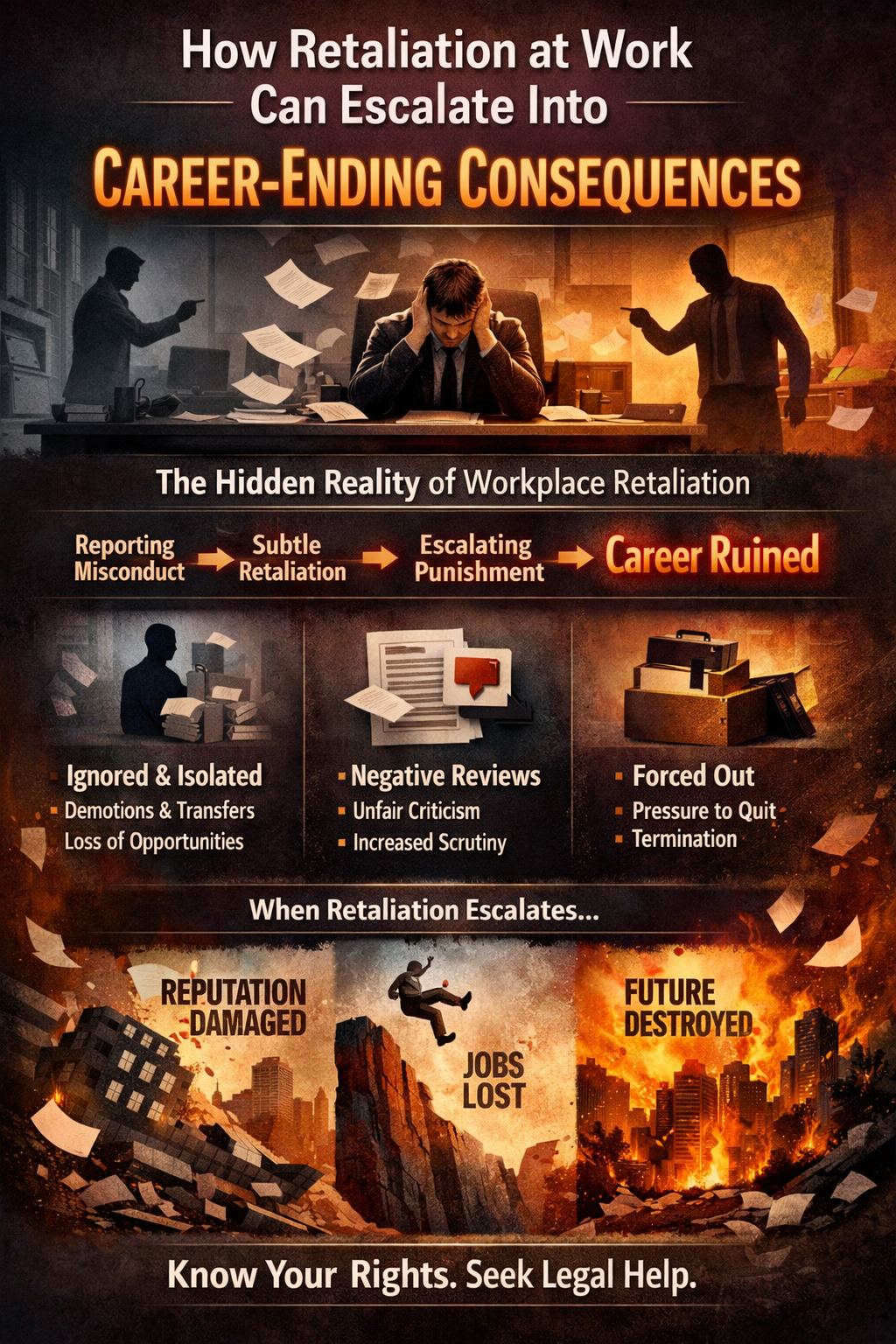
How Retaliation at Work Can Escalate Into Career-Ending Consequences
The Hidden Reality of Workplace Retaliation
Many employees believe that reporting wrongdoing at work will lead to solutions and accountability. Unfortunately, the reality inside many workplaces is far more complicated. In some environments, retaliation can quietly follow workers who speak up about discrimination, harassment, or other unlawful conduct. What begins as a simple complaint can escalate into serious professional consequences.
Across the United States, workplace retaliation is one of the most frequently reported employment violations. Employees may report discrimination or harassment believing the law will protect them, only to discover that subtle forms of punishment begin appearing afterward. These actions can affect an employee’s reputation, career path, and financial stability.
When retaliation is ignored or allowed to escalate, it can damage careers permanently. Employees may be pushed out of positions they worked years to obtain, lose promotional opportunities, or experience emotional and financial strain. Understanding how retaliation develops and the legal protections available is essential for anyone working in today’s complex workplace environment.
What Retaliation Means Under Employment Law
The legal definition of retaliation generally involves an employer taking negative action against an employee because that worker engaged in a protected activity. A protected activity might include reporting discrimination, participating in an investigation, or refusing to tolerate harassment.
Federal law, including Title VII of the Civil Rights Act, specifically prohibits retaliation against employees who report workplace violations. The goal of these laws is to encourage workers to speak up when discrimination or harassment occurs. Without these protections, many employees would remain silent out of fear.
However, retaliation can still happen despite these legal protections. Sometimes the employer’s actions appear subtle or are disguised as normal management decisions. This makes it difficult for employees to recognize when their rights are being violated.
Protected Activities That Should Never Trigger Retaliation
Employees have the right to raise concerns without fear of punishment. When workers report workplace misconduct, the law recognizes that they are engaging in protected activity.
Examples of protected activity often include:
- Reporting workplace discrimination based on national origin, race, gender, or religion
- Reporting harassment or unwanted sexual advances
- Participating in an investigation conducted by the equal employment opportunity commission
- Supporting co workers who file discrimination claims
- Refusing discrimination resisting sexual advances in the workplace
These actions are protected under federal law as well as many state and local laws. An employer cannot legally punish employees for exercising these rights.
Common Types of Workplace Discrimination That Lead to Complaints
Many retaliation cases begin with discrimination in the workplace. Discrimination can appear in many forms, and sometimes employees do not initially recognize that unlawful conduct is occurring.
Some common types of workplace discrimination include:
- Age discrimination affecting older workers
- Discrimination based on national origin or immigration status
- Disability discrimination addressed by the disabilities act
- Gender discrimination including harassment and sexual advances
- Religious discrimination affecting scheduling or family responsibilities
When employees report these violations, they expect fairness and protection. Unfortunately, retaliation may begin soon after a complaint is raised.
How Harassment and Retaliation Often Overlap
Workplace harassment and retaliation frequently occur together. An employee might first experience harassment, such as offensive remarks or unwanted sexual advances. Employers can reduce these risks through regular sexual harassment training for employees. After reporting the problem, retaliation may begin.
Harassment can involve repeated behavior that creates a hostile workplace. When an employer ignores these issues, the situation may escalate. If employees report the harassment and management reacts negatively, retaliation becomes a serious legal concern.
The combination of harassment and retaliation can make the workplace unbearable for workers trying to protect their rights.
Subtle Signs of Retaliation That Employees Often Miss
Retaliation does not always appear as a termination. In many cases, retaliation develops gradually and quietly. Employers may attempt to hide retaliatory conduct behind routine workplace decisions.
Employees should watch for warning signs such as:
- Sudden negative performance reviews after reporting discrimination
- Loss of promotional opportunities
- Increased scrutiny from supervisors or agency officials
- Being excluded from meetings or projects
- Changes to job duties that affect an employee's current position
These actions may seem minor individually, but together they can destroy an employee’s career trajectory.
The Escalating Impact of Retaliation on Careers
Retaliation can begin with small workplace changes but grow into career-ending consequences. Over time, employees may experience damage to their professional reputation.
For example, an employer might remove responsibilities, assign unfavorable schedules, or transfer the employee to another department. These decisions can affect how coworkers and management perceive the worker’s value.
Eventually, the employee may feel pressured to resign or face termination. This type of retaliation can impact future employment opportunities and financial stability.
Why Employers Sometimes Retaliate Against Employees
Some employers retaliate because they fear legal exposure. When discrimination or harassment complaints surface, management may worry about investigations or lawsuits.
In other cases, workplace culture plays a role. Some organizations discourage reporting problems because leadership views complaints as disruptive to the agency's mission.
There are also situations where individual supervisors retaliate out of personal resentment. They may feel challenged or embarrassed when employees report misconduct.
Regardless of the reason, retaliation is prohibited by many laws designed to protect workers.
The Role of Federal Agencies in Addressing Workplace Retaliation
Several federal agencies enforce laws that protect employees from discrimination and retaliation. One of the most important enforcement bodies is the equal employment opportunity commission, but employers may also rely on independent internal investigation services for harassment and discrimination to address serious allegations.
This agency investigates complaints filed by employees and job applicants who believe their rights were violated. The commission evaluates evidence and determines whether discrimination claims should proceed.
Federal agencies also develop regulations and guidance designed to prohibit retaliation and ensure fair workplace practices.
Legal Protections Under Title VII and Federal Law
Title VII of the Civil Rights Act is one of the most important employment laws in the United States. It prohibits discrimination based on race, religion, sex, or national origin. Just as importantly, Title VII also prohibits retaliation.
Under federal law, employers cannot punish employees who report discrimination or participate in investigations. These protections apply to private employers, federal government agencies, and many local governments.
Additional federal law protections exist through statutes addressing age discrimination, disability rights, and workplace fairness.
Understanding the Role of the United States Code
Many workplace protections are codified within the United States Code. These laws establish legal standards for how employers must treat employees and job applicants.
Within these statutes, retaliation is defined as an adverse action taken because a worker exercised protected rights. Courts rely on these provisions to evaluate workplace retaliation claims.
The United States Code also guides how federal agencies enforce employment laws and investigate violations.
The Influence of State and Local Laws
While federal law provides strong protections, state and local laws often expand these rights further. Many states have enacted additional workplace protections that address discrimination and retaliation, and some employers partner with firms that offer labor and employment legal services and training to keep policies aligned with these changing requirements.
State laws may provide broader definitions of discrimination or stronger penalties for employers who retaliate against workers. Local laws adopted by cities or counties may also protect employees.
In many situations, these laws work together to provide overlapping protections.
How Dallas Fort Worth School Districts Address Workplace Complaints
Public school systems must follow strict employment laws when handling workplace complaints. Many Dallas Fort Worth school districts have policies designed to address discrimination and retaliation concerns, including procedures for filing retaliation and labor complaints with oversight agencies.
Teachers, administrators, and other school employees may file complaints when harassment or discrimination occurs. School districts must investigate these allegations while protecting employees from retaliation.
When these procedures fail or retaliation occurs, employees may need legal guidance to protect their careers.
Retaliation Risks for Federal Employees
Federal employees also face retaliation risks when reporting workplace violations. Complaints may involve discrimination, harassment, or safety concerns within federal agencies.
Federal employees may report violations through internal channels or the equal employment opportunity commission. In some cases, agency officials may place workers on administrative leave while investigations occur.
Although protections exist, retaliation can still occur through transfers, performance reviews, or removal from projects.
Administrative Leave and Workplace Investigations
Administrative leave is sometimes used when employers investigate workplace allegations. Understanding administrative leave and pay at work is important because administrative leave is typically a form of paid leave where employees remain away from the workplace while the employer reviews a complaint.
In certain situations, an agency head may grant administrative leave during an investigation. The agency determines whether this leave is necessary based on agency policies and operational needs.
Administrative leave may also be used for brief periods when employees must be separated from workplace disputes.
Understanding Paid Administrative Leave in Workplace Disputes
Paid administrative leave is intended to protect both the employee and the workplace during sensitive investigations. It allows employers to evaluate allegations without immediate disciplinary action.
Administrative leave may occur when harassment complaints involve co workers or supervisors. In some cases, administrative leave protects employees from ongoing harassment or retaliation.
However, when misused, administrative leave can also become a tool for retaliation if the employer isolates employees without justification.
Other Types of Leave in Government Workplaces
Government agencies sometimes use several types of leave during investigations or emergencies. These types of leave may include:
- Investigative leave during workplace misconduct investigations
- Safety leave when employees face threats or harassment
- Notice leave during employment transitions
- Excused absence granted for short periods
These forms of leave may occur on a time limited basis and must follow opm regulations and opm guidance.
How Agency Officials Make Leave Decisions
When workplace complaints arise in government workplaces, agency officials may evaluate whether administrative leave or investigative leave is appropriate, sometimes in consultation with outside general counsel employment law services.
The agency determines whether the situation threatens workplace safety or disrupts the agency's mission. In some cases, the agency head may authorize leave while investigators gather information.
Agency judgments must follow federal law, agency policies, and opm regulations governing personnel management.
Situations Where Administrative Leave May Be Appropriate
Administrative leave may be used in several workplace situations. Employers must apply this leave carefully to avoid appearing retaliatory.
Examples of situations where administrative leave may occur include:
- Investigating harassment complaints involving co workers
- Addressing allegations of discrimination or misconduct
- Ensuring workplace safety during disputes
- Protecting witnesses participating in investigations
Administrative leave should generally occur for brief periods while an investigation proceeds.
The Risk of Retaliation Through Leave Decisions
Although administrative leave is intended to protect employees, it can sometimes be misused. Employers might place employees on administrative leave to isolate them from the workplace after they report discrimination.
If administrative leave lasts too long or damages an employee’s reputation, it could become retaliatory conduct. Courts examine whether the leave was justified and whether the employer followed proper procedures.
In these cases, legal review may determine whether retaliation occurred.
Workplace Retaliation Against Job Applicants
Retaliation can affect not only employees but also job applicants. Individuals who previously reported discrimination may face challenges when applying for new positions.
Employers may quietly reject candidates who have a history of filing discrimination claims. These decisions can be difficult to prove but may still violate employment laws.
Job applicants also have legal rights when facing discriminatory hiring practices.
The Role of Internal Policies in Preventing Retaliation
Employers should create strong internal policies to address discrimination and retaliation. Many organizations seek HR consulting services and training to ensure these policies comply with complex employment laws. Organizations must issue internal policies consistent with federal law and local laws.
Effective policies typically include:
- Clear procedures for reporting harassment
- Protection for employees engaging in protected activity
- Training for supervisors and managers
- Guidelines for investigating discrimination claims
When organizations fail to enforce these policies, retaliation risks increase.
The Importance of Reasonable Accommodations
Some workplace complaints involve disability discrimination. The disabilities act requires employers to provide reasonable accommodations when employees need adjustments to perform or her job.
Failure to provide accommodations can lead to discrimination claims. If an employee reports discrimination and later faces retaliation, legal protections may apply.
Employers must carefully evaluate accommodation requests while protecting employees from retaliation.
Retaliation That Involves Family Responsibilities
Employees sometimes face discrimination connected to family responsibilities. Workers caring for a family member may need flexible schedules or leave.
When employees request accommodations or report unfair treatment related to family responsibilities, retaliation may follow. Employers might reduce hours, change assignments, or deny promotional opportunities.
These actions may violate workplace laws if they occur because the employee raised concerns.
Presidential Directives and Federal Workplace Policies
Federal workplace policies sometimes originate from a presidential directive or executive order. These directives may instruct federal agencies to strengthen workplace protections or improve personnel management practices.
A presidential memorandum may also guide federal agencies on leave policies or workplace investigations. These directives can influence how agency officials handle retaliation complaints.
Although these policies primarily affect federal employees, they also shape broader employment standards.
Examples of Excused Absences and Special Leave
Some workplaces allow excused absence for specific activities. These may include officially sponsored events, blood donations, or civic duties.
Excused absence policies typically apply for short periods and must align with agency policies. In government workplaces, an agency head may approve excused absence when appropriate.
Although these policies are routine, they must be applied consistently to avoid retaliation claims.
How Retaliation Can Lead to Adverse Employment Actions
When retaliation escalates, employees may face serious adverse action affecting their careers. An adverse action might include termination, demotion, or suspension, and many workers in education and other fields turn to a retaliation and employment law attorney for help.
Retaliation may also involve disciplinary action following a discrimination complaint. Employers sometimes justify these decisions using vague performance concerns.
Courts evaluate whether the adverse action occurred because the employee engaged in protected activity.
The Emotional and Professional Impact on Employees
Retaliation can damage more than a worker’s career. It can also affect mental health, professional confidence, and financial stability, which is why both employees and employers may benefit from guidance from an experienced employment lawyer for workplace disputes.
Employees who report discrimination often expect fairness from their employer. When retaliation occurs, workers may feel isolated from co workers or targeted by supervisors.
The emotional toll can affect the employee’s well being and long term career prospects.
Why Early Legal Guidance Can Make a Difference
When retaliation begins, employees often feel unsure about what steps to take. Some workers hesitate to report misconduct because they fear losing their job instead of consulting a dedicated retaliation lawyer for workplace retaliation claims.
Seeking legal guidance early can help employees understand their rights. Employment attorneys can evaluate whether workplace actions violate federal law or state laws.
Early intervention may also prevent retaliation from escalating into career ending consequences.
How Legal Representation Can Protect Your Career
Employment attorneys can assist employees in several ways. Legal counsel can evaluate evidence, communicate with employers, and guide workers through complex complaint procedures.
Legal representation may also involve filing a complaint with the equal employment opportunity commission or pursuing legal claims in court.
When retaliation threatens a worker’s career, professional legal support can make a critical difference.
Contact Masterly Legal Solutions for Guidance
If you are facing retaliation, discrimination, or harassment in the workplace, you do not have to navigate the situation alone. Employees across the Dallas Fort Worth school districts and surrounding communities often encounter difficult workplace challenges after reporting misconduct.
At Masterly Legal Solutions, we work with employees who believe their rights have been violated. Whether the issue involves workplace harassment, discrimination based on national origin, retaliation after reporting sexual advances, or conflicts involving local governments or federal agencies, our team is prepared to help evaluate your situation.
Every workplace dispute is unique, and understanding your legal protections can be complicated. Speaking with an experienced employment attorney can help you determine whether the actions taken by your employer violate federal law, state laws, or local laws.
If you have questions about retaliation, discrimination claims, administrative leave, or workplace harassment, we invite you to contact our office. Our team offers a free consultation to discuss your concerns and help you understand potential options for protecting your career.
Call (972) 236-5051 today to schedule a free consultation with Masterly Legal Solutions. We are committed to helping employees understand their rights and take informed steps toward resolving workplace disputes.
Disclaimer: This article is provided for informational purposes only and does not constitute legal advice or legal guidance. Reading this material does not create an attorney client relationship with Masterly Legal Solutions. Laws and legal interpretations may change over time, and individual circumstances vary. If you need legal advice regarding retaliation, discrimination, harassment, or employment matters, you should consult with a qualified attorney regarding your specific situation.






Looking for Legal & Business Solutions? Contact Us Now
Fill in the form or call us to set up a meeting





