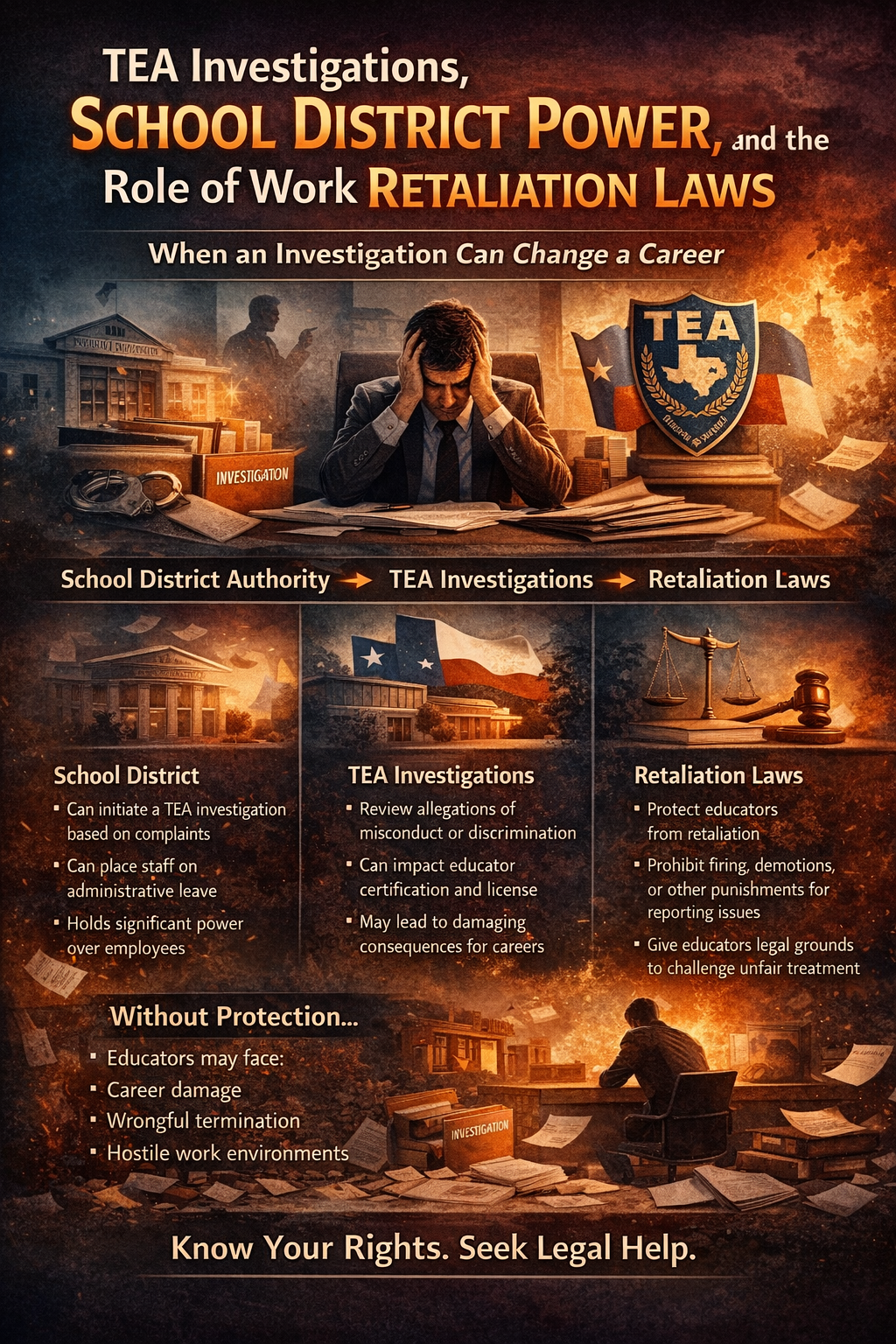
TEA Investigations, School District Power, and the Role of Work Retaliation Laws
When an Investigation Can Change a Career
Educators and school staff dedicate years to building their professional reputations. A teacher, administrator, or school employee often believes that strong performance and commitment will protect their career. However, a workplace investigation can quickly disrupt that stability. When complaints arise inside a school district, the power imbalance between an employee and the employer can become very clear.
In Texas, investigations involving the Texas Education Agency can have significant consequences. These investigations sometimes begin with a simple complaint about workplace conduct, discrimination, or harassment. What starts as a review of an incident may quickly expand into a broader investigation affecting an employee’s license, reputation, and future employment.
Understanding how retaliation, discrimination, and harassment laws apply during a TEA investigation is critical. Teachers and staff members often feel overwhelmed when school districts begin reviewing allegations. Without guidance, employees may not realize how workplace laws exist to protect them during these stressful moments.
The Authority of School Districts During Investigations
School districts hold considerable authority over their employees. Administrators may initiate an investigation after receiving a complaint from students, parents, or other employees. In some cases, districts must report allegations directly to state officials for further review.
The employer typically controls access to evidence, witnesses, and records during an investigation. This imbalance can make employees feel powerless while defending themselves. For educators, even a temporary removal from the classroom can cause professional harm.
When a school district begins reviewing allegations, the situation may affect both the employee and the district’s reputation. Because of this, administrators often move quickly to address concerns, sometimes placing employees on administrative leave during the investigation.
Understanding the Role of TEA Investigations
The Texas Education Agency investigates allegations involving educator misconduct, certification violations, or serious workplace complaints, and educators often need Texas TEA investigations and teacher certification help to navigate those processes. These investigations can involve allegations of harassment, discrimination, or inappropriate conduct in the workplace.
A TEA investigation may begin after a school district reports concerns to the agency. Once an investigation begins, agency officials review documentation, interview witnesses, and evaluate whether further action is necessary.
The outcome of an investigation can impact an educator’s certification and future employment opportunities, making it critical to understand how to survive a TEA investigation and protect your license. For many educators, this process becomes one of the most stressful experiences in their professional life.
Why Workplace Complaints Trigger Formal Investigations
Many TEA investigations begin with a workplace complaint tied to common causes of TEA investigations and related teacher protections. Employees, parents, or students may report behavior they believe violates school policy or workplace laws.
Common complaints that trigger investigations include:
- Allegations of harassment in the workplace
- Reports of discrimination based on national origin or disability
- Concerns involving inappropriate sexual advances
- Allegations involving retaliation after a complaint is filed
Each complaint requires the employer to evaluate the situation carefully. School districts must balance their responsibility to investigate allegations with the need to protect employees from unfair treatment.
The Impact of Workplace Harassment in School Systems
Harassment can take many forms in educational environments. Teachers and school employees may experience inappropriate comments, hostile work conditions, or unwanted sexual advances from colleagues or supervisors.
Workplace harassment often involves repeated behavior that interferes with an employee’s ability to perform their job. In some cases, harassment may involve discrimination related to gender, national origin, disability, or genetic information.
When harassment is reported, the school district must begin an investigation. Failure to respond appropriately could expose the employer to serious legal consequences.
When Discrimination Becomes a Legal Issue
Discrimination occurs when an employee is treated unfairly because of a protected characteristic. Federal law and state laws prohibit discrimination in many workplace settings, including public schools.
Employees may experience discrimination related to national origin, disability, genetic information, or immigration status. In some situations, discrimination may occur after an employee refuses sexual advances or reports misconduct.
For example, a teacher who reports discrimination resisting sexual advances may later face negative treatment from supervisors. When that occurs, the situation may involve retaliation as well as discrimination.
Retaliation in School District Workplaces
Retaliation occurs when an employer punishes an employee for engaging in protected activity, and consulting a retaliation lawyer for workplace retaliation claims can help employees understand their options. Protected activity might include reporting harassment, filing a complaint, or participating in an investigation.
Retaliation can appear in many forms within a school district. A supervisor might suddenly issue negative evaluations, remove responsibilities, or limit promotional opportunities.
The law recognizes that retaliation at work discourages employees from reporting misconduct. Because of this, federal law and state laws prohibit retaliation against workers who raise concerns about discrimination or harassment.
Recognizing Protected Activity
Protected activity refers to actions employees take when asserting their workplace rights. These actions are legally protected, meaning the employer cannot punish the employee for engaging in them.
Examples of protected activity include:
- Filing a complaint about discrimination
- Participating in a workplace investigation
- Reporting harassment or sexual advances
- Supporting another employee who files discrimination claims
When retaliation occurs after protected activity, the employee may have grounds to pursue legal action, including filing a retaliation or labor complaint through appropriate channels.
Administrative Leave During Investigations
One of the most common steps taken during a workplace investigation is placing employees on administrative leave. Administrative leave is often used when an employer believes an employee should temporarily step away from the workplace.
Administrative leave may occur when allegations involve harassment, discrimination, or safety concerns. During administrative leave, employees typically remain away from the workplace while the investigation proceeds.
In many cases, administrative leave is paid leave intended to allow investigators to review allegations without workplace interference.
Paid Administrative Leave in School District Cases
Paid administrative leave is sometimes used when districts want to separate employees from the workplace temporarily. This type of leave allows the employer to review allegations while the employee continues receiving compensation.
The agency determines whether paid administrative leave is appropriate based on the circumstances. The agency head or other agency officials may review evidence before deciding whether to grant administrative leave.
Although administrative leave can be necessary during investigations, extended leave may harm an employee’s reputation or career.
Investigative Leave and Workplace Safety Concerns
Investigative leave is another option used during workplace investigations. Investigative leave allows an employer to temporarily remove an employee while investigators gather evidence.
In certain circumstances, investigative leave may be necessary to maintain workplace safety. For example, if allegations involve harassment or threats toward other employees, the district may place the accused employee on investigative leave.
Investigative leave typically occurs for brief periods while the employer completes its investigation.
Notice Leave and Temporary Workplace Separation
Notice leave may occur when an employee is transitioning out of a position or awaiting investigation results. Notice leave often occurs on a time limited basis while the employer evaluates disciplinary decisions.
Employers must apply notice leave carefully to avoid the appearance of retaliation. When notice leave occurs after a complaint is filed, employees may question whether the employer is responding fairly.
Understanding the purpose of notice leave can help employees evaluate whether the action was appropriate.
Agency Authority in Federal Workplace Systems
Although school districts operate at the state level, many workplace policies are influenced by federal standards. Federal agencies follow strict procedures when handling employee complaints and investigations.
Within federal agencies, the agency head and authorized agency officials may review allegations before determining appropriate action, often with support from HR consulting and internal investigation services. In certain cases, federal employees may be placed on administrative leave during investigations.
Federal workplace policies often influence how local governments and school systems structure their procedures.
Administrative Leave in Federal Employment Systems
Administrative leave is widely used within federal agencies. OPM regulations and opm guidance outline how federal agencies should handle personnel management during investigations.
Federal agencies may grant administrative leave when an employee’s presence in the workplace could disrupt an investigation. Administrative leave is generally intended for short periods or brief periods while investigators review allegations.
These policies aim to protect both the employee and the agency's mission.
The Legal Framework That Protects Employees
Workplace protections are established through federal law and the United States Code. Laws such as Title VII prohibit discrimination based on national origin, disability, or genetic information.
These laws also protect employees who report harassment or discrimination. When retaliation occurs after protected activity, the employee may have the right to pursue legal action.
State laws and local governments may also create additional protections for employees in public school systems.
The Role of the Equal Employment Opportunity Commission
The equal employment opportunity commission investigates workplace discrimination and retaliation complaints. Employees who believe their rights were violated may file a complaint with this agency.
The commission reviews evidence and determines whether discrimination or retaliation occurred. In some cases, the commission may authorize employees to pursue a lawsuit in federal court.
For educators facing retaliation or discrimination, this process can be an important step toward protecting their rights.
Filing a Complaint and Beginning a Legal Process
Filing a complaint often begins the formal legal process for addressing workplace violations. Employees may submit a complaint through internal school district procedures or through federal agencies.
The filing process may involve documenting incidents, identifying witnesses, and providing evidence of discrimination or harassment. Each step becomes part of the official investigation record.
When retaliation occurs after filing a complaint, employees may consider additional legal options.
The Risk of Adverse Employment Actions
Adverse action refers to workplace decisions that negatively affect an employee’s career. These actions may include suspension, demotion, termination, or reassignment.
When adverse action occurs after protected activity, the situation may involve retaliation. Courts examine whether the employer’s decision was motivated by discrimination or retaliation.
An adverse action can significantly affect an employee’s career, especially within public education systems.
How Retaliation Laws Protect Employees
Retaliation laws exist to protect employees who report misconduct. Without these laws, many workers would hesitate to speak up about discrimination or harassment.
These laws apply to both private sectors and public employers. They ensure that employees can report violations without fear of losing their job.
Understanding these protections helps employees recognize when their rights may have been violated.
The Influence of Federal Policies and Executive Orders
Federal workplace standards are often shaped by executive order, presidential directive, or presidential memorandum. These policies may instruct federal agencies to strengthen employee protections.
Federal policies also influence how investigations are conducted. They guide agency officials in balancing workplace safety with employee rights.
Although these policies primarily affect federal agencies, they often influence employment practices across other government institutions.
Situations Where Administrative Leave Is Appropriate
Administrative leave may be appropriate in several workplace circumstances. Employers must ensure that the decision to place employees on administrative leave is reasonable.
Examples may include:
- Allegations of workplace harassment requiring investigation
- Concerns involving workplace safety
- Situations where evidence must be reviewed without interference
Administrative leave should occur on a time limited basis and should not be used as retaliation.
The Long-Term Impact of Investigations on Careers
A workplace investigation can have lasting consequences. Even when allegations are not proven, the existence of an investigation may affect an employee’s professional reputation.
Teachers and administrators may find it difficult to secure future employment after a public investigation. This is especially true if the employer documents disciplinary action during the process.
Because of these risks, educators often benefit from early legal guidance from Texas TEA investigation defense attorneys during the investigation process.
The Role of Other Authorized Agency Officials During Investigations
In complex workplace investigations, decisions are not always made by a single administrator. In many situations, other authorized agency officials may participate in reviewing evidence, evaluating witness statements, and determining how the investigation should proceed. Their involvement helps ensure that decisions are balanced and not influenced by a single supervisor or department. These officials may coordinate with leadership, legal advisors, and the administrative office responsible for handling sensitive employee matters. Their role is particularly important when investigations involve serious allegations of discrimination, harassment, or retaliation.
Administrative Leave Used for Brief or Short Periods
During a workplace investigation, employers sometimes separate an employee from daily responsibilities while the matter is reviewed. In many cases, administrative leave is used only for brief or short periods so investigators can gather information without workplace disruptions. This temporary step allows the employer to interview witnesses and review documentation while maintaining fairness to everyone involved. Short administrative leave periods may help protect the integrity of the investigation while also preserving professional relationships within the workplace.
How an Investigation Can Affect the Employee's Current Position
One of the most stressful aspects of a workplace investigation is the uncertainty surrounding the employee's current position. Even before the investigation concludes, an employer may temporarily adjust job responsibilities or remove an employee from certain duties. These changes can create anxiety for employees who worry about how the situation may affect their long-term career prospects. Although these adjustments are sometimes necessary during investigations, employers must ensure that the employee's current position is not unfairly altered in a way that suggests retaliation or discrimination.
Federal Government Influence on Workplace Procedures
Many workplace procedures are influenced by standards developed by the federal government. Federal employment laws establish guidelines for addressing discrimination, harassment, and retaliation in public and private workplaces. These standards help ensure that investigations follow consistent rules designed to protect employees and maintain fairness. When organizations adopt policies aligned with federal guidelines, they create clearer expectations for supervisors and employees during workplace disputes.
The Importance of Policies That Issue Internal Policies Consistent With the Law
Employers must issue internal policies consistent with federal and state employment laws to ensure fair treatment of workers. These policies explain how complaints should be reported, investigated, and resolved. When organizations clearly communicate their expectations, employees are more likely to trust the investigation process. Effective policies also protect the employer by demonstrating that workplace rules follow established legal standards.
How Agency Judgments Shape Investigation Outcomes
Every workplace investigation requires decision makers to evaluate evidence and determine the appropriate outcome. These agency judgments often influence whether disciplinary action occurs or whether the employee returns to normal duties. Because careers may be affected by these agency judgments, employers must base their conclusions on documented facts rather than assumptions. When employees believe that agency judgments were unfair or biased, they may seek legal guidance to review the investigation process.
When Administrative Leave Is Specifically Authorized
In many organizations, administrative leave can only be implemented when it is specifically authorized by senior leadership or designated officials. This requirement prevents supervisors from placing employees on leave without proper review. Authorization procedures help ensure that leave decisions follow established rules and are applied fairly across the organization. When administrative leave is specifically authorized, the employer demonstrates that the decision was reviewed carefully and not made impulsively.
Understanding Excused Absence During Workplace Reviews
In addition to administrative leave, some employers may grant excused absence when employees must temporarily step away from the workplace. Excused absence allows employees to remain away from work without disciplinary consequences while certain issues are reviewed. This type of leave may be used when employees must participate in interviews or when an investigation creates temporary scheduling conflicts. Employers typically limit excused absence to short time frames while the situation is evaluated.
Legal Protections That Extend to Job Applicants
Workplace laws do not protect only current employees. Job applicants also have legal protections against discrimination and retaliation during the hiring process. Employers must evaluate job applicants based on qualifications rather than characteristics such as national origin, disability, or genetic information. If job applicants believe they were denied employment due to unlawful discrimination, they may have legal options available to challenge those decisions.
The Role of Agency Policies in Workplace Accountability
Strong agency policies help guide how complaints and investigations are handled. These policies explain how employees can report harassment or discrimination and how the organization will respond. Agency policies also outline procedures for reviewing evidence and determining whether workplace rules were violated. When agency policies are applied consistently, employees gain confidence that workplace concerns will be addressed fairly.
Safety Leave as a Workplace Protection Measure
In certain circumstances, employers may place employees on safety leave when workplace conflicts or threats raise concerns about personal security. Safety leave allows employees to remain away from the workplace while investigators evaluate the situation. This type of leave may be used when harassment or serious conflict creates a potentially unsafe environment. Employers must carefully document the reasons for safety leave to ensure that it is applied appropriately.
The Influence of Internal Policies on Workplace Culture
Well-designed internal policies help establish expectations for professional behavior within an organization. These policies guide how supervisors respond to complaints and how investigations should be conducted. When internal policies are clearly communicated, employees understand how to report misconduct and what protections exist for them. Organizations that maintain strong policies often experience fewer disputes because employees know that the workplace values fairness and accountability.
Administrative Leave for Community and Health Activities
Some employers provide administrative leave or excused absence for civic and health-related activities. For example, employees may receive time away from work to participate in blood donations or other public health initiatives. These programs encourage community involvement while supporting important causes. Employers who support blood donations demonstrate a commitment to both employee well-being and community service.
Workplace Programs That Are Officially Sponsored
Organizations sometimes organize training sessions, volunteer events, or wellness initiatives that are officially sponsored by the employer. When employees participate in officially sponsored activities, they may be granted administrative leave or excused absence to attend. These programs can improve workplace morale and encourage collaboration among employees. Participation in officially sponsored initiatives often strengthens relationships within the organization.
Ad Hoc Investigations for Unexpected Complaints
Occasionally, a workplace complaint requires an ad hoc investigation to address unexpected circumstances. These investigations are created quickly to evaluate allegations that require immediate attention. An ad hoc investigative team may gather evidence, interview witnesses, and provide recommendations to leadership. Although ad hoc investigations are temporary, they play an important role in addressing urgent workplace concerns.
Interpreting Other Provisions Within Employment Policies
Employment laws sometimes include an other provision designed to address situations that are not clearly defined within standard policies. This language allows employers to respond to unusual circumstances that may arise during an investigation. While these provisions provide flexibility, they must be applied carefully to avoid violating employee rights. Legal review may be necessary when disputes arise over how such provisions should be interpreted.
Investigations That Extend Across a Calendar Year
Workplace investigations occasionally take longer than expected, especially when multiple witnesses and complex evidence are involved. Some investigations may extend across an entire calendar year before a final decision is reached. During this time, employers must carefully document each stage of the investigation. Maintaining transparency throughout the process helps ensure that employees remain informed about the status of the review.
The Administrative Office and Its Role in Investigations
Within many organizations, the administrative office plays a central role in coordinating workplace investigations. The office typically collects records, schedules interviews, and maintains documentation related to the complaint. Staff in the office ensure that investigation procedures follow established workplace policies and legal guidelines. Because these records may become important evidence in future disputes or legal proceedings, the office must maintain accurate and organized documentation throughout the investigation process.
Why Legal Guidance Matters During TEA Investigations
When employees face investigations involving harassment, discrimination, or retaliation, legal representation can provide important support, including guidance on the immediate steps to take after a TEA investigation notice. Attorneys can help employees understand their rights and evaluate the employer’s actions.
Legal professionals may also communicate with school districts or federal agencies during the investigation. This guidance can help employees avoid mistakes that could affect their case.
When a lawsuit becomes necessary, legal representation becomes even more important.
Protecting Educators and School Employees
Educators deserve fair treatment during workplace investigations. Federal law, state laws, and local governments all establish rules designed to protect employees from discrimination and retaliation.
When school districts misuse their authority, employees may face serious consequences, making experienced Texas education lawyers an important resource. Legal protections exist to ensure that investigations remain fair and balanced.
Understanding these protections empowers employees to defend their careers.
Speak With Masterly Legal Solutions About Your Situation
Facing a workplace investigation or retaliation can feel overwhelming, especially when your professional reputation is at stake. Teachers, administrators, and school employees often find themselves navigating complicated investigations without clear guidance.
At Masterly Legal Solutions, we work with employees who believe they have been treated unfairly during workplace investigations. Whether the issue involves discrimination, harassment, retaliation, or administrative leave during a TEA investigation, our team helps employees understand their legal options.
If you believe your employer has taken adverse action after you filed a complaint or participated in an investigation, it may be time to seek legal guidance. Understanding your rights early in the process can make a significant difference in protecting your career.
We invite you to contact Masterly Legal Solutions for a free consultation to discuss your concerns and explore potential next steps. Our team can help evaluate the circumstances surrounding your workplace investigation and explain how retaliation laws may apply.
Call (972) 236-5051 today to schedule a confidential consultation and learn how we may assist you in protecting your career and professional reputation.
Disclaimer: This article is intended for informational and educational purposes only. It does not constitute legal advice or create an attorney-client relationship with Masterly Legal Solutions. Employment laws and regulations may change, and individual circumstances vary. If you are facing discrimination, harassment, retaliation, or a workplace investigation, you should consult a qualified attorney regarding your specific legal situation.





Looking for Legal & Business Solutions? Contact Us Now
Fill in the form or call us to set up a meeting