

How Statements Made to TEA Investigators Are Used Against Educators
If you are a teacher and you receive a call, email, or letter connected to the Texas Education Agency, your first instinct may be to “clear things up” quickly. Many educators are professional by nature, and they assume that being open, cooperative, and detailed will resolve misunderstandings. In a normal school setting, that approach often works. In a TEA investigation, however, the words you choose—and the way you explain events—can be turned into evidence and used against you in ways you never expected.
At Masterly Legal Solutions, we work with teachers, administrators, and other school employees who feel blindsided by how an investigation unfolded. They often say the same thing: “I was just trying to be helpful.” Unfortunately, statements made to investigators can shape the entire case, including the allegations, the credibility findings, and whether disciplinary proceedings move forward. This article is meant to educate you, but also to make one point clear: you can protect yourself while still being respectful, truthful, and professional.
Education law is full of strict procedures, timelines, and high-stakes consequences. A single sentence can affect your employment, your certification, and your future in public education. When the pressure is high, the best results often come from preparation, not improvisation.
Understanding TEA Investigations in the Education System
The education system in Texas is built on layers of oversight, including local school district rules, state standards, and federal law. When a concern is reported—whether it involves ethics, testing, boundaries, special education, or conduct—investigators may gather information to determine whether discipline is appropriate. TEA investigators are not there to “coach” you through the conversation, and they are not required to interpret your statements in the most charitable way. Their focus is to collect facts, compare accounts, and build an administrative record.
A TEA investigation can involve teachers, staff members, school administrators, parents, students, and witnesses in the school system. It may connect to public school, charter schools, private school settings, and even university-related education programs depending on the allegations. In many cases, the investigation begins inside the school district and then extends outward. The words you provide may be referenced in district decisions, state board reviews, and later legal matters.
Because education law matters can touch multiple systems at once, educators should treat every statement as potentially permanent. In education, even informal conversations can become formal evidence.
Why Educators Feel Pressured to Talk
Teachers are trained to communicate. In an educational setting, you are expected to explain decisions, justify actions, and describe interactions with students. That habit can become a vulnerability when you’re under investigation because you may over-explain, fill in gaps, or respond emotionally. Investigators often ask open-ended questions that invite long narratives, and the longer you talk, the more opportunities there are for misunderstandings.
Many educators also fear that refusing to answer questions will make them look guilty. That fear is understandable, especially when your identity is tied to your work in schools and public education. But protecting your rights is not the same as hiding the truth. It is about making sure your truth is presented accurately and fairly.
Education attorneys often see cases where a teacher’s statements did more harm than the original complaint. This is not because the teacher lied, but because the statement was incomplete, poorly phrased, or interpreted in a damaging way.
How TEA Investigators Use Statements in Real Cases
A statement is not just “your side of the story.” In many investigations, your statement becomes the backbone of the agency’s timeline and theory of the case. Investigators may compare your words to other evidence, highlight inconsistencies, and emphasize phrases that support a policy or ethical violation.
Statements may be used to:
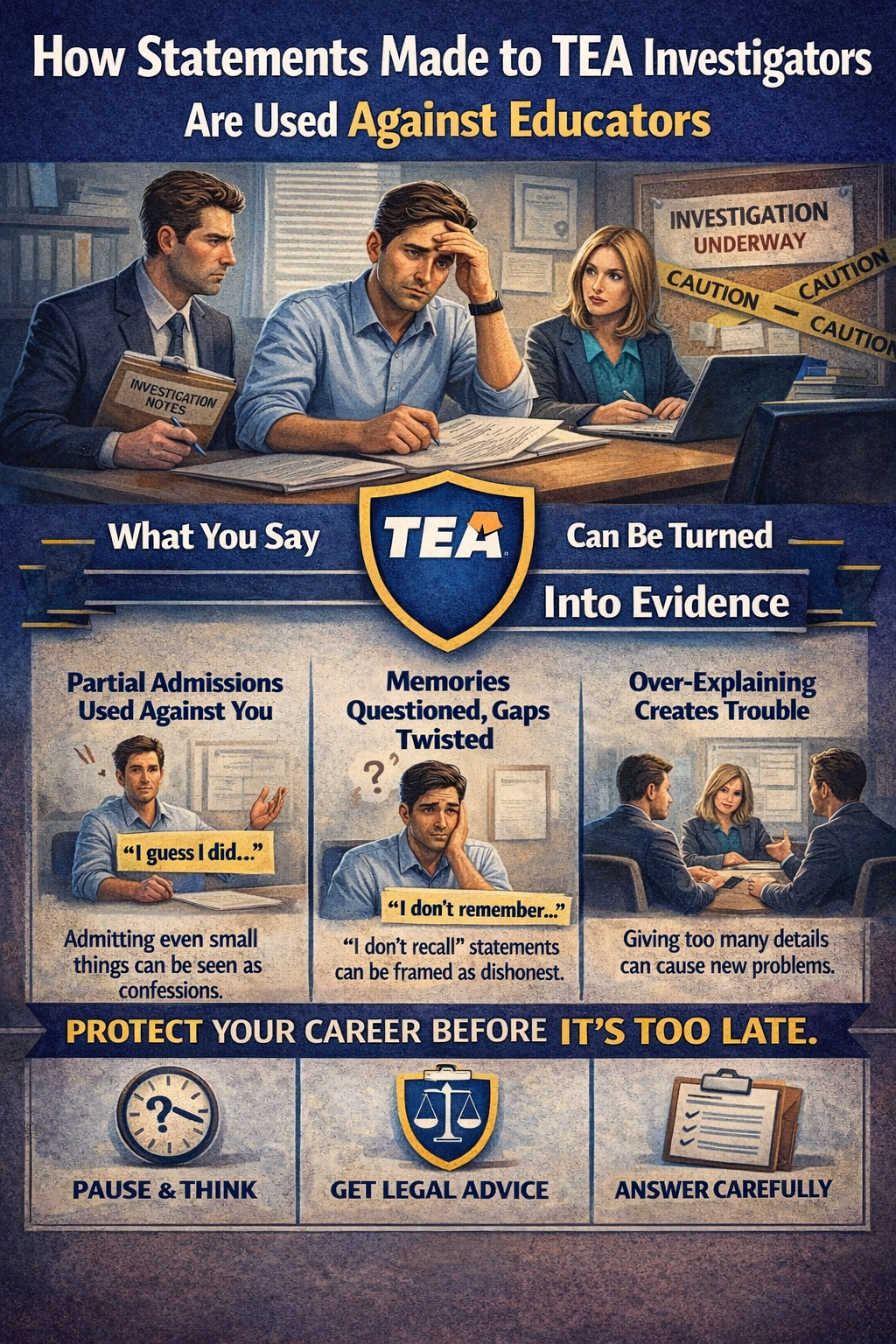
- Identify admissions or “partial admissions”
- Support a finding that conduct was intentional
- Argue that a teacher knew a rule and violated it anyway
- Suggest a teacher was careless or reckless
- Challenge credibility by comparing accounts
- Build a basis for disciplinary action or disciplinary proceedings
This is one reason education law attorneys encourage careful preparation. A TEA case is not a casual conversation. It is a process with consequences that can follow you across your career.
The Most Common Ways Statements Get Twisted
A teacher can say something truthful and still get hurt by how it is framed. The risk often comes from ambiguity, emotion, and assumptions. Investigators may interpret a phrase in a way that supports their narrative, even if that was not your intent.
When “I Was Just Trying to Help” Becomes an Admission
Teachers often try to show good intent. Unfortunately, in complex legal issues, intent language can be used to argue you knowingly crossed a boundary.
For example, saying, “I knew it wasn’t ideal, but I thought it would be okay,” can be interpreted as awareness of wrongdoing. Even when the best interests of students were your real motivation, your phrasing can be read as minimizing a rule. Education lawyers often help educators replace vague intent statements with clear, factual descriptions.
When “I Don’t Remember” Sounds Like Dishonesty
Memory gaps are normal, especially when educators handle dozens of interactions daily. But in disciplinary hearings or disciplinary proceedings, repeated “I don’t remember” statements can be presented as evasive.
That does not mean you should guess. Guessing is often worse. The safer approach is learning how to answer accurately without speculating, while still sounding prepared and credible.
When Emotions Create Inconsistencies
Investigations can feel personal. When educators are stressed, they may speak faster, include extra details, or defend themselves aggressively. That can create inconsistencies between early statements and later statements.
A small inconsistency can be framed as dishonesty, even if it was simply stress. Skilled lawyers and legal professionals help educators stay consistent, calm, and focused on verifiable facts.
The Problem With Over-Explaining in Education Law Cases
Teachers often give long explanations because they are used to being evaluated by administrators. But long explanations create risks: side stories, extra names, and unnecessary details can trigger new allegations or new challenges.
Over-explaining can also introduce concepts you did not intend. For example, a teacher may describe classroom management and accidentally reveal a policy violation unrelated to the complaint. In education law, one issue can expand into multiple legal issues quickly.
Education law attorneys often advise educators to answer only what is asked, in a factual and structured way. That approach protects you while still cooperating.
Investigators Look for “Admissions,” Even When You Don’t Realize It
An admission is not always a confession. In many education law matters, an admission can be as simple as acknowledging you were alone with a student, acknowledging you used a personal phone, or acknowledging you did not follow a reporting step perfectly.
Admissions can be created when educators use phrases like:
- “I probably should have…”
- “I guess I did…”
- “I didn’t think it mattered…”
- “I know the policy says…”
- “I was just trying to…”
These phrases may sound normal in conversation. In administrative matters, they can be highlighted as evidence. Education attorneys help teachers communicate facts without accidentally building a case against themselves.
When a TEA Statement Impacts Employment Decisions
Even if TEA does not immediately take action, your statement can still impact employment. Many school districts review investigation records when deciding whether to reassign duties, recommend termination, or impose discipline. Your school district may treat your statement as a “final version” of events, even if you later realize you misunderstood a question.
Employment consequences can include:
- Reassignment within the school system
- Limits on contact with students
- Paid administrative leave or administrative leave
- Increased monitoring by supervisors
- Contract nonrenewal or termination
- Reporting to the state board
Employment in a public school system can be affected quickly when the district believes risk exists. When your job is on the line, legal representation can make all the difference.
Administrative Leave and the Danger of “Off-the-Record” Conversations
Teachers placed on administrative leave often receive calls framed as “informal” check-ins. They may be told, “This isn’t official,” or “We just want to hear your side.” Many educators do not realize these conversations can still influence the process and later disciplinary action.
Even if a conversation isn’t recorded, a summary may be written into the investigation file. That summary can be used later during administrative hearings or appeal process steps. If you are on administrative leave, treat every interaction about the case as part of the case.
Education law attorneys frequently assist educators during administrative leave to prevent careless statements from creating lasting harm.
How Title IX Changes the Stakes in Schools and Universities
Title IX cases can involve allegations related to sex-based harassment, sexual harassment, boundaries, or misconduct in an educational setting. Title IX matters often include strict procedures, specialized investigators, and detailed reporting requirements. In these cases, statements are often compared carefully with other witness accounts, texts, emails, and digital evidence.
A teacher or university employee may believe they are “explaining context,” but investigators may interpret context as justification. Title IX cases can also involve students rights, due process hearings, and disciplinary hearings depending on the institution. In university matters, the education system approach may differ, but the risk is still serious.
Education lawyer guidance is especially valuable in Title IX matters because a poorly worded statement can escalate the case.
Special Education Law and Statements in IEP-Related Disputes
Special education law adds another layer of complexity. Investigations may involve special education services, IEP meetings, accommodations, and disputes about a child’s rights. Teachers and staff members may be questioned about what happened during IEP meetings, what was offered, and whether procedures were followed.
In special education cases, statements can be used in due process hearings, grievance hearings, or administrative hearings. A teacher’s statement might be presented as proof that a service was denied or that documentation was incomplete. Even when the teacher acted in good faith, poor phrasing can create legal exposure for both the educator and the school district.
Education attorneys who handle special education cases know how quickly these matters can become complex legal issues.
The High-Risk Topics Where Statements Are Closely Scrutinized
Some categories of allegations trigger heightened scrutiny, particularly when student safety is involved. In these situations, investigators may look for intent, knowledge, and failure to report.
High-risk allegations include:
- Physical or sexual abuse claims
- Sexual abuse accusations
- Sexual harassment claims
- Boundary violations involving students
- Reporting failures involving special needs children
- Concerns tied to civil rights protections
When the allegations involve children and students, the emotional pressure can be intense. Educators often feel panicked and want to “fix it” with one conversation. In reality, those are the moments when legal support is most important.
How Civil Rights Issues Appear in Education Investigations
Civil rights issues arise when students or teachers claim discrimination, unequal treatment, or improper handling of protected categories. Civil rights concerns may also appear in special education disputes, discipline issues, or Title IX matters. In these cases, statements are evaluated for bias, intent, and compliance with policies.
A teacher may accidentally use language that sounds dismissive, even if that was not the intent. Investigators may also compare teacher statements to school policies and training materials. Civil rights topics are sensitive and often politically charged in public education.
Education law attorneys help educators respond professionally while protecting their own rights and reputation.
Representing Teachers vs. Representing Students: Why the Focus Matters
Education law is broad. Some education attorneys focus on representing students and families, including child’s rights, special education services, and due process hearings. Others focus on representing teachers and other school employees facing investigations, discipline, or licensing action.
The strategy differs depending on who the client is. If you are the educator under investigation, you need legal professionals who understand teacher defense, employment consequences, and TEA procedures. You also need someone who understands how school districts operate internally.
At Masterly Legal Solutions, our practice includes representing teachers in serious education law matters where statements and credibility can shape the outcome.
The “Record” Follows You: Why This Is Not Just One Meeting
Teachers sometimes believe that once they finish an interview, it is over. In education law, it is often just beginning. Your statement can be referenced later in disciplinary proceedings, licensing reviews, and administrative matters. It can also appear in district files that follow you across hiring decisions.
Even if you move to a different school district, the prior record can impact opportunities in the education system. For educators who built a career in public school or a public school system, that can be devastating.
Because the record matters, careful phrasing matters.
Common Mistakes Educators Make When Talking to Investigators
Most mistakes are not intentional. They happen because teachers are stressed, surprised, and unprepared.
Trying to Talk Your Way Out of Trouble
Teachers often believe that if they just explain enough, the investigator will “get it.” But investigations rely on documents, timelines, and structured findings, not empathy. Over-talking can create additional contradictions and open new lines of inquiry.
Admitting Policy Issues Without Understanding the Rule
Educators sometimes admit “I didn’t follow the policy” without realizing the policy is more nuanced. Or they assume a rule exists when it doesn’t. A statement like that can become a foundation for discipline.
Speaking Negatively About Students, Parents, or Staff Members
In the heat of stress, a teacher may express frustration about parents, students, or staff members. Those comments can be portrayed as bias or unprofessional conduct. In a civil rights context, those statements can be especially harmful.
How Education Attorneys Help You Prepare Without “Hiding Anything”
Some teachers worry that hiring an education lawyer makes them look guilty. In reality, legal representation is about clarity, fairness, and protection. Education attorneys help you understand what questions mean, what evidence matters, and how to answer accurately.
Preparation does not mean changing the truth. It means presenting the truth in a clear way that cannot be twisted. Education law attorneys also help you avoid speculation and ensure your statements align with documents and timelines.
That preparation can make all the difference in your outcome.
The Role of Administrative Hearings and Disciplinary Hearings
If a matter escalates, it may move into administrative hearings, disciplinary hearings, or other formal proceedings. These forums are structured, and statements are often introduced as exhibits. Educators may be cross-examined on what they previously said, and small inconsistencies may be emphasized.
Disciplinary proceedings can also involve the state board, licensure decisions, and employment consequences. Once in these stages, “I meant something else” becomes hard to explain. The earlier statement becomes the anchor.
Education law attorneys prepare educators with the understanding that each stage can build on the last.
The Appeal Process and Why Early Statements Still Matter
Even when an educator has appeal rights, appeals often focus on the record already created. That means your early statements can still control the narrative. Appeals can be limited in what new information can be introduced, depending on the forum.
If you are considering the appeal process, it is important to know that success often depends on how well the case was handled at the start. A strong early strategy is often more effective than trying to repair damage later.
That’s why education attorneys emphasize early involvement.
How Schools and Educational Institutions Coordinate With Investigations
Many educational institutions coordinate closely with investigators and legal teams. School districts may consult their own law firm and legal professionals to manage risk and protect the organization. This means you are often facing an employer who already has legal services behind the scenes.
Teachers sometimes assume the district is “neutral,” but the district’s interests are not the same as yours. The district’s priority is minimizing exposure, protecting the school system, and maintaining compliance. That is not personal; it is business, risk management, and policy.
To level the playing field, teachers often need their own education lawyer.
Charter Schools and Private School Investigations Still Carry Serious Risk
Educators working in charter schools or private school environments sometimes believe TEA processes apply only to public school. While the structure can differ, investigations involving licensure, reporting duties, or student safety can still impact a teacher’s credentials and future employment.
The school system may change, but your professional record remains attached to you. Statements made in one investigation can affect future opportunities across the education system.
When in doubt, treat the matter as serious and protect yourself early.
Representing Students and Teachers: A Balanced Perspective
Education law touches students, families, and educators. Teachers often care deeply about students rights and the best interests of children, including special needs children. Many educators also support special education services and want every student to succeed.
Yet when an investigation begins, the teacher becomes a subject, and the process shifts. Your desire to help does not eliminate the risk to your career. Teachers need to be able to advocate for students while also protecting themselves.
Education attorneys can help you do both without sacrificing your future.
New Challenges for Teachers in Modern Investigations
Today’s investigations often involve more documentation, digital evidence, and heightened public sensitivity. Emails, texts, classroom recordings, and online posts can all become part of the evidence. New challenges also include broader Title IX enforcement, increased attention to civil rights, and complex special education expectations.
Teachers face pressure from many directions: parents, administrators, students, and community expectations. Investigations can become intense quickly, even when the incident was minor.
These new challenges make careful communication more important than ever.
Practical Ways to Protect Yourself Before You Speak
You do not need to be defensive to be smart. The goal is to protect your voice, your record, and your job.
Before providing any statement, consider these protective steps:
- Ask what the topic is and what policies are involved
- Request time to review documents and refresh your memory
- Avoid guessing dates, names, or details
- Keep your answers factual and focused
- Do not volunteer extra information beyond the question
- Speak with education law attorneys if the allegations are serious
These steps help you cooperate while still protecting yourself.
What to Do If You Already Gave a Statement
Many educators contact us after they already gave a statement and then realize it may be used against them. If this is you, you are not alone. What matters now is how you move forward.
Education law attorneys can still help by reviewing the statement, preparing for follow-up interviews, correcting misunderstandings through proper channels, and building a strategy for disciplinary proceedings. You may still have options depending on where the case is in the process.
It is often better to get legal support now than to wait until the case escalates.
Why Masterly Legal Solutions Focuses on Teacher Defense in Education Law
At Masterly Legal Solutions, we understand that teachers are often doing their best in high-pressure environments. We also understand how quickly a teacher’s words can be taken out of context and used as a weapon. Our team supports educators facing investigations, administrative matters, and disciplinary action—because we know a career in education is more than a job. It’s identity, stability, and long-term purpose.
We provide tailored legal services designed for real educators facing real risk. We work to protect your rights, your reputation, and your ability to continue working in public school, charter schools, private school environments, and other educational institutions. When your future is on the line, strong legal representation can make all the difference.
Our extensive experience in education law helps us anticipate how statements will be read, quoted, and used, and we prepare you accordingly.
Education Law Firm Support When Your Career Is on the Line
When a TEA complaint or school district investigation escalates, working with an education law firm can bring structure to a process that often feels confusing and one-sided. An education law firm can help you prepare statements, respond to interview requests, and protect your professional record before a misunderstanding becomes a lasting allegation. At Masterly Legal Solutions, we focus on education law matters that affect teachers and other school employees, with tailored legal services designed to protect your license, your reputation, and your future.
Texas Education Lawyers Who Understand TEA and District Procedures
Texas education lawyers know how the Texas Education Agency, school districts, and licensing rules intersect—and why timing, documentation, and strategy matter so much. In many cases, educators do not realize how quickly a district report can create state-level consequences, including disciplinary proceedings and administrative hearings. With texas education lawyers involved early, you can avoid common mistakes, present your facts clearly, and protect yourself while still cooperating with the investigation.
Employment Law Issues That Often Overlap With TEA Investigations
A TEA matter can trigger serious employment law problems, even when the original complaint seems narrow. Administrative leave, reassignment, disciplinary action, and contract nonrenewal are employment decisions that can affect pay, benefits, and long-term career options. Because employment law and education law frequently overlap, it’s important to approach the situation with a plan that protects both your job status and your certification risk.
Teachers Rights During Investigations and Disciplinary Proceedings
Understanding teachers rights can help you stay grounded when the district’s process feels rushed or unclear. Teachers rights may involve notice of allegations, fair procedures, the ability to respond, and access to representation depending on the circumstances and district policy. Even when you want to be cooperative, you should not be pressured into statements, resignations, or agreements without fully understanding how those choices could affect your license and future employment.
Disabilities and Workplace Protections for Educators Under Stress
Investigations can impact an educator’s health, especially when anxiety, depression, or other conditions are triggered or worsened under pressure—and that’s where disabilities considerations may matter. Some educators may qualify for workplace accommodations or protected leave if a medical condition substantially limits major life activities, and documentation becomes especially important when administrative leave or discipline is involved. If disabilities are part of your situation, legal counsel can help you communicate carefully, protect your privacy, and pursue options that support your stability while the investigation moves forward.
Contact Masterly Legal Solutions for a Free Consultation
If you are being contacted by the Texas Education Agency or your school district, or you are preparing to speak with investigators, don’t walk into that conversation unprepared. Many teachers think the safest move is to “just explain,” but in education law investigations, your statement can shape everything that follows—employment decisions, disciplinary proceedings, administrative hearings, and even your long-term place in the education system.
At Masterly Legal Solutions, our education law attorneys help educators respond with clarity, confidence, and protection. Whether you are facing Title IX concerns, special education law disputes, allegations involving students, or questions that could lead to disciplinary hearings, we can provide the legal support you need. We work with teachers who want to cooperate while still protecting their career, their license, and their future.
Contact Masterly Legal Solutions at (972) 236-5051 for a free consultation.
Let’s talk through your situation and help you take the next step with the preparation and guidance you deserve.
Disclaimer: This article is for educational purposes only and does not constitute legal advice or legal guidance. Reading this article does not create an attorney-client relationship. For advice on your specific circumstances, consult a qualified attorney.



Teacher Rights When Assaulted by a Special Needs Student: Safety, Reporting and Investigation Issues


Looking for Legal & Business Solutions? Contact Us Now
Fill in the form or call us to set up a meeting





