

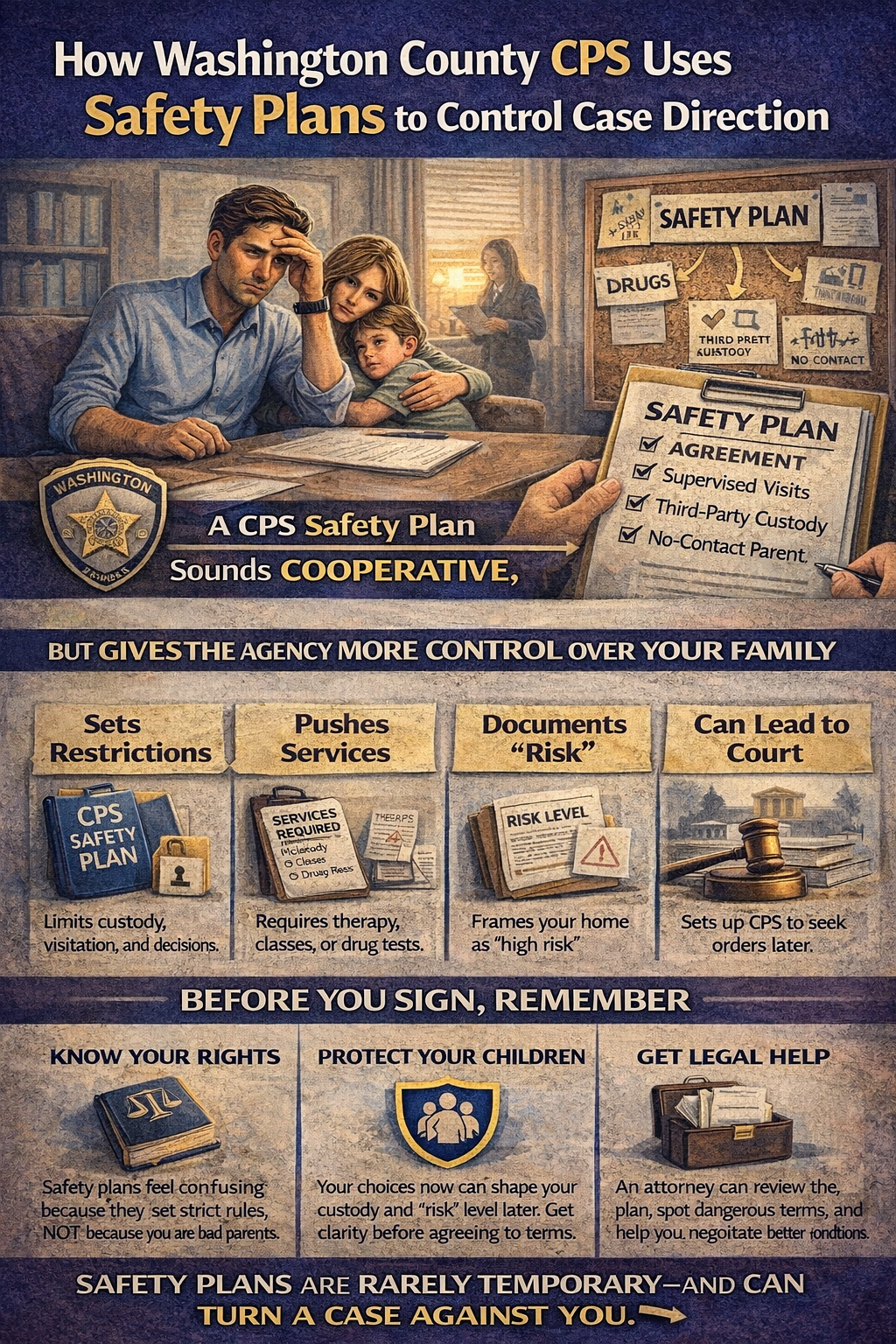
How Washington County CPS Uses Safety Plans to Control Case Direction
The first days of a CPS case can feel like a blur. One phone call turns into home questions, interviews, paperwork, and a growing sense that someone else is steering your family life. In Washington County, many families discover that the most powerful “tool” CPS uses isn’t always a courtroom hearing—it’s the safety plan. Safety plans are often presented as temporary, cooperative agreements, but they can quietly shape the entire direction of a case long after the initial shock fades.
At Masterly Legal Solutions, we work with families who signed documents too quickly because they wanted the stress to stop or believed cooperation would end the investigation. Later, they learn those administrative agreements can influence everything: custody decisions, visitation restrictions, the “risk level” assigned to your household, and whether CPS pushes for court involvement. Safety plans can seem simple in the moment, but they can become the framework that CPS uses to justify the next step. When families understand this early, they can make smarter choices and protect their rights.
This article explains how Washington County CPS uses safety plans to control case direction, why these agreements affect long-term outcomes, and what families can do to build a strong response. We’ll also show how a cps defense lawyer can help you protect your child, your reputation, and your family’s future without escalating the conflict.
What CPS Is Really Doing When It Offers a Safety Plan
In many cps cases, CPS frames a safety plan as a way to “keep the child safe” while the agency finishes its work. That sounds reasonable, and many parents want to show they support child safety. But a safety plan is also a control document. It sets conditions, restrictions, and expectations that can later be used as proof that CPS had valid safety concerns in the first place.
This matters because CPS is part of government agencies tasked with handling child welfare cases and responding when cps receives a report. Once CPS is involved, it is not only investigating reports—it is building a record. That record can shape the rest of the cps investigation process. The safety plan becomes part of the case narrative, even if you never go to court.
Families should treat safety plans as more than “temporary paperwork.” In many situations, they are the first major pivot point of the entire investigation.
Understanding the Washington County CPS Investigation Process
A cps investigation usually starts with a report claiming abuse or neglect. The report may involve child abuse, a neglect case, or concerns about supervision, home conditions, or family conflict. The agency opens an investigation, assigns a cps caseworker or investigator, and begins gathering information. In Washington County, the investigation can move quickly because caseworkers often use standard processes to document risk and determine what services to require.
The cps investigation process typically includes interviews, home assessments, requests for records, and questions about the child’s routine. CPS may also ask about other relatives, household members, or caregivers involved. The agency may look for patterns and past history, even if the report involved only one incident. This is where families often feel like the investigation is expanding beyond what makes sense.
If you understand these steps early, you can respond calmly, document properly, and avoid decisions that lock in the agency’s version of events.
Why Safety Plans Can Feel “Voluntary” but Function Like Orders
CPS often says a safety plan is voluntary. In practice, families may feel there is no real choice. Parents are told, “Sign this or we may have to take further action,” and fear does the rest. That fear is understandable, especially when CPS mentions removal, supervised visitation, or court involvement.
A safety plan may not be a court order, but it can operate like one inside your home. It can restrict who can be around the child, what the family must do, and how parenting decisions are made. Parents may also worry that refusing will be interpreted as refusing to protect children. This is why safety plans are such a powerful tool for directing the case.
The safest approach is to treat a safety plan like a legal document—because its impact is often legal in practice, even when it’s framed as administrative.
How CPS Uses Safety Concerns to Justify the Plan
Safety plans usually begin with “safety concerns.” CPS may claim the home is unsafe because of alleged risks, even when no injury occurred. Sometimes the concern is tied to child abuse or neglect. Other times it’s tied to a conflict, stress, or household instability. The key is that once safety concerns are listed, CPS has a reason to impose conditions.
This is where families must be careful. Safety concerns may sound vague, but they often become the foundation for future decisions. If the plan claims “risk of abuse,” later documents may reference that phrasing as if it were already proven. Even a family that strongly denies alleged child abuse can get pulled into a plan that reads like an admission.
Understanding the language of the plan is essential. Small wording details can shape the next steps more than most parents expect.
The Hidden Power of Administrative Agreements
Safety plans are a type of administrative agreement. They can influence case direction without a judge ever getting involved. That’s why families sometimes underestimate them. But administrative agreements can become evidence of “need,” and CPS can later argue the family required intervention because the family signed the plan.
Administrative agreements can also shape how CPS categorizes your household. CPS may decide your case is “high risk” because the plan required restrictions. That classification can affect how long the case stays open and what additional services CPS demands. It can also shape whether CPS decides to file a dependency petition or seek court intervention.
In other words, the plan can become the engine that moves the case forward—whether you intended that or not.
How Safety Plans Affect Parental Rights Before Court Begins
Most parents assume parental rights change only if a court takes action. In reality, safety plans can reshape parental rights informally. Parents may lose decision-making power over who watches the child, where the child stays, and how the family functions day-to-day. Some plans essentially transfer control to CPS-approved adults.
Safety plans can also set the stage for custody problems. If a plan requires the child to live with a relative or other caregiver, that arrangement can become normalized. Later, CPS may argue the child is already stable elsewhere and should remain there. Parents may feel their rights are slipping away quietly.
This is why families should not sign a safety plan without understanding what it does to their real-life authority.
Why CPS Determines “Direction” Based on Compliance
CPS often measures progress through compliance. If you comply fully, CPS may say the plan was necessary and successful. If you struggle, CPS may claim the family is unwilling or unable to ensure safety. Either way, CPS uses compliance as a decision tool.
This is why the plan matters so much. The plan becomes the yardstick used to measure your family. If the plan is unrealistic, vague, or overbroad, it increases the risk of alleged noncompliance. CPS may then argue it has sufficient evidence that the family needs stronger control.
A better plan is not just “shorter.” It is clearer, fairer, and tied to facts that can actually be proven.
Supervised Visitation and the Long Tail of Safety Plans
Safety plans sometimes include supervised visitation even before a court hearing. This is often justified as “temporary,” but it can become a long-term arrangement if the case expands. Supervised visitation can impact the child emotionally and can strain the parent-child relationship. It can also create a record suggesting CPS had reason to believe the parent was unsafe.
In many cases, supervised visitation becomes the default schedule. Parents may then be forced to “earn back” normal access by completing services. That is a huge power shift, especially when the original allegations were not proven.
If supervised visitation appears in a safety plan, families should treat it as a major legal moment and seek legal help right away.
How Safety Plans Expand Investigations Instead of Ending Them
Many families sign a safety plan believing it will close the case. In practice, it can expand the investigation. The plan often triggers additional interviews, monitoring, and service referrals. CPS may also use the plan to justify checking other parts of the home environment, including finances, relationships, mental health, and prior history.
This expansion can surprise families because it feels like moving goalposts. The original report may have been about one issue, but now the plan requires multiple services and ongoing follow-ups. In Washington County, this can mean repeated contacts, repeated documentation, and repeated evaluations. Families may feel like they are being investigated constantly.
This is one reason CPS defense should focus on case direction early—not just “getting through today.”
Child Abuse Allegations and Safety Plans as “Proof by Paper”
When the original report involves child abuse, CPS often moves quickly to secure a safety plan. The plan might include restrictions on contact, requirements for another adult to supervise, or rules about discipline. Even if no abuse is proven, the existence of the plan can look like confirmation that the child was at risk.
This is especially dangerous in cases involving serious claims like physical harm, sexual concerns, or repeated accusations. CPS may later quote the plan as evidence that abuse was suspected strongly enough to require restrictions. Families must understand this is not neutral paperwork. It can become a narrative tool.
That is why working with a cps defense attorney early can protect you from harmful language being locked into the record.
Neglect Cases and “Safety” Language That Keeps the Case Open
In a neglect case, CPS often uses broad safety language. Neglect may involve supervision, environment, medical care, or basic needs. Some cases are serious; others are misunderstandings driven by stress, poverty, or imperfect living conditions. CPS may still argue neglect exists because “risk factors” are present.
A safety plan in a neglect case may require parenting classes, home walkthroughs, and multiple services. If you miss an appointment or disagree with a recommendation, CPS may interpret it as unwillingness. That can extend the case timeline and lead to deeper investigation.
Because neglect findings can shape future custody and even future CPS involvement, parents should not treat neglect allegations lightly.
Juvenile Dependency and the Pipeline from Plan to Petition
Safety plans can function as the first step in a pipeline toward juvenile dependency. In many systems, CPS uses the plan as evidence that the family needed intervention. If CPS later seeks court involvement, the plan can be cited to show the child faced risk and the family required oversight.
Once juvenile dependency enters the picture, the case becomes more formal, with hearings, deadlines, and potential long-term orders. CPS may file a dependency petition, request temporary custody changes, or seek court-imposed services. What started as an administrative agreement can become part of the court record.
Families often wish they had challenged the plan earlier, before juvenile dependency became part of the case structure.
The Difference Between Court Intervention and Administrative Control
Court intervention means a judge is involved, orders are issued, and due process rights apply. Administrative control can happen earlier and more quietly through safety plans and service requirements. Families sometimes prefer administrative handling because it feels less scary than court. But administrative control can be just as restrictive without the same level of oversight.
A safety plan can restrict your family life without a judge reviewing the evidence. That’s why families must be cautious. If CPS is imposing heavy restrictions through an administrative plan, you may be living under court-like conditions without court protections.
A defense strategy should evaluate whether the plan is fair and whether court review might actually provide clarity.
Why Families Often Sign Without Reading the Details
Parents facing CPS are often exhausted, scared, and overwhelmed. They may be worried about the child, the household, work schedules, and finances. They may also fear that any resistance will cause removal or foster care placement. In that moment, signing can feel like the fastest way to protect the child from disruption.
But signing without reading can change the family’s future. A safety plan may include admissions, vague obligations, or restrictions that create future conflict. Parents may also not realize they are agreeing to services that are hard to complete. Once signed, CPS may treat those terms as binding.
A calm review with a defense attorney can prevent irreversible mistakes.
How Evidence Shapes Case Direction During Safety Plan Negotiations
Families often ask, “What can I do to prove I’m safe?” The answer usually involves evidence. Evidence may include medical records, school reports, photos of safe living conditions, proof of childcare arrangements, and witness statements. When families present evidence early, CPS may narrow concerns instead of expanding them.
Evidence also helps you negotiate the plan. If CPS claims a child is at risk due to a condition that you can document is resolved, the plan can be limited. If CPS claims supervision is weak, evidence of stable caregiving can change the conversation. A defense attorney can help you gather and present evidence effectively.
Evidence should not be emotional storytelling. It should be organized proof that supports child safety and stability.
Foster Care as the Fear That Drives Agreement
The fear of foster care is real. Many parents sign safety plans because they believe the alternative is removal. CPS may not say “foster care” directly, but the implication is often there. Families feel trapped between signing and losing time with the child.
CPS does have authority to seek removal in serious cases. But that does not mean every threat is immediate or legally justified. Families should understand what CPS can actually do and what the agency must prove. In many cases, a defense lawyer can reduce fear by clarifying options.
Fear-based decisions often create long-term problems. Strategy-based decisions protect the family’s future.
When Criminal Charges Enter the Picture
Some CPS allegations overlap with law enforcement. If the case involves serious injury, sexual claims, or severe harm, criminal charges may become a risk. Statements made during a CPS investigation can sometimes be used in later proceedings depending on circumstances. That makes safety plan negotiations even more sensitive.
Parents should be extremely careful about admissions, explanations, or guessing when criminal exposure exists. This is not the moment to “talk your way out.” It is the moment to protect yourself and your child through structured legal representation.
A cps defense lawyer helps families cooperate appropriately while still protecting legal rights.
Orange County, Southern California, and Why Families See Similar Patterns
Families searching online often encounter information about Orange County or Southern California systems. While Washington County processes may differ, the pattern can look similar: safety plans, service demands, case expansion, and movement toward juvenile dependency. The names and procedures vary, but the pressure families feel is often the same.
It can be helpful to know you’re not alone. Across many counties, safety plans are used as a control mechanism that shapes case direction. The legal rules differ by state and county, so you should rely on local legal support for local action. But understanding the pattern can help families recognize what is happening.
Recognition is the first step to protecting yourself.
Defending Families Means Controlling the Narrative Early
CPS cases often become “what the paperwork says.” If your side isn’t documented properly, the agency’s narrative becomes the truth by default. Defending families means acting early, building a record, and refusing to let fear drive your decisions. It means asking questions, requesting clarity, and negotiating reasonable terms.
A well-handled case often focuses on child safety while also protecting parental rights. It also avoids unnecessary restrictions that can become long-term habits. The earlier you take control, the better the odds of a stable outcome.
A safety plan should never be the moment you lose your voice.
What a CPS Defense Lawyer Actually Does for Your Family
A cps defense lawyer helps you understand what CPS is asking, why they are asking it, and what your options are. A cps defense lawyer also helps you evaluate whether a safety plan is fair, necessary, and properly worded. When the plan is flawed, the lawyer can push for revisions that protect the family’s future.
A cps defense lawyer can also help you prepare evidence, communicate calmly, and avoid damaging admissions. If court intervention becomes likely, the lawyer helps you prepare for hearings and protect custody rights. Legal support is not about fighting CPS emotionally; it’s about protecting your family with structure.
When the stakes are your child and your family life, legal help can make all the difference.
The Value of Legal Representation During Administrative Agreements
Legal representation changes the dynamic of the case. CPS often becomes more precise and careful when an attorney is involved. Legal representation helps ensure the plan does not overreach, misstate facts, or create unnecessary restrictions. It also helps families understand the process and avoid being cornered by threats.
Administrative agreements can shape long-term outcomes, which is why they should not be handled casually. A lawyer can review each clause and explain its future impact. Many families wish they had done this at the start.
An experienced attorney can help you protect your rights without escalating the conflict.
Choosing a Law Firm With a Proven Track Record
A strong defense begins with the right team. Working with a law firm that has a proven track record matters because CPS cases move quickly, and mistakes can be costly. You want a team that understands how CPS determines risk, how investigations expand, and how safety plans can control case direction. That knowledge helps avoid traps.
At Masterly Legal Solutions, we focus on protecting families through strategic CPS defense. We understand the stress families feel and the urgency behind every decision. Our goal is to protect the child while also protecting the family’s future.
Experience is not just confidence—it is clarity under pressure.
What to Do Before You Sign Anything
If CPS presents a safety plan, you should slow down. Even if the caseworker pushes urgency, you have the right to understand what you are signing. Ask what each term means, what happens if you disagree, and what evidence CPS has. Request time to review the plan and speak with counsel.
Practical steps that help protect you include:
- Ask for a copy of the plan before signing
- Identify every restriction on custody and contact
- Clarify whether supervised visitation is required
- Request the factual basis for each safety concern
- Gather evidence that supports child safety and stability
- Speak with a cps defense attorney before agreeing to major terms
These steps can protect your family from unnecessary long-term restrictions.
How Masterly Legal Solutions Helps Families Facing CPS Involvement
At Masterly Legal Solutions, we understand how quickly CPS involvement can reshape a family’s life. Families come to us scared, confused, and worried about the child’s future. We focus on clear guidance, strong documentation, and effective defense strategy. We help families evaluate safety plans, challenge unfair allegations, and protect parental rights before the case direction becomes locked in.
We also help families prepare for court if needed, while aiming to keep control and stability as the priority. Our clients deserve a calm and knowledgeable advocate who understands the process and can explain each step. That’s what we provide.
When you need to protect your child and your family’s future, you deserve a team that takes the stakes seriously.
Your Next Step if CPS Is Pushing a Safety Plan
If CPS in Washington County offered a safety plan—or you signed one and the case is now widening—you don’t have to “figure it out as you go.” Safety plans may look informal, but they often influence long-term outcomes like custody restrictions, supervised visitation, required services, and whether the case moves toward juvenile dependency court involvement. When the plan is overly broad or poorly written, it can quietly shift control away from parents and make it harder to protect parental rights later.
At Masterly Legal Solutions, we help families respond strategically from the start. Our team can explain what CPS is really asking for, help you organize and present evidence, and build a CPS defense approach that protects both child safety and your family life. If you’re looking for a cps defense lawyer who understands how administrative agreements shape case direction, we’re ready to step in and help you move forward with clarity.
Call (972) 236-5051 to request a free consultation.
We’ll discuss your circumstances, your options, and practical steps you can take to protect your child and your family’s future.
Disclaimer: This article is for educational purposes only and does not constitute legal advice or legal guidance. Reading this article does not create an attorney-client relationship. For advice about your specific circumstances, consult a qualified attorney licensed in your jurisdiction


Teacher Rights When Assaulted by a Special Needs Student: Safety, Reporting and Investigation Issues



Looking for Legal & Business Solutions? Contact Us Now
Fill in the form or call us to set up a meeting