

Your Rights as a Teacher During a TEA or School District Investigation
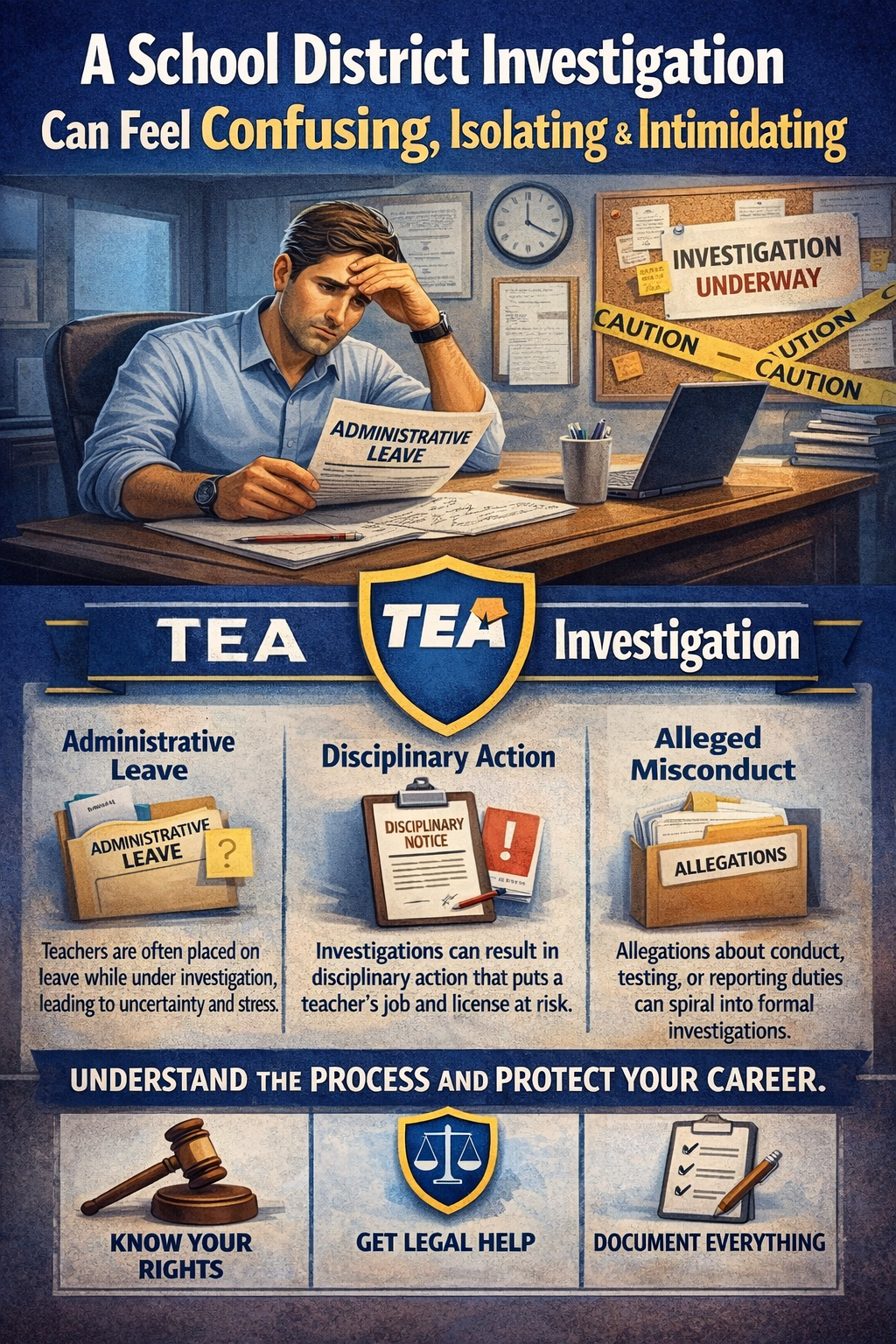
A TEA or school district investigation can feel like the ground shifts under your feet overnight. One day you’re focused on lesson plans, supporting students, and building trust with families, and the next you’re being asked to explain decisions you made in a stressful moment. Many teachers describe this experience as confusing, isolating, and even intimidating—especially when they are placed on administrative leave with little information about what comes next. If you are a teacher facing this situation, it is normal to feel worried about your job, your license, and your future.
At Masterly Legal Solutions, we help educators understand their options during a school district investigation and TEA investigation, especially when administrative leave, disciplinary action, or allegations of misconduct are involved. We believe teachers deserve fair treatment, clear communication, and a process that respects both their rights and their professional reputation. This article is designed to empower you with knowledge, while also showing why trying to navigate a high-stakes investigation alone can be risky.
When you know what to expect, you can make better decisions, avoid common mistakes, and protect what you have worked so hard to build. That includes protecting your pay, benefits, professional standing, and the opportunities you have earned through years—often decades—of work in education.
Understanding What a TEA Investigation Really Means
A TEA investigation typically involves concerns about educator conduct, professional boundaries, testing issues, reporting duties, or other conduct-based claims. These investigations can impact your certification and career path even if you never intended harm. Sometimes the issue begins with a misunderstanding, a complaint from a student or parent, or a disagreement about classroom management.
Even when the allegation seems minor, TEA can still investigate and request information. A TEA investigation may also overlap with a school district investigation, meaning you are dealing with two different tracks at the same time. That is one reason the process can feel so overwhelming for employees in education.
The school district may treat it as an employment matter, while TEA views it as a licensing issue. Your rights, risk level, and strategy may change depending on which agency is involved.
How a School District Investigation Usually Starts
Many district investigations begin with an internal report, a parent complaint, or concerns raised by a supervisor. Sometimes the report is based on an employee’s behavior, a conflict with a co-worker, or a claim of policy violation. In other situations, the district may initiate an investigation after a campus event or disciplinary incident involving students.
School administrators often involve human resources early in the process. Human resources may document the complaint, interview witnesses, and recommend interim measures like administrative leave. The district may also ask the teacher for a written statement, which can feel urgent and intimidating.
What you say early on matters, because those statements may later be used in TEA filings or employment-related disciplinary action.
Why Teachers Are Often Placed on Administrative Leave So Quickly
One of the biggest shocks for many teachers is how fast administrative leave happens. Administrative leave may be framed as “neutral,” but it rarely feels neutral to the subject of the investigation. Administrative leave can come with isolation, uncertainty, and rumors spreading through the workplace.
Districts sometimes place teachers on administrative leave to separate the teacher from students while they investigate. In other cases, administrative leave is used to reduce liability while the district determines if there was a possible violation of policy, law, or professional standards.
Administrative leave is not always a sign you will be terminated. Still, administrative leave can have serious consequences for your job, your finances, and your peace of mind.
Administrative Leave vs. Suspension: Why the Difference Matters
Administrative leave is often different from suspension, but the terms can get mixed together. Administrative leave usually means you are temporarily removed from duties while an investigation is ongoing. Suspension may indicate a stronger disciplinary action and can sometimes be unpaid.
If you are told you are on administrative leave, it is important to clarify whether it is paid administrative leave or unpaid status. Your pay and benefits may be affected depending on district policy and the circumstances of the allegations. Administrative leave can also come with restrictions, such as not contacting students or staff.
Because each district has its own regulations and procedures, administrative leave should be reviewed carefully.
Paid Administrative Leave and What It Can Include
Paid administrative leave is common during early investigations, but it is not guaranteed. Paid administrative leave may allow the district to maintain continuity while protecting both the organization and the teacher from escalation. Paid administrative leave may include continuing regular pay, maintaining benefits, and preserving employment status while the district investigates.
Even when paid administrative leave is provided, teachers can still experience professional harm. A teacher on paid administrative leave may lose coaching duties, campus roles, or professional opportunities during the period of removal. Paid administrative leave can also cause stress because it feels like a waiting game.
If you are on paid administrative leave, you should still treat the situation seriously and protect yourself through careful communication and documentation.
When Administrative Leave Becomes Unpaid or Extended Too Long
In some circumstances, administrative leave may shift from paid to unpaid, especially if the district changes its position or if the investigation drags on. Unpaid administrative leave can create immediate wage pressure and make it harder for employees to manage bills and family responsibilities. It can also cause confusion about whether you are expected to work elsewhere during the absence.
Even extended paid administrative leave can create long-term strain, because you may not know when you will return or whether dismissal is being considered. Administrative leave that goes on without updates can feel like the district is quietly pushing you out.
If administrative leave is becoming unclear, legal guidance can help you understand what options exist.
Your Rights as the Subject of an Investigation
If you are the subject of a district investigation, you still have important rights. Teachers are not required to guess what their rights are while under pressure, but many employees do exactly that—because they feel afraid or unsupported. While school policies vary, employee rights often include basic fairness and access to information about expectations.
You also have the right to avoid self-sabotaging decisions made out of panic. That includes rushing into written statements, resigning too early, or ignoring deadlines that impact your job. Teachers should take allegations seriously while also protecting themselves strategically.
A knowledgeable attorney can help you respond without giving the district more ammunition than necessary.
The Role of Human Resources in a District Investigation
Human resources often serves as the “process manager” for district investigations. Human resources may gather statements, coordinate interviews, and ensure the district follows internal policy. In some situations, human resources may also recommend disciplinary action based on findings.
However, human resources is not your personal advocate. Human resources exists to protect the employer and the organization, even when individual employees feel unheard. That does not mean HR is unfair in every case, but teachers should understand the role clearly.
When you are on administrative leave, HR communication can shape what happens next.
What “Alleged Misconduct” Can Mean for Teachers
“Alleged misconduct” is a broad phrase that can describe many different issues. For teachers, alleged misconduct may involve classroom conduct, reporting obligations, interactions with students, social media, testing integrity, or workplace policy disputes. Some cases involve misunderstandings, while others involve more serious accusations.
Even when alleged misconduct is minor, the district may investigate aggressively. Alleged misconduct allegations can trigger administrative leave, formal interviews, and licensing risks. The teacher may feel like they are being treated as guilty before facts are confirmed.
This is why teachers should take alleged misconduct claims seriously, even if they believe the complaint is false.
Your Right to Understand the Allegations Against You
One common frustration is that employees are not always given details right away. Some districts provide minimal information at the beginning of a school district investigation. Teachers may be told only that there is an investigation and that administrative leave is required.
You have the right to request clarity about what you are accused of and what policies may be involved. You may also be entitled to documents or notices depending on district policy and applicable law. The district may not reveal everything immediately, but you should not be expected to respond blindly.
If you are unsure what to say, a lawyer can help you avoid statements that cause harm.
Preparing for the Interview: What Teachers Should Expect
During the investigation, you may be asked to participate in an interview. This can be led by HR, an administrator, or an outside investigator hired by the employer. The interview may feel conversational, but it is usually designed to collect evidence and determine whether disciplinary action is justified.
Teachers should prepare carefully and avoid guessing. If you do not know an answer, you should not speculate. Investigators may also compare your statement with others to determine credibility.
Preparation and guidance can make the difference between a fair outcome and a damaging misunderstanding.
Should You Have a Union Representative Present?
Some teachers have the right to a union representative depending on their district and labor agreements. A union representative may help the teacher understand the process, provide support, and observe how the employer conducts questioning. In some cases, a union representative can help ensure the interview is not overly aggressive or misleading.
However, a union representative may not provide the same level of individualized legal counsel as an attorney. In high-risk cases involving administrative leave or certification concerns, legal representation may still be essential.
It is also important to understand what the union can and cannot do in your specific circumstances.
The Risk of Saying “The Wrong Thing” Without Legal Counsel
Many teachers are honest, straightforward people who assume truth alone will solve the problem. Unfortunately, investigations are not always that simple. Teachers can accidentally hurt themselves by offering extra information, responding emotionally, or providing details that get misunderstood.
Legal counsel can help you communicate clearly without overexplaining. Legal counsel can also help you choose the best format for responses, especially when the district is requesting written statements. In many teacher cases, the biggest damage happens in the first few days of the process.
Getting guidance early can help protect your career and reduce risk.
How Administrative Leave Impacts Your Pay and Benefits
One of the first questions employees ask is: “Do I still get pay?” That depends on whether your administrative leave is paid administrative leave or unpaid. Pay may continue normally on paid administrative leave, while unpaid leave can interrupt wages and create immediate pressure.
Benefits also matter, especially health coverage and retirement contributions. During administrative leave, some benefits continue, but others may change depending on the district’s policies and your employment status. Your family may rely on that coverage, which increases stress during an already difficult period.
If you are concerned about pay, benefits, or job status, it’s worth seeking assistance quickly.
Job Protected Leave, FMLA, and Medical Reasons
Sometimes teachers are dealing with extreme stress, anxiety, or other medical reasons during an investigation. That stress can affect sleep, health, and the ability to function day-to-day. In certain cases, job protected leave may be available through the Family and Medical Leave Act.
FMLA entitles eligible employees to take job protected leave for qualifying health conditions and certain family needs. FMLA entitles eligible employees to time away without losing the job, but it does not automatically guarantee paid leave. Eligibility also depends on whether you are an eligible employee and whether the district is a covered employer.
If the investigation is affecting your health or family responsibilities, discussing leave options with legal counsel can help you protect yourself.
Eligible Employees and Covered Employers Explained
Not every worker qualifies for every type of leave. Eligible employees generally must meet certain requirements related to length of employment and hours worked. Covered employers typically include many school districts, but the details still matter.
A teacher may assume they automatically qualify, but eligibility can depend on your contract type and employment status. When the district is investigating, you may need to coordinate leave requests carefully to avoid triggering further disciplinary action.
This is another area where proper guidance can prevent costly mistakes.
Retaliation Concerns During TEA and District Investigations
Retaliation is a major concern for teachers who speak up about problems. If a teacher reports harassment, discrimination, testing irregularities, safety issues, or protected activity, and then faces sudden discipline or removal, retaliation may be part of the case.
Retaliation can look like:
- Being placed on administrative leave right after a complaint
- Increased scrutiny from a supervisor
- Sudden disciplinary action after reporting concerns
- Threats about dismissal or transfer
- Schedule changes that disrupt family responsibilities
Retaliation can happen quietly and can be difficult to prove without documentation. Retaliation attorneys can help evaluate whether the timing and conduct suggest a prohibited motive.
Protected Activity and the Teacher Workplace
Protected activity includes actions that the law protects, such as reporting discrimination, reporting harassment, participating in investigations, and filing complaints. Teachers often don’t realize their actions may be protected activity until after the backlash begins.
A teacher may engage in protected activity by reporting unsafe working conditions, reporting policy violations, or raising concerns through the correct channels. After protected activity, any adverse employment action should be reviewed carefully for retaliation.
Even if the district insists it is acting “normally,” retaliation may still be present depending on the facts.
Disciplinary Action: When the District Moves Toward Punishment
A district investigation can lead to disciplinary action ranging from reprimands to suspension or termination. Disciplinary action may also include written warnings, performance plans, or reassignment into roles that harm career advancement. Some districts use disciplinary action as a way to create documentation for later dismissal.
Teachers should understand what disciplinary action means under district regulations and employment policies. Disciplinary action can also be used in a TEA context depending on what is reported.
Before responding to disciplinary action, it may be wise to consult with an attorney.
Dismissal and Contract Nonrenewal Risks
A major concern for teachers is dismissal or contract nonrenewal. Some districts use investigations as justification for ending a teacher’s job, even if the allegations are weak. Teachers may also be pressured to resign “voluntarily,” which can still carry long-term consequences.
Dismissal decisions often involve HR, administrators, and legal review by the district. Your response and documentation can matter significantly, especially when the district is trying to establish a violation.
If you are facing dismissal threats while on administrative leave, it is critical to protect yourself quickly.
The Pressure to Resign While on Administrative Leave
Teachers often report being encouraged to resign during administrative leave. This can be presented as a “clean exit” or “best option,” but resignation can come with hidden consequences. It may affect unemployment eligibility, future hiring, and TEA reporting issues.
Before resigning, teachers should understand the full picture. Administrative leave may feel like a dead end, but resignation should not be rushed. Once you resign, it can be much harder to fight back.
Legal guidance can help you determine whether resignation is truly in your best interests.
How an Investigation Affects Your Teaching License
A district investigation can be forwarded to TEA depending on the allegations. When TEA becomes involved, your certification and professional future may be at risk. Even teachers with strong past records can face stressful consequences if the district reports suspected misconduct.
The teacher may feel like they are fighting two battles: one for their job and another for their license. TEA matters can also affect future employment in education, which can impact income and career stability.
This is why teachers should take the investigation seriously from day one.
Common Examples of Teacher Investigation Triggers
Each case is different, but teachers are often investigated for issues like student discipline disputes, alleged verbal incidents, classroom management conflicts, reporting concerns, or policy misunderstandings. Sometimes the incident is recorded, documented by staff, or based on hearsay.
Here are a few example situations that often lead to administrative leave:
- A parent alleges misconduct after a grading dispute
- A student makes a complaint after being disciplined
- A co-worker reports concerns about classroom interactions
- A supervisor claims repeated policy issues
- A district audits testing compliance and flags irregularities
An example does not prove wrongdoing, but it often triggers a formal process. Once the investigation begins, it can move quickly.
Workplace Harassment and Teachers’ Rights
Harassment can occur in schools just like any other workplace. Teachers may experience harassment from a co-worker, a supervisor, or even through hostile treatment by leadership. In some cases, harassment is tied to protected activity or retaliation after the teacher reports concerns.
Harassment can cause stress, emotional exhaustion, and fear of returning to work. Harassment may also become part of a broader pattern where the employer tries to push the teacher out. When harassment is present, documentation and reporting become especially important.
Teachers deserve a workplace environment that respects their dignity and safety.
Police Involvement and Campus Incidents
Some teacher investigations involve police, especially when allegations involve threats, physical incidents, or claims of harm. Police involvement can raise the seriousness of the situation instantly. Even if you have not been arrested, an investigation that includes police attention can affect how the district handles administrative leave.
School districts may also coordinate with outside agencies or request statements related to police reports. Teachers should be cautious and understand how statements can be used.
If police are involved, it is especially important to speak with an attorney before making formal statements.
Documentation: How Teachers Can Protect Themselves
When you are under investigation, documentation can protect you. Teachers should keep records that show timelines, communications, and the steps taken by the employer. Many teachers assume the district will keep everything fair and organized, but missing documentation can hurt the teacher later.
Helpful documentation includes:
- Administrative leave notices
- Emails from HR or a supervisor
- Timeline notes of important events
- Copies of relevant policies or handbooks
- Witness names if co-workers observed events
You are not being “dramatic” by documenting—you are protecting yourself in a high-stakes process.
Schedule Changes, Reassignment, and Subtle Retaliation
Even during administrative leave, some teachers face retaliation through schedule changes, reassignment, or sudden role shifts. Teachers may return from administrative leave only to find they have lost their classroom, their preferred schedule, or leadership responsibilities.
If the teacher engaged in protected activity, retaliation may be a factor. Retaliation does not always appear as firing; it can appear as career damage and workplace exclusion. Teachers should not ignore these signs, especially when a supervisor becomes hostile after a complaint.
Support from attorneys can help teachers identify whether retaliation is occurring.
Mediation and Disputes with the District
Some conflicts can be resolved through mediation, depending on district policies and the specific dispute. Mediation can sometimes help teachers negotiate return-to-work conditions, clarify record issues, or address communication breakdowns.
However, mediation is not always appropriate if the district is pursuing dismissal or TEA reporting. Mediation also works best when the teacher is prepared, supported, and not pressured into unfair terms.
Teachers should be careful about signing agreements without reviewing them with legal counsel.
Wage Questions and What Happens During the Waiting Period
During administrative leave, teachers often worry about wage stability and financial survival. Even on paid administrative leave, teachers may lose supplemental pay such as coaching stipends or club pay. If administrative leave becomes unpaid, the impact can be immediate and severe.
The waiting period—the period where nothing seems to happen—can be one of the hardest parts emotionally. Teachers may feel powerless while the employer controls the timeline. During this time, teachers should focus on documenting, protecting communication, and getting guidance.
The goal is to protect your job and your financial future.
The Role of Employers and District Leadership
School districts are employers, and like other employers, they make decisions based on risk, policy, and reputation. Sometimes a district reacts aggressively because it wants to appear decisive, even before the facts are complete. Other times, a district acts fairly but still moves quickly because of legal or safety concerns.
The employer’s goal may not align with what is best for the individual teacher. That reality can be painful, especially for employees who feel loyal to their school. Understanding the employer’s motivations can help teachers make smarter choices during the investigation.
A strong legal strategy often focuses on facts, process, and protection.
When the Organization Prioritizes Optics Over Fairness
Schools are public-facing organizations, and district leaders may worry about community perception. When a complaint becomes public, the district may respond fast by removing the teacher through administrative leave, even before verifying details.
This is especially true when allegations involve student conduct, social media, or misunderstandings that trigger strong reactions. Teachers can feel like their entire career is being judged in a matter of days.
If you feel you are being treated unfairly to protect the district’s image, it may be time to seek legal assistance.
Why Teachers Need a Strategy, Not Just Hope
Teachers often want to believe the truth will speak for itself. But in an investigation, truth can get distorted through incomplete reporting, assumptions, or biased witnesses. Teachers need a strategy that protects them through each step of the process.
A strategy may include:
- How to respond to interviews
- What documentation to provide
- How to address administrative leave terms
- How to protect pay, benefits, and reputation
- When to escalate concerns
This is not about being combative. It is about protecting what you’ve earned.
How a Law Firm Can Support Teachers Under Investigation
Working with a law firm can help teachers feel less isolated and more prepared. A law firm can review allegations, assess risk, and help you avoid mistakes that harm your case. Teachers should not feel like they must navigate complex systems alone while stressed and uncertain.
At Masterly Legal Solutions, we help employees and workers in education understand the process and protect their future. We also help teachers respond professionally and protect their record from unnecessary damage.
When your career is at stake, support and preparation matter.
Working With an Attorney During Administrative Leave
A teacher on administrative leave may wonder whether hiring an attorney is “too much.” In reality, administrative leave is often the moment when legal support is most effective. Administrative leave can be the beginning of a chain of events leading to disciplinary action, nonrenewal, or TEA reporting.
An attorney can help you understand your rights and the risks in your circumstances. An attorney can also help you communicate with your employer in a way that protects you. This is especially important when the district requests written statements or offers resignation options.
Legal counsel can help you protect your job and your future.
Practice Areas That Often Overlap With Teacher Investigations
Teacher investigations can overlap with multiple practice areas, including employment issues, administrative proceedings, and workplace retaliation matters. These cases may also involve labor-related rights, procedural disputes, and reporting obligations.
Sometimes teachers experience harassment or retaliation after reporting concerns, which adds another layer to the case. Sometimes the issue involves benefits, leave, or pay problems while on administrative leave. Because each case is different, your legal approach should be tailored to the facts.
A lawyer who understands education-related employment disputes can be especially helpful.
The DMV Area, Virginia, Maryland, and Why These Issues Are Nationwide
Even though TEA is Texas-based, teacher workplace investigations are not unique to one state. Similar disputes happen nationwide, including in large school systems in the DMV area, Virginia, Maryland, and cities like Arlington. The challenges often look similar: administrative leave, unclear allegations, pressure to resign, and career-threatening documentation.
Teachers everywhere face systems that move fast while expecting the employee to keep up. Whether you teach in a major city district or a smaller community, the stress of being accused is the same.
If you’re in Texas dealing with TEA, you deserve a strong advocate who understands what’s at stake.
Steps Teachers Can Take Right Now to Protect Themselves
If you are on administrative leave or under investigation, there are practical steps that can help protect you immediately.
Consider these actions:
- Stay calm and avoid emotional emails
- Keep all written communications from the district
- Document key dates, meetings, and instructions
- Follow directives while protecting your rights
- Avoid discussing details with coworkers casually
- Seek guidance before submitting written statements
These steps help protect your job and reduce risk during the investigation process.
What Makes a Teacher’s Case Stronger or Weaker
Every investigation outcome depends on facts, evidence, and how the process is handled. A case may be stronger when the teacher has consistent documentation, credible witnesses, and a clear timeline. It may be weaker when the teacher makes inconsistent statements, violates instructions, or lacks support.
Even if you did nothing wrong, the district may still determine a violation if the reporting is biased. That is why preparation and legal counsel can change the outcome. A teacher who is prepared is harder to pressure, mischaracterize, or push aside.
Your goal is not just to “get through it,” but to protect your future career options.
Contact Masterly Legal Solutions for a Free Consultation
If you are a teacher facing a TEA or school district investigation, you don’t have to carry this stress alone. Administrative leave can feel like a professional limbo—quiet on the outside, but heavy on the inside—especially when you’re worried about pay, benefits, allegations of misconduct, and what the district might do next.
At Masterly Legal Solutions, we help teachers protect their rights during investigations, respond strategically, and avoid decisions that can cause long-term damage. Whether you are on paid administrative leave, facing disciplinary action, worried about retaliation, or feeling pressured toward dismissal, our team is ready to provide clear guidance and real support. We understand how quickly these situations can escalate, and we take the time to help you feel informed, prepared, and protected.
Contact Masterly Legal Solutions today at
(972) 236-5051 for a free consultation.
Let’s talk about your circumstances, your options, and the smartest next step to protect your job and your professional future.
Disclaimer: This article is for educational purposes only and does not constitute legal advice or legal guidance. Reading this article does not create an attorney-client relationship. For advice about your specific situation, consult a qualified attorney.




Teacher Rights When Assaulted by a Special Needs Student: Safety, Reporting and Investigation Issues



Looking for Legal & Business Solutions? Contact Us Now
Fill in the form or call us to set up a meeting