

Retaliation at Work Through Schedule Changes, Discipline, or Reassignment
Most employees expect their workplace to have rules, structure, and fairness. Even when a job is demanding, many workers can tolerate stress as long as they feel respected and treated consistently. But when an employee speaks up about discrimination, harassment, safety concerns, or another serious issue—and suddenly their schedule gets worse, they are written up, or they are moved into a less desirable position—it can feel personal, targeted, and deeply unsettling. That experience is often described as retaliation, and it may be illegal under federal and state laws.
At Masterly Legal Solutions, we help individual employees recognize retaliation patterns, understand their rights, and take action to protect their career, income, and well being. Retaliation cases can be emotionally exhausting because they often happen quietly, in ways that look “normal” on paper. A schedule change may be framed as “business needs.” A write-up may be called “performance management.” A reassignment may be labeled a “reorganization.” However, if the timing and circumstances suggest an unlawful motive, you may have valid claims.
This article explains how retaliation can show up through schedule changes, disciplinary action, and reassignment, and what you can do if you believe your employer is trying to punish you for protected activity. We will also discuss how investigations work, what legal protections may apply, and how experienced employment lawyers can help you fight back the right way.
What Workplace Retaliation Really Means
Retaliation in employment happens when an employer takes adverse action against an employee because the employee engaged in protected activity. The purpose is often to pressure the worker into backing down, quitting, or staying silent. Many employees don’t realize retaliation is a legal issue until the damage is already happening.
Retaliation is not just about getting fired. It can involve changes that make your job harder, less stable, or more stressful. In retaliation cases, the issue is often the “why” behind the employer’s decision—not just the decision itself.
Why Schedule Changes, Write-Ups, and Reassignments Are Common Retaliation Tactics
Employers often choose subtle methods of retaliation because they’re easier to deny. Instead of openly saying, “You caused problems by reporting harassment,” the company may quietly reduce hours, assign inconvenient shifts, or create a paper trail of disciplinary action.
These tactics can hit an employee where it hurts most—time, money, career growth, reputation, and emotional stability. They can also affect family responsibilities, childcare routines, transportation, and your ability to keep up with basic life obligations.
The Legal Foundation: Laws That Prohibit Retaliation
Several laws exist to protect workers from retaliation. These laws don’t just punish obvious wrongdoing—they are meant to protect the playing field so employees can report wrongdoing without fear.
Depending on your job, the legal protections may come from:
- Title VII of the civil rights act
- The disabilities act
- The employment act (in many discussions, this refers to employment-related statutes and protections depending on your jurisdiction)
- Federal and state laws governing workplace rights
- State and local laws that may add stronger protections
- Whistleblower laws, especially for safety and public interest reporting
Employers are expected to respect the complaint process and not punish workers for using it.
Protected Activity: The Trigger for Many Retaliation Claims
Protected activity is the key concept in most retaliation cases. It generally means an employee did something the law encourages or protects, such as reporting unlawful conduct or participating in an investigation.
Common Examples of Protected Activity
A protected activity can include:
- Reporting discrimination based on race, sex, religion, national origin, or other protected classes under title vii
- Filing a complaint about harassment by a supervisor or co worker
- Reporting wage concerns, unsafe conditions, or occupational safety violations
- Participating in an internal investigation
- Supporting another employee’s complaint as a witness
- Requesting reasonable accommodations for disabilities
- Reporting age discrimination
- Filing a complaint with the equal employment opportunity commission
Even if your complaint is ultimately not proven, you may still be protected if you made it in good faith.
Adverse Action: When a Workplace Decision Becomes Punishment
An adverse action is something negative that would discourage a reasonable employee from speaking up again. It doesn’t have to be termination to count, and it doesn’t need to involve pay cuts in every situation.
Adverse action can include embarrassment, loss of opportunity, or career harm that changes your employment experience. Many employees feel the pressure immediately, especially when they see management treating them differently after a complaint.
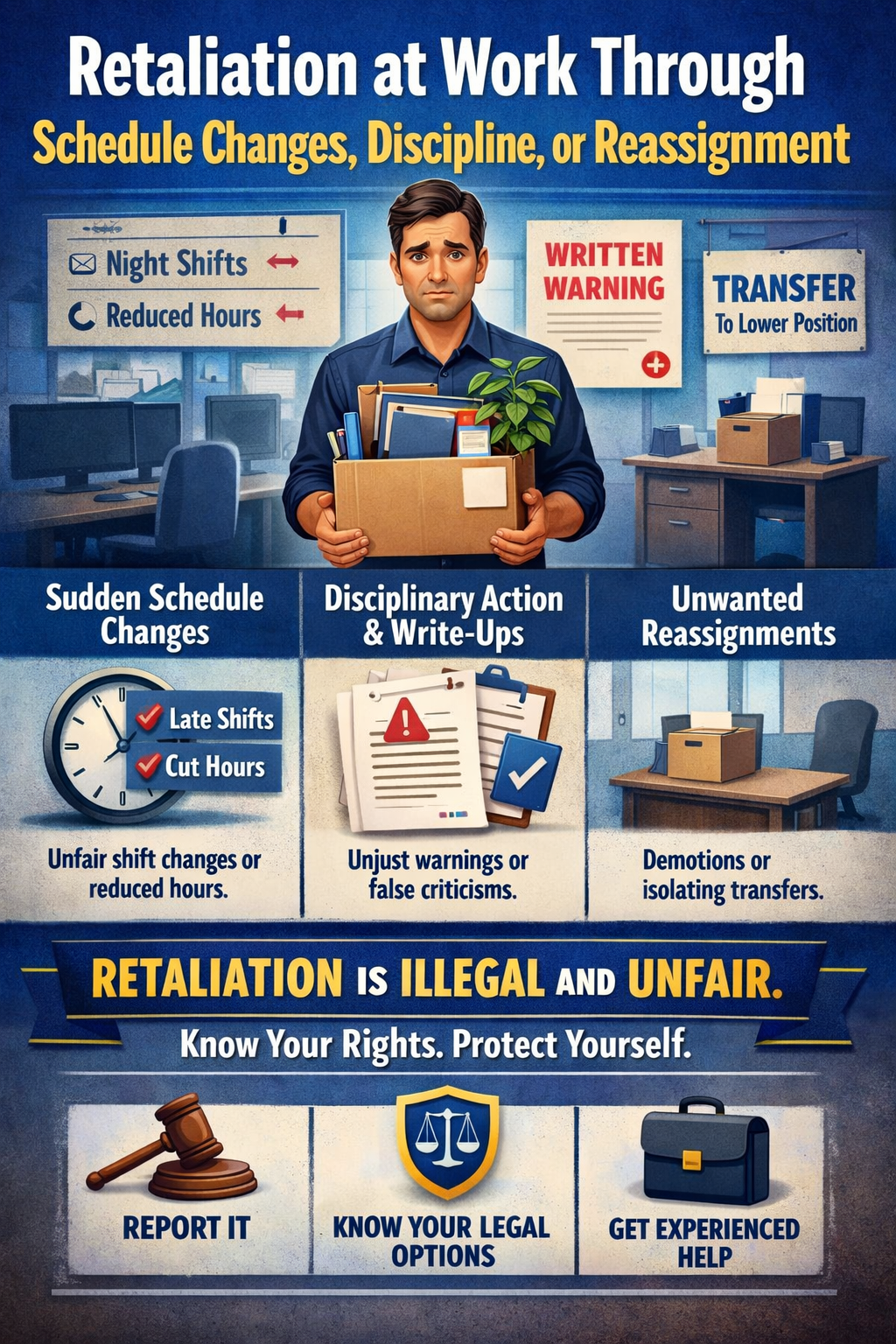
Retaliation Through Schedule Changes
One of the most common and disruptive ways retaliation shows up is through scheduling. It can be hard to prove, but it can also be extremely damaging, especially for workers with family responsibilities or second jobs.
Sudden Shift Changes After a Complaint
If you’ve been working a steady schedule for months or years and suddenly your employer changes it right after you file a complaint, that timing can matter.
A schedule change might look like:
- Moving you to nights after you worked days
- Giving you split shifts that disrupt your routine
- Assigning weekend work without a fair rotation
- Changing your “set schedule” to unpredictable hours
Your employer may say it’s about staffing, but when the change happens right after protected activity, it may be retaliation.
Cutting Hours or Limiting Work Opportunities
Schedule retaliation can also affect your pay by cutting hours, removing overtime chances, or assigning fewer shifts.
This type of retaliation can be especially serious for businesses that may benefit from consulting with an employment lawyer:
- Hourly workers
- Gig-style employees
- Workers relying on commission or shift availability
- People supporting a family member financially
Even when the company claims “budget issues,” the facts and patterns may tell a different story.
Targeted Scheduling That Impacts Your Family Responsibilities
Some employees experience schedule punishment that seems designed to trigger failure. For example, a parent may suddenly be scheduled during childcare pick-up times, or an employee caring for a family member may be assigned to unpredictable shifts that disrupt medical routines.
Retaliation can be illegal even when it doesn’t explicitly mention your family. The outcome matters, and the employer’s intent matters.
Retaliation Through Discipline and Write-Ups
Disciplinary action can be legitimate when an employee violates a rule. But it can also be abused as retaliation, especially when an employer wants a paper trail to justify future termination.
Why “Progressive Discipline” Can Become a Weapon
Some companies use progressive discipline policies to build documentation, even when the employee’s work performance hasn’t changed, which can sometimes be a form of workplace retaliation.
Common retaliation discipline patterns include:
- Sudden “performance problems” after years of good reviews
- Write-ups based on vague accusations
- Selective enforcement of policies
- Overreaction to minor mistakes
If you are experiencing these warning signs at work, you may be at risk of being placed on administrative leave.
A single write-up may feel small, but repeated write-ups can be used to justify termination or demotion later.
Fake or Inflated Performance Concerns
One common example of retaliation is when an employee receives criticism that doesn’t match reality. A supervisor may suddenly claim the employee is not a “team player” or has “attitude issues” after the employee reports harassment or discrimination.
In many workplaces, these vague terms become code for punishment, especially when the company wants to discipline without clear proof.
Disciplinary Action for “Tone,” “Communication,” or “Fit”
Employees who report discrimination or harassment are sometimes disciplined for reasons that could be addressed through proper HR consulting services:
- “Being difficult”
- “Not following the chain of command”
- “Creating conflict”
- “Not aligning with culture”
This can be a strategy to shift blame onto the employee who spoke up. It’s not always illegal by itself, but it becomes legally significant when connected to protected activity. For families and individuals interested in safeguarding their futures against all types of risks, understanding the essential legal documents every family should have in place by age 40 is an important step to consider.
Retaliation Through Reassignment or Transfer
Reassignment can be one of the most frustrating retaliation tactics because employers often claim it is neutral or even helpful. But if it harms your career trajectory or working conditions, it may qualify as retaliation.
Being Moved to a Less Desirable Position
A transfer may be retaliatory if it places the employee into situations that jeopardize their position. If you are a teacher experiencing retaliation, you may benefit from legal support from education attorneys.
- A less desirable position with fewer responsibilities
- A role with worse hours or fewer opportunities
- A lower-status assignment that harms reputation
Even if pay stays the same, the change can still be an adverse action if it reduces professional growth.
Being Removed From a Desirable Position or High-Visibility Work
Another form of retaliation happens when employees are removed from:
- A desirable position
- Leadership opportunities
- High-earning assignments
- Client-facing responsibilities
- Special projects or promotions
Many employees recognize this quickly because the message is clear: “You spoke up, and now you’re being pushed out.”
Reassignment Used to Isolate or Humiliate
Some reassignments are designed to isolate the employee socially and professionally.
A serious example may involve being moved away from your team, assigned to a corner, excluded from meetings, or placed under harsher supervision. This often goes hand-in-hand with harassment, especially when co worker dynamics change after a complaint.
Harassment After Reporting: Retaliation’s Close Companion
Retaliation and harassment frequently overlap. After an employee reports misconduct, they may be targeted through sarcasm, intimidation, exclusion, or hostile behaviors.
Harassment retaliation can look like:
- A supervisor ignoring you or speaking to you differently
- Co worker hostility or gossip
- Public criticism in meetings
- Increased micromanagement
- Threats about your job future
Even if the original complaint involved discrimination, the retaliation can become its own legal problem.
Discrimination and Retaliation Often Intersect
Many retaliation cases start with discrimination. The employee reports unfair treatment, and then the punishment begins. This cycle is one reason discrimination remains underreported in many workplaces.
Discrimination can involve protected traits such as:
- Race or ethnicity
- Sex or pregnancy-related issues
- Religion
- National origin
- Age discrimination
- Disabilities
- Immigration status (in some workplace abuse patterns, even when employers try to misuse it)
An employer cannot legally punish someone for raising good-faith concerns about discrimination, even if the employer disputes the complaint.
Federal Employees and Retaliation Risks
Retaliation can look different for federal employees because federal agencies follow specific rules and internal processes. Federal employees may also have unique timelines, appeal procedures, and reporting steps compared to private workers.
Examples of retaliation affecting federal employees include:
- Unfair performance reviews
- Removal from assignments or duties
- Transfer to undesirable posts
- Increased scrutiny after internal reporting
- Discipline tied to administrative processes
Because federal systems can be complex, federal employees often benefit from legal guidance early.
State and Local Laws Can Strengthen Your Case
In many situations, state laws and local laws provide additional worker protections beyond federal law. Some state and local laws also expand definitions of retaliation, add stronger damages, or provide more avenues for filing claims.
Your rights may depend on:
- The state where you work
- Your city or county regulations
- Industry rules and labor protections
- Whether you work for government or private employers
- The nature of the discrimination or complaint
This is why understanding state and local laws is so important when a retaliation situation begins.
Retaliation Related to Administrative Leave
Many employees ask about retaliation involving administrative leave. Administrative leave is often presented as neutral, but the impact can still be harmful if it’s used unfairly or to punish someone.
When Administrative Leave Is Legitimate
An employer may place an employee on administrative leave during an investigation to:
- Protect the integrity of the process
- Prevent workplace conflict
- Reduce risk while facts are reviewed
- Maintain workplace safety
In some circumstances, administrative leave may be reasonable and lawful.
When Administrative Leave Becomes Retaliation
Administrative leave can become retaliation when it is used to isolate, embarrass, or remove an employee without real justification.
Retaliatory administrative leave may involve:
- Removing the employee right after a complaint
- Treating the employee as “guilty” without facts
- Using leave to disrupt income or career progression
- Keeping the employee out indefinitely without updates
Paid Administrative Leave vs. Unpaid Removal
Some employers use paid administrative leave, while others may suspend workers without pay. Even paid leave can feel like punishment when it harms reputation or blocks promotions, but unpaid leave can quickly become financially devastating.
If leave is used unfairly after protected activity, it may support retaliation claims.
Retaliation in High-Risk Fields: Teachers, Police, and Public Workers
Certain professions face retaliation in ways tied to public accountability and internal reporting structures. Teachers, police, and other government workers sometimes face workplace retaliation after reporting discrimination, safety concerns, or policy violations.
Retaliation Risks for Teachers
Teachers may experience retaliation when they report:
- Discrimination
- Harassment from leadership
- Unfair investigations
- Workplace safety concerns involving students or staff
Retaliation can show up through reassignment, discipline, or denial of career opportunities within a district.
Retaliation Concerns for Police and Public Safety Staff
Police and public safety workers may deal with unique pressures, including internal retaliation connected to reporting concerns inside a department. These cases may involve strict regulations, high scrutiny, and internal politics.
Because government agencies have internal reporting structures, retaliation can be subtle but still damaging.
The Investigation Process: What Usually Happens
When retaliation is suspected, the facts matter. Employers often defend themselves by pointing to policies or “business decisions.” That’s why documentation and timing are so important.
An investigation into retaliation may include:
- Reviewing schedule records
- Comparing discipline to other employees
- Examining performance history
- Identifying who made the decision
- Evaluating email, texts, or written warnings
- Analyzing the timeline after protected activity
A strong process can reveal patterns that a single incident might not show.
What to Document If You Suspect Retaliation
Many employees wait too long to document what is happening. Retaliation can escalate quickly, and memory alone is not always enough to support claims.
Helpful documentation includes:
- Copies of schedules before and after your complaint
- Write-ups or disciplinary action notices
- Performance reviews and commendations
- Notes on conversations with your supervisor
- Witness names if a co worker observed the retaliation
- Emails or HR communications about your complaint
- Any changes to duties, department, or role status
Documentation helps protect the employee and strengthens the case if filing becomes necessary.
Examples of Retaliation Through Scheduling, Discipline, and Reassignment
Retaliation is easier to understand through real-world example scenarios. While every workplace is unique, these patterns show up repeatedly.
Example: Schedule Changes After Reporting Harassment
An employee reports harassment by a co worker. Two weeks later, the employer changes their schedule to closing shifts only, making childcare impossible and reducing their ability to earn overtime.
Example: Discipline Used to Pressure a Worker to Quit
An employee reports discrimination. Soon after, the supervisor issues multiple write-ups for small mistakes that were never previously punished. The goal appears to be forcing resignation.
Example: Reassignment to a Less Desirable Position
An employee reports unfair treatment and participates in an investigation. A month later, they are reassigned to a less desirable position with fewer responsibilities and no visibility with leadership.
Example: Being Removed From a Desirable Position After Filing a Complaint
A high-performing employee files a complaint regarding discrimination. After that, they are removed from a desirable position on a major project and placed on routine tasks with no advancement.
Example: Administrative Leave Used to Discredit the Employee
An employee reports wrongdoing, and management places them on administrative leave immediately, implying misconduct even though no evidence exists. The leave drags on without communication.
These examples demonstrate how retaliation can happen without a formal firing, yet still create serious harm.
Immigration Status and Retaliation Concerns
Some workers fear retaliation because of their immigration status, or because an employer tries to intimidate them through threats. While not every issue falls neatly into a single category, threats tied to immigration status can be part of broader unlawful retaliation, harassment, or discrimination patterns.
No employee should be threatened or manipulated into silence through fear tactics. Legal protections may apply depending on the facts and the laws involved.
Wrongful Termination and Retaliation Escalation
Retaliation sometimes ends in termination. When that happens, employees may wonder whether they have a wrongful termination claim. If the firing occurred because the employee engaged in protected activity, it may be illegal under federal and state laws.
A termination might be framed as performance-based, but if the timeline shows the employer acted after complaints or participation in an investigation, it can become a key part of the case.
Filing a Complaint: Where Employees Often Start
Many employees start by filing a complaint internally through HR. Others file externally with government agencies.
A complaint may include:
- Reporting discrimination or harassment
- Reporting retaliation behavior
- Requesting help with schedule changes or discipline issues
- Asking for policy enforcement
External filing may involve the equal employment opportunity commission or other federal agencies, depending on the type of claim and the job category.
Filing can be stressful, but it can also be an important step toward protecting yourself—especially when retaliation is escalating.
How Settlement Negotiations Can Help Resolve Retaliation Claims
Not every retaliation case ends in a trial. Many cases resolve through settlement negotiations, which may involve compensation, job references, policy changes, and other terms.
Settlement discussions can help employees:
- Secure compensation for lost pay and harm
- Avoid prolonged workplace conflict
- Exit employment with stronger protections
- Reduce the emotional toll of ongoing retaliation
Having lawyers involved can help ensure negotiations are taken seriously and handled strategically.
What Compensation Might Be Available
Compensation in retaliation claims depends on the facts, the laws involved, and the impact on the employee.
Possible compensation may include:
- Back pay (lost wages)
- Front pay (future lost earnings)
- Damages tied to emotional distress and well being harm
- Attorney’s fees in certain claims
- Reinstatement in some cases
- Policy-related changes within the company
Not every case qualifies for every category, but understanding the possibilities can help employees make informed decisions.
Why Legal Guidance Matters in Retaliation Cases
Retaliation is rarely obvious. It often looks like ordinary workplace management until the pattern becomes clear. But by that time, the employee may already be overwhelmed, financially strained, or close to termination.
Employment lawyers help evaluate:
- Whether protected activity occurred
- Whether adverse action took place
- Whether there is evidence connecting the two
- Whether discrimination or harassment overlaps
- Whether state and local laws create stronger options
With the right legal guidance, employees can respond strategically instead of reacting emotionally, which can help protect both career and future opportunities.
How Masterly Legal Solutions Helps Employees Fight Retaliation
At Masterly Legal Solutions, we understand how retaliation can affect every part of a person’s life—not just their job. A schedule change can disrupt a family routine. A disciplinary action can damage confidence. A reassignment can derail years of career building. And being forced into silence can feel like losing your voice in your own workplace.
We work with employees dealing with discrimination, harassment, and retaliation, including situations involving administrative leave and workplace investigations. Our goal is to help you understand your options, protect your rights, and pursue justice through a process that makes sense for your circumstances.
Contact Masterly Legal Solutions for a Free Consultation
If you believe your employer is retaliating against you through schedule changes, unfair discipline, reassignment, or administrative leave, you do not have to navigate this alone. You deserve answers, and you deserve to be treated with respect in your workplace.
At Masterly Legal Solutions, we offer a free consultation to discuss your situation, help you understand legal protections, and explain what next steps may look like—whether that involves filing a complaint, responding to disciplinary action, addressing discrimination, or preparing for a workplace investigation. If you’re worried about your job, your pay, your reputation, or how retaliation is affecting your family responsibilities, now is the time to get real support.
Contact Masterly Legal Solutions today at
(972) 236-5051 for a free consultation.
We’re here to listen, help you feel informed, and protect your rights with clarity and confidence.
Disclaimer: This article is for educational purposes only and does not constitute legal advice or legal guidance. Every situation is different, and reading this article does not create an attorney-client relationship. If you need advice regarding your specific circumstances, contact a qualified attorney.





Teacher Rights When Assaulted by a Special Needs Student: Safety, Reporting and Investigation Issues



Looking for Legal & Business Solutions? Contact Us Now
Fill in the form or call us to set up a meeting