

Understanding Texas CPS Administrative Appeals Before Rights Are Lost
Few situations feel more urgent—or more personal—than getting a call about CPS. One moment you’re handling normal family life, and the next you’re wondering whether your child will be taken, whether a court order is coming, or whether you’re being accused of child abuse or neglect. Many parents feel shocked, angry, or terrified, especially when they believe the report is exaggerated or based on false allegations. What makes it even harder is that the system moves fast, and you may not realize that deadlines for administrative appeals can arrive before you have time to breathe.
At Masterly Legal Solutions, we work with families facing child protective services involvement and help them understand what is happening, what steps come next, and how to protect parental rights before they risk losing control over their case. In Texas, a cps investigation can trigger serious outcomes even if criminal charges are never filed. The administrative side of the process can be just as damaging, because records and findings can follow a parent for years.
This article will help you understand the administrative appeal process connected to child protective services CPS, why it matters so much, and what you should do early—before your rights are limited or lost. We’ll also explain how a skilled cps attorney can help build compelling arguments and protect your future.
Why CPS Administrative Appeals Matter More Than Most Parents Realize
Many parents assume the only fight happens in court. But administrative actions and findings can impact your ability to work, your reputation, and your access to your child. These processes often begin quietly—through paperwork, findings letters, or internal decisions made by a government agency. If you wait too long, the system may treat the findings as final, even if they are based on incomplete facts.
Administrative appeals can be the difference between correcting an unfair finding and carrying a permanent label that affects your family. They are also a key tool for protecting your credibility when CPS believes something happened that you strongly deny. Parents deserve a fair chance to challenge the record before it becomes locked in.
When handled early, the appeal process can support long-term stability, reduce risk of further action, and help protect your child’s well being.
What Child Protective Services Does in Texas
Child protective services exists to investigate concerns about abuse or neglect and respond to situations involving potential danger to a child. In Texas, protective services may be involved after a report is made through a hotline or another reporting system. After that, CPS receives the report, reviews it, and decides whether to open an investigation.
The goal is supposedly ensuring child safety, but the system does not always get it right. Mistakes can happen, and families can be swept into stressful and invasive procedures quickly. A single misunderstanding can lead to a serious case, especially when allegations involve violence, drugs, or domestic violence.
Understanding how CPS works can help you respond strategically instead of reacting emotionally.
The CPS Investigation Process in Simple Terms
The cps investigation process usually begins with contact from a cps caseworker. That contact may be unannounced, and parents often feel pressured to cooperate immediately without knowing their rights. The caseworker may ask questions, request interviews, look at the home, or ask to speak to the child privately.
During the cps investigation process, CPS is investigating reports and looking for evidence of danger or harm. The caseworker may also speak with a school, daycare, doctor, or other family member. In many cps cases, CPS will gather information quickly and make recommendations that impact what happens next.
This is why early legal counsel is important. Once the caseworker documents something a certain way, it can be difficult to undo.
What Triggers a CPS Investigation
A cps investigation can be triggered by many different situations. Some reports involve genuine danger, and others involve misunderstandings, bitter custody conflicts, or inaccurate statements by someone upset. Parents are often shocked by how easily a report turns into a formal case.
Common triggers include:
- Accusations of child abuse
- Claims that neglect occurred
- Reports of unsafe living conditions
- Concerns related to domestic violence
- Suspicion of sexual abuse
- Allegations connected to substance use or mental health crises
- Claims that a child is in immediate danger
Even when you believe the report is false, CPS may still investigate. That investigation can lead to consequences unless it is handled carefully.
Abuse, Neglect, and the Words CPS Uses Against Parents
In CPS paperwork, terms like “abuse,” “neglect,” and “endangerment” can feel broad and harsh. Parents may believe CPS is calling them monsters, even when the facts are far more complicated. It is important to understand that CPS uses legal definitions, not everyday language, and those definitions can stretch further than you expect.
Child abuse or neglect can involve physical harm, emotional harm, sexual abuse, or failures to supervise. Neglect can include medical neglect or failure to provide adequate care. In severe cases, CPS may argue the child is unsafe even if no injury occurred.
A strong defense starts with understanding what CPS is actually alleging and what evidence exists.
Child Safety Versus Parental Rights: The Balancing Act
Every CPS case involves a tension between child safety and parental rights. CPS focuses heavily on the idea of protecting children, but that does not mean parents lose their constitutional protections. A CPS investigation is not a free pass for unlimited control over your home and family.
Parents often feel helpless because they assume CPS has all the power. In reality, CPS is still subject to rules, oversight, and limitations. There are legal boundaries around interviews, removals, court involvement, and searches.
A knowledgeable cps lawyer can help you protect your rights while still demonstrating that your child is safe.
The Role of CPS Workers and Caseworkers
It’s important to remember that cps workers and a cps caseworker are not judges. They are employees of a system, and their reports can strongly influence outcomes. They may make recommendations for services, safety plans, or removal, but their views are not the final word.
However, their documentation carries significant weight. If a caseworker writes a summary that sounds negative, it can shape how a judge responds later. Caseworkers may also interpret situations based on training and assumptions that don’t fully reflect your reality.
That’s why your words, behavior, and documentation matter from the very first interaction.
Can CPS Enter Your Home Without Permission?
One of the most common questions parents ask is whether CPS can come inside immediately. Parents often feel pressured, but you have rights. In most cases, CPS cannot force entry without your consent unless they have legal authority, such as a warrant or a court order.
Many families don’t realize they may be able to refuse entry under certain circumstances. CPS may try to persuade you, but you are not required to give up your rights out of fear. Of course, refusing entry can sometimes escalate things, so it must be handled carefully.
Talking to a cps defense attorney can help you make the right decision based on your unique situation.
“Refuse Entry” Without Making Your Situation Worse
The phrase refuse entry sounds simple, but the reality is complicated. If you refuse entry in a hostile or confrontational way, CPS may interpret that as hiding something. If you refuse entry politely while asking for documentation and requesting your attorney present, the situation can look very different.
Parents should consider calm, controlled communication. The goal is to avoid giving CPS an excuse to escalate while still protecting your home and your rights. Every CPS case is different, and what works in one situation may not work in another.
This is why having legal counsel early can prevent a misunderstanding from becoming a bigger fight.
When CPS Can Remove a Child
CPS cannot remove a child from a home just because a report exists. Typically, removal requires legal justification and is connected to safety. CPS may argue removal is needed if there is immediate danger, or they may seek court intervention to obtain authority to remove the child.
Sometimes CPS asks parents to agree to temporary placement with a family member. Other times, CPS may pursue emergency removal. In more serious situations, a child may be placed in foster care.
Removal is a major legal moment. Parents should contact an attorney immediately if removal is threatened.
Court Orders and Why They Matter So Much
A court order changes everything. Once CPS obtains a court order, they may gain authority to enforce certain actions, including home access, temporary placement, service requirements, or restrictions on contact. A court order can also set deadlines and requirements that parents must follow.
Parents often don’t understand what they signed or agreed to until later. If you receive paperwork referencing a court order, it is critical to understand the terms. A court order may also include restrictions that impact your daily family life.
A strong defense requires reading the paperwork carefully and responding promptly.
What Happens When a Judge Gets Involved
Once the case is in court, a judge has the authority to make serious decisions. A judge may review CPS evidence, listen to testimony, and consider whether the child should stay in the home. A judge may also order services, monitoring, or visitation schedules.
In many cases, CPS argues that safety concerns justify restrictions. Parents may argue that CPS lacks sufficient proof. Sometimes the judge deems CPS concerns valid even when parents disagree.
A skilled attorney can help present facts clearly and challenge weak evidence.
Sufficient Evidence: What CPS Needs to Prove
Many parents feel shocked by what CPS treats as proof. CPS does not always need perfect evidence to open a case. However, CPS must still support their claims with facts, documentation, and testimony when serious actions are taken.
The concept of sufficient evidence matters in both administrative and court-related decisions. Parents should not assume CPS has strong evidence just because they sound confident. Sometimes the case is built on assumptions, misinterpretations, or unverified statements.
This is where compelling arguments and careful documentation can create a turning point.
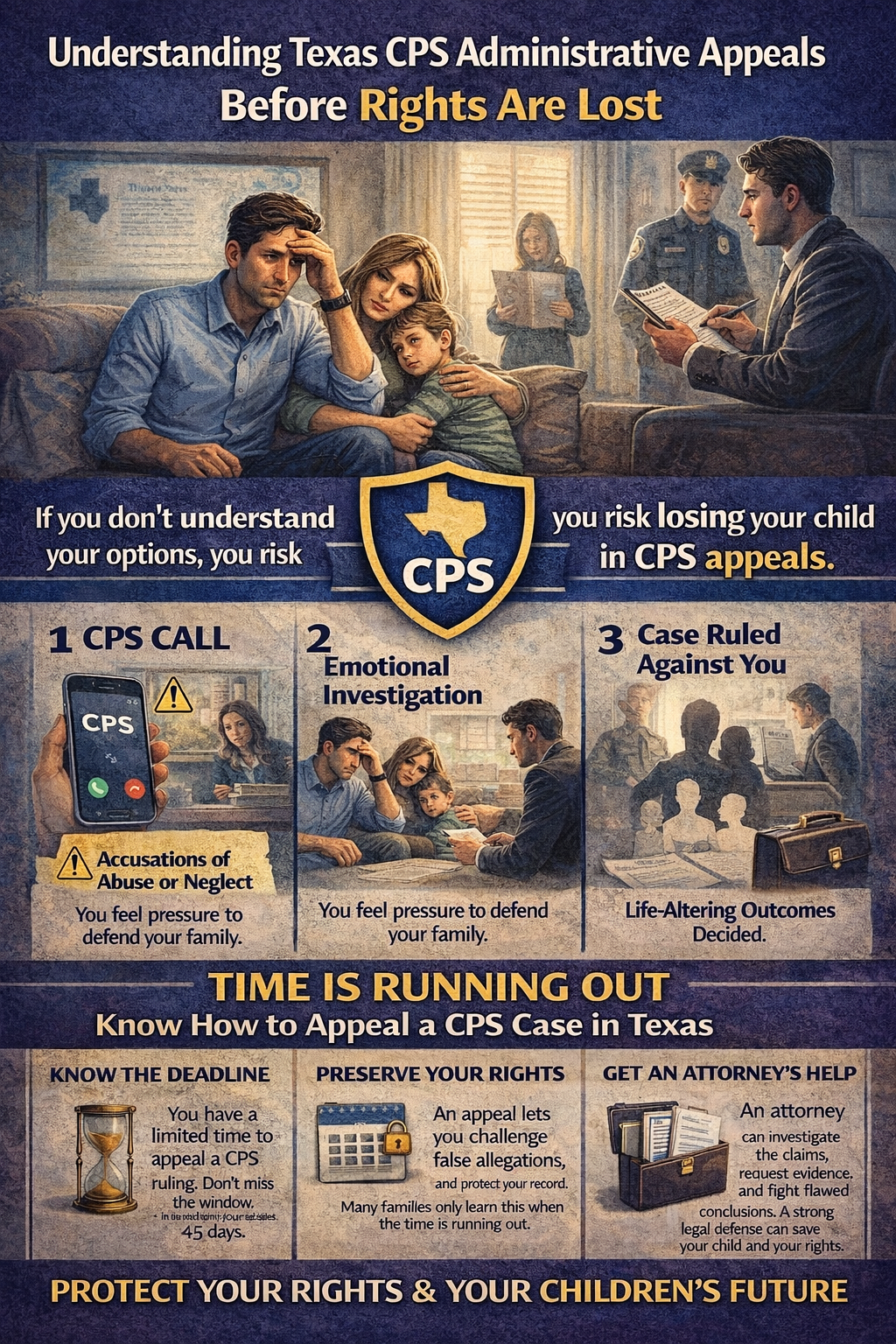
The Administrative Side of CPS: The Part Families Miss
When people think about CPS, they often picture court. But CPS also has internal processes that can affect your record and rights. Administrative findings can appear in databases, affect background checks, and influence future investigations.
Administrative appeals are a tool to challenge these findings. If you miss your chance, you may carry consequences even after the court case ends. Many parents don’t realize they are on the clock until it’s too late.
Understanding administrative procedures early is part of protecting your family’s future.
What Is a CPS Administrative Appeal in Texas?
A CPS administrative appeal is a way to challenge certain CPS decisions, findings, or records. It may involve reviewing the evidence CPS relied on, challenging conclusions, and presenting your side formally. Administrative appeals can be time-sensitive, and missing the deadline can result in permanent consequences.
This process often happens before rights are completely lost. That’s why it matters to act quickly. It can also be a critical moment for correcting the record and preventing long-term harm.
A cps attorney can help you determine if an appeal is available in your situation and what steps to take.
Why Acting Early Protects Parental Rights
Parental rights can be affected long before a final court ruling. Administrative findings, safety plans, and service recommendations can shape the entire case. Even if you are never charged criminally, CPS actions can limit your parenting time and your authority.
Acting early can help protect your child and your family structure. Parents who wait often feel trapped because the narrative has already been written by the agency. Early action can also reduce the risk of additional restrictions.
Your goal is to protect your child’s stability and your role as a parent.
Juvenile Dependency and the CPS System
Many people hear the phrase juvenile dependency and think it only applies outside Texas, but the broader concept exists across many child welfare systems. CPS cases often function like juvenile dependency matters because they involve government oversight of children’s placement, safety, and services.
The stakes can be high, including removal, visitation limits, and court monitoring. Even if your CPS case begins as “informal,” it can evolve into something that feels like full dependency control. Parents should take these cases seriously from the start.
Strong legal representation can help keep the case from spiraling.
Abuse or Neglect Allegations Can Escalate Into Criminal Charges
In some situations, CPS cases overlap with law enforcement. Allegations involving serious harm can lead to criminal charges. Even if the criminal case is separate, what you say to CPS may be used against you later.
That’s why parents should consider their right to remain silent in certain situations. You can still cooperate without confessing or guessing. You can also request that your attorney be present before providing detailed statements.
A CPS defense strategy must account for both family court risk and criminal risk.
Domestic Violence and CPS: A Common Factor
Domestic violence is one of the most common factors in CPS involvement. Sometimes CPS investigates because a child witnessed violence or because the home environment appears unstable. Even when a parent is the victim, CPS may still question safety planning and supervision.
Parents may feel punished for something they didn’t cause. These cases require careful handling because CPS may push for separation, relocation, or protective plans. The parent’s actions and cooperation are often scrutinized closely.
A defense attorney can help you respond without losing control over your family decisions.
Neglect Cases and How CPS Defines Neglect
A neglect case may involve supervision concerns, home conditions, educational concerns, or medical issues. CPS may argue neglect exists even when the child is loved, fed, and housed. Parents sometimes feel insulted by the accusation because they see it as judgment instead of fact-based analysis.
Neglect allegations can also be tied to poverty-related issues, lack of resources, or emergencies. CPS may not always view these challenges with compassion. Instead, they may document “risk factors” that lead to recommendations and restrictions.
Protecting your rights means addressing the facts CPS is relying on, not just your intent.
The Role of Protective Services Plans and Services
Many families are offered services during a CPS investigation. CPS may “offer services” like parenting classes, counseling, or home safety improvements. Sometimes these services are reasonable. Other times, they feel excessive or unfair.
Accepting services can sometimes be helpful, but it can also be interpreted as admitting wrongdoing. Parents should understand what agreeing means and what it does not mean. In some cases, agreeing can create a record that CPS later uses against you.
A cps lawyer can help you decide whether to accept services and how to document your position properly.
Why CPS Defense Requires Strategy, Not Panic
CPS cases move quickly, and panic can lead to mistakes. Parents may say too much, sign documents without understanding them, or act emotionally in ways that look suspicious. Even when you are innocent, panic can create confusion.
A strong CPS defense approach is calm, organized, and fact-focused. It involves documenting events, communicating carefully, and understanding timelines. It also means building a plan that protects your child and your parental rights.
This is where an experienced law firm can provide stability during chaos.
The Difference Between a CPS Lawyer and a CPS Defense Attorney
Parents often search for a cps lawyer, but not all lawyers handle CPS defense the same way. A cps defense attorney focuses specifically on protecting parents against removal, findings, and restrictions. CPS defense involves evidence, administrative rules, and courtroom strategy.
A general lawyer may not understand the unique procedures that CPS uses. A defense-focused attorney understands how to challenge caseworker narratives and demand proper proof. This kind of legal help can shape the outcome dramatically.
When your family is at stake, you want someone with substantial experience in CPS cases.
What a CPS Attorney Does During Administrative Appeals
A cps attorney can do more than show up in court. Administrative appeals often require detailed preparation, careful analysis of records, and strategic presentation. Parents may not even know what documents exist until an attorney requests them.
During administrative appeals, your attorney may:
- Review CPS records for errors or unsupported claims
- Identify inconsistencies in the investigation
- Prepare your written response and evidence
- Help you avoid statements that can be used against you
- Build a defense narrative that fits the legal standard
These steps can protect your record long-term and reduce future harm.
Why “Proven Track Record” Matters in CPS Defense
CPS is a complex system. Families often feel like they are fighting a machine that already made up its mind. That’s why working with a defense law firm with a proven track record matters. A proven track record means experience with CPS procedures, administrative appeals, and the realities of how agencies operate.
Parents deserve more than generic advice. They need tailored legal representation that addresses their exact situation. That is what effective CPS defense looks like in practice.
When you’re worried about losing your child, experience matters.
Court Intervention and Administrative Action Often Happen Together
CPS cases can involve both administrative steps and court steps at the same time. The administrative side may shape the record, while the court side shapes custody, visitation, and placement. Parents sometimes focus only on court hearings and miss the administrative deadlines.
This is a dangerous mistake. Administrative findings can impact future jobs, licensing, and even future custody disputes. The two tracks can influence each other.
A strong strategy considers both and protects your rights on both levels.
The Texas Department and Oversight in CPS Matters
In Texas, CPS functions under a state structure that includes the Texas Department overseeing protective services functions. This structure creates policies, procedures, and internal rules. Parents sometimes assume the caseworker makes all the rules, but the caseworker is operating within agency policies.
Understanding this can help you challenge actions properly. It can also help you avoid being bullied into agreement by someone misrepresenting their authority.
CPS may feel personal, but it is a system—and systems can be challenged.
What Parents Should Know About False Allegations
False allegations happen more often than people want to believe. Sometimes they are malicious. Other times they are misunderstandings or exaggerations. Schools, medical personnel, and neighbors may report concerns out of caution, not certainty.
Even if allegations are false, CPS may still treat them seriously and begin an investigation. Parents should not assume that the truth will “obviously” win. The outcome depends on documentation, timing, and how the case is handled.
That’s why parents should treat every CPS case as high-stakes from day one.
Safety Concerns and How CPS Frames Risk
CPS often documents “risk factors” and safety concerns. These phrases can be used to justify recommendations, restrictions, or even removal. Parents may feel like CPS is twisting normal life challenges into “danger,” but CPS is trained to look for patterns.
Some safety concerns are real and require immediate action. Others may be overstated. The key is not to argue emotionally but to address the evidence and show stability and protection.
Your case should focus on demonstrating a safe environment for your child.
Ensuring Child Safety Without Losing Your Voice
You can cooperate with CPS while still protecting your rights. Ensuring child safety does not require giving up your dignity or admitting wrongdoing. Parents can show they care by providing documentation, participating appropriately, and maintaining calm communication.
The goal is to protect the child and also protect your parental rights. Parents often feel forced into unfair choices, but many outcomes can be improved with legal support.
You do not have to face CPS alone to prove your child is safe.
Why Parents Should Consider Having an Attorney Present
One of the most important protective steps is asking for an attorney present before detailed interviews. Parents often worry CPS will get angry. But requesting legal counsel is not disrespectful—it is responsible.
Having an attorney present helps prevent miscommunication. It also helps ensure you do not accidentally say something that CPS uses against you. This is especially important if the allegations involve serious harm or potential criminal charges.
The right attorney can help you stay calm, focused, and protected.
When to Ask for a Confidential Consultation
A CPS case can feel embarrassing or stigmatizing. Parents may not want to talk about it publicly. That’s why it helps to seek a confidential consultation early. A confidential consultation gives you a private space to explain what happened and understand your options.
At Masterly Legal Solutions, we provide confidential consultation options designed to help families feel safe and supported. We know parents need answers quickly, without judgment. Even a single conversation can clarify your rights and reduce fear.
Your first step can be private, respectful, and productive.
Why an Initial Consultation Can Change the Outcome
An initial consultation can help you understand what CPS is likely to do next and what you should avoid doing. Parents often make mistakes early that are hard to fix later. An initial consultation helps you see the system clearly before you get pulled deeper into it.
This is also where a CPS attorney can spot red flags, like removal risks or dangerous allegations. It can help you create a plan for interacting with CPS and the court.
The earlier you seek guidance, the more options you often have.
CPS Defense in Severe Cases
In severe cases, CPS may seek immediate removal, fast court action, and strict restrictions. These cases often involve allegations of serious injury, sexual abuse, drug exposure, or repeated neglect. Parents may feel like the system has already decided they are guilty.
In severe cases, time is critical. CPS may push for emergency hearings, and families can lose the ability to present their story properly. A strong defense requires fast action, organized evidence, and skilled legal strategy.
This is where substantial experience becomes especially important.
How CPS Cases Impact the Child’s Health and Stability
CPS involvement affects the child’s health and emotional stability, even when CPS believes it is “helping.” Investigations can be disruptive, stressful, and confusing for a child. Children may be interviewed repeatedly, moved between homes, or exposed to adult conflict.
Parents often want to shield their child from stress but feel powerless. Protecting the child includes protecting their routines, school stability, and emotional well being. That’s why legal defense is not just about parents—it’s about minimizing harm to the child.
A stable plan can protect your child while you fight the case. If your situation involves educational records or student privacy concerns, consider exploring trusted legal solutions for guidance and support.
Family Life Under CPS Scrutiny
CPS can disrupt ordinary family life in ways that feel invasive. Families may feel watched, judged, and pressured to prove they are good parents. Even simple choices like discipline methods, childcare arrangements, or household routines may be questioned.
The stress can strain relationships and impact mental health. Parents may also feel isolated from support networks out of fear of judgment. CPS cases can change how you live day-to-day.
A legal defense plan can help families regain control and stability.
The Importance of Documentation During a CPS Investigation
Documentation is one of the strongest tools you have. During a CPS investigation, what is written down often matters more than what you remember later. Parents should document dates, contacts, and everything CPS requests.
Keep track of:
- Names of CPS workers involved
- Dates and times of visits and calls
- Any requested interviews
- Service recommendations or demands
- Anything connected to court paperwork or court orders
Documentation helps protect your story and challenge inaccurate reporting.
How Court Hearings Fit Into the Big Picture
The court process can include multiple hearings, reviews, and deadlines. The court may focus on safety plans, temporary orders, and long-term placement decisions. Each hearing is an opportunity for CPS to shape the narrative further.
Parents should not treat hearings casually. A small statement in court can lead to bigger consequences later. The court may also rely heavily on CPS reports unless challenged effectively.
This is why working with a defense attorney is so valuable in CPS cases.
What Happens if a Judge Deems the Child Unsafe
If a judge deems the child unsafe, restrictions may be imposed immediately. The judge may order temporary removal, limited visitation, or supervised contact. The judge may also order services and monitoring.
Parents may feel devastated and misunderstood. However, even after a negative ruling, parents may still have options. The outcome may depend on compliance, evidence, and legal strategy moving forward.
This is one reason administrative appeals and court actions should be handled together.
Risk Losing Your Rights: How It Happens Faster Than You Think
Parents can risk losing key rights simply by missing deadlines or signing documents without understanding them. Some parents believe they can “fix it later,” but CPS matters often become final quickly. Administrative findings, court orders, and service plans can lock families into a path that is hard to change.
That’s why acting early matters. If you delay, CPS may move forward with further action that becomes harder to fight. Even if you believe CPS is wrong, you must respond strategically.
Protecting your rights is time-sensitive.
How a Defense Law Firm Builds a CPS Strategy
A defense law firm builds a strategy by analyzing evidence, understanding CPS goals, and identifying legal weaknesses. A strong strategy considers how to prevent removal, how to challenge allegations, and how to protect your record long-term.
Your strategy may include:
- Challenging lack of sufficient evidence
- Documenting safe conditions for the child
- Preparing for court hearings and administrative deadlines
- Communicating with CPS through legal counsel
- Preventing unnecessary admissions or misunderstandings
A coordinated strategy is often the key to protecting parental rights.
Orange County, Southern California, and Why CPS Systems Feel Similar Everywhere
Even though this article focuses on Texas, many people search online and see information from places like Orange County or Southern California. These areas have their own protective services systems, but families often describe similar stress: surprise visits, intimidating interviews, and fear of removal.
The legal rules vary by location, but the emotional experience is often the same. CPS cases are intense everywhere because the child’s future and the family’s unity are at stake. Texas parents need Texas-specific legal counsel, but it can help to know you’re not alone.
The key is not where you read about CPS—it’s how you respond in your own case.
What to Say and What Not to Say During a CPS Investigation
Parents want to defend themselves immediately. But the wrong statement can cause damage. You should avoid guessing, exaggerating, or making emotional accusations toward CPS workers. You should also avoid admitting facts you are unsure about.
If criminal charges are possible, it may be appropriate to remain silent and request counsel. You can still cooperate by providing documents and scheduling communication through your attorney. Your words matter, and everything can be documented.
Smart communication is one of the most powerful forms of CPS defense.
Child Protective Services Cases and Long-Term Consequences
Even after CPS closes a case, the consequences may remain. Administrative findings can affect employment, licensing, volunteering, and future custody matters. A case may also be reopened if a new report comes in.
This is why parents should treat CPS outcomes seriously. Clearing the record matters, especially if you work in schools, healthcare, childcare, or other child-related fields. A negative finding can follow you for years.
Administrative appeals are often the best chance to stop long-term harm early.
Why You Need Legal Representation in CPS Appeals
Administrative appeals are not simply “explaining what happened.” They involve procedure, deadlines, and legal standards. A parent without legal training may not know how to present evidence effectively.
Legal representation helps parents avoid mistakes that cost them their rights. It also ensures the appeal is framed properly, with clear arguments and organized support. Legal representation is not about aggression—it’s about protection.
A CPS case is too serious to handle by guesswork—especially if you're facing false accusations.
Working With an Experienced Attorney During CPS Appeals
An experienced attorney can identify whether CPS followed proper procedures and whether the evidence supports the finding. An experienced attorney can also challenge assumptions and highlight contradictions in reports.
Many families feel relief when they finally have someone who understands the system and can speak the language of CPS and the court. Instead of feeling powerless, parents gain direction and support.
In cases involving parental rights, experience is not optional—it’s essential.
CPS Defense Attorney Support for Parents
A cps defense attorney supports parents by building a defense that focuses on child safety, stability, and facts. A cps defense attorney also helps protect your communication, prevent damaging admissions, and keep the focus on what CPS can actually prove.
Parents often feel CPS is pressuring them into agreement. A defense attorney helps balance the power dynamic and ensure your rights are respected.
No parent should have to face CPS alone, especially when the stakes are high.
CPS Attorney Services at Masterly Legal Solutions
At Masterly Legal Solutions, our law firm understands how fast CPS cases can change a parent’s life. We help clients facing cps investigations, administrative appeals, and court matters involving parental rights and the best interest of the child. We focus on protecting families through structured strategy, careful documentation, and strong legal counsel.
Our clients often come to us feeling overwhelmed and scared. We respond with clear steps and calm guidance. Whether you need a cps lawyer for immediate defense or support through administrative appeals, we are prepared to help.
We know that your child and your future deserve protection.
Contact Masterly Legal Solutions for a Free Consultation
If you are facing a CPS investigation or you believe you are running out of time to challenge an administrative finding, don’t wait until your options shrink. CPS cases move fast, and families can lose opportunities to appeal before they even understand what happened. Whether the allegations involve abuse or neglect, domestic violence concerns, or claims you believe are false, the earlier you get legal counsel, the more power you may have to protect your rights and your child’s stability.
At Masterly Legal Solutions, we offer a free consultation to discuss your situation, explain what the CPS administrative appeal process may involve, and help you take the next step with confidence. If you’ve been searching for help related to Charlotte CPS concerns online and you’re worried about how child protective services can impact your family, we can still help you understand Texas procedures and what to do before rights are lost. Your family deserves real answers, not confusion or fear.
Contact Masterly Legal Solutions at (972) 236-5051 for a free consultation.
Let’s talk privately and help you protect your child, your parental rights, and your future.
Disclaimer: This article is for educational purposes only and does not constitute legal advice or legal guidance. Reading this article does not create an attorney-client relationship. For advice about your specific circumstances, you should consult a qualified attorney licensed in your jurisdiction. If you're interested in learning more about the essential legal documents every family should have in place by age 40, visit our guide.

Teacher Rights When Assaulted by a Special Needs Student: Safety, Reporting and Investigation Issues


Looking for Legal & Business Solutions? Contact Us Now
Fill in the form or call us to set up a meeting