

Ways to Report a Compliance Issue Include Actions That Can Expand CPS Authority
Most parents never expect to hear the words “child protective services” connected to their home. They imagine CPS is only involved in extreme situations, like obvious violence or serious neglect. But many CPS investigations begin in quieter ways—through paperwork, a workplace incident, a “routine” report, or a compliance concern that someone escalates without thinking. When the wrong type of compliance report is filed the wrong way, the situation can expand fast, and families can lose control before they realize what happened.
At Masterly Legal Solutions, we regularly speak with parents and caregivers who say the same thing: “I was trying to do the right thing, and now CPS is involved.” That’s the danger of unintended escalation. A compliance concern that could have been handled internally can quickly become an allegation of abuse or neglect, leading to a safety plan, a home visit, and serious consequences for parental rights. The purpose of this article is not to scare you—it’s to keep you from being blindsided.
In many cases, families believe they are “reporting a problem” and don’t realize they may be triggering a legal chain reaction. These situations can lead to protective services involvement, emergency actions based on “risk,” and sometimes even a criminal investigation. Once CPS gets jurisdiction, the CPS process becomes its own world, with rules that can reshape your family’s life quickly. The earlier you understand how compliance reporting can expand CPS authority, the better you can protect your home, your child, and your future.
This article is written for parents, guardians, and caregivers who want to protect a child’s safety while also protecting their legal position. It also speaks to professionals and organizations that may interact with child welfare reporting, including schools, childcare providers, healthcare staff, and administrators. No matter where you are in the timeline, you deserve clarity, strategy, and control.
How Compliance Reporting Can Turn Into a CPS Case Overnight
People often think compliance reporting is separate from CPS. They imagine compliance is for businesses, while CPS is for families. In reality, compliance concerns can overlap with child welfare quickly when a report touches on supervision, living conditions, injury, or safety procedures. A poorly framed report can be interpreted as child abuse or neglect, even when that was never the intent.
Once a report is routed in a way that suggests immediate danger, the response may shift from “internal review” to CPS investigations. If an allegation is written broadly, CPS may treat it as potential child abuse or neglect and begin collecting facts immediately. This is where urgency becomes real, because CPS authority grows with every step they take. If you don’t intervene early, your options may shrink quickly.
Why “Doing the Right Thing” Can Still Create Unintended Escalation
Many parents and caregivers report concerns because they want accountability. They want a school to follow policy, a clinic to document injuries correctly, or a childcare provider to obey safety rules. The goal is often to keep the child safe, not to trigger punishment or removal. But when compliance issues are phrased as danger or misconduct, they may be treated like abuse claims.
Escalation can also happen when emotions take over. A stressed employee, a worried teacher, or an angry parent may make statements that feel strong in the moment but become dangerous later. The written language becomes the foundation for everything that follows. In CPS matters, the report’s content can change your reality fast.
Ways to Report a Compliance Issue Include Choices That Change Everything
Here’s the key point most families never learn until it’s too late: ways to report a compliance issue include actions that directly influence which systems get involved, who has authority, and how serious the response becomes. Reporting pathways may include internal channels, licensing boards, law enforcement, state hotlines, or formal compliance departments. Some paths create resolution; other paths create escalation.
What matters is not only what happened, but how it is described and where it is sent. If the report uses language that implies harm, threat, or unsafe supervision, it may automatically trigger the child welfare system. Once CPS is involved, you cannot “take it back.” You can only defend yourself and manage the damage.
Understanding What CPS Does With a Report
When child protective services receives information suggesting a risk to a child, they may open an investigation quickly. The goal is presented as child protection, but the process often feels aggressive and invasive to families. CPS may contact parents, visit the home, and collect information from multiple sources. Many families experience this as a loss of control.
CPS is part of protective services, and their involvement can change your family’s daily life immediately. They may ask questions, request documentation, and push for safety planning even before they verify all facts. The system is built around preventing risk, not protecting family comfort. That’s why early strategy matters.
How CPS Workers Interpret “Safety Concerns” in Reports
Even when a report does not accuse someone directly, CPS may treat general “safety concerns” as grounds for action. Vague wording is dangerous because CPS tends to fill gaps with worst-case assumptions. Something that could have been a minor compliance issue may become a major risk narrative. The family then becomes responsible for disproving what was never proven.
This is why families should take written statements seriously. CPS records do not always capture nuance, and the first version of the story often becomes the “official” version. Once CPS workers begin documenting, their notes may influence every next step. A strong defense strategy focuses on controlling how the situation is framed.
Compliance Reporting vs. Child Welfare Reporting: Not the Same Thing
Compliance reporting usually aims to confirm rules were followed, document procedures, and improve standards. Child welfare reporting is different—it is designed to identify abuse or neglect, prevent harm, and respond to risk. When compliance reports overlap with child welfare reporting, outcomes can become severe quickly.
A compliance complaint might involve missed documentation, staff mistakes, or operational failures. But if the report implies a child was endangered, CPS may treat it as suspected abuse. This is where families get pulled into CPS investigations based on misunderstandings. You should always assume the system will take the strictest interpretation first.
Financial Compliance Reports and the Risk of Misinterpretation
Most people don’t connect financial compliance reports to CPS, but they can overlap in certain environments. For example, childcare centers, foster placements, family service providers, and programs involving children may trigger audits and financial reporting requirements. If a report suggests misuse of funds impacted care or supervision, the response may broaden. That can bring attention not only to the organization but to families involved.
When money issues are connected to care decisions, allegations can expand beyond accounting. Reports may imply that children were not properly supervised, supported, or protected. That can open the door to CPS scrutiny even when no abuse occurred. The wording and documentation matter more than most people realize.
Operational Compliance Reports That Trigger More Than You Intended
Operational compliance reports often focus on how things were handled day-to-day: staffing, supervision ratios, incident procedures, or safety protocols. These issues may be legitimate concerns, but they can become major triggers when a child is involved. If the report suggests unsafe supervision, it may be interpreted as neglect. That can create a child welfare response immediately.
Operational reports often include time stamps, witness names, and internal communications. If the language suggests a repeated problem, CPS may treat it as ongoing risk. That is how “operational oversight” becomes “danger to the child.” Once CPS believes risk exists, the situation becomes harder to contain.
Comprehensive Compliance Report: Helpful Tool or Legal Trigger?
A comprehensive compliance report can be useful when done correctly. It can provide a factual narrative, support risk management, and guide corrective steps. But it can also create legal exposure when the content is too broad or too accusatory. If the report implies child abuse and neglect, it can expand authority beyond what was necessary.
This is one of the most important moments to be careful. The more comprehensive the report, the more material exists for CPS to interpret. A report meant to demonstrate accountability can become evidence of alleged failure. When writing matters, strategy matters.
Detailed Compliance Reports and the Danger of Over-Documentation
Detailed compliance reports can reduce confusion, but they can also create unintended damage if written poorly. Details without context can paint an inaccurate picture. A parent or caregiver may be described as “uncooperative” or “non compliant,” even when they were confused or overwhelmed. Those words can stick.
Over-documentation can also lock in assumptions before the full story is understood. If details are recorded as “facts” instead of “observations,” they can be weaponized later. This is why families and organizations must learn to separate suspicion from proof. Accuracy protects everyone.
Compliance Status and the Organization’s Compliance Status
Parents often don’t realize their family can be affected by an organization’s compliance problems. A facility’s compliance status can trigger inspections, reporting, and escalation that affects children and families connected to that facility. If the organization is being scrutinized, families can get pulled into broader investigations. That may include questions about home life, supervision, and parenting.
A poor organization’s compliance status can also create pressure on staff to report more aggressively. When organizations feel watched, they may over-report to protect themselves. That can mean families face CPS involvement even when the underlying issue was manageable. This is how compliance anxiety becomes child welfare action.
Compliance Obligations and Legal Requirements That Expand Reporting
Every regulated program has compliance obligations and legal requirements, and some of those obligations involve reporting concerns about children. Mandatory reporting rules can require action even when the situation is unclear. Some professionals over-report out of fear, assuming it is safer for them personally. Unfortunately, that can put innocent families into the system.
Compliance processes often encourage “better safe than sorry.” But families pay the price when reports are exaggerated or poorly phrased. Once CPS is triggered, the CPS process becomes difficult to stop. That is why understanding the reporting chain is critical.
Compliance Processes and Compliance Initiatives Inside Organizations
Organizations implement compliance processes and compliance initiatives to reduce errors, protect children, and meet standards. When done correctly, those systems create safer environments. But when done aggressively, compliance systems can become overreactive. That overreaction can trigger outside involvement.
Sometimes compliance initiatives are tied to audits, licensing checks, or internal accountability programs. These initiatives can create reports that describe issues in alarming ways. If those reports are shared outside the organization, the result can be CPS involvement. The difference between “fixing a process” and “accusing a family” can be one sentence.
Regulatory Requirements and Regulatory Bodies That Change the Stakes
Many organizations that interact with children must follow regulatory requirements and answer to regulatory bodies. These bodies may demand documentation, incident reports, and immediate disclosure of suspected harm. If a report crosses certain language thresholds, it may be automatically forwarded to child welfare systems. That is how compliance becomes child welfare action.
Some reporting is required and appropriate. But even required reporting can be drafted carefully. The goal should be to protect the child without exaggerating unknowns. When reports overstate risk, authority expands.
Regulatory Adherence, Regulations, and the Push to “Show Action”
Organizations are often terrified of being accused of weak oversight. So they focus on regulatory adherence and visible compliance actions. That can lead to excessive reporting, strict rules, and aggressive documentation. In many cases, families become collateral damage.
The push to comply with regulations can create an environment where staff members report every concern as if it’s an emergency. This is especially risky when the report involves vague signs like bruises, missed appointments, or emotional distress. Those signs can have many explanations, but the system often assumes the worst first. That’s how families end up in CPS cases.
Audit Findings and How They Trigger Expanded Compliance Reporting
Audit findings can trigger intense internal reporting and corrective measures. When an audit suggests gaps in documentation, supervision, or response protocols, organizations may rush to prove they’re improving. That often means more reports, more documentation, and more escalation. Sometimes, it means more CPS referrals.
The problem is that audits rarely capture the human reality of a child’s life. They capture whether paperwork matches expectations. When audits drive reporting behavior, families can be subjected to scrutiny based on compliance panic. Strategy matters because overreaction can become harm.
Data Protection Laws and Data Privacy Reports in Child-Related Systems
Modern compliance also involves data protection laws and data privacy duties. Schools, clinics, service providers, and child programs collect sensitive information constantly. If privacy is mishandled, data privacy reports may be created to address exposure or risk. Sometimes these reports include details about children and families that should have stayed protected.
When protecting sensitive information fails, the harm can be personal and immediate. Data exposure can lead to confusion, misinterpretation, or unauthorized reporting. In the worst cases, families face CPS attention because sensitive details were shared out of context. Privacy failures can create legal problems beyond what anyone intended.
Data Collection, Sensitive Information, and the Risk of Oversharing
The more an organization practices data collection, the more likely it is to store information that can be misused or misunderstood. Reports about attendance, injuries, behavioral concerns, and home conditions may be logged and shared. That can become dangerous when details are escalated without verification. A family may be described as unstable based on assumptions rather than facts.
This is why organizations must be careful with sensitive information. What looks like “documentation” can become a weapon if it’s shared improperly. For families, this creates a new urgency: you may be judged based on records you never saw. Legal counsel helps families challenge misleading documentation.
Data Breaches, Cyber Attacks, and the Compliance Fallout
Data breaches and cyber attacks can trigger emergency compliance responses. Organizations may rush to report what happened, who was impacted, and what data was exposed. If those reports involve children’s care information, families may face unexpected consequences. A breach can turn into a reputational disaster, and organizations may over-report to reduce liability.
This can lead to confusion about what is real versus what is assumed. In the chaos, families may be flagged unfairly. When compliance reporting happens under pressure, errors increase. The goal should always be to ensure accuracy before systems escalate.
Reduce Human Error and Ensure Accuracy Before Reporting
A major goal of compliance programs is to reduce human error, especially in environments involving children. But the reality is that human error still happens under stress, high workload, and emotional situations. A single inaccurate statement can trigger CPS involvement. That is why careful reporting is essential.
Organizations and individuals must focus on processes that ensure accuracy. That includes documenting what is known, what is unknown, and what is suspected without overstatement. If you must report, do it carefully. Accuracy protects children and families.
Risk Management and Risk Assessment: How Systems Decide “Danger”
Compliance systems often rely on risk management tools and risk assessment scoring. In child-related cases, that scoring can influence decisions quickly. If the system flags “high risk,” responses become aggressive. That is how a compliance issue can trigger CPS involvement rapidly.
The problem is that risk scoring is not always fair. It may rely on incomplete data, assumptions, or worst-case bias. Once risk labels attach, the family must work harder to disprove them. A strong legal strategy challenges risk framing with facts and context.
Non Compliance Issues vs. Non Compliance: Not Every Gap Means Danger
Many families are harmed by sloppy labeling. Non compliance issues might mean missed paperwork, misunderstanding, or late documentation. But CPS-related reports can treat non compliance as if it means neglect. That can be unfair and damaging.
Non compliance does not automatically equal child harm. But systems may treat it that way when they are anxious or afraid of liability. Parents should be cautious when professionals accuse them of being “non compliant” with services or expectations. Those words can be used to justify escalation.
Internal Controls and Internal Reporting That Can Expand Authority
Organizations rely on internal controls to detect problems and correct them. Those controls may generate reports that are shared with supervisors and decision-makers. If those reports are then routed externally, CPS involvement can follow. A parent may never realize the origin of the escalation.
Internal controls must be designed to promote fairness, not panic. Reporting should focus on facts, context, and corrective options. When internal reports are written like legal accusations, families can be harmed. The goal should be compliance, not crisis creation.
Corrective Actions That Fix Problems Without Creating CPS Cases
Good systems focus on corrective actions that improve safety without punishing innocent people. Corrective actions may include training, supervision changes, documentation improvements, or safety updates. Those steps can strengthen the environment for children without triggering child welfare action. The key is choosing proportional solutions.
Corrective actions should also involve the right responsible parties. Organizations must identify who can realistically fix the issue. When corrective actions are handled properly, risk decreases. When handled poorly, reports escalate.
Responsible Parties and Relevant Stakeholders in Compliance Reporting
Every compliance system needs clarity about responsible parties and relevant stakeholders. This includes who reports, who reviews, and who decides escalation. When roles are unclear, chaos increases. And chaos is where CPS referrals happen unnecessarily.
Relevant stakeholders may include administrators, compliance managers, supervisors, and legal teams. But families are also stakeholders when the report affects their home. Parents deserve transparency and accuracy, not blind escalation. Strategy prevents the wrong people from being blamed.
Compliance Managers and the Pressure to Escalate
Compliance managers often feel pressure to report aggressively. They may worry about regulatory consequences if they appear passive. That pressure can lead to over-reporting, especially when children are involved. In many environments, compliance managers are trained to focus on protection of the organization first.
This is where families can get caught in the crossfire. A situation that needed clarification becomes an official claim of child risk. Once that happens, the narrative may be hard to reverse. Legal strategy helps families intervene early when organizations escalate too fast.
Compliance Efforts, Compliance Processes, and “Proving” Accountability
Organizations invest in compliance efforts to show they take safety seriously. They also rely on compliance processes to document activity and show improvement. The problem is that visible compliance actions don’t always equal accuracy. Sometimes “showing action” creates harm.
When compliance reporting becomes performance, families suffer. Over-reporting can create cases that don’t need to exist. That is why thoughtful reporting matters. Safety must be protected, but truth must also be protected.
Financial Reporting, Investor Confidence, and Over-Reporting Fear
In some organizations, compliance is tied to financial reporting and protecting investor confidence. That can create a culture where staff report aggressively to avoid liability. In child-related settings, this can lead to CPS referrals that are designed to protect the organization, not the child. That is a dangerous imbalance.
When investors and leadership pressure compliance behavior, staff may overstate risk. Reports may become more dramatic to justify actions taken. Families can be harmed when compliance becomes self-protection rather than accuracy. Legal counsel helps families push back against unfair escalation.
Comprehensive Overview: What a Good Report Should Include
A report should provide a comprehensive overview of what happened without exaggeration. It should separate facts from assumptions and include what is confirmed versus what is suspected. It should also explain context that matters. A well-written report supports safety and fairness at the same time.
If reporting is required, focus on clarity. Avoid emotionally loaded language. Avoid making legal conclusions you cannot prove. Accuracy reduces harm and prevents unnecessary CPS escalation.
Investigating Allegations: When Compliance Becomes Child Abuse Allegations
The moment an organization begins investigating allegations, the situation becomes more serious. Even if the concern started as compliance, the investigation may shift into suspected child abuse or neglect. That can trigger formal child welfare involvement. This is how families become caught in systems they never expected.
If the allegations suggest child abuse or neglect, CPS may treat the report as urgent. CPS may move quickly to assess the child’s home and caregiver behavior. This is where strategic legal representation matters most. The earlier you intervene, the more you can control the narrative.
Child Abuse, Child Abuse and Neglect, and the Danger of Broad Accusations
The term child abuse carries a heavy weight and can ruin reputations instantly. Many reports use this language too broadly, even when facts are unclear. Accusations may also include child abuse and neglect wording that implies a pattern or intentional harm. That can trigger severe responses from CPS.
When a report involves abuse language, families should treat it as serious immediately. It may affect jobs, custody arrangements, and family stability. It may also lead to court threats. Legal strategy helps families respond without panic.
Abuse or Neglect Claims and How They Expand CPS Authority
CPS authority expands most quickly when a report suggests abuse or neglect. That phrase triggers a system designed to intervene fast. Even when the report is wrong, the system moves first and verifies later. Parents often feel trapped in that dynamic.
This is where misunderstanding becomes dangerous. A report about discipline, a bruise, a missed appointment, or a household argument can be framed as abuse or neglect. Once framed that way, CPS may feel justified in demanding compliance. Early legal representation can prevent unnecessary escalation.
Child Abuse or Neglect Findings and What Families Risk
When CPS believes the evidence supports child abuse or neglect, the consequences increase. Families may be pressured into ongoing services, supervision rules, or court involvement. The case may also impact future custody matters. Parents may feel like their life is being rewritten by a stranger’s opinion.
Even if the findings are wrong, they can become part of the family’s record. That is why families must take investigations seriously from the beginning. A defense strategy protects both your child and your reputation. The goal is a stable outcome, not ongoing scrutiny.
Child’s Safety, Child Safe Planning, and What CPS Wants to See
CPS claims to focus on child’s safety, and parents should also care about that. The challenge is CPS often defines safety in rigid terms that don’t match real family life. They may demand changes that feel unnecessary or extreme. Parents often feel pressured to “prove” the child is safe even when there was never a real danger.
When you focus on keeping the child safe, do it in a structured way. Document routines, medical care, school involvement, and supervision plans. Avoid emotional arguments and focus on facts. A calm, stable approach often reduces CPS pressure.
Safety Plan Demands and the Loss of Control Parents Feel
A safety plan can become the center of the case quickly. CPS may require a parent to accept restrictions, remove someone from the home, or accept monitoring. Parents often feel like they are signing away rights just to keep their child. And sometimes, they are.
A safety plan can be used as evidence later. It can also create a practical nightmare for working parents and caregivers. Before agreeing, parents should understand what the plan means and how long it may last. Legal counsel can help protect your parental rights while addressing safety issues.
Voluntary Services and the Trap of “Proving” Cooperation
CPS may offer voluntary services as a way to reduce risk. Services may include parenting classes, counseling, or support programs. Sometimes services help families stabilize. Other times, services become a trap where any misstep is labeled “non compliant.”
Families should approach services strategically. Participation should be documented properly, with clear evidence of cooperation. Do not assume CPS will interpret services as “progress” automatically. The system can still escalate if the caseworker is not satisfied.
CPS Investigations and the Power of the Case File
Once CPS opens a case, CPS investigations begin producing records fast. That includes notes, interview summaries, home observations, and internal recommendations. Parents rarely get to see what is written in real time. That is why families often feel powerless.
Every interaction can become part of the file. CPS workers may describe a parent’s frustration as aggression. They may interpret nervousness as deception. Your best protection is consistency, calm behavior, and strong documentation. Legal representation helps you avoid giving CPS unnecessary ammunition.
CPS Workers and How Their Decisions Change Your Family’s Life
CPS workers have wide discretion in the field. They decide how to interpret situations, what to document, and how aggressively to act. Some are professional and fair. Others may be rushed, biased, or overly suspicious. Parents must be prepared for either experience.
CPS workers can recommend a safety plan, services, or court action. Their recommendations may influence the entire system. That is why parents should not treat them casually. You can be respectful without surrendering your rights.
Alleged Perpetrator Labeling and the Damage It Causes
In some cases, CPS may identify an alleged perpetrator early, even before the facts are confirmed. This label can reshape the home environment instantly. CPS may demand separation, restrict contact, and treat the labeled person as a danger. Families may be forced into difficult decisions under pressure.
This is one of the most serious moments in a case. The alleged perpetrator label can affect custody and reputation long-term. Parents should seek legal counsel immediately if labeling occurs. Strategic intervention can limit damage and prevent court escalation.
Court Orders and When CPS Uses Legal Force
CPS may pursue a court order when they believe the family is not cooperating or when they claim the child faces immediate risk. Court orders can require services, restrict contact, or authorize removal. Once the court is involved, families often feel like they have lost control completely.
Court orders can also expand timelines. The case may become longer and more expensive emotionally and financially. Avoiding court escalation is often the best strategy when possible. That’s why early legal guidance matters so much.
Temporary Custody and the Risk of Foster Care
In high-risk cases, CPS may pursue temporary custody. This can happen quickly when CPS claims immediate danger or serious harm. Parents may be shocked at how fast removal discussions start. Even families with no history can face aggressive action if the report is framed badly.
Removal can lead to foster care, which is traumatic for children and families. It can also complicate the path back to normal life. Prevention is always easier than repair. If you fear removal, legal representation must begin immediately.
Complete Investigations and the Possibility of Escalation
CPS will eventually complete investigations, but the outcome depends heavily on the early narrative. If the case file is built on exaggerated reporting, CPS may push for longer involvement. If the family shows stability and factual clarity, the case may close faster. That is why timing matters.
A completed investigation can still create consequences. Some families face ongoing monitoring or restrictions. Others face court action depending on findings. The goal is to control the outcome by controlling the early record.
Central Registry and Long-Term Record Concerns
Many parents don’t learn about the central registry concept until they are already deep in a case. Record consequences can follow families for years depending on findings. Even if custody is not affected, records can impact jobs and future opportunities. This is why it matters to fight unfair labeling early.
A strong defense strategy focuses on protecting your present and your future. You want the case resolved fairly, not permanently attached to your name. If CPS outcomes feel inaccurate, you need legal guidance immediately. Waiting can make it harder to correct the record.
Immediate Risk Decisions and the “Worst-Case” Bias in CPS
CPS often acts based on immediate risk assessment, not confirmed guilt. That means families can face restrictions based on what might happen, not what did happen. This bias is frustrating, but it’s part of the system. CPS prefers to be criticized for being strict, not for being too relaxed.
If CPS believes risk exists, they will move aggressively. They may demand changes, services, or court action quickly. Families should not underestimate how quickly decisions can be made. The best protection is calm strategy and early legal representation.
Parental Rights and the High Cost of Silence
When CPS is involved, parental rights can be affected before a judge ever hears anything. Safety plans, voluntary agreements, and service requirements can restrict how you parent and who can be around your child. Parents often feel pressured into silence and compliance because they fear retaliation. That fear is understandable—but it can be dangerous.
Parents have rights, but those rights must be protected intentionally. You can cooperate without surrendering your legal position. You can address safety concerns without admitting wrongdoing you didn’t commit. Legal representation helps you hold that line.
Protecting the Child’s Family Without Creating Bigger Risk
Most parents aren’t trying to “win a case.” They’re trying to protect the child’s family and return to a normal life. They want the home to feel safe again. They want their child to stop feeling anxious. They want the calls, visits, and pressure to end.
The problem is that CPS cases rarely resolve through emotion. They resolve through structure, documentation, and strategic communication. If you want your family protected, you need a plan that prevents escalation. That is what Masterly Legal Solutions provides.
Step by Step Guide for Families When Reporting or Responding
If you are about to report a compliance concern or you have already triggered a CPS response, you need to slow down and act carefully. A step by step guide mindset helps prevent panic decisions. Your goal is to protect the child and protect your rights at the same time. That balance matters more than people realize.
Here is a simple approach that often helps families:
- Identify the exact issue and avoid broad accusations
- Document facts without guessing motives
- Keep records of communications and actions
- Avoid emotional escalation or public posting
- Speak with legal counsel before signing agreements
A small mistake can expand CPS authority quickly. Careful steps reduce that risk.
Informed Decisions Require Strategy, Not Fear
CPS cases and compliance reporting both involve high-pressure decision-making. Families must make choices quickly, often while scared and overwhelmed. But fear-based decisions create long-term consequences. You need informed decisions built on facts, rights, and strategy.
This includes identifying areas of risk early and addressing them appropriately. It also includes recognizing when a report is being framed unfairly. When you understand the system, you can respond with control instead of panic. Strategy is the path back to stability.
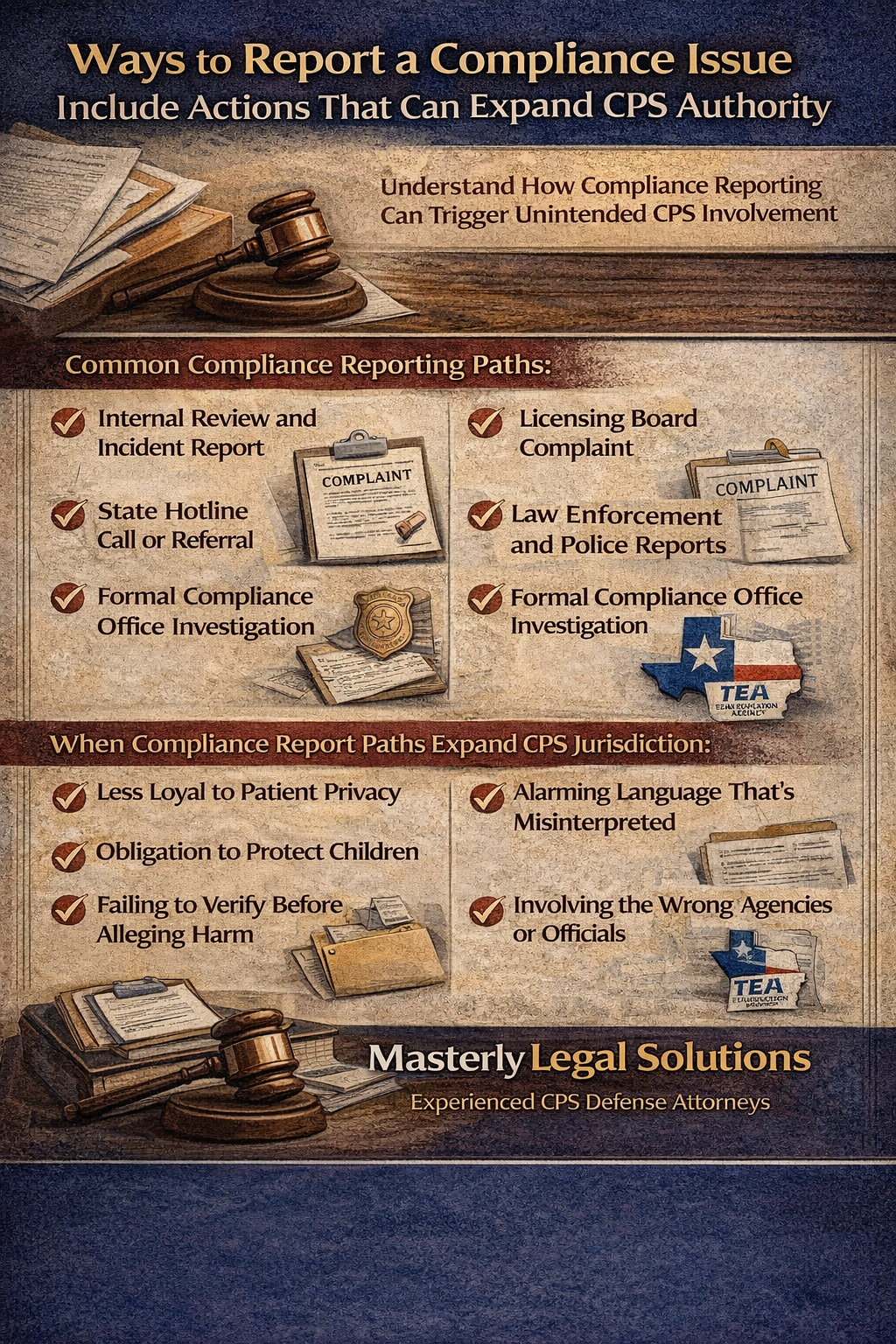
Valuable Insights Families Learn Too Late—Unless They Get Help Early
Families often say the most painful part was not the investigation—it was realizing they didn’t know the rules. They didn’t know how wording mattered. They didn’t know safety plans could trap them. They didn’t know compliance reporting could become child welfare intervention.
These valuable insights should not come after the damage is done. If your family is already feeling pressure, this is your sign to act now. There is a way to respond without making it worse. And it starts with legal strategy.
Masterly Legal Solutions Helps Families Protect Their Rights Before It Escalates
At Masterly Legal Solutions, we understand how quickly CPS authority can expand once reporting systems are triggered. We help families respond to compliance-related escalation, child welfare concerns, and CPS investigations with structure and clarity. Our role is not to inflame conflict, but to protect stability and stop unnecessary escalation. We help you protect parental rights while keeping the focus on the child’s safety.
We also help families understand how reporting language, documentation, and early decisions shape outcomes. When you have legal representation, you gain a plan instead of panic. You gain communication control instead of confusion. And you gain protection when the system feels too powerful.
Contact Masterly Legal Solutions for a Free Consultation
If you are dealing with a situation where reporting a compliance issue has triggered child protective services, or you are worried that the wrong report could expand CPS authority, don’t wait for the situation to get worse. Compliance reporting can move faster than families expect, and small wording choices can turn into CPS investigations with serious consequences. Whether the issue involves alleged abuse, safety concerns, a voluntary agreement, or pressure to sign a safety plan, you deserve guidance that protects your family’s stability from the start.
At Masterly Legal Solutions, we help parents, guardians, and caregivers protect their rights when CPS becomes involved—especially in cases where the escalation was unintended. We’ll help you understand your options, reduce legal risk, and build a strategy to protect your child, your home, and your future.
Call (972) 236-5051 today to schedule your free consultation.
Disclaimer: This article is for educational purposes only and does not constitute legal advice or legal guidance. Every case is different, and outcomes depend on the specific facts and circumstances involved. For advice regarding your situation, consult a qualified attorney directly.
Teacher Rights When Assaulted by a Special Needs Student: Safety, Reporting and Investigation Issues


Looking for Legal & Business Solutions? Contact Us Now
Fill in the form or call us to set up a meeting





