

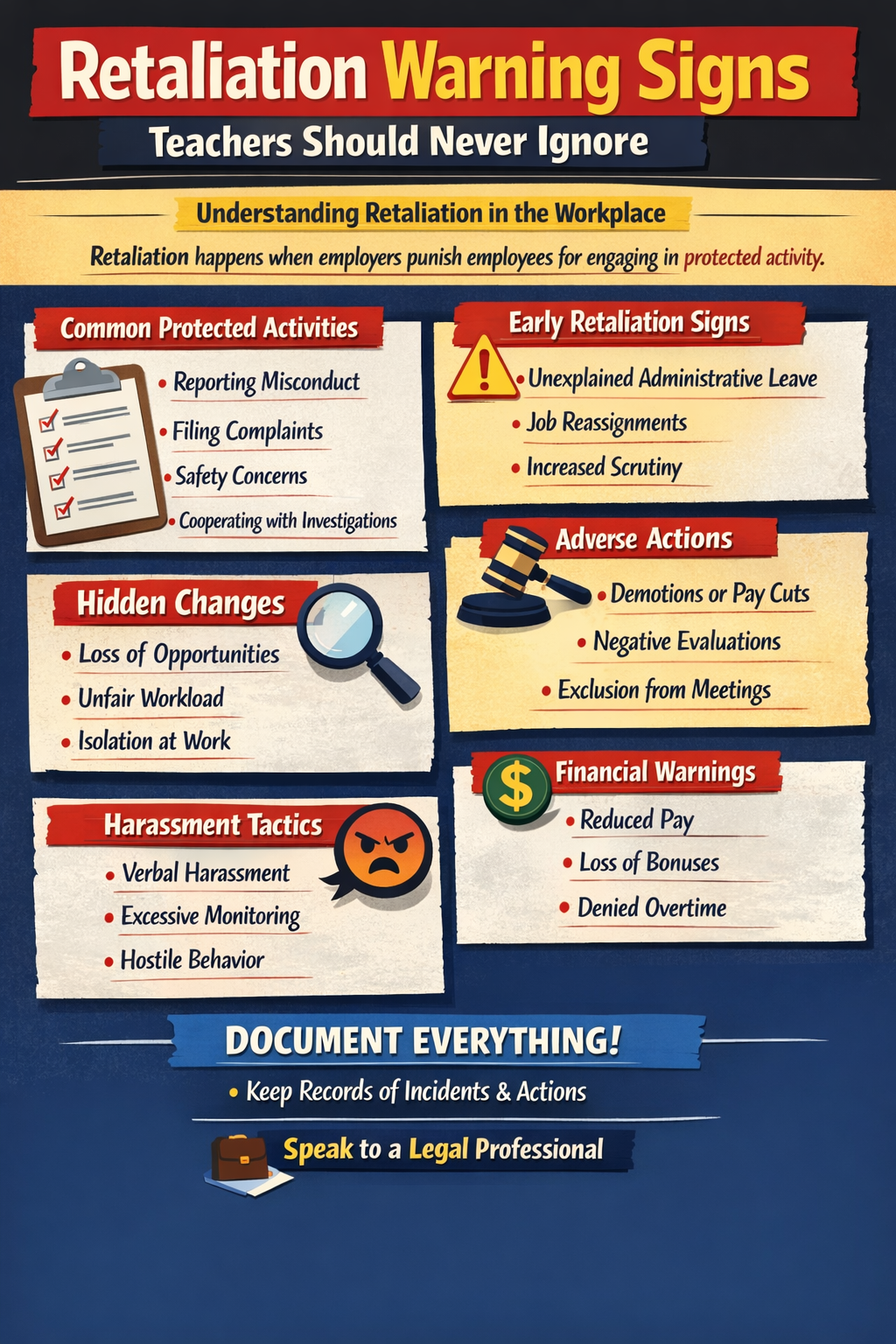
Retaliation Warning Signs Teachers Should Never Ignore
Understanding Retaliation in the Workplace
Retaliation in the workplace is one of the most overlooked issues that employees face, especially in education. Many teachers focus on doing their job well and supporting students, but may not immediately recognize when retaliation occurs. In simple terms, retaliation happens when an employer takes adverse action against employees because they engaged in a protected activity. This could include reporting misconduct, raising a concern about workplace safety, or participating in an investigation.
For teachers, recognizing retaliation early can make a major difference in protecting their career. School environments often involve layers of administration, human resources, and agency policies, which can make identifying improper behavior more complicated. A reasonable employee may not always see subtle changes as retaliation at first, but patterns matter. When actions by a supervisor or manager feel directly related to a complaint or report, it is important to take a closer look.
What Counts as a Protected Activity
A protected activity is any action employees take that is legally safeguarded under work retaliation laws. These actions are designed to protect individuals from punishment when they report wrongdoing or exercise their rights. Teachers often engage in protected activity without realizing the full scope of what qualifies.
Common examples of protected activity include:
- Reporting harassment or discrimination
- Participating in an investigation involving alleged misconduct
- Filing discrimination claims under Title VII
- Raising concerns about workplace safety
- Cooperating with police or other authorized agency officials
When employees engage in protected activity, the law is meant to protect both the employee and the integrity of the agency’s mission. However, retaliation still happens, and recognizing it is key.
How Retaliation Typically Begins
Retaliation rarely starts with obvious disciplinary action. Instead, it often begins with subtle changes that can easily be overlooked. An employer may attempt to justify decisions through agency judgments or internal policies, even when those actions have a negative impact on the employee.
For example, a teacher who reports alleged misconduct may suddenly be placed on administrative leave. While administrative leave can be appropriate in certain investigations, repeated or unnecessary use of administrative leave may raise concerns. The agency determines whether such leave is justified, but patterns can reveal improper motives.
The Role of Administrative Leave in Retaliation
Administrative leave is not inherently negative. In fact, it is sometimes necessary to allow an investigation to proceed without disruption. However, when used improperly, administrative leave can become a tool of retaliation.
In many situations, employees are placed on paid administrative leave during an investigation. This type of paid leave is meant to be temporary and fair. However, problems arise when administrative leave is extended beyond brief periods or used without clear justification.
Teachers should watch for signs such as:
- Being placed on administrative leave without explanation
- Repeated use of administrative leave after engaging in protected activity
- Being kept on administrative leave for short periods that repeatedly renew
- Lack of communication from agency officials during the leave
When administrative leave becomes excessive or inconsistent with agency policies, it may signal retaliation.
Paid Administrative Leave Versus Investigative Leave
It is important to understand the difference between paid administrative leave and investigative leave. Investigative leave is often used when the employer believes an employee’s presence could interfere with an investigation. Paid administrative leave, on the other hand, is generally used to protect both the employee and the agency’s mission.
Under OPM regulations and other guidance, federal agencies must carefully consider how they grant administrative leave. While these rules may differ in private sectors and under state laws, the principles remain similar. The agency head and human resources teams are responsible for ensuring that leave decisions align with internal policies.
If an employer fails to follow proper procedures or applies them inconsistently, it may suggest that retaliation occurs.
Warning Signs Hidden in Workplace Changes
Not all retaliation is obvious. In many cases, the warning signs are hidden in day-to-day workplace changes. Teachers should pay attention to shifts that seem minor but occur after engaging in protected activity.
These may include:
- Being reassigned to a less desirable position
- Being removed from a desirable position
- Sudden changes in duties not directly related to performance
- Reduced opportunities for advancement
- Negative changes in employee morale surrounding the individual
A reasonable employee would recognize that these changes, when tied to a complaint or investigation, may indicate retaliation.
When Adverse Action Becomes a Pattern
An adverse action is any decision by an employer that negatively affects an employee’s job. This can include demotions, pay cuts, or disciplinary action. However, adverse action does not need to be severe to qualify as retaliation.
In many cases, multiple small actions add up to a pattern. For example, a teacher may experience:
- Increased scrutiny from a supervisor
- Unwarranted internal reviews
- Repeated placement on administrative leave
- Exclusion from meetings or school activities
When adverse action happens repeatedly after protected activity, it becomes harder for the employer to justify those decisions as routine agency judgments.
The Impact of Investigations on Teachers
Investigations are a common part of school administration, especially when alleged misconduct is involved. However, the way an employer conducts an investigation can reveal whether retaliation is present.
A fair investigation should be, and education law attorneys can help ensure school investigations remain fair and compliant:
- Transparent
- Timely
- Consistent with agency policies
- Conducted by authorized agency officials
If an investigation appears ad hoc, lacks structure, or disproportionately targets one employee, it may raise a concern. Teachers should also watch for situations where investigative leave is used excessively or without proper explanation.
Paid Leave, Notice Leave, and Safety Leave Explained
Teachers may encounter several types of leave during their employment, including paid leave, notice leave, and safety leave. Each serves a different purpose, but misuse can indicate retaliation.
Notice leave is often used when an employee is transitioning out of their position. Safety leave may be granted when there is a concern about workplace safety. While these types of leave are legitimate, they must be applied consistently.
If an employer uses notice leave or safety leave selectively after a protected activity, it may be a sign that retaliation occurs.
Subtle Shifts in Employee Morale
Employee morale can be a strong indicator of underlying issues in a workplace. When a teacher reports a concern, the reaction of other employees and management can reveal a lot about the environment.
Signs to watch include:
- Isolation from other employees
- Negative comments or treatment by colleagues
- Lack of respect from leadership
- A noticeable decline in overall employee morale
These changes may not always be documented, but they can have a real negative impact on a teacher’s experience and career.
The Role of Human Resources and Agency Officials
Human resources departments play a critical role in addressing complaints and ensuring compliance with the law. However, they also work for the employer, which can create challenges for employees.
Agency officials and authorized agency officials are responsible for enforcing internal policies and maintaining fairness. When these individuals fail to act or appear biased, it may signal a possible violation of work retaliation laws.
Teachers should document interactions with human resources and agency officials, especially when concerns are raised.
Retaliation Through Job Reassignment
One of the most common forms of retaliation involves job reassignment. A teacher may be moved from their employee's current position to another role that is less favorable.
This could include:
- Assignment to a less desirable position
- Removal from leadership roles
- Transfer to a different campus or department
While employers may claim these decisions support the agency’s mission, timing and context matter. If the change follows a protected activity, it may not be coincidental.
Financial Warning Signs Teachers Should Notice
Changes in pay can be a clear form of adverse action. Teachers should be especially alert to any financial impact after reporting a concern.
Examples include:
- Reduction in pay or benefits
- Loss of stipends or bonuses
- Denial of overtime or additional opportunities
Even small financial changes can signal retaliation, particularly when they occur alongside other warning signs.
Harassment as a Form of Retaliation
Harassment is not always separate from retaliation. In many cases, it is a direct response to a protected activity. Teachers may experience increased hostility from a supervisor or manager after raising concerns.
This type of behavior can include:
- Verbal harassment
- Unfair criticism
- Increased monitoring
When harassment is directly related to a protected activity, it strengthens a retaliation claim.
Understanding Legal Protections for Teachers
Teachers are protected under various laws, including Title VII and other provisions in the United States Code, and education law attorneys help protect teacher rights under these laws. These laws are designed to ensure that employees can report wrongdoing without fear.
Employers are required to follow agency policies and OPM guidance when handling complaints. This includes ensuring that any administrative leave, investigative leave, or disciplinary action is justified and consistent.
The Importance of Documentation
Documentation is one of the most powerful tools teachers have when facing retaliation. Keeping records of interactions, emails, and decisions can help establish patterns.
Important details to track include:
- Dates of protected activity
- Changes in job duties
- Instances of adverse action
- Communication with human resources
This information can be critical during an investigation or legal review.
When Administrative Leave Becomes Excessive
Administrative leave should generally be limited to brief or short periods. When it extends beyond what is reasonable, it may indicate a problem.
Excessive administrative leave can:
- Disrupt a teacher’s career
- Affect pay and benefits
- Impact overall employee morale
If administrative leave is repeatedly used or extended without clear justification, it may signal retaliation.
The Role of Agency Leadership
The agency head and leadership team are responsible for setting the tone of the workplace. Their decisions influence how policies are applied and how employees are treated.
When leadership fails to issue internal policies consistent with legal requirements, it can create an environment where retaliation thrives. Teachers should be aware of how leadership responds to complaints and concerns.
Comparing Public and Private Sector Practices
While this article focuses on education, it is important to note that practices can vary between federal agencies, schools, and private sectors. However, the core principles of fairness and protection remain consistent.
Regardless of the setting, employers must avoid taking adverse action against employees who engage in protected activity.
Recognizing Patterns Over Time
Retaliation is often easier to identify when viewed over time. A single incident may not seem significant, but repeated actions can reveal a pattern.
Teachers should look for:
- Consistent negative treatment
- Repeated placement on administrative leave
- Ongoing changes to their role
Patterns provide stronger evidence than isolated events.
How Retaliation Affects Career Growth
Retaliation can have long-term effects on a teacher’s career. It can limit opportunities, damage reputation, and create unnecessary stress, and in some situations an employer’s conduct may even feel like pressure to resign or quit your job.
Employers who engage in retaliation risk not only legal consequences but also damage to the agency’s mission and overall employee morale.
Taking Action When You Notice Warning Signs
When teachers recognize warning signs, it is important to act promptly. Knowing your legal rights and protection options as a teacher can guide your next steps. This may include:
- Reporting concerns to human resources
- Consulting with legal professionals
- Documenting all relevant information
Taking action early can help protect your rights and prevent further harm.
Protecting Yourself Moving Forward
Teachers should take proactive steps to protect themselves, including understanding their rights and staying informed about agency policies. Awareness is the first line of defense against retaliation.
Speak With a Legal Professional Today
If you believe retaliation has affected your career, it is important to speak with a retaliation lawyer who understands the complexities of work retaliation laws. At Masterly Legal Solutions, we help employees navigate difficult workplace situations, including retaliation, investigations, and adverse action.
Our team is committed to helping you protect your rights, your career, and your future. We understand how overwhelming these situations can feel, especially when your employer holds significant power.
Personnel Management and the Role of Authorized Decisions
Personnel management plays a critical role in how schools and educational agencies handle employee concerns, especially after a teacher engages in a protected activity. Decisions involving discipline, reassignment, or administrative leave should be carefully evaluated to ensure they are specifically authorized and not influenced by retaliation. In many cases, an employer may attempt to justify actions by pointing to internal procedures, but those actions must still align with the law and fair workplace practices, and HR consulting and training services can help institutions meet those standards. Teachers should be aware that even decisions presented as routine personnel management can raise concerns if they follow closely after a complaint or report.
Excused Absence and Guidance from Presidential Directives
In certain situations, employees may be granted an excused absence during an investigation or review process. This can be appropriate when supported by a presidential directive or presidential memorandum that outlines how agencies should handle sensitive matters. However, an excused absence must be applied consistently and not used as a hidden form of adverse action. When an employer places a teacher on leave without clear communication or justification, it may signal a deeper issue. Teachers should understand that even policies tied to high-level guidance must still protect their rights and not be used to mask retaliation.
Workplace Policies, Blood Donations, and Officially Sponsored Activities
Employers often create policies that allow flexibility for employees to participate in activities such as blood donations or other officially sponsored events. These opportunities are generally seen as positive benefits that support both the employee and the agency’s mission. However, problems can arise when employers begin placing employees on leave or denying participation in these activities after a protected activity. When access to these benefits changes suddenly, it may indicate unequal treatment. Teachers should pay attention to whether they are being treated differently from other employees in similar situations.
Executive Orders and Time Limited Decisions in the Workplace
An executive order or similar authority may guide how agencies implement certain policies, including leave decisions or investigative procedures. In some cases, actions such as administrative leave or reassignment may be applied on a time limited basis, particularly during an investigation. While this can be appropriate, the duration and reasoning must remain fair and transparent. If an employer repeatedly extends these decisions without explanation, it may raise concerns about retaliation. A reasonable employee would question whether these actions are truly necessary or if they are being used to create pressure.
Tracking Patterns Over a Calendar Year
Sometimes retaliation is not obvious in a single moment but becomes clear when viewed over a calendar year. Teachers may notice patterns such as repeated administrative leave, shifting job duties, or ongoing adverse action following a protected activity. When these actions continue over time, it becomes harder for an employer to claim they are unrelated. Tracking events across a longer period can help reveal whether decisions are part of normal operations or something more concerning, and pursuing retaliation and labor complaints through appropriate legal channels may become necessary. Documentation over time is often one of the strongest ways to identify improper behavior.
Understanding Other Related Protected Activity
Teachers should also be aware that protection extends beyond one specific complaint. The law recognizes other related protected activity, including supporting colleagues, participating in internal reviews, or cooperating with an investigation. Even if the activity is not the original complaint, it may still be protected under work retaliation laws, and retaliation and workplace law attorneys can help enforce these protections. Employers are prohibited from taking adverse action based on any related protected activity, not just the initial report.
Recognizing Related Protected Activity in Real Situations
Related protected activity can include a wide range of actions that may not seem obvious at first. For example, speaking with human resources, providing information during an investigation, or raising concerns about policy violations can all qualify. These actions are often directly related to maintaining fairness and accountability in the workplace. When an employer responds negatively to these efforts, it may indicate retaliation. Every teacher needs legal protection in education law matters, and teachers should understand that their right to protect themselves and others does not end after the first complaint—it continues throughout the entire process.
Contact Us for a Free Consultation
If you have questions about retaliation, administrative leave, or your rights as an employee, we encourage you to reach out. Every situation is unique, and speaking with an experienced legal team can provide clarity and direction.
Contact Masterly Legal Solutions today at (972) 236-5051 for a free consultation. We are here to listen, answer your questions, and help you understand your options so you can move forward with confidence.
This article is provided for educational purposes only and does not constitute legal advice. For guidance specific to your situation, please contact a qualified attorney.





Teacher Rights When Assaulted by a Special Needs Student: Safety, Reporting and Investigation Issues



Looking for Legal & Business Solutions? Contact Us Now
Fill in the form or call us to set up a meeting