

The Difference Between CPS Investigations and CPS Findings in Washington County
When CPS shows up in your life, it rarely feels like a calm, orderly process. It feels like a door suddenly opened into your private family world—one you didn’t invite and can’t easily close. Parents often hear terms like “investigation,” “finding,” “case,” and “court,” and they’re expected to understand what each one means while also protecting their child and keeping daily life together. That confusion is one reason families feel powerless in the early days of a CPS matter.
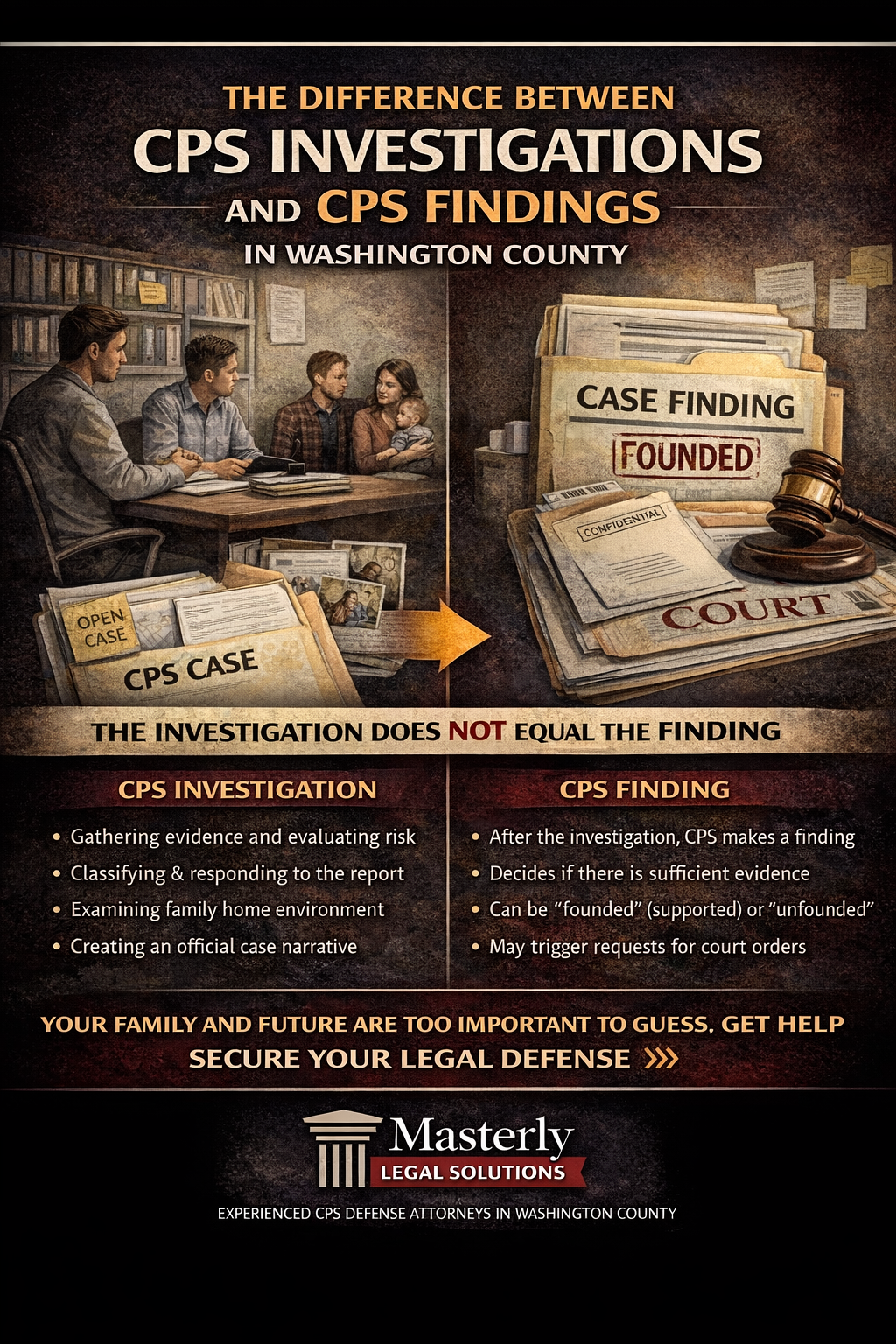
In Washington County, families frequently misunderstand one critical distinction: a cps investigation is not the same as a CPS finding. An investigation is the process of gathering information. A finding is the agency’s decision about whether the allegations are supported, and that decision can shape your future in ways most people don’t anticipate.
At Masterly Legal Solutions, our law firm helps families protect parental rights from the moment CPS becomes involved. We know how fast a file can turn into a long-term problem, and we know how important it is to respond with strategy, evidence, and legal knowledge. This article breaks down the difference between investigations and findings, what each stage means for your family life, and when it’s time to secure legal representation.
Why This Difference Matters More Than Families Expect
Many parents think, “If I cooperate, the investigation will go away.” Cooperation can help, but it does not guarantee CPS will close the case without a finding. CPS is a government agency with internal rules, timelines, and decision-making standards that don’t always match a parent’s understanding of fairness.
The investigation stage is about investigating reports and collecting details. The finding stage is where CPS determines whether there was child abuse or neglect, a safety concern, or another basis for ongoing involvement. A finding can affect custody, supervised visitation, future CPS cases, and even employment opportunities depending on the circumstances.
That’s why the distinction matters. Investigations are stressful, but findings can be lasting.
What Child Protective Services Does and Why It Gets Involved
Child protective services exists to respond to allegations involving child safety. In many child protective services cases, the report comes from a concerned party such as a teacher, doctor, neighbor, or family member. Sometimes the report is accurate. Sometimes it’s a misunderstanding, a conflict, or an exaggerated claim during a difficult time.
Child protective services cps may investigate claims of abuse, neglect, or child endangerment. The agency may also look at living conditions, supervision, medical care, and other factors related to a child’s well being. This is part of the broader system sometimes described as protective services and family services.
Parents should understand that CPS involvement does not mean guilt. It means the agency has decided the situation requires review, and that review becomes the cps investigation process.
Understanding the CPS Investigation Process
A cps investigation process typically begins after CPS receives a report and opens a file. The case is assigned to a cps caseworker or other CPS workers who make contact with the family. The caseworker may request interviews, home visits, and documents.
In a typical cps investigation, CPS may:
- Interview parents and the child
- Speak with school staff or medical providers
- Review records and prior reports
- Evaluate home environment and supervision
- Assess safety concerns and immediate risk
This investigation phase can feel intrusive because it touches private aspects of family life. But the agency is collecting information to decide what appropriate actions to take.
The key point is that an investigation is still a fact-gathering period. It is not yet the final decision.
What a CPS Finding Really Is
A CPS finding is the agency’s conclusion after the investigation. It is how CPS determines whether the allegations are supported by sufficient evidence. Parents often assume a “finding” means the case went to court. That’s not always true.
A finding can be made administratively, based on CPS’s internal review of the evidence and reports. That finding may still have serious consequences, including the possibility of court intervention or a juvenile dependency case, depending on your county’s procedures and how the case proceeds.
A finding can also influence future CPS cases. Even if this case ends without court action, the finding may remain in the record and affect later decisions.
Why Parents Confuse “Open Case” With “Finding”
Parents hear, “The case is open,” and they assume CPS already decided something. But an open case simply means the investigation or service plan is active. CPS may still be gathering evidence, interviewing people, and preparing for a final decision.
Many parents also confuse safety plans with findings. A safety plan is not the same as a finding, but it can affect parental rights in real life. It may limit contact with the child, require supervised visitation, or require a parent to leave the home temporarily.
This is why clear legal guidance matters early. Without legal representation, families may agree to restrictions without realizing how those steps can influence the finding.
The Administrative Side Families Don’t See
Much of CPS work happens behind the scenes. CPS workers write notes, supervisors review decisions, and internal systems track risk assessments. Parents often do not see the full record until later, if at all.
These administrative notes can shape what CPS recommends. They can influence whether the case proceeds toward court order requests, whether foster care is discussed, and whether a juvenile dependency case becomes likely.
If the file contains inaccurate summaries, those inaccuracies can become part of the official narrative. That’s why present evidence early matters, not after decisions harden.
What CPS Looks For During an Investigation
During a cps investigation, CPS focuses on child safety. That can include physical safety, emotional safety, and basic needs. CPS may examine whether alleged abuse occurred, whether there are ongoing risks, and whether the home can remain stable.
CPS may look at:
- Allegations of child abuse
- Neglect related to supervision or living conditions
- Abuse or neglect tied to substance use
- Concerns about violence in the home
- Claims of child endangerment
Even if the child is not removed, CPS may still decide a safety plan is necessary. That can feel like punishment, but from CPS’s perspective, it is framed as ensuring child safety.
How CPS Determines Whether There Is “Sufficient Evidence”
Parents often ask what “proof” CPS needs. The reality is that CPS is not the same as criminal court. CPS findings may rely on what CPS believes is sufficient evidence based on interviews, records, and observations.
This can feel unfair to parents because the standards may seem subjective. The caseworker’s impression can matter, and so can the way witnesses describe events. That is why it is crucial to gather evidence, clarify misunderstandings, and present compelling arguments through counsel.
A cps defense attorney can help identify gaps in CPS reasoning and highlight weaknesses in the agency’s evidence. When the evidence is thin, strategic advocacy matters.
Allegations vs. Findings: The Turning Point
Allegations are claims. Findings are conclusions. Families often focus on defending against allegations, but they don’t realize the goal is to prevent a damaging finding.
Allegations can be broad and emotional, especially in family conflict. A parent might face allegations tied to discipline, an accident, a misunderstanding, or a heated argument. CPS may document that information and then decide whether the allegation rises to child abuse or neglect.
Once the finding is made, reversing it can be much harder. That’s why cps defense is most effective when it begins early, during the investigation stage.
When a Case Moves Toward Court Intervention
Not every cps investigation leads to court. But if CPS believes the child is unsafe or services are not being followed, the agency may seek court intervention. That could include requesting a court order for access, services, or temporary custody changes.
When court becomes involved, families may face court hearings and legal deadlines. The case can become more formal and more intimidating, especially for parents unfamiliar with the system.
In some areas, the case may resemble a juvenile dependency case structure. In other places, the language may differ, but the principle is the same: once court is involved, the stakes increase.
Juvenile Dependency and Juvenile Dependency Case Language
Some families hear terms like juvenile dependency and assume the case is about delinquency. In reality, juvenile dependency usually refers to a child welfare case where the court oversees placement and services. It can involve removal, supervised visitation, and long-term planning.
A juvenile dependency case can affect family life deeply. It can involve multiple hearings, service plans, and ongoing monitoring. Parents may be required to complete counseling, parenting classes, evaluations, or other services.
If your case proceeds in a juvenile dependency structure, having a cps defense lawyer with legal expertise becomes critical. Court systems move fast, and parents need a plan.
Safety Plans and Supervised Visitation: Not Just “Temporary Steps”
A safety plan can be presented as a short-term agreement, but it can influence findings. If CPS says a safety plan is needed, it often implies CPS believes there is an active risk.
Safety plans may require:
- A parent to live elsewhere temporarily
- A relative to supervise contact
- Supervised visitation rules
- Restrictions on discipline or contact
- Immediate service enrollment
Parents should not sign a safety plan casually. A defense attorney can review the terms, explain risks, and negotiate appropriate actions that protect the child without unfairly stripping the parent's rights.
Foster Care and Removal Decisions
Removal is one of the most frightening possibilities in cps cases. If CPS believes there is an immediate danger, it may seek to place the child with relatives or in foster care. Families often assume removal only happens after a judge is involved, but emergency situations can move quickly.
Even when removal does not occur, CPS may discuss placement options as part of risk planning. These discussions can feel like threats to parents, especially when the agency acts aggressively.
CPS decisions about foster care can be influenced by the administrative record and the caseworker’s narrative. That is another reason to act early and present evidence that supports child safety and stability.
Neglect Case vs. Abuse Case: Why the Label Matters
A neglect case and an abuse case may be handled differently. Neglect often focuses on supervision, environment, and meeting needs. Abuse often focuses on physical harm, sexual allegations, or intentional cruelty.
Both are serious, and both can lead to findings. But the way CPS evaluates evidence may vary. In a neglect case, CPS may emphasize home conditions, routines, and caregiving patterns. In an abuse case, CPS may emphasize medical records, injury explanations, and witness statements.
Understanding the category helps families respond strategically. It also helps an attorney build a strongest possible defense tailored to the allegations.
Criminal Charges: When CPS and Criminal Systems Overlap
Some allegations can lead to criminal charges, especially when the report involves serious physical injury or sexual abuse. CPS investigations may share information with law enforcement depending on the situation.
Parents should be cautious about statements made during investigations. Even if you believe you did nothing wrong, a misunderstood statement can create risk.
If criminal exposure is possible, legal representation should happen immediately. A cps defense attorney can help protect your rights and coordinate strategy.
Parental Rights and Custody: What’s Really at Stake
Parents often focus on the immediate stress of CPS visits. But the deeper risk involves parental rights and custody. CPS findings can influence custody arrangements, court orders, and future family law matters.
In many cases, CPS involvement intersects with family law disputes, especially when parents are separated. A parent may worry CPS is being used as leverage. CPS may not care about family drama, but the agency’s decisions can still affect custody outcomes.
That’s why families should approach cps investigations with a long-term view. The goal is not just to “get through” the moment. The goal is to protect your family’s future.
Why Having a CPS Defense Attorney Changes the Outcome
Families often try to handle CPS alone, hoping cooperation will lead to closure. Sometimes it does. But when the stakes rise, legal knowledge matters.
A cps defense attorney can:
- Communicate with CPS on your behalf
- Help you present evidence effectively
- Identify weaknesses in CPS claims
- Prepare for court hearings if needed
- Protect the parent’s rights during interviews and agreements
This is more than paperwork. It’s legal strategy. And in child protective services cases, small mistakes can create big consequences.
CPS Defense Lawyer vs. General Legal Help
Not every attorney understands CPS systems. CPS cases involve specific procedures, timelines, and administrative frameworks. That’s why many families seek a cps defense lawyer with legal specialization in protective services matters.
A defense attorney familiar with cps investigation process steps can anticipate how CPS determines findings and how cases proceed. They can also prepare compelling arguments when CPS narratives are inaccurate.
Parents should look for a law firm that offers legal expertise and practical experience. When your child and family life are at stake, you need more than generic advice.
Washington County vs. Other Counties: Why Location Still Matters
Every county has its own practical style, even when the broader structure is similar. Families in Washington County may deal with different staffing levels, local protocols, and court scheduling patterns. That’s why local strategy matters.
At the same time, families often search online and see references to other jurisdictions like San Bernardino County, Orange County, or Riverside County in Southern California. Those references can confuse parents who are trying to understand their own county’s process.
What matters most is understanding the distinction between investigation and finding where you live. A cps investigation is a process, and a finding is a decision—regardless of whether you’re hearing terms from San Bernardino or other counties online.
How Clients Can Protect Themselves During an Investigation
Parents can take steps that protect the case without escalating conflict. The goal is calm cooperation paired with smart boundaries.
Helpful steps often include:
- Keep a written timeline of events
- Save messages, photos, and relevant records
- Ask for clarity on allegations and scope
- Avoid informal conversations that can be misquoted
- Request an initial consultation with an attorney
- Document service participation and communication
These steps help families protect themselves if CPS later claims noncooperation or increased risk.
Present Evidence the Right Way, Not the Emotional Way
Families are emotional because this involves their child. That reaction is normal. But CPS systems often respond better to organized proof than passionate arguments.
When you present evidence, focus on facts and documentation. Show consistency in care, stability in the home, and support from safe relatives or community members. An experienced attorney can help you prepare documentation and frame it effectively.
If you wait until the case proceeds to a court hearing, you may have lost valuable time. Present evidence early when it can still influence the finding.
What “Providing Services” Means After an Investigation
If CPS believes there is a risk but not immediate removal, it may request services. This is often described as family services or protective services support, but it can also become a compliance test.
Services may include counseling, classes, evaluations, and monitoring. Parents should take services seriously because refusal can be framed as lack of cooperation, even when the services feel unnecessary.
At the same time, parents should not accept unreasonable demands without advice. A defense attorney can negotiate service expectations and ensure appropriate actions are fair and realistic.
Proven Track Record and Why It Matters in CPS Defense
Parents often ask how to choose representation. In cps cases, you want a law firm that understands both administrative CPS decisions and court processes. A proven track record matters because CPS defense is not just paperwork—it is strategy under pressure.
The right attorney will know how CPS determines findings, how to address safety plans, and how to protect parental rights before court becomes unavoidable.
At Masterly Legal Solutions, our clients rely on our legal knowledge, commitment, and dedication to protecting family stability. We focus on building the strongest possible defense from the beginning.
When to Seek Legal Representation Right Away
Some parents try to wait and see. But waiting can allow the record to become unfavorable. You should strongly consider contacting counsel if:
- The allegations involve child abuse or neglect
- CPS mentions possible court intervention
- A safety plan is being pressured
- Supervised visitation is being discussed
- Removal or foster care is mentioned
- You fear criminal charges could arise
These moments are turning points. Early legal representation can prevent escalation and protect your rights.
Contact Masterly Legal Solutions for a Free Consultation
If you are dealing with washington county cps involvement, the most important thing to remember is that an investigation is not the same as a finding—and what happens during the investigation can shape everything that comes next. When CPS is building a record, families need more than hope. They need clarity, strategy, and legal protection.
At Masterly Legal Solutions, we provide focused cps defense for parents who want to protect their child, their parental rights, and their family life. Our law firm helps clients respond to a cps investigation, challenge unfair allegations, and work toward outcomes that keep families together whenever possible. If you need a cps defense attorney or a cps defense lawyer to guide you through interviews, services, and potential court hearings, we are ready to help.
Call (972) 236-5051 for a free consultation. You can contact us to discuss what CPS is requesting, how the cps investigation process may unfold, and how to present evidence effectively before a finding becomes permanent.
Disclaimer: This article is for educational purposes only and does not constitute legal advice or legal guidance. Reading this content does not create an attorney-client relationship. For advice about your specific situation, contact Masterly Legal Solutions directly.

Teacher Rights When Assaulted by a Special Needs Student: Safety, Reporting and Investigation Issues


Looking for Legal & Business Solutions? Contact Us Now
Fill in the form or call us to set up a meeting