
Can a Civility Policy Violation Notice Put Your Teaching License at Risk?
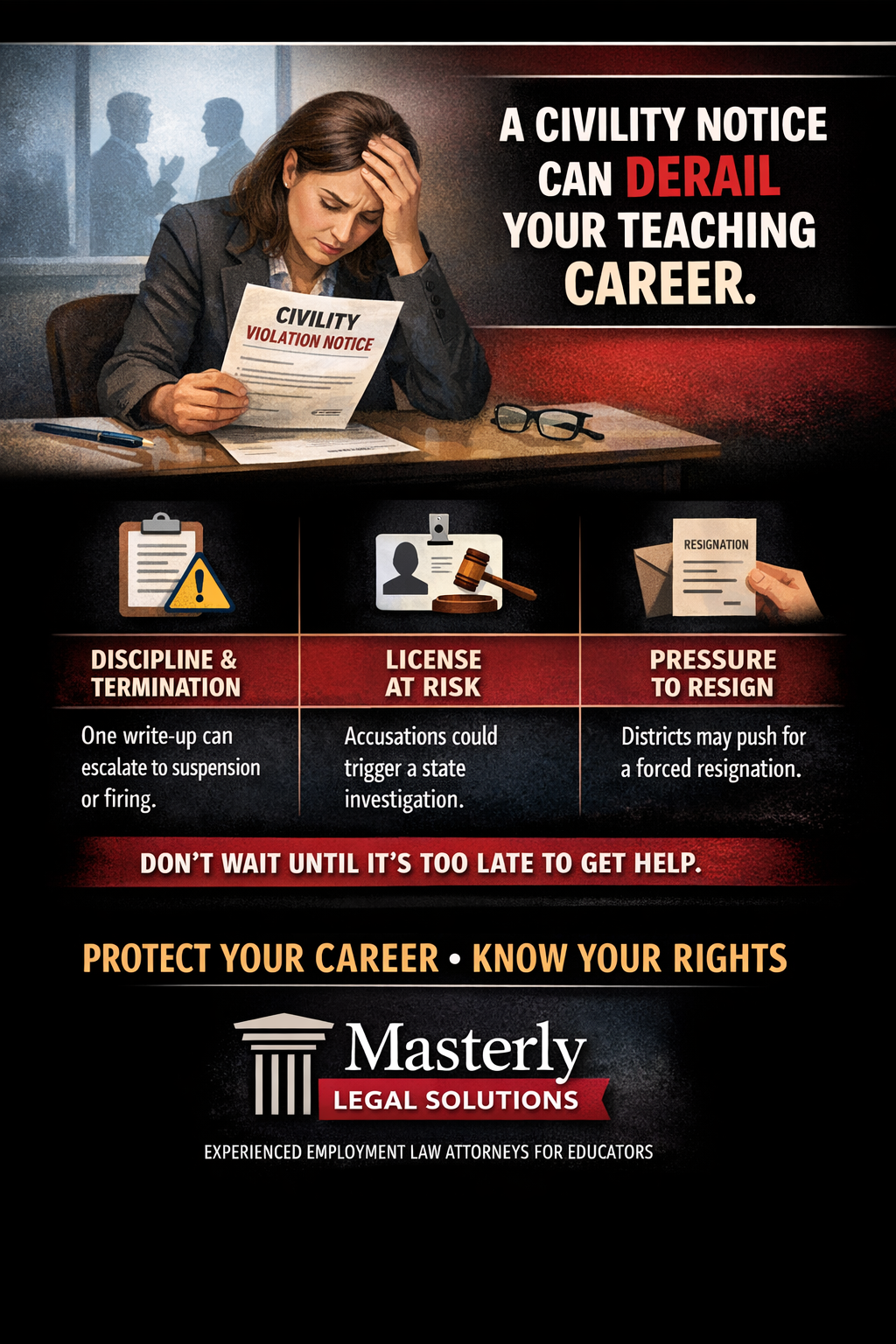
Getting a civility policy violation notice can feel humiliating, confusing, and unfair—especially when you’ve built your career around helping students and supporting a school community. Many educators assume it’s “just a workplace write-up” and nothing more. But the truth is, one notice can start a chain reaction that affects your reputation, your employment, and your ability to stay in the profession.
At Masterly Legal Solutions, we’ve seen how quickly a situation that starts as an internal conflict can turn into a serious professional crisis. In some circumstances, a civility allegation becomes the foundation for discipline, an escalation to an investigation, and even termination. Worse, school district paperwork can follow you long after you leave, creating exposure that may impact your teaching license.
This article breaks down what these notices really mean, why they matter long-term, and what steps educators can take to protect themselves early. If you’re dealing with accusations, changing working conditions, or pressure to resign, you may need legal guidance sooner than you think.
What Is a Civility Policy Violation Notice?
A civility policy violation notice is typically a written document claiming that an employee failed to meet the professional expectations outlined in a school district’s conduct rules. It may reference workplace behavior, tone in communication, emails, meetings, or interactions with a supervisor or co worker. Even if the issue seems minor, the notice is often used to create a paper trail.
Sometimes the notice is tied to vague wording like “unprofessional conduct,” “hostile behavior,” or “disruptive communication.” Other times, the employee is accused of being “insubordinate” or “not respectful.” These labels can be damaging because they are subjective, and districts often interpret civility policies differently depending on circumstances.
Even when the educator believes they were acting reasonably, the employer may treat the situation as a serious violation. The problem is that a violation notice does not stay isolated—it can be used in later disciplinary action or employment decisions.
Why This Notice Matters More Than People Think
In education employment, a written allegation can become a tool for discipline and eventual termination. Many school systems are structured to document every step in a performance “process,” whether the employee agrees or not. Once the notice exists, it can become “strong evidence” that a pattern exists—even if there was never a fair evaluation.
This is how educators get trapped. The employer may say: “We warned you,” even if the warning was exaggerated or based on one incident. From a legal standpoint, a single notice can become a key document used to justify placing someone on administrative leave, recommending termination, or supporting the district’s actions in later legal action.
A notice may also impact your job mobility, because districts often request or reference internal records. If you apply for a new position, concerns about professionalism may come up behind the scenes, even if you were never formally disciplined beyond the notice.
Can a Civility Policy Allegation Trigger a License Investigation?
A civility issue does not always mean a license case—but it can become a starting point depending on how it’s handled by the employer. When school districts believe conduct relates to professional standards, they may report concerns to state licensing authorities. What begins as a workplace complaint can turn into an investigation that affects your future.
This becomes more likely if the district frames the situation as harassment, bullying, intimidation, discrimination, retaliation, or alleged misconduct toward students or staff. Sometimes the situation is not what it seems, but the wording of the complaint can still create risk.
Even if you never intended harm, an aggressive write-up can be used to argue you are unfit or unsafe. Educators should not assume that “civility” is always harmless. It depends on the employer’s interpretation, the documentation, and the way the incident is reported.
How Districts Use Documentation to Build a Case
A lot of school employment cases follow the same pattern, even if they look different on the surface. It often starts with an email, complaint, meeting, or conflict. Then it grows into official paperwork.
Once the employer begins documenting a “violation,” the district may create a timeline meant to support eventual termination. This is where many educators get blindsided. The process often feels like the outcome was established long before the employee had a fair chance to respond.
School districts sometimes rely on:
- Written complaints from other employees
- Meeting notes created by administration
- Statements recorded by human resources
- Performance plans or “growth plans”
- Past conflicts that are suddenly brought back up
- A workplace investigation that favors management
- A narrative suggesting the employee refuses direction
Even when the educator tries to explain or defend themselves, the employer may treat their response as another violation.
Administrative Leave and Paid Administrative Leave: What It Means for Your Career
When a district removes an educator from campus during a dispute, they often call it administrative leave. Sometimes it is paid administrative leave, and educators feel temporary relief because pay and benefits continue. But this is not a harmless pause—it is often a strategic move. For support and guidance, educators may consider seeking legal services.
Administrative leave is frequently used as a holding period while the employer conducts an investigation or finalizes a recommendation. The district may claim it’s necessary for workplace safety, student safety, or protecting the integrity of reporting.
While you’re on administrative leave, the employer controls the narrative. It may be harder for the employee to access emails, respond to allegations, or gather evidence. A paid leave period can also be a time when the district pushes for a forced resignation.
This is why educators should treat administrative leave as a major warning sign, not a break.
How “Professionalism” Accusations Become Termination
Many teachers assume termination only happens for something extreme. In reality, termination can be supported by repeated paperwork that frames the employee as difficult, disrespectful, or “not a team player.” A civility notice can be used to justify the decision even when the underlying complaint is petty or retaliatory.
The employer might claim the teacher violated policy by:
- Disagreeing with a supervisor in a meeting
- Asking for clarification on instructions
- Reporting issues that make administration uncomfortable
- Defending themselves against unfair criticism
- Refusing to accept blame for something they didn’t do
The district may argue that the teacher’s conduct created disruption or damaged working conditions for other employees. That argument is often used as the legal foundation for disciplinary action and termination.
When Workplace Pressure Turns Into Forced Resignation
One of the biggest risks after a civility notice is pressure to resign. Districts may try to avoid formal due process by pushing the employee toward a “voluntary exit.” This is often presented as a way to protect the teacher’s record, but it can be a trap.
A forced resignation can happen in subtle ways. The employer might imply you have no future at the school. They may say the board will terminate you, or they may suggest that resigning is best to “move on.” In reality, resigning can still create professional damage, and it may not protect your teaching license.
Examples of pressure tactics include:
- Threatening termination if you don’t resign
- Suggesting “it will be worse for you” if you fight
- Isolating you from campus support
- Increasing scrutiny on your daily work
- Assigning unrealistic duties or impossible deadlines
- Blocking you from defending yourself in the process
These circumstances can result in constructive discharge, where working conditions are made so intolerable that a reasonable person would feel they had no choice but to resign.
Constructive Discharge and Constructive Termination in Education Settings
Constructive discharge occurs when an employee quits because the employer made the job environment unbearable. Some educators also hear terms like constructive termination or constructive dismissal, depending on the jurisdiction and context. The key idea is that the resignation wasn’t truly voluntary—it was forced through pressure and harmful conditions.
Constructive discharge can be difficult to prove, but it may be relevant when a teacher is targeted after reporting an issue, requesting support, or refusing to participate in illegal activity. Educators may also face a constructive termination situation when the employer creates a path where termination feels inevitable.
School working conditions that may support a constructive discharge argument include:
- Being repeatedly written up without fair cause
- Being removed from duties or assigned demeaning tasks
- Losing pay opportunities or important benefits
- Being isolated, targeted, or harassed by leadership
- Being blamed publicly or privately for unproven conduct
- Having your reputation destroyed internally
If an employee quits under these conditions, they may still have legal rights, especially if public policy or statutory protections were violated.
Can You File a Wrongful Termination Claim After a Civility Notice?
Not every termination is illegal. Many school systems operate under policies that resemble at will employment, especially for certain roles or employment arrangements. But even in at-will systems, there are still limits. If the employer fired you for illegal reasons, you may have claims worth reviewing with an employment lawyer.
A civility notice often becomes a justification for wrongful discharge when the real reason was retaliation, discrimination, or protected activity. In these cases, the employer may claim the termination was about “conduct,” but the timing tells a different story.
A wrongful termination claim may arise when termination happens after:
- Reporting misconduct or unsafe conditions
- Making a complaint about employment discrimination
- Refusing improper directives
- Requesting medical care accommodations
- Supporting another worker’s complaint
- Cooperating with investigations
If the termination is based on protected activity, a jury believes the district’s paperwork may not be enough to justify what happened.
How Retaliation Can Be Hidden Behind Civility Language
Retaliation is one of the most common hidden issues in civility cases. It happens when an employer punishes an employee for speaking up, reporting concerns, or refusing to violate policy. In education settings, retaliation can look like sudden write-ups, negative evaluations, and removal from roles.
The employer may claim the teacher was disrespectful, but the real issue could be that the teacher reported something the district didn’t want addressed. Retaliation can be especially strong when reporting involves staff misconduct, student safety, or compliance.
Examples of retaliation disguised as a civility violation include:
- A teacher reporting grade manipulation
- A teacher raising workplace safety issues
- A teacher reporting discrimination or harassment
- A teacher questioning unethical decisions
- A teacher refusing to change official records
This is why the employee should document reporting and communication carefully, because timing matters when evaluating a claim.
The Role of Human Resources in Civility Complaints
Many employees expect human resources to act as a neutral party. In reality, human resources often exists to protect the employer and ensure legal compliance (Higher Education Law Services | Legal Support for Schools). That doesn’t mean they are always unfair, but it means the employee should be cautious about how they communicate and what they admit.
HR may conduct the investigation, collect statements, and advise leadership on termination options. They may also pressure the employee to accept discipline, sign documents, or agree to a resignation plan.
When HR becomes involved, your case may already be moving into a formal stage. The teacher should treat every meeting and email as something that could later be used as evidence.
Union Representative Support and Its Limits
If you are in a district with union protections, you may have access to a union representative. That support can be valuable, especially during an investigation or disciplinary meeting.
However, union support does not always resolve the deeper legal issues. A union representative may help you understand district procedures, but they may not provide individualized legal guidance. If your case involves potential license exposure, retaliation, discrimination, or termination risks, it may be time to speak with an employment attorney.
In high-stakes cases, the combination of union support and legal counsel may offer stronger protection than relying on internal processes alone.
Employment Laws That May Apply to Education Workplace Disputes
Educators often feel stuck because school district policies seem to override everything. But employment laws still apply, especially when the employer crosses legal lines. State law protections may apply differently depending on your jurisdiction, your contract, and your role.
Employment laws may protect educators when issues involve:
- Employment discrimination
- Retaliation for protected activity
- Wrongful discharge in violation of public policy
- Reporting illegal activity
- Unsafe working conditions
- Pressure to resign under coercion
Even in complex systems, employees still have legal rights, and the employer cannot use “civility” to shield unlawful decisions.
What Counts as “Illegal Reasons” for Termination?
School districts often believe documentation gives them total authority. But documentation does not erase unlawful motives. A termination can be illegal even if the employer has paperwork, especially when paperwork is created to justify a pre-planned outcome.
Illegal reasons may include firing a teacher because they:
- Reported misconduct
- Refused to break regulation or policy
- Reported discrimination
- Requested medical care accommodations
- Participated in an investigation
- Raised concerns about working conditions
An employment lawyer may look for patterns that show the termination was not truly based on conduct, but instead on retaliation or discrimination.
When a Civility Notice Becomes a Tool for Wrongful Discharge
A civility write-up can become “step one” in a chain of discipline. Once the employer has a violation on record, they may escalate quickly. Some teachers are placed on administrative leave within days or weeks, even if they were never a workplace problem before.
If the employer fired the teacher without fair cause, or used the civility process as cover for a hidden motive, that may open the door to a wrongful termination claim. A wrongful discharge case may require showing that the employer’s reason is not credible or that the termination violated public policy.
In these cases, having strong evidence matters. That includes emails, timelines, witness statements, and consistent reporting of the true events.
How a Former Employer Can Affect Your Future Career
Many educators believe leaving the district ends the story. Unfortunately, a former employer can still impact your career in ways you don’t expect. Future job applications may require you to disclose why you left, whether you were disciplined, or whether you were placed on administrative leave.
Even if you were not fired, a resignation under pressure can raise questions. A former employer may be contacted informally through references or professional networks. The employer’s narrative may spread faster than the truth.
This is why it’s important to protect your record early, before the district controls the final version of events.
Employment Discrimination and Civility Accusations
Employment discrimination can show up inside civility allegations when certain employees are treated differently than others. Sometimes the district tolerates aggressive communication from some people but labels it as a “violation” when it comes from others.
Educators may experience discrimination based on protected traits, even if the employer never says it out loud. Instead, they may use professionalism language as cover.
If other employees behave similarly and are not disciplined, that can be a sign the process is not fair or consistent. Differences in discipline can be important evidence if legal action becomes necessary.
Alleged Misconduct vs. Proven Misconduct
A civility notice is often built on alleged misconduct, not proven facts. This distinction matters because teachers are sometimes punished based on assumptions, rumors, or one-sided reports.
An employer can write a notice based on what someone “felt” rather than what actually happened. That creates serious risk because licensing and employment decisions may rely on the written narrative rather than the truth.
A teacher should never assume that “it will be fine” just because the allegation is false. False allegations still create damage if they are not challenged properly.
Workplace Safety Issues Can Trigger Retaliation
Educators often raise workplace safety concerns in good faith. That could involve threats, student aggression, unsafe staffing, or physical hazards. When a teacher reports safety problems, administration may see it as “complaining” or “not being a team player.”
Unfortunately, reporting safety issues can lead to retaliation, and the retaliation may be framed as a civility violation. The teacher may be told their tone was inappropriate or they were “disrespectful” when they were simply advocating for safety.
If you were reporting safety concerns and then suddenly received discipline, that sequence matters.
Reporting Concerns Is Not Misconduct
Reporting issues is part of professional responsibility. Teachers should be able to report misconduct, policy violations, or dangerous conditions without being punished. When a district uses civility rules to silence reporting, that may raise legal concerns.
If your reporting was in good faith, it may be protected activity. Protected activity can include reporting discrimination, reporting illegal activity, participating in an investigation, or refusing improper conduct.
If the district’s response is discipline or termination, an employment attorney may review whether your rights were violated.
“Reasonable Person” Standards and Constructive Discharge Cases
In constructive discharge claims, the legal focus is often whether a reasonable person in the same position would have felt forced to resign. It’s not about whether the employer intended harm—it’s about whether the circumstances became intolerable.
A teacher may feel trapped if they are repeatedly threatened, isolated, written up, or removed from duties. They may feel they must resign to protect their license, benefits, or professional reputation.
If you resigned due to pressure, it may still be considered constructive discharge depending on the facts. It’s important to evaluate what was happening during the period leading up to the resignation.
Pay, Benefits, and Financial Pressure as Leverage
Financial stress is one of the biggest tools districts use to push an employee out. Even when a teacher is on paid leave, they may worry about what comes next. If paid administrative leave ends or the district threatens unpaid leave, the pressure can become intense.
School employees often have families, mortgages, and professional obligations. Losing pay or benefits can create a situation where the employee quits simply to survive.
That resignation can later be framed as voluntary, even if the district created the circumstances that made staying impossible.
Emotional Distress and the Hidden Damage to Educators
Civility cases are not just professional—they’re personal. Teachers often experience emotional distress from being falsely accused, isolated, or treated as a problem employee. These situations can affect sleep, mental health, family life, and confidence in the workplace.
Even strong educators can break down under constant pressure and scrutiny. This is especially true when the employer’s messaging feels designed to humiliate the employee or make them appear unfit.
Emotional distress can also impact your ability to perform, which the employer may then use to justify termination. That spiral is why early intervention matters.
When District Conduct Crosses Into Public Policy Violations
Public policy is a legal concept that can matter in wrongful discharge cases. In general, public policy supports ethical reporting, legal compliance, and protection from retaliation.
If an employer terminates someone for doing the right thing—like reporting wrongdoing or refusing illegal activity—that may violate public policy. These cases can be complex, but they may create a path for a wrongful termination claim depending on jurisdiction.
Public policy cases often involve statutory protections and broader workplace rights that go beyond district policy manuals.
Illegal Activity and Compliance Red Flags
In some cases, teachers report illegal activity or dangerous practices and are punished for it. That is not just unfair—it can be unlawful. Even if you are not a compliance officer, educators may notice misconduct that puts students or staff at risk.
Examples could include falsifying records, misusing funds, or ignoring mandatory procedures. Some situations may even involve serious issues like employing undocumented workers or policy violations involving undocumented workers in the workplace environment.
While these issues are complex, retaliation for reporting misconduct can still create legal exposure for the employer.
Wrongful Termination vs. Resignation: Why the Label Matters
Teachers sometimes feel pressured to resign so they can “avoid being fired.” But the label can matter for your next job, your record, and your legal options. A resignation can be used as a shield by the employer, while the employee loses leverage.
A resignation may still be challenged if it was forced resignation or constructive discharge. But the employer will often argue that the employee quits voluntarily.
Before resigning, educators should seriously consider getting guidance from an employment attorney, especially when license risk is involved.
What Educators Should Do Immediately After Receiving a Notice
A civility notice is not something to ignore. Your response matters, and timing matters. Even if you want to keep peace, staying silent can allow the employer’s version to become the official version.
Here are steps that can help protect your legal rights:
- Request a copy of the civility policy and any related regulation
- Ask for the specific facts supporting the violation
- Document your recollection of events immediately
- Save emails, texts, schedules, and written communications
- Identify witnesses and supportive staff
- Keep your response calm and professional
- Track changes to your job duties and working conditions
These actions can help create strong evidence if the employer escalates the case.
How Investigations Can Be Biased Against the Employee
School investigations often appear “neutral,” but many are designed to support management decisions. The employee may not receive full access to complaints or evidence. They may not be allowed to cross-examine witnesses or challenge inaccurate statements.
The employer controls the investigation process, and that can lead to unfair outcomes. If the employer fired you based on an internal investigation that was one-sided, that may become an issue in later legal action.
An employment attorney may help you evaluate whether the investigation met basic fairness standards and whether it violated policy or law.
How to Tell If Termination Is Already the Goal
Some educators feel the district is “just trying to get rid of me.” That instinct is often correct. When a civility notice appears suddenly after years of solid work, it may be the beginning of a planned exit strategy.
Signs that termination may be the employer’s goal include:
- Sudden discipline with little warning
- Multiple write-ups in a short period
- Being excluded from meetings or decisions
- Pressure to resign immediately
- Being placed on administrative leave quickly
- HR involvement early in the conflict
- Being told “your position is no longer a good fit”
If these red flags appear, the employee should not assume the situation will calm down on its own.
Do You Need an Employment Lawyer for a Civility Notice?
Not every workplace issue needs a lawyer. But when your professional future is at stake, legal guidance can be critical. A civility notice can be the starting point for termination, license exposure, and long-term employment damage.
An employment lawyer can help you understand options, respond strategically, and avoid mistakes that cost you later. The earlier an employment attorney is involved, the more options may be available to protect your record.
At Masterly Legal Solutions, we help educators evaluate their circumstances, identify risks, and build a plan before the employer controls the outcome.
Legal Action, Damages, and Accountability
Some educators hesitate to seek legal action because they feel guilty or afraid. But your career matters, and you have legal rights. When an employer acts unlawfully, there may be consequences.
Depending on the facts and jurisdiction, damages in a claim may involve:
- Lost pay and benefits
- Emotional distress damages
- Reinstatement in some circumstances
- Compensation for wrongful discharge
- Punitive damages in extreme cases
Of course, outcomes depend on the facts. But accountability is possible when the employer crosses legal lines.
What Happens If a Jury Believes You Were Targeted?
Many cases turn on credibility. If the employer claims your conduct was the issue, but the facts show retaliation or discrimination, a jury believes the employee’s account when the evidence supports it.
That’s why documentation matters. Emails, timelines, witness statements, and consistency can help show that the employer’s reason is not real. The stronger the evidence, the harder it becomes for the employer to justify their actions.
Even one clear example of unfair treatment can shift the case.
Why Timing Matters in Teacher Employment Disputes
Employment disputes move fast. A notice can turn into termination within weeks. A paid administrative leave can become an unpaid separation. A meeting can turn into a resignation demand before you’ve had time to process what’s happening.
The period right after the notice is often when you have the most power to protect your record. Once termination is finalized or a resignation is submitted, it becomes harder to undo the damage.
If you feel unsure, it’s better to ask for assistance early than to wait until the options shrink.
Contact Masterly Legal Solutions for a Free Consultation
If you received a civility policy violation notice, you may be facing more than an uncomfortable workplace moment—you may be facing a career risk. Teaching is more than a job, and no educator should lose their professional future because of vague accusations, biased reporting, or a district that already decided the outcome.
At Masterly Legal Solutions, we help educators protect their licenses, careers, and financial stability when administrative issues escalate. Whether you are on administrative leave, facing disciplinary action, worried about termination, or feeling pressure toward a forced resignation, our team can explain your options and help you respond strategically.
Call (972) 236-5051 today for a free consultation. We’re here to answer your questions, review your notice, and help you understand the legal risks before the situation gets worse.
Disclaimer: This article is for educational purposes only and does not constitute legal advice or legal guidance. Every situation is different, and reading this content does not create an attorney-client relationship. For advice about your specific circumstances, contact Masterly Legal Solutions directly.


Teacher Rights When Assaulted by a Special Needs Student: Safety, Reporting and Investigation Issues



Looking for Legal & Business Solutions? Contact Us Now
Fill in the form or call us to set up a meeting