

The Administrative Side of CPS Houston Cases Most Families Never See
When most families think about a CPS case, they imagine a home visit, tense questions, and the fear that their child could be removed without warning. That fear is real, and it’s one of the most stressful situations a parent can face. But what many families don’t realize is that a huge part of the case is happening quietly behind the scenes—inside district offices, internal systems, and administrative steps that families rarely get to witness.
In Houston, a CPS matter can move quickly, and families often feel powerless because they don’t understand what is happening outside of their direct interactions with a caseworker. The truth is that the administrative side of cps investigations can have as much impact as the court side. Decisions about risk, safety planning, referrals, and next steps often start long before a judge hears anything.
At Masterly Legal Solutions, we help families understand what CPS is doing, why it matters, and how to protect their rights at every stage. Whether you are facing allegations of child abuse, concerns about neglect, or confusing demands for services, understanding the process is the first step toward building the strongest possible defense.
Why CPS Cases Feel Like They Move in the Dark
A CPS case can feel unpredictable because families only see pieces of it. You may interact with a caseworker or a houston cps worker, but much of the real decision-making happens elsewhere. Notes are entered, supervisors weigh in, and internal classifications guide how aggressive the agency becomes.
That “invisible” side of the case is what many parents never expect. Families assume their case is being judged only on facts they can explain in person. But in reality, CPS is building a record using reports, internal forms, and risk assessments that may not match the full truth of family life.
That’s why early cps defense matters. If the administrative narrative becomes one-sided, it can set the tone for everything that follows.
What CPS Really Means in Texas and Houston
In Texas, CPS is part of the Texas Department of Family and Protective Services, often referred to by families simply as cps. Most parents don’t spend time learning this structure until they are forced into it. But once CPS is involved, the agency’s internal rules and timelines can affect everything.
Child Protective Services is responsible for responding to allegations involving abuse or neglect. CPS may also investigate concerns tied to school reports, medical reports, domestic conflict claims, or anonymous tips. While the system is designed to protect children, it can also be overwhelming for families who are doing their best.
In the Houston area, cases can move quickly due to caseload pressures and strict administrative procedures. This can make families feel like their life is being evaluated through a checklist instead of reality.
The First Report: Where the Administrative Process Begins
Almost every CPS case begins with a report. This report might come from a teacher, doctor, neighbor, ex-partner, or another person who believes a child may be at risk. Sometimes the report is accurate, but sometimes it comes from misunderstanding, conflict, or exaggeration.
Once a report is received, CPS begins its internal intake review. This is the first administrative step, and it matters because the agency decides how urgent the case is, what category it falls under, and whether it requires a rapid response.
Families rarely see the full content of the initial report right away. But the report often influences how CPS views the parent before anyone even speaks to them.
The Classification System Families Don’t Know Exists
Many parents assume CPS approaches every case the same way. In reality, CPS uses classification systems to rank risk and prioritize response times. These administrative decisions can determine whether CPS visits immediately, schedules a meeting, or escalates to emergency action.
A case may be treated differently depending on what the report alleges, including:
- Physical abuse concerns
- Sexual abuse accusations
- Neglect allegations related to supervision or living conditions
- Substance exposure claims
- Domestic violence-related safety concerns
Even if the family situation is not dangerous, the way it is described in the report can trigger a high-risk classification. That classification can follow the case the entire time, shaping every step.
The Investigation File: A Story CPS Starts Writing Early
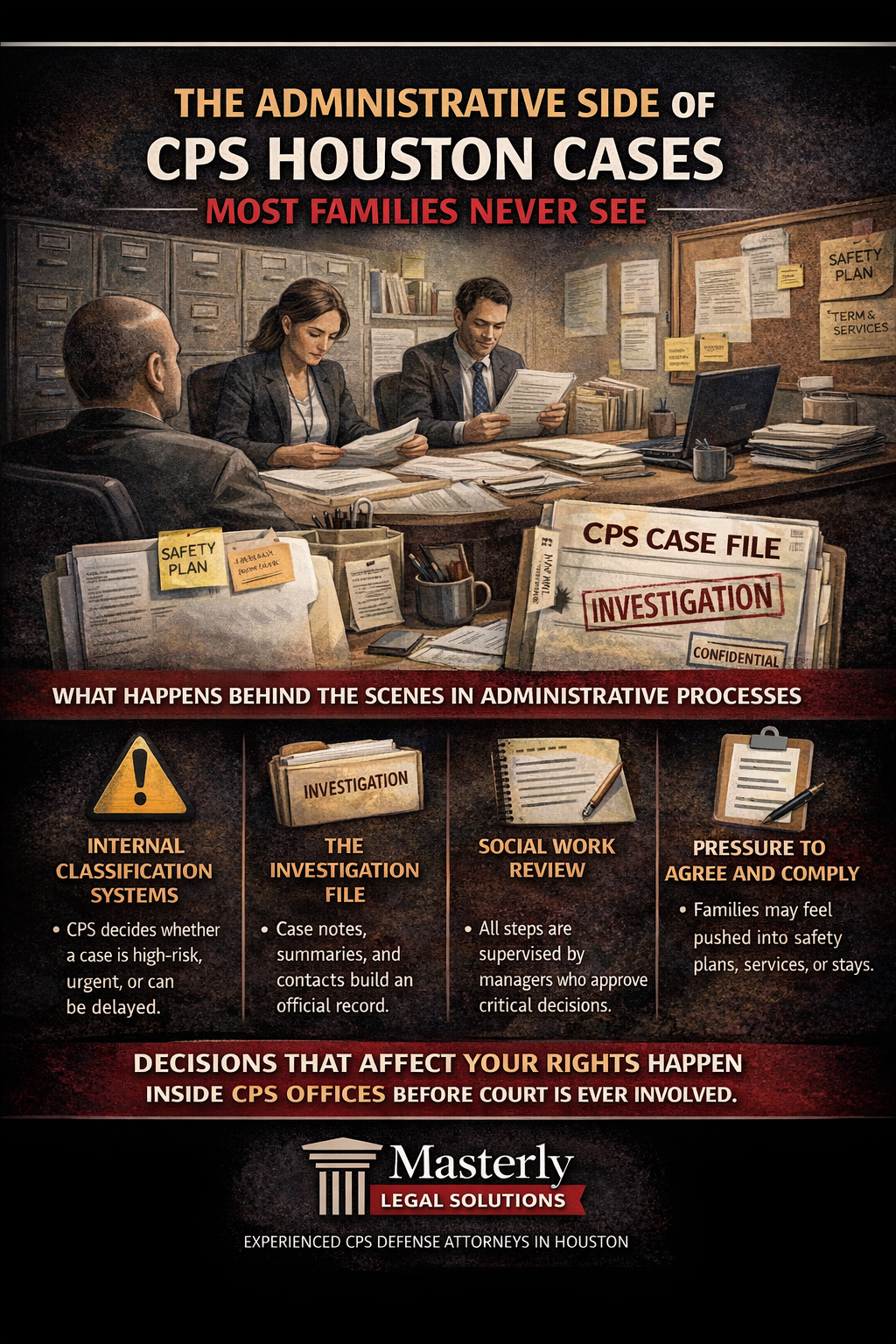
From the moment CPS opens a case, it creates a file. This file is more than paperwork—it’s a narrative. It contains summaries, internal notes, contact attempts, and conclusions about the child and family.
A family might feel like they gave a clear explanation in person. But CPS might record a shorter summary that doesn’t capture the full context. These records are used internally and may later be referenced in court or future investigations.
This is why families need to think carefully about what they say and how they say it. It’s also why having an attorney early can help families avoid misunderstandings that become permanent in the file.
The Role of Social Workers and Supervisors
Most people think the caseworker is the final decision-maker. But CPS cases often involve multiple layers of review. Social workers conduct interviews and gather details, but supervisors may approve major decisions like removals, safety plans, and escalations.
The caseworker may also consult with legal counsel inside the agency. Families may never see these conversations, but the outcomes can drastically affect the direction of a case.
When you feel like you are being judged by someone who barely knows your family, it’s often because more people are involved behind the scenes than you realize.
The Hidden Importance of “Contacts” and “Attempts”
One major administrative detail that harms families is how CPS documents “contact attempts.” If a caseworker says they tried to reach you and couldn’t, the record may imply you were avoiding the investigation. Even if you missed a call due to work or childcare, CPS may see it differently.
That’s why families should respond quickly and document communication. You don’t want the record to reflect failure to cooperate when the truth is you were simply managing life.
A missed contact can become the basis for escalation, especially if CPS believes a child could be at risk.
The CPS Process Can Feel Like Compliance Is the Only Option
Many parents think they must comply with every request immediately, no matter what. While cooperation can be important, families still have rights. You are allowed to understand what CPS is asking and why.
The cps process often includes requests for interviews, home walkthroughs, and family assessments. CPS may ask to speak with your child at school or privately. They may ask about relationships, discipline methods, and parenting decisions.
If you are unsure what to do, speak with an attorney before agreeing to anything that could harm your case.
The Safety Plan: The Administrative Tool That Changes Everything
One of the most misunderstood parts of CPS cases is the safety plan. It often sounds like a harmless agreement, but it can significantly affect parental rights and daily life. CPS may present it as “voluntary,” but families often feel pressured to sign.
A safety plan may require that a parent move out temporarily, that a family member supervise contact, or that certain conditions be met for the child to remain in the home. In practice, safety plans can operate like informal restrictions without a court order.
Safety plans are administrative tools. They can be used to justify later court actions if CPS claims the family did not follow the plan. That is why legal guidance matters before signing.
What “Voluntary” Really Feels Like in CPS Cases
Families are often told, “You don’t have to agree, but…” And that “but” is where the pressure comes in. A parent may be told that if they refuse, CPS might remove the child or go to court immediately.
This is where families feel powerless. They may agree to terms that are unfair because they fear a worse outcome. But agreeing without a strategy can create long-term consequences.
A safety plan may sound temporary, but it can shape the entire case and influence what CPS later argues is in the child’s best interests.
Services Requests: Providing Services or Building a Case?
CPS often requires families to complete services like parenting classes, counseling, evaluations, or supervised visits. The agency may describe this as providing services to strengthen the home environment. Sometimes services are truly supportive.
But in many cases, services become a checklist used against the parent. If a parent is unable to complete services due to work, transportation, cost, or scheduling, CPS may label it a “failure” to cooperate.
Services can include:
- Counseling or therapy
- Parenting education
- Substance testing
- Psychological evaluations
- Anger management programs
- Supervised visitation requirements
Completing services doesn’t always mean the case will close quickly. But failure to complete them can be used as evidence for escalation.
Why Scheduling and Documentation Create Real Risk
CPS cases involve intense scheduling demands. Parents may be expected to attend multiple appointments weekly while also working, caring for kids, and managing life. CPS often does not account for real-world limitations.
If you miss an appointment, the missed appointment may be recorded as noncompliance. The administrative record becomes a timeline of “missed services,” even if the parent was actively trying.
This is why having counsel involved can help. Your attorney can help clarify expectations, document barriers, and prevent minor scheduling issues from turning into major accusations.
How CPS Uses Reports and Evidence Internally
CPS case decisions are influenced by internal reports. These reports may include medical records, school notes, police calls, photographs, and witness statements. Parents often don’t know what CPS has gathered until later.
Evidence can include both objective items and subjective summaries. For example, an agency might record that a child appeared nervous, that the home seemed cluttered, or that the parent was “defensive.” Those descriptions can become part of the official narrative.
If CPS misunderstands your family situation, you may need to present evidence to correct the record. Waiting too long allows the agency’s version to become the default truth.
What Parents Should Know About “Presenting Evidence”
Presenting evidence does not mean arguing emotionally. It means creating a clear, organized response to protect your child and your future. Evidence can include documentation that shows a stable home, supportive family involvement, and safe parenting.
Depending on the case, evidence may include:
- School attendance and performance records
- Medical care records showing appropriate treatment
- Photos showing safe living conditions
- Witness statements from credible adults
- Proof of completed services
- Work schedules showing your availability and stability
Your attorney can help you determine what proof matters most and how to present it effectively.
The Court Side Is Only One Part of the Process
Families often believe court is where everything is decided. Court matters, but court is often influenced by what CPS has already documented administratively. When the case reaches court, CPS may already have summaries, conclusions, and recommendations prepared.
Judges often rely on CPS reports and attorney arguments. That means the administrative case file can heavily shape what happens in court. Even before the first hearing, CPS may have already framed what it believes is best for the child.
That is why early CPS defense strategy is critical, not optional.
How CPS Determines “Best Interests” Behind the Scenes
Parents hear “best interests” all the time, but few people understand how CPS applies it. CPS uses internal standards to evaluate safety, supervision, stability, and risk. These evaluations influence recommendations about custody, visitation, and placement.
The agency may consider:
- Whether the child feels safe in the home
- Whether the parent has support from family
- Whether the home environment appears stable
- Whether the parent has prior CPS history
- Whether allegations involve physical or sexual abuse
- Whether services are being completed
Even good families can be judged harshly if the administrative record is negative. That’s why controlling the narrative matters.
Foster Care Decisions Often Start Administratively
When families hear “foster care,” they often think it happens only after a court order. But foster placement discussions often start earlier, internally. CPS may begin exploring potential placements before the family even realizes removal is being considered.
CPS may evaluate relatives or family friends, ask about home suitability, and document whether placement options exist. If CPS believes the home is unsafe, it may push for removal quickly.
In some cases, the parent is caught off guard because the agency has already built a placement plan behind the scenes.
Foster vs. Foster Care: Placement Language Can Be Confusing
Families often hear “foster” used casually, but the meaning can vary. A child may be placed with relatives as a temporary safety measure, or the child may be placed into formal foster care.
CPS decisions about foster placement often depend on internal assessments and available resources. Families may feel like these decisions are made without fully hearing their side.
This is especially stressful when the child is removed quickly. Parents may feel like life is unraveling overnight.
Criminal Charges and CPS: Two Systems That Collide
Some CPS cases involve allegations that also trigger criminal charges. Even when a case begins with CPS, law enforcement may become involved. This can happen in serious child abuse cases or allegations involving sexual misconduct.
Parents should understand that statements made to CPS can sometimes be used later. CPS cases are not always confidential in the way families assume. When two systems collide, the risk increases.
This is why families should speak with an attorney before giving detailed statements, especially if criminal exposure is possible.
Child Abuse Cases vs. Neglect Cases: Why the Category Matters
CPS often divides cases into categories such as child abuse cases and neglect cases. These categories matter because they influence how CPS treats the case and what services may be demanded.
Child abuse allegations may involve physical injury, sexual harm, or emotional cruelty. Neglect allegations may involve supervision, unsafe conditions, or failure to meet the child’s needs.
Both categories are serious. But the administrative path can look different, and the urgency may differ depending on the classification. That classification can shape the entire case from the start.
Why Families in League City Face Similar CPS Pressures
Even though this article focuses on Houston, many surrounding areas—including League City—experience the same CPS structure and pressure. Families in League City often deal with the same systems, service demands, and administrative timelines.
The stress is similar regardless of location. The difference is sometimes the speed of response or how local offices handle case volume.
If CPS is involved in your family life, the core principles remain the same. Act quickly, protect your rights, and don’t assume the agency’s paperwork tells the whole story.
What Happens When CPS Says You Should “Contact Child Protective Services”
Families sometimes hear that they should “contact child protective services” to clarify a report or schedule a meeting. That advice can be confusing because families are already overwhelmed. They may not know what to say, what to share, or how to protect themselves.
When CPS asks for contact, the conversation usually becomes part of the record. Even a casual explanation can be summarized in a way that changes your case.
Before you make the call, consider speaking with an attorney. Strategic communication can make the difference between closure and escalation.
CPS Cases and Family Law: Where It Overlaps
CPS cases often overlap with family law, especially when custody disputes exist. In some situations, CPS becomes involved during divorce, separation, or conflict between parents.
Sometimes CPS reports are used as leverage in custody disputes. Sometimes CPS becomes part of the conflict even when there is no true abuse. When these issues intersect, the case becomes more complex.
A family law strategy alone may not be enough. You need a CPS defense approach that treats the case as both legal and administrative.
Parental Rights Can Be Pressured Before Court Ever Happens
Many parents think parental rights can only be restricted in court. In reality, parental rights can be pressured through safety plans, service demands, and informal restrictions. CPS may control access, supervision, and decision-making before any judge hears the case.
Parents may be told they cannot be alone with their child, cannot live in the same home, or must comply with certain services to keep their child present. That control can feel like losing custody without a hearing.
This is why early defense matters. Parental rights must be protected from day one, not after a court order arrives.
How Caseworkers Document Your Behavior and “Cooperation”
Caseworkers are trained to document cooperation levels. A parent who asks too many questions might be labeled difficult. A parent who is nervous might be labeled evasive. A parent who is emotional might be labeled unstable.
This is not fair, but it is common. CPS often records behavior interpretations alongside facts. Those interpretations may be used later as “proof” of risk.
That’s why communication strategy matters. Your attorney can help you respond in a calm, consistent way that protects you in the record.
Why Families Feel Like CPS Is Always One Step Ahead
CPS has training, internal systems, and a process designed to move cases forward. Families walk into the situation with fear, confusion, and limited understanding.
That imbalance is why families feel powerless. It isn’t because parents are bad. It’s because the system is unfamiliar and administrative decisions are being made quickly.
The good news is that families can fight back with the right strategy. You can protect your child, defend your parenting, and demand fairness through legal representation.
What CPS Defense Really Looks Like in Practice
CPS defense is not just courtroom arguing. It starts with understanding the administrative side of the case. It means reviewing reports, correcting inaccuracies, and building a proactive record.
CPS defense often includes:
- Guiding parents on communication and meetings
- Preserving evidence and presenting proof
- Challenging unsafe or unfair safety plan terms
- Advocating during service planning and scheduling
- Preparing for court hearings if required
Your defense should not begin at the last minute. It should begin as soon as CPS becomes involved.
Why Masterly Legal Solutions Takes a Protective, Strategic Approach
At Masterly Legal Solutions, we understand that CPS cases affect more than paperwork. They affect family stability, mental health, finances, and the daily life of your kids. We also know how quickly misinformation can become an official finding.
Our team is dedicated to protecting families by building a plan that fits the case from the beginning. We focus on facts, documentation, and the strongest legal strategy for your situation.
We don’t treat your case like a number. We treat it like your life—because that’s exactly what it is.
The Truth: Act Quickly Before the Administrative Story Hardens
If CPS is involved, time matters. The longer the agency controls the narrative, the harder it becomes to correct it. Families often wait because they hope the case will close on its own. Sometimes it does, but many times the opposite happens.
Act quickly if you notice escalation. Act quickly if services are being piled on. Act quickly if a safety plan is being pushed aggressively. The earlier you get legal support, the more control you can regain.
When your child’s future is at stake, you cannot afford delay.
Contact Masterly Legal Solutions for a Free Consultation
When CPS becomes involved in your home, it can feel like you’re being judged from every angle—sometimes without understanding what is happening behind the scenes. If you’re dealing with cps investigations in Houston, facing allegations of child abuse or neglect, or worried that a caseworker is building a record against you, now is the time to protect your rights and your child’s future.
At Masterly Legal Solutions, we focus on cps defense and helping families respond strategically to administrative demands, safety plans, and court-driven pressure. In addition to CPS defense, we also assist families with estate planning and trust services to help secure their assets and prepare for the future. We can help you understand what CPS is doing, how the process works, and how to present evidence that supports your family and protects parental rights.
Call (972) 236-5051 for a free consultation. You can contact us today to discuss your situation privately and learn what steps to take next before CPS decisions become permanent.
Disclaimer: This article is for educational purposes only and does not constitute legal advice or legal guidance. No attorney-client relationship is formed by reading this content. For advice about your specific case, contact Masterly Legal Solutions directly.


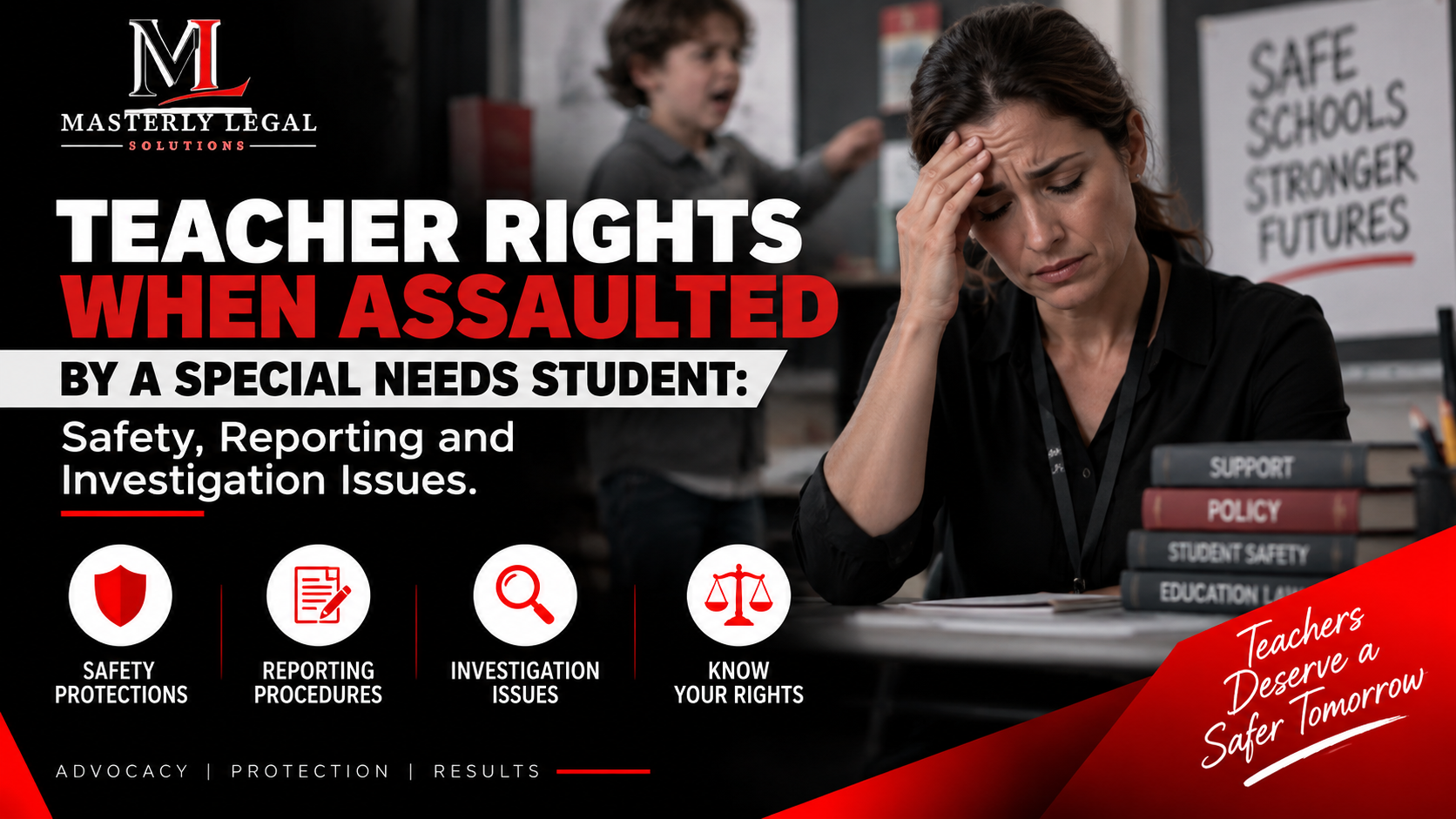
Teacher Rights When Assaulted by a Special Needs Student: Safety, Reporting and Investigation Issues



Looking for Legal & Business Solutions? Contact Us Now
Fill in the form or call us to set up a meeting





