
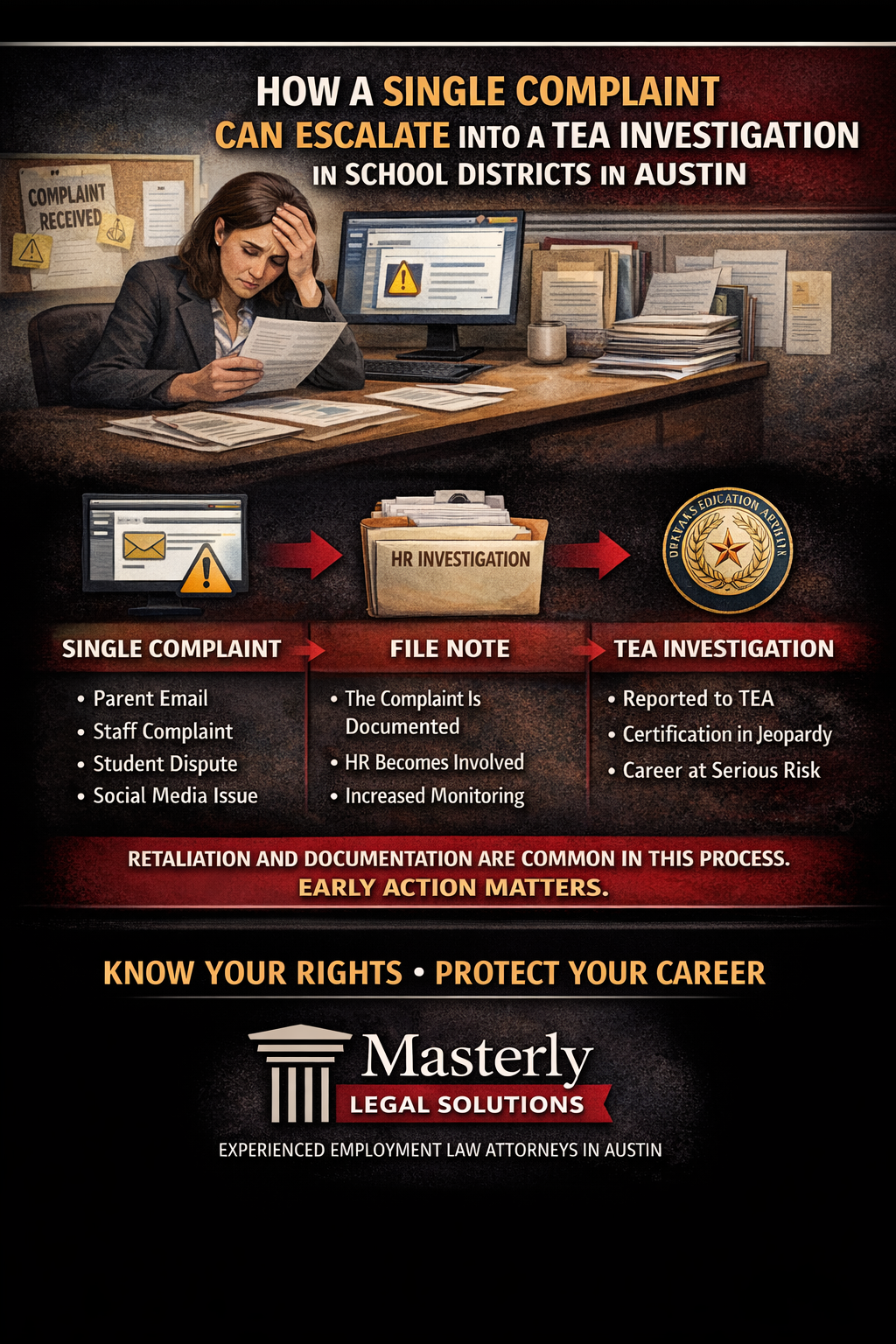
How a Single Complaint Can Escalate Into a TEA Investigation in School Districts in Austin
A teacher can spend years building trust with students, parents, and colleagues—and then feel that stability wobble after one complaint. Sometimes the complaint is small: a parent email about tone, a misunderstanding with a coworker, or a student discipline dispute that gets replayed on social media. In Austin school districts, these moments can move faster than most employees expect, especially when administrators are managing public pressure and risk.
At Masterly Legal Solutions, we see the same pattern again and again: a minor issue becomes a “file note,” then a formal workplace process, then a report to regulators. What worries teachers most is not just embarrassment or stress. It’s the fear that a single complaint could create a record that follows them, threatens their employment, or opens the door to a TEA investigation that puts their certification at risk.
This article explains how escalation happens, where retaliation often hides inside the process, and why early strategy matters—especially for educators in Austin employment settings where the pace can be intense. If you are dealing with discipline, pressure, or a sudden shift in how your employer treats you, this is the moment to protect yourself.
Why Complaints Escalate So Quickly in Austin School Districts
In many workplaces, complaints are handled informally, with coaching and time to correct misunderstandings. In school environments, the employer is also balancing student welfare, parent trust, and public accountability. That pressure can cause administrators to treat even small issues as potential liability.
In Austin, the “safest” move for the employer often feels like documenting everything. Documentation can be sensible, but it can also become a roadmap to discipline and termination. Once a complaint is placed into a file, it may be referenced later as proof of a supposed pattern, even when the teacher has a strong record.
This is where teachers get blindsided. The employee thinks they are addressing one incident, but the employer’s actions may already be shaping a bigger narrative.
What Counts as a “Single Complaint” That Can Spark Bigger Consequences
A single complaint can come from many sources, and it can take many forms. It might be a parent report, a student statement, an internal email, or an allegation by other staff. What matters is how the employer frames it and whether the complaint is treated as a possible policy violation.
In school districts, common complaint categories include:
- Classroom management concerns
- Communication tone with parents or staff
- Discipline decisions or grading disputes
- Allegations of bias or unfair treatment
- Social media issues connected to school reputation
- Staff conflict inside the workplace
A complaint does not have to be proven to trigger process. Sometimes the employer moves forward based on perceived risk, not confirmed facts.
The Hidden Problem: Documentation Can Outlive the Truth
Teachers often assume that if they “explain it,” the issue will disappear. But documentation often stays—especially if it was entered into HR systems or shared with district leadership. Even when a complaint is resolved informally, it can still be pulled later to justify an adverse decision.
This matters because documentation can become the foundation for:
- A negative performance write-up
- A reassignment that harms your career
- A “last chance” agreement
- A recommendation for termination
- A referral to the Texas board or TEA review pathways
Once the file grows, the employee’s ability to “reset” the narrative becomes harder.
Early Warning Sign: The Tone of the Employer Changes
Many teachers describe a moment when everything feels different. Admin stops being collaborative. Meetings feel scripted. The employee is no longer “part of the team.” In legal terms, that shift can matter because it often precedes adverse actions or a negative employment action.
If you notice a sudden change after you raised a concern, requested help, or questioned a decision, you should consider whether workplace retaliation is developing. Retaliation in the workplace rarely announces itself loudly. It often shows up as slow pressure, subtle isolation, or “policy enforcement” that is unevenly applied.
In Austin, where districts respond quickly to stakeholder complaints, the speed of that shift can be shocking.
How the Internal Process Typically Starts
A common escalation path begins with a meeting. The employee is told a complaint was received and is asked to “share your si
de.” The teacher expects fairness, but the meeting may be part of a documentation strategy.
Often, the employer will do the following:
- Create a memo summarizing the conversation
- Request a written statement from the employee
- Interview other employees in the workplace
- Ask the teacher to sign a document acknowledging “coaching”
- Place the employee under increased monitoring
None of these steps automatically means you did something wrong. But each step creates a record that can be used later in employment law disputes.
When the Complaint Becomes “Protected Activity” on the Other Side
Sometimes the complaint itself is framed as protected activity by the person who made it. For example, a staff member may claim discrimination, harassment, or retaliation. A parent may claim bias. Even if the allegation is inaccurate, the employer may treat it as sensitive and escalate the response.
This is one reason teachers must be careful about how they respond. A quick email or emotional reply can be mischaracterized later. In cases where workplace retaliation occurs, the process often turns on communications and timelines.
This is where an employment lawyer can help you understand the risk without overreacting.
The “Investigation” Stage: Where Careers Start to Shake
Once an employer opens an internal investigation, the teacher is no longer dealing with a simple complaint. Investigations can involve HR, legal counsel, and district compliance teams. The stakes rise because the results may be used to justify discipline or reporting.
Investigations often include interviews, document reviews, and written summaries that the employee may never see. The teacher might not know what statements were made, what evidence is being weighed, or whether the process is balanced.
If the employer’s actions are not neutral, the investigation can become a vehicle for a predetermined outcome. That outcome could include reassignment, discipline, or wrongful termination.
How “Minor” Becomes “Serious” in TEA-Related Settings
Teachers worry about TEA because a TEA investigation is not just about employment—it can implicate certification and professional standing. While not every complaint leads to TEA, escalation happens when a district believes it must show it responded aggressively.
Escalation is more likely when the complaint is framed as involving:
- Student safety concerns
- Boundary issues or professionalism allegations
- Alleged discrimination or bias
- Claims that policy violations affected students
- Accusations tied to district reputation or compliance
If you have received notice of a TEA investigation, it’s important to take immediate steps to protect your certification and career.
In Austin, districts often move quickly to avoid headlines and demonstrate accountability. That fast pace can create decisions that feel unfair, especially when the initial complaint was minor.
The Retaliation Risk: When the Process Turns on the Teacher Who Spoke Up
Some educators become targets after raising legitimate concerns. They report misconduct, request accommodations, raise safety issues, or question unethical decisions. That reporting can be a form of protected activity, depending on the facts.
When retaliation begins, it can look like:
- Sudden write-ups for small issues
- Increased surveillance of classroom decisions
- Unfair performance evaluations
- Hostile meetings and “gotcha” documentation
- Reassignment to undesirable roles
- Threats of termination
This is classic retaliation in the workplace, and it can support retaliation claims when the evidence shows a clear timeline.
If you believe retaliation is happening, talk with an employment attorney early. Waiting often gives the employer time to build a paper trail.
What Makes Retaliation “Unlawful Retaliation”?
Retaliation becomes unlawful retaliation when an employer punishes an employee for engaging in protected conduct. Protected conduct can involve reporting discrimination, requesting leave, or participating in investigations.
This area of employment law is shaped by state and federal laws, and it can apply even when the employer claims discipline was for “performance.” The key is whether the discipline was a false reason that covered a retaliatory motive.
Educators often assume they have no power against a district. But the law can still protect employees when retaliation is involved.
Reporting Discrimination and the School District Response
A common trigger for retaliation is reporting discrimination. A teacher might report unfair treatment based on national origin, disability status, or other protected categories. The employer may respond by “investigating,” but sometimes that investigation is turned against the reporting teacher.
Teachers may experience:
- A sudden claim they are “unprofessional”
- Accusations of being “divisive” in the workplace
- Claims that they are “not a culture fit”
- Disciplinary meetings with shifting allegations
If a discrimination claim is part of the background, the teacher should be careful to preserve evidence and keep communication professional.
Unlawful Discrimination and the Role of Federal Protections
Some cases involve unlawful discrimination, which may be evaluated under federal law such as Title VII and, depending on the facts, the disabilities act. These laws exist to protect employees from being targeted based on protected characteristics.
When discrimination overlaps with retaliation, cases can become complex. The employer may claim discipline was neutral, while the teacher experiences a consistent pattern of unequal treatment.
An experienced lawyer can help determine whether facts support a case under state and federal court processes, including potential pathways through the equal employment opportunity commission.
How Administrative Decisions Become Adverse Actions
Retaliation and discrimination often show up through adverse actions. In schools, adverse actions may include formal discipline, negative evaluations, reassignment, removal from committees, and loss of opportunities.
In practical terms, adverse actions can damage a teacher’s standing and make them vulnerable to termination. They can also influence how an internal record looks when reviewed by outsiders.
A single complaint can become the excuse for these adverse actions, even when performance was strong.
The Pressure Cooker: Medical Leave and Retaliation
Many teachers need medical leave at some point. Unfortunately, leave can become another trigger for retaliation. Some employees notice that after they request leave, the employer becomes colder, stricter, or less flexible.
If an employer starts punishing an employee for taking protected leave, it may support a retaliation case. The teacher should keep records of requests, approvals, and any negative responses.
This is especially important in Austin employment settings where staffing shortages can make leadership impatient with absences.
Financial Pressure: Pay, Benefits, and Wage Issues
When teachers are pushed out, money often becomes leverage. An employee may be threatened with losing pay or benefits, or may face changes that make the job financially unstable.
In some broader employment law cases, schools and public employers can also face wage-related concerns, such as unpaid wages, disputes about overtime pay, or overtime violations in certain roles. These issues may not be the main focus in TEA escalation, but they can be part of the larger pattern of employer pressure.
If financial pressure is used to punish a teacher for speaking up, that may support retaliation claims.
The Termination Risk: How Complaint Escalation Ends Careers
Many teachers ask one question: “Can they really fire me over this?” Sometimes the answer is yes—if the employer builds enough documentation. Other times, the termination may be challenged as wrongful.
Wrongful termination can apply when the termination violates law or public policy. A teacher who is wrongfully terminated may have options, but the strategy depends on facts and timelines.
Termination may be preceded by:
- Escalating write-ups
- “Improvement plans” with impossible metrics
- Coaching memos that distort events
- Repeated meetings with HR
- Isolation from leadership support
This is why protecting your record early can be the difference between survival and exit.
The Power of a “False Reason” in District Discipline
A “false reason” is often the heart of a retaliation case. The employer may say the teacher was disciplined for professionalism or classroom management. But the timing shows discipline started right after protected activity.
When the facts support that pattern, the teacher may be able to pursue legal action. That legal action could involve internal grievance processes, administrative filings, or court proceedings depending on the case.
Teachers should not assume the employer’s paperwork is unchallengeable. Paperwork can be questioned when it’s used to hide unlawful motives.
Why TEA Risk Feels Bigger in Austin School Communities
Teachers in Austin often work in high-visibility environments. Parent advocacy can be intense. Community feedback can be immediate. District leadership may feel pressure to move quickly, even when facts are still unclear.
That environment can create a fast escalation cycle:
- A complaint is filed
- Admin responds quickly to show “action”
- The teacher is documented and monitored
- The narrative grows
- District leaders consider reporting pathways
The teacher’s career becomes exposed, even if the original complaint was minor.
When a District Refers a Matter to the Texas Board
Educators sometimes hear references to the “Texas board” in casual conversations, but any referral pathway connected to certification should be taken seriously. Referral decisions are often made with risk management in mind, not fairness.
A referral can occur when the employer wants to demonstrate it handled a concern aggressively. The teacher may feel like they are being made an example.
If you believe a referral could happen, you need a strategy that protects your long-term professional future.
The Difference Between District Discipline and a TEA Investigation
District discipline is internal. TEA-related scrutiny can extend beyond your current job and affect your ability to remain in education. That’s why a single complaint can feel so threatening.
A TEA investigation can involve record review, statements, and regulatory evaluation. Teachers often feel powerless because the process is unfamiliar and intimidating.
Early representation helps educators avoid mistakes that come from fear and rushed decisions.
Practical Steps Teachers Can Take Before Things Escalate
Teachers can protect themselves without becoming confrontational. The goal is not to “fight” at every step, but to stay strategic and preserve evidence.
Steps that often help include:
- Keep a timeline of events and key communications
- Save emails and messages related to the complaint
- Document any adverse actions after protected activity
- Stay calm and professional in responses
- Request clarification when allegations are vague
- Avoid informal hallway discussions that can be twisted
- Seek advice before signing disciplinary documents
These steps can strengthen your position if a retaliation case develops.
Why Talking to an Employment Lawyer Early Matters
Many teachers wait until they are one step from termination. By then, options are narrower. An employment lawyer can help you assess the real risk, respond with precision, and avoid statements that the employer can weaponize.
Working with an employment attorney does not mean you are “suing your district” tomorrow. It means you are protecting your career and making informed decisions.
If you are in Austin, speaking with Austin employment lawyers who understand retaliation patterns can be critical. The strategy should fit your specific circumstances, your district’s behavior, and the timeline.
How Masterly Legal Solutions Supports Educators in Austin Employment Disputes
At Masterly Legal Solutions, we focus on protecting educators when workplace issues threaten their licenses and livelihoods. We understand how fast district processes move and how easily a complaint can spiral into discipline and investigation.
We help employees facing workplace retaliation or discrimination:
- Identify whether protected activity is involved
- Evaluate whether adverse actions suggest retaliation
- Build documentation that supports legal rights
- Respond strategically to investigations and meetings
- Pursue options when termination becomes likely
We also represent employees in serious disputes where careers are at stake, including retaliation and discrimination concerns.
Understanding Retaliation Claims Under Texas Labor Code and Beyond
Many teachers hear the term “retaliation” but don’t know what it means legally. Retaliation claims can arise under the Texas Labor Code and other frameworks, depending on what the employee reported and how the employer responded.
The legal analysis often focuses on:
- Was the teacher engaged in protected activity?
- Did the employer take adverse actions afterward?
- Is there a clear timeline connecting the two?
- Is the employer’s explanation credible or a false reason?
These cases can involve state and federal laws, and in some situations may reach federal court or other formal proceedings.
Why Supreme Court and Federal Standards Still Matter
Employment standards evolve through court decisions, including rulings that shape how retaliation is defined and proven. Teachers don’t need to memorize legal cases, but they should understand that retaliation standards are not just “district policy.” They are real legal principles.
In certain disputes, courts look at whether the employer would have taken the same action without the protected activity. That’s why documentation and timing are central.
If the evidence shows retaliating behavior, the educator may have a viable claim and may be entitled to remedies.
Potential Outcomes: Financial Compensation and Career Protection
The goal in many teacher cases is not simply money. Often the goal is protecting reputation, preserving career options, and preventing license damage. But in some cases, financial outcomes matter too.
Depending on the facts, outcomes may include:
- Financial compensation for lost wages or harm
- Correction of records and documentation
- Negotiated separation terms that protect the future
- Relief tied to retaliation claims or discrimination findings
Every case is different, and outcomes depend on evidence, timing, and the employer’s conduct.
When You Feel Cornered, It’s Time to Protect Yourself
Teachers often feel trapped between two fears: fear of staying and being targeted, and fear of leaving and losing the profession. That emotional pressure is exactly why early support matters.
If you’re seeing escalation, document it. If you suspect retaliation, take it seriously. And if you believe your employer is building a case against you, don’t wait until the final meeting.
You deserve fair treatment, and you deserve a process that does not punish you for doing the right thing.
Contact Masterly Legal Solutions for a Free Consultation
When a single complaint in Austin turns into meetings, write-ups, and shifting accusations, it’s easy to feel like the ground is moving under your feet. If you’re worried that an employer is retaliating, building a record against you, or steering a matter toward a TEA investigation, you don’t have to navigate it alone.
At Masterly Legal Solutions, we approach these cases with urgency and care because we know what is on the line: your job, your reputation, and your future in education. If you need an austin retaliation attorney who understands how workplace processes can be used to create leverage, we’re ready to help you evaluate your options and protect your legal rights.
Call (972) 236-5051 for a free consultation. You can also contact our team to discuss whether your situation involves workplace retaliation, discrimination, or other unlawful conduct, and to determine the best next step before the district’s narrative becomes permanent.
Disclaimer: This article is for educational purposes only and does not constitute legal advice or legal guidance. Reading this content does not create an attorney-client relationship. For advice regarding your specific circumstances, contact Masterly Legal Solutions directly.




Teacher Rights When Assaulted by a Special Needs Student: Safety, Reporting and Investigation Issues



Looking for Legal & Business Solutions? Contact Us Now
Fill in the form or call us to set up a meeting