

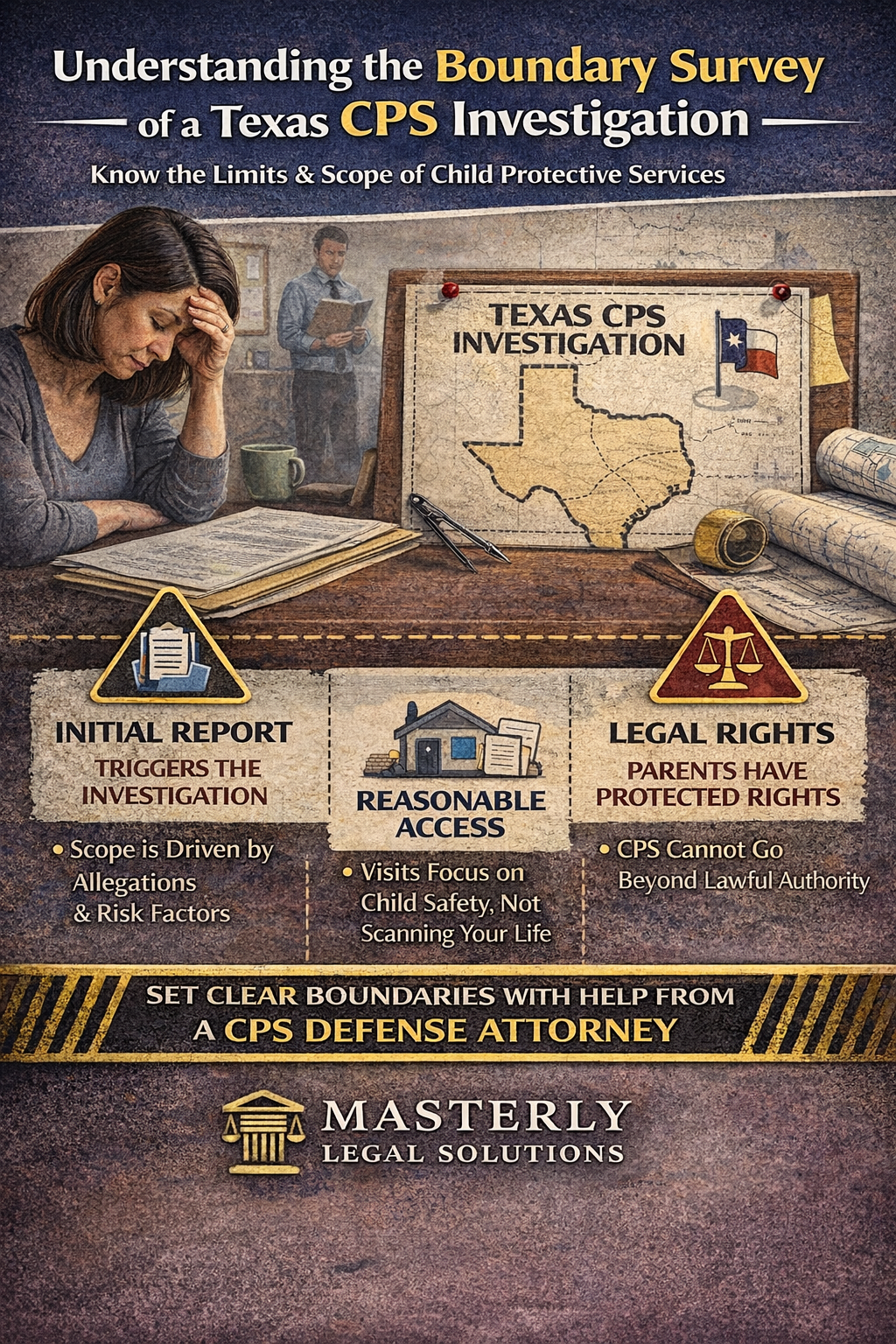
Understanding the Boundary Survey of a Texas CPS Investigation
When Child Protective Services becomes involved with a family, most parents feel immediate fear and uncertainty. Many assume the agency has unlimited authority to examine every aspect of their lives. In reality, CPS investigations are structured evaluations with defined limits, thresholds, and decision points. Understanding how those limits work can help families protect their rights while addressing legitimate safety concerns.
At Masterly Legal Solutions, we guide parents through Texas CPS cases using a calm, administrative, and investigation-focused approach. We help families understand what CPS can and cannot do, how decisions are made, and when legal representation becomes essential. This article explains how CPS evaluates cases through what we refer to as a boundary survey, a framework that helps define the scope of a Texas CPS investigation and the actions that may follow.
What a Boundary Survey Means in a CPS Context
A boundary survey refers to the practical limits CPS applies when evaluating allegations involving a child. CPS does not investigate without structure or purpose, even though it may feel invasive to parents. Each CPS case begins with specific allegations and proceeds based on defined risk thresholds. Understanding these boundaries helps families avoid unnecessary escalation.
The goal of child protective services is to assess whether a child’s safety is at risk, not to punish parents. Investigators evaluate facts, observations, and risk factors to determine next steps. When families understand this framework, they are better positioned to respond appropriately.
The Role of Child Protective Services in Texas
Child protective services is a division within the Texas Department responsible for responding to reports of suspected child abuse or neglect. CPS acts as part of the broader child welfare system, working alongside courts and family services. Their authority is governed by the Texas Family Code and internal policies.
CPS involvement may arise from concerns involving domestic violence, substance abuse, unsafe living conditions, or school-related reports. Each report triggers a CPS investigation, but not every investigation results in court involvement. The boundary survey helps determine how far CPS involvement extends.
How CPS Investigations Begin
Most CPS investigations begin with an initial contact following a report. CPS workers may receive information from schools, medical professionals, neighbors, or law enforcement. Once CPS determines a report meets statutory criteria, an investigation is opened.
This initial phase sets the tone for the entire CPS case. The allegations define the scope of the investigation stage, and CPS is expected to stay within those limits unless new risk factors emerge. Understanding this helps families avoid volunteering information unrelated to the alleged abuse.
The CPS Investigation Process Explained
The CPS investigation process follows a structured sequence designed to assess risk and safety. CPS investigators conduct interviews, observe the child’s home, and evaluate whether abuse or neglect occurred. They also assess the child’s safety and well being throughout the investigation.
CPS investigations are not criminal trials, but findings can influence future legal actions. Statements made early may affect court proceedings or administrative decisions. That is why understanding the investigation process is critical.
Risk Assessment and CPS Decision-Making
Risk assessment plays a central role in CPS investigations. CPS workers evaluate whether the child faces immediate danger, potential future abuse, or serious harm. These assessments guide decisions about safety plans, voluntary services, or court involvement.
Risk factors may include prior CPS history, domestic violence, substance use, or unsafe housing. CPS believes that addressing risk early helps support families and prevent future harm. However, misinterpretation of risk can lead to unnecessary intervention.
How CPS Determines Child Safety
Child’s safety is the primary concern guiding every CPS decision. CPS evaluates whether the child is safe in their current environment and whether protective actions are needed. This evaluation often includes input from family members, schools, and medical providers.
When CPS believes a child is at immediate risk, the agency may take swift action. However, not every concern rises to that level. Understanding how CPS distinguishes between safety concerns and long-term risk is essential.
Safety Plans and Their Purpose
A safety plan is one of the most common tools used during CPS investigations. Safety plans outline specific steps parents must take to address safety concerns while the investigation continues. These plans may involve supervision, restrictions, or temporary arrangements.
Safety plans are not court orders, but they carry serious implications. Parents should understand what they are agreeing to before signing. Legal counsel can help evaluate whether a safety plan is reasonable or overly restrictive.
Voluntary Services and Voluntary Agreements
CPS often offers voluntary services to families during investigations. These services may include counseling, parenting classes, or referrals to community resources. Voluntary services are intended to support families without immediate court intervention.
A voluntary agreement may seem harmless, but it still becomes part of the CPS case record. Families should carefully consider whether voluntary placement or services align with their long-term goals. Understanding these options helps parents maintain control over the process.
When CPS Moves Beyond Voluntary Measures
If CPS determines that voluntary measures are insufficient, the agency may seek a court order. This typically occurs when CPS believes there is immediate risk or ongoing danger to the child. Court involvement significantly changes the trajectory of a CPS case.
Once court proceedings begin, the boundary survey expands to include judicial oversight. At this point, legal representation becomes especially important to protect parental rights.
Court Orders and CPS Authority
A court order grants CPS authority to take specific actions, such as temporary custody or child’s removal. These orders are issued by a judge after reviewing evidence presented by CPS. Parents have the right to contest these actions in court.
Court orders mark a shift from administrative investigation to formal legal proceedings. Understanding this transition helps families prepare and respond effectively.
Temporary Custody and Child Placement Decisions
Temporary custody decisions are among the most stressful outcomes of CPS investigations. CPS may place a child with relatives, foster care, or other approved caregivers. These decisions are based on safety assessments and available options.
Child’s placement is intended to protect the child, but it can deeply disrupt family life. Parents should understand the criteria CPS uses when making placement decisions.
Juvenile Dependency Court and CPS Cases
Juvenile dependency court oversees many CPS cases involving court intervention. Judges evaluate CPS recommendations, evidence, and compliance with legal standards. Court hearings determine whether CPS actions align with the child’s best interest.
These proceedings can continue for months or longer. Having an experienced attorney during juvenile dependency court proceedings helps ensure that CPS stays within appropriate boundaries.
The Role of CPS Workers in Investigations
CPS workers are responsible for investigating allegations and documenting findings. They interview parents, children, and other relevant individuals. Their reports often shape CPS decisions and court outcomes.
While CPS workers aim to support families, they also operate under agency guidelines. Understanding their role helps families communicate effectively without unintentionally expanding the investigation.
Allegations of Abuse or Neglect
Allegations of abuse or neglect vary widely, from suspected child abuse to concerns that neglect occurred due to supervision or living conditions. CPS evaluates whether child abuse or neglect is supported by evidence.
Not every allegation is substantiated, but all are taken seriously. Families should avoid assuming that cooperation alone will resolve concerns.
Child Abuse, Neglect, and CPS Thresholds
Child abuse includes physical harm, sexual abuse, or emotional injury. Neglect may involve failure to provide basic needs, supervision, or medical care. CPS distinguishes between isolated incidents and patterns of risk.
Understanding these thresholds helps families respond accurately. Overreaction or misunderstanding can complicate CPS investigations unnecessarily.
Criminal Investigations and CPS Involvement
Some CPS cases overlap with criminal investigation processes. Law enforcement may become involved when allegations suggest criminal conduct. Statements made to CPS can sometimes be shared with authorities.
This overlap increases the stakes for parents. Legal counsel helps manage communication and protect legal rights during parallel investigations.
Drug Testing and CPS Evaluations
CPS may request a drug test as part of a risk assessment. Refusal or compliance can both carry implications depending on context. Parents should understand their options before agreeing.
Drug test results become part of the CPS case file. Legal advice can help families navigate these requests strategically.
Written Notice and Investigation Results
At the conclusion of a CPS investigation, families receive written notice of the findings. Investigation results may include administrative closure, ongoing services, or court involvement. These outcomes affect future CPS interactions.
Understanding the meaning of investigation results helps families plan next steps. Administrative closure does not always mean the case disappears entirely.
Administrative Closure and Its Significance
Administrative closure occurs when CPS completes investigations without further action. While this is often a favorable outcome, records may still exist within CPS systems. Future reports may reference prior cases.
Families should understand what administrative closure means and how to protect themselves moving forward.
Parental Rights During CPS Investigations
Parental rights remain intact during CPS investigations unless restricted by court order. Parents have the right to understand allegations, participate in meetings, and seek legal representation. These rights are protected under family law.
Understanding parental rights helps families maintain control and avoid unnecessary concessions. Knowledge empowers parents during stressful situations.
Legal Representation and Its Role
Legal representation provides clarity during CPS investigations. An experienced attorney helps families understand the CPS process, respond appropriately, and protect their interests. Legal counsel is especially valuable when court proceedings are possible.
Early involvement often prevents escalation. Strategic guidance can make a significant difference in outcomes.
Family Law and CPS Cases
Family law principles guide CPS cases involving custody, visitation, and parental rights. Courts evaluate how CPS actions align with the child’s best interest. Family law knowledge is essential in these matters.
Understanding how family law intersects with CPS investigations helps families anticipate possible outcomes.
Support Services and Community Resources
CPS often refers families to support services and community resources. These may include counseling, parenting programs, or housing assistance. These resources are intended to support families and reduce risk.
Using resources wisely can demonstrate cooperation without compromising rights. Families should understand how participation affects their CPS case.
Child’s Education and CPS Involvement
CPS investigations sometimes involve a child’s education, particularly when schools initiate reports. Attendance, behavior, and academic performance may be reviewed. Schools may share information with CPS workers.
Parents should be aware of how educational records factor into investigations.
Ensuring Child Safety Without Overreach
Ensuring child safety is the stated goal of CPS involvement. However, safety measures should be proportional to the actual risk. Overreach can harm families without improving outcomes.
Understanding the boundary survey helps families advocate for reasonable accommodations and appropriate responses.
The Importance of Risk Factors and Context
Risk factors are evaluated within context, not isolation. CPS should consider family history, support systems, and current circumstances. Context matters in determining whether safety concerns justify intervention.
Families can help ensure context is considered through thoughtful communication and documentation.
Supporting Families Through the CPS Process
CPS states its mission is to support families and prevent future abuse. Effective support requires balanced intervention, not excessive intrusion. Families benefit when CPS stays within defined limits.
Legal advocacy helps maintain that balance.
When CPS Decides Court Action Is Necessary
When CPS decides court involvement is necessary, the case enters a more formal phase. Court hearings, evidence presentation, and judicial review become central. Parents should prepare for this shift.
Understanding when and why CPS decides to escalate helps families respond proactively.
Protecting Well Being During CPS Cases
CPS investigations take an emotional toll on families. Stress, uncertainty, and fear can affect mental health and relationships. Protecting well being is an important part of navigating CPS involvement.
Professional support and legal guidance help families remain grounded during the process.
Planning for the Future After CPS Involvement
Even after CPS involvement ends, families should plan for the future. Understanding records, compliance, and prevention helps reduce the risk of future investigations. Preparation provides peace of mind.
Learning from the experience strengthens family resilience.
Contact Masterly Legal Solutions
If you are facing CPS involvement and want to understand the boundary survey that defines a Texas CPS investigation, Masterly Legal Solutions is here to help. We offer a free consultation to help families navigate CPS cases with clarity and confidence. Our approach focuses on administrative strategy, preparation, and professional legal representation. Call (972) 236-5051 to discuss how understanding CPS boundaries can help protect your family and your future.
Disclaimer: This article is provided for educational purposes only and does not constitute legal guidance or legal advice. Reading this article does not create an attorney-client relationship. For advice specific to your situation, consult a qualified attorney.

Teacher Rights When Assaulted by a Special Needs Student: Safety, Reporting and Investigation Issues


Looking for Legal & Business Solutions? Contact Us Now
Fill in the form or call us to set up a meeting