

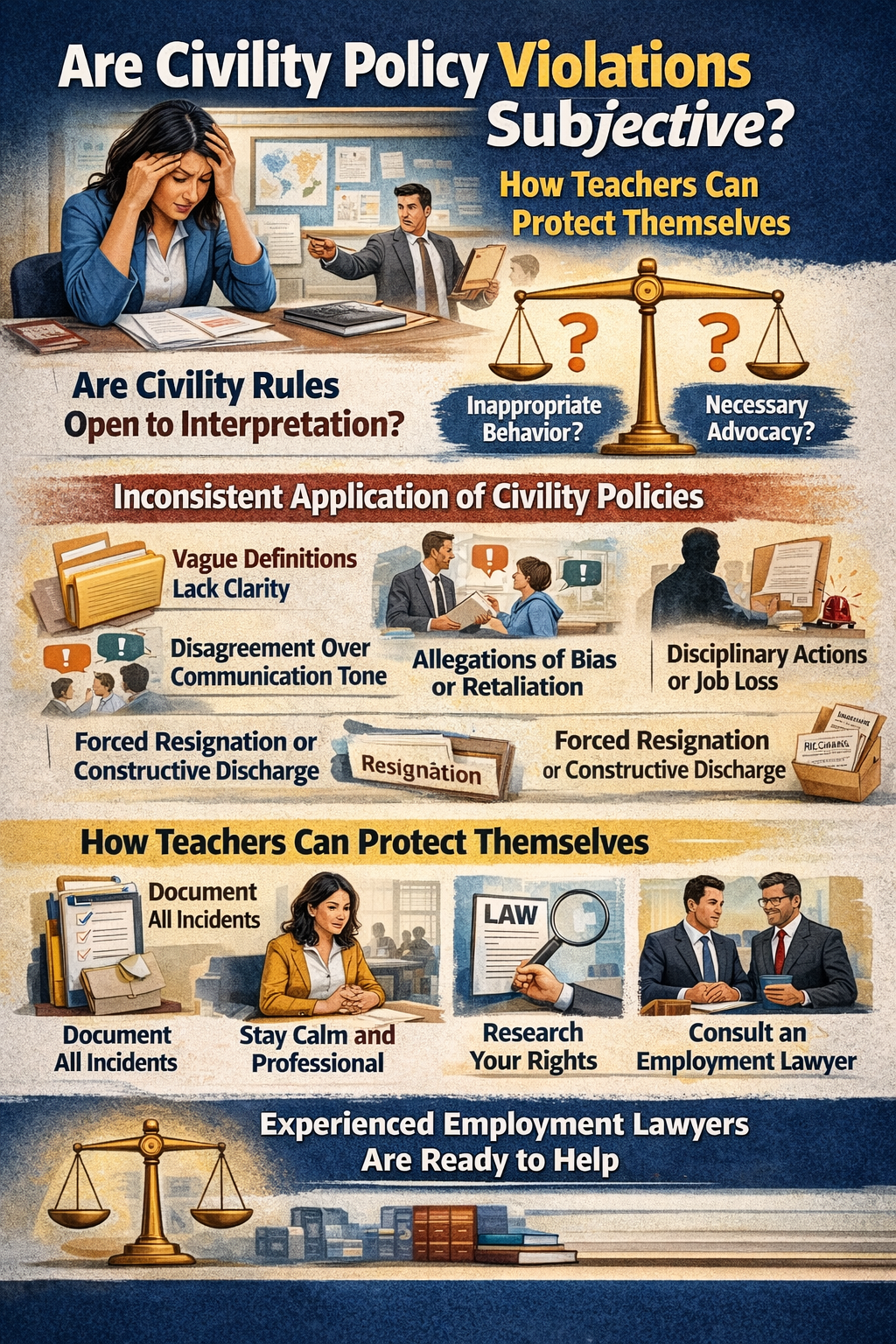
Are Civility Policy Violations Subjective? How Teachers Can Protect Themselves
Educators are expected to maintain professionalism, patience, and respect every day in the classroom. Teachers work with students, administrators, parents, and colleagues while managing constant demands and high expectations. Because of this environment, many school districts have adopted civility policies designed to promote respectful conduct in the workplace.
However, civility rules sometimes raise an important question: are these policies truly objective, or are they open to interpretation? In some cases, what one supervisor considers inappropriate behavior may simply be a misunderstanding or a difference in communication style. When a policy becomes too vague, the risk increases that a teacher could face discipline or even termination without clear justification.
For educators in san antonio texas school districts, this issue can become even more serious if allegations of civility violations lead to job loss, retaliation, or a forced resignation. Teachers must understand how these policies work, how they may be interpreted, and how to protect their legal rights under employment law.
Understanding Civility Policies in Schools
Most school districts adopt civility rules to maintain professional environments for students and staff. These policies typically encourage respectful communication, cooperation between colleagues, and professional interactions with parents and administrators.
Generally, civility policies are designed to prevent behavior that may disrupt the educational environment. Examples may include disrespectful language toward colleagues, aggressive communication during meetings, or inappropriate interactions with students or parents.
However, the challenge arises when policies lack clear definitions. If a policy does not clearly explain what behavior constitutes a violation, teachers may be disciplined for actions that fall into a gray area.
This uncertainty can create situations where a teacher feels unfairly targeted by an employer. In extreme cases, accusations tied to civility policies may lead to wrongful termination, leaving educators struggling to defend their professional reputation.
Why Civility Violations Can Become Subjective
Not all workplace standards are easy to define. Professional tone, attitude, and demeanor can be interpreted differently depending on who is evaluating the situation.
For instance, a teacher who firmly advocates for classroom resources during a meeting might be described by one administrator as assertive, while another may claim the teacher behaved inappropriately. This difference in perception can turn into a disciplinary issue.
Subjectivity becomes especially concerning when discipline appears motivated by personal conflicts or administrative bias. When policies are applied inconsistently, teachers may feel that they are being singled out unfairly.
If a civility complaint eventually results in termination or a forced resignation, the teacher may begin exploring whether the situation involves wrongful termination or a violation of public policy.
The Risk of Wrongful Termination for Educators
When a teacher loses their job because of a civility allegation that lacks clear evidence, the situation may raise serious legal questions. Wrongful termination occurs when an employer ends a worker’s employment for reasons that violate law, public policy, or contractual obligations.
In some cases, teachers may face wrongful discharge after reporting concerns about school policies or administrative decisions. If a teacher’s dismissal appears connected to protected activities such as reporting misconduct or refusing to participate in illegal activity, a legal claim may arise.
Examples of circumstances that may raise concerns about wrongful termination include:
- A teacher disciplined after reporting safety concerns involving students
- A teacher terminated after refusing to participate in questionable administrative actions
- An educator facing termination shortly after raising concerns about workplace discrimination
These situations may involve a violation of public policy, which can form the basis of wrongful termination cases under state law.
What Public Policy Means in Employment Law
The concept of public policy plays an important role in many employment disputes. In simple terms, public policy refers to principles that protect the public interest and ensure that workers are not punished for acting responsibly.
Courts have recognized several four categories of situations where a violation of public policy may occur. These categories help determine whether a worker has a valid claim related to wrongful discharge.
The four commonly recognized areas of public policy include:
- Refusing to engage in illegal conduct
- Reporting violations of law or regulation
- Exercising a statutory right such as medical leave or safety protections
- Performing a legal duty required by government authority
If a teacher experiences termination, forced resignation, or disciplinary action under these circumstances, it may qualify as a violation of public policy and raise questions about whether an employer can effectively force an educator to resign or quit a job (employer can effectively force an educator to resign or quit a job).
Constructive Discharge and Forced Resignation
Not every teacher who loses a job is directly fired. In some cases, an employer creates circumstances so difficult that a teacher feels they have no choice but to leave. This situation may be considered constructive discharge or constructive dismissal.
Under constructive discharge, an employee quits because the working conditions become unbearable. Courts examine whether a reasonable employee would feel forced to resign under the same conditions, making it important for educators to understand the legal protection for teachers and their rights and options (legal protection for teachers and their rights and options).
Examples of constructive discharge situations may include:
- Repeated disciplinary actions based on vague civility accusations
- Unfair evaluations used to pressure a teacher to resign
- Being reassigned or isolated after reporting concerns
When these conditions reach the level of intolerable working conditions, the law may treat the worker's resignation as a form of wrongful termination.
Hostile Work Environment and Civility Policies
In some cases, civility allegations may be used as a tool to justify a hostile work environment. Teachers may experience ongoing scrutiny, repeated complaints, or targeted disciplinary actions, situations where guidance from an experienced education lawyer in Texas for support with school law issues (education lawyer in Texas for support with school law issues) can be critical.
A hostile work environment may occur when an employee faces severe or persistent harassment that interferes with their ability to perform their job. This type of situation may also involve workplace discrimination based on protected characteristics.
For example, an educator might be accused of civility violations after reporting concerns about sexual harassment or discriminatory practices. If the accusations appear motivated by retaliation or bias, the situation may involve a violation of public policy.
These cases often require careful review of evidence, documentation, and witness testimony to prove that the disciplinary actions were not legitimate, and teachers may benefit from education law legal insights for teachers and education professionals (education law legal insights for teachers and education professionals).
The Role of Evidence in Employment Disputes
Teachers who believe they have been treated unfairly should begin documenting important events immediately. Records can become critical if a legal claim develops later.
Examples of helpful evidence may include:
- Emails or written communication with administrators
- Performance evaluations that contradict later accusations
- Documentation of meetings or disciplinary notices
- Witness statements from colleagues
In many wrongful termination cases, the ability to prove the timeline of events can help a jury understand whether the employer acted improperly, especially when navigating the investigation process with guidance from an education law attorney (investigation process with guidance from an education law attorney).
Filing a Claim for Wrongful Termination
If a teacher believes they were employer fired unfairly or pressured into a forced resignation, they may consider filing a claim related to wrongful discharge.
The process typically begins by consulting an employment lawyer or employment attorney who understands the complexities of employment law. A qualified lawyer can evaluate whether the situation involves a violation of public policy or other legal issues and may also provide broader education law support so every teacher has a lawyer for legal protection (education law support so every teacher has a lawyer for legal protection).
The legal process may involve:
- Reviewing employment policies and disciplinary records
- Investigating the actions of supervisors and administrators
- Determining whether a public policy violation occurred
- Preparing evidence for potential legal action
In some situations, claims may be resolved through negotiation. In others, a jury may ultimately decide the case in court.
The Impact of Forced Resignation on Teachers
A forced resignation can be devastating for an educator’s career. Teachers who feel pressured to resign often worry about how the decision will affect future employment opportunities.
Unfortunately, a forced resignation can appear similar to voluntary departure on a professional record. This is why educators facing disciplinary pressure should carefully evaluate their options before submitting a resignation letter.
When an employer creates circumstances that push a teacher to resign, courts may view the situation as constructive discharge rather than voluntary resignation, a scenario where an expert education lawyer providing legal support for schools and teachers (expert education lawyer providing legal support for schools and teachers) can help assess potential claims.
Understanding the difference between voluntary departure and constructive dismissal can be critical when evaluating a potential legal claim.
How Public Policy Protects Workers
One of the primary goals of public policy in employment disputes is to ensure that workers are not punished for doing the right thing. The law recognizes that employees must be free to report wrongdoing, refuse illegal instructions, and exercise their statutory rights.
For teachers, this may include reporting concerns about student safety, administrative misconduct, or violations of education regulations, circumstances where education lawyers offering expert legal support for teachers and schools (education lawyers offering expert legal support for teachers and schools) can help protect their rights.
When an employer retaliates against an educator for these actions, the situation may involve a violation of public policy. Courts evaluate whether the termination, forced resignation, or discipline conflicts with the broader public policy interests of society.
How Juries Evaluate Wrongful Termination Cases
When disputes reach trial, a jury may play an important role in determining the outcome. Jurors examine whether the employer’s decision was justified or whether the termination violated law or public policy.
During these proceedings, lawyers must present evidence that explains the events leading to the teacher’s dismissal. Witness testimony, employment records, and policy documents may all become part of the case.
If the jury determines that a violation of public policy occurred, the educator may be awarded financial compensation. In certain cases, courts may also award punitive damages if the employer’s behavior was especially harmful.
The Importance of Legal Guidance
Teachers facing disciplinary action under civility policies should not assume that they must navigate the process alone. An experienced employment lawyer can help evaluate the facts and determine whether the situation involves wrongful termination, constructive discharge, or another legal issue.
A knowledgeable employment attorney understands how public policy, state law, and school district policies interact in these cases.
Legal professionals can help teachers:
- Review documentation and disciplinary notices
- Identify possible public policy violations
- Evaluate whether a forced resignation may qualify as constructive discharge
- Prepare for potential legal action
With proper guidance, educators can better protect their professional reputation and career.
Protecting Yourself When Facing Civility Allegations
Teachers can take several proactive steps to protect themselves if they face accusations related to civility policies.
Important steps may include:
- Maintaining written records of important workplace conversations
- Documenting concerns related to harassment, discrimination, or retaliation
- Avoiding impulsive decisions to resign without seeking advice
- Consulting a qualified employment lawyer if disciplinary actions escalate
Taking these steps can help establish a clear timeline of events and strengthen a potential claim if legal action becomes necessary.
Support for Educators Facing Difficult Circumstances
Educators dedicate their careers to serving students and communities. When disputes arise with an employer, the situation can feel overwhelming.
However, teachers should remember that the law provides important legal rights and statutory protections for workers. When policies are applied unfairly or when disciplinary actions appear motivated by bias or retaliation, legal remedies may be available.
Understanding how public policy, employment law, and termination rules interact can help teachers make informed decisions about their next steps.
How At Will Employment Laws Affect Teacher Job Security
Many educators are surprised to learn how at will employment laws can influence their job stability. Under these rules, an employer generally has the authority to end an employee’s job at any time, for almost any reason, as long as the reason does not violate law or public policy. However, this does not give school districts unlimited power. If a teacher is dismissed in circumstances involving a violation of public policy, workplace discrimination, or retaliation for reporting misconduct, the situation may still lead to a valid wrongful termination claim. Teachers should understand that even under at-will employment, they still maintain important legal rights and protections that can limit how an employer makes termination decisions.
When a Former Employer’s Actions May Still Create Legal Issues
In some situations, disputes do not end after a teacher leaves a job. Actions taken by a former employer can sometimes affect a teacher’s future career opportunities or professional reputation, including when an educator has been placed on leave and must follow steps Texas teachers should take when on administrative leave (steps Texas teachers should take when on administrative leave). For example, a district may provide negative references, dispute eligibility for benefits, or continue making claims about alleged policy violations. If those actions are motivated by retaliation or are connected to a violation of public policy, the educator may still have the right to pursue a legal claim. Courts may examine whether the conduct of the former employer created ongoing harm that affected the teacher’s ability to secure new employment.
Understanding Whistleblower Protections for Educators
Teachers who report misconduct are sometimes protected by whistleblower protections established under certain laws and policies. These protections are designed to encourage reporting of illegal activity, violations of regulation, or unsafe practices within public institutions. If an educator raises concerns about wrongdoing and then faces termination, retaliation, or a forced resignation, the situation may involve a violation of public policy, making early help from education law attorneys for teachers offering Texas legal help (education law attorneys for teachers offering Texas legal help) especially important. In many cases, whistleblower protections exist to ensure that workers can report problems without fear of losing their job or suffering professional consequences.
Emotional Distress and the Personal Impact of Workplace Disputes
Employment disputes can take a serious toll on teachers and their families. When an employee experiences a hostile work environment, ongoing harassment, or pressure to resign, the situation may lead to significant emotional distress. Courts sometimes consider emotional harm when evaluating damages in wrongful termination cases, especially when an employer’s actions appear intentional or abusive. Although financial recovery may focus on lost wages or benefits, the emotional impact of unfair discipline, retaliation, or public accusations can also be part of the broader claim.
How Performance Issues Are Sometimes Used in Termination Decisions
School districts often rely on documentation of performance issues when explaining disciplinary decisions or termination actions. While legitimate performance concerns can be part of employment management, they may sometimes appear suddenly after an educator engages in protected activity such as reporting misconduct. In these circumstances, a court may examine whether the alleged performance issues were genuine or whether they were used as a justification for wrongful discharge. Establishing the true motivation behind an employer’s actions is often central to proving a violation of public policy.
Determining the Extent of Employer Responsibility
In disputes involving wrongful termination or constructive discharge, courts often examine the extent of the employer’s responsibility for creating the situation. Judges and juries evaluate whether the actions of administrators or supervisors contributed to intolerable working conditions that forced a teacher to resign. The extent of employer involvement can influence whether the case qualifies as constructive dismissal or another form of unlawful termination. Evidence showing repeated disciplinary measures, hostile treatment, or retaliatory behavior may help establish the employer’s role in creating the dispute.
Financial Pay and Losses After Wrongful Termination
Losing a teaching position can lead to immediate financial hardship. When a court finds that wrongful termination occurred, compensation may include back pay, lost wages, and the value of lost benefits. In some cases, courts also consider future earnings that the educator may have lost due to the termination. The goal of these financial remedies is to restore the employee to the position they would likely have been in if the unlawful termination had not occurred.
Why Teachers Should Not Feel Like the Subject of Unfair Discipline
Teachers deserve to work in an environment where they are respected professionals, not the constant subject of unfair scrutiny. When a single educator is repeatedly targeted with disciplinary complaints, civility allegations, or administrative criticism, the situation may signal deeper problems in the workplace. If the pattern appears connected to discrimination, retaliation, or a violation of public policy, the teacher may have grounds for legal review. Recognizing these patterns early can help educators protect their professional standing before the situation escalates into termination.
Contacting the Right Resources for Guidance
Educators facing serious workplace disputes should not hesitate to seek guidance from qualified professionals. In many cases, teachers may need to contact a knowledgeable employment attorney who understands employment law and public school regulations. An experienced lawyer can review documentation, evaluate possible claims, and explain whether a situation involves wrongful termination or a violation of public policy. Early legal guidance often helps educators make informed decisions before disciplinary actions become permanent.
When a Government Agency May Become Involved
Certain employment disputes may involve oversight by a government agency responsible for enforcing workplace regulations. These agencies investigate claims involving discrimination, retaliation, and violations of employment standards. When educators submit complaints or begin filing a claim, a government agency may review evidence and determine whether the employer violated relevant laws or policies. This process can sometimes lead to mediation, corrective actions, or additional legal proceedings.
Employment Benefits That May Be Affected After Termination
The loss of a teaching position can also impact important financial and professional benefits. Teachers may lose access to retirement contributions, healthcare coverage, and other employment-related programs when a termination occurs. In wrongful termination cases, courts may evaluate whether the educator lost significant benefits due to the employer’s actions. Recovering these benefits, along with lost wages and future earnings, may be part of the damages sought through a legal claim.
Legal Provisions That Protect Workers
Various statutes include a provision designed to safeguard employees from retaliation or unlawful termination. These protections may arise under state law, federal statutes, or school district policies governing employment conduct. A provision within these laws may allow workers to seek compensation if they are punished for reporting violations or exercising a statutory right. Understanding how each provision applies to a particular case is often essential when evaluating potential legal options.
Seeking Assistance When Your Career Is at Risk
When a teacher faces serious disciplinary action, seeking professional assistance can make an important difference. Legal professionals who understand education-related employment disputes can provide guidance on how to document events, gather evidence, and evaluate potential claims. The right legal assistance can help educators determine whether their termination or forced resignation resulted from legitimate reasons or from a violation of public policy. Acting early may help protect both professional reputation and long-term career opportunities.
Speak With Masterly Legal Solutions About Your Situation
Educators working in san antonio texas school districts deserve clear answers when their careers are placed at risk. If you are facing allegations related to civility policies, pressure to resign, or possible wrongful termination, it is important to understand your legal rights before making decisions about your future.
At Masterly Legal Solutions, our team understands how complex employment disputes can become for teachers. Allegations of misconduct, accusations related to professional conduct, or disciplinary actions may sometimes lead to forced resignation, constructive discharge, or other serious consequences.
Our legal professionals help educators evaluate whether a situation involves a violation of public policy, wrongful discharge, or other violations of law. We review the facts carefully, examine available evidence, and work to determine whether an employer acted improperly.
If you believe your termination, discipline, or workplace treatment may violate your legal rights, speaking with an experienced professional can help you better understand your options.
Call (972) 236-5051 today for a free consultation. During your consultation, we can discuss your circumstances, review potential concerns related to wrongful termination, and help you explore possible next steps for protecting your career and professional reputation.
Disclaimer: This article is intended for informational and educational purposes only. It does not provide legal advice and should not be relied upon as a substitute for professional legal guidance. Every legal situation is unique, and outcomes depend on the specific facts and circumstances involved. If you have question





Looking for Legal & Business Solutions? Contact Us Now
Fill in the form or call us to set up a meeting





