
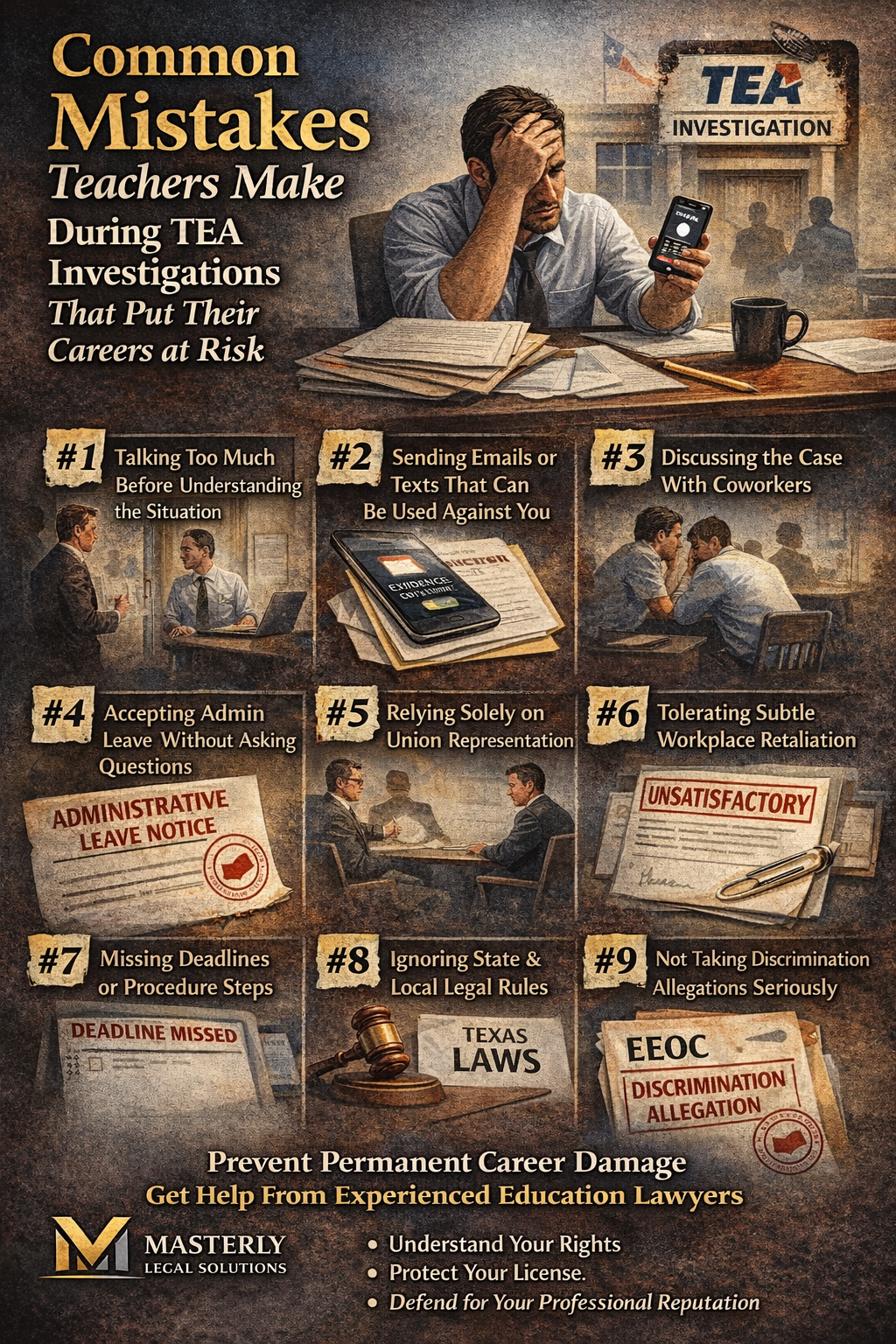
Common Mistakes Teachers Make During TEA Investigations That Put Their Careers at Risk
When a teacher is told there is an investigation, the first reaction is often disbelief. Many educators have never been through a formal complaint process, and they assume the truth will “speak for itself” if they cooperate. The problem is that TEA-related cases do not unfold like everyday workplace conversations. They follow rules, timelines, and documentation standards that can quietly reshape a teacher’s future before the teacher even realizes what happened.
At Masterly Legal Solutions, we have seen good employees—people who care about students, families, and their job—make small mistakes that turn into major professional consequences. A rushed email, an unplanned meeting, or a casual statement to a supervisor can become part of a record that supports disciplinary action. In the education workplace, the risk is not only employment consequences, but also certification and long-term career damage that can follow you across districts.
This article is written to create urgency without panic. A TEA investigation can move faster than you expect, and an educator can lose control of the narrative early. The goal is to help you understand what common missteps look like and how to protect yourself while staying professional. If you are already on administrative leave, or you feel retaliation in the workplace after a report or complaint, it is even more important to get the right guidance quickly.
Why TEA Investigations Feel Different Than Other Employment Problems
Many employment issues inside schools are handled through HR, internal meetings, and district policies. A TEA investigation can involve higher stakes because it may affect certification, future hiring, and professional standing. Teachers sometimes think they are just dealing with a local dispute, but the process may be building a statewide record. That record can matter even if you change campuses or leave the district.
A TEA-related investigation often overlaps with workplace concerns like harassment, discrimination, and retaliation. It may also involve questions about reporting, professional boundaries, or allegations that touch student welfare. Even when the underlying event seems manageable, the process can become complex due to regulations and documentation expectations. When the risk includes your license and your ability to work, it is wise to treat the situation as a serious legal matter from the beginning.
Administrative Leave Is Not a Neutral Event
Schools often place employees on administrative leave early in a complaint process. Districts may describe it as standard or “non-disciplinary,” but it can still impact your reputation and your options. Educators on administrative leave may lose daily access to the campus, lose informal support from coworkers, and feel isolated from the workplace community. That isolation can lead to poor decisions made out of fear or frustration.
In some cases, teachers are placed on paid administrative leave and assume the situation is under control. But paid administrative leave is often used as a risk-management step by employers, not a sign that the teacher will be cleared. The longer you are on administrative leave, the more likely it is that documentation and narratives are forming without your input. If you treat the leave period casually, you may miss the chance to respond properly and protect your career.
The High Cost of “Innocent” Missteps
Teachers are trained to communicate, explain, and de-escalate conflict. During a formal investigation, those instincts can backfire. An educator’s natural desire to clarify can be interpreted as inconsistency, defensiveness, or even an admission. Statements made without planning can become the foundation for disciplinary action later.
The risk is not just job discipline. A single mistake can trigger broader consequences that affect employment, future pay, and long-term stability for the educator’s family. When teachers feel pressure, they may over-explain, guess at details, or make assumptions that later appear inaccurate. Small missteps can become big when they are documented and repeated.
Mistake One: Talking Too Much Before You Understand the Process
One of the most common mistakes teachers make is speaking freely before learning the rules of the investigation. Teachers may be asked for a “quick statement” or informal explanation by a supervisor. In reality, the conversation may be documented and used in a formal file. Even a calm conversation can become a written summary that the teacher never gets to correct.
Teachers should be careful about answering questions on the spot. If you do not know what the allegation is, you cannot respond intelligently or safely. When the pressure is high, educators sometimes fill silence by guessing dates, motives, or details. That can create inconsistencies that are later treated as credibility problems.
Mistake Two: Writing Emails or Texts That Become Evidence
Teachers often think written messages help show professionalism. During an investigation, written messages can become evidence—even when they were meant to be helpful. A short email to HR or an apology to a parent can be interpreted as an admission of wrongdoing. A text to a coworker can be forwarded and stripped of context.
This is especially risky when emotions are involved. Teachers may write from fear, frustration, or desperation to “fix” things quickly. Once the message exists, it can be used in ways you did not intend. If you need to communicate, it should be done with careful planning and clear purpose.
Mistake Three: Speaking With Co Workers About the Allegations
Many educators lean on co workers for support, especially when they feel isolated. The danger is that workplace conversations can spread quickly and shift the narrative. Coworkers may mean well, but they may also repeat information incorrectly or share personal opinions that do not help your case. In some situations, a coworker may later be interviewed and misremember what you said.
It is also common for teachers to feel betrayed when workplace dynamics change. A person you trusted may become a witness without warning. Even casual comments can be used to support claims of intent or motive. When your career is at risk, privacy is protection.
Mistake Four: Accepting Administrative Leave Without Clarifying the Terms
Teachers may accept administrative leave as if it is a simple pause. In reality, administrative leave can include instructions, restrictions, and expectations that matter legally. Some educators violate restrictions without intending to, such as visiting campus, contacting students, or discussing the case. Those actions can be framed as noncompliance and used as justification for disciplinary action.
If you are placed on administrative leave, you should treat it as a formal stage of the process. You should ask what is allowed, what is prohibited, and how communication should occur. If your leave is paid, it is still serious. If paid leave transitions into unpaid leave or other consequences, the financial impact can be immediate.
Mistake Five: Assuming Your Union Representative Is Enough
A union representative can be helpful, but a union representative is not always a substitute for legal counsel. Unions may provide support for employment rights, meetings, and district procedures. But TEA-related risks can involve broader legal issues beyond internal district processes. A union representative may not be trained to handle complex licensing consequences.
Teachers sometimes assume union help means they are fully protected. But a TEA investigation can escalate into serious professional discipline even when a district case seems manageable. For teachers who want full protection, it can be important to consult an attorney who understands both education and employment-related legal risks.
Mistake Six: Not Recognizing Retaliation Patterns Early
When an employee reports an issue, requests accommodations, or participates in a complaint, they may later face retaliation in the workplace. Retaliation can look subtle at first. It may involve schedule changes, negative evaluations, isolation, or a sudden push toward discipline. Teachers often second-guess themselves and assume it is “just politics.”
Retaliation can also overlap with discrimination. If an educator believes they are being targeted based on disability, age, or other protected traits, the situation can involve multiple legal layers. The earlier you recognize a retaliation pattern, the more options you may have to respond strategically. Waiting too long can allow employers to build a paper trail that looks legitimate on the surface.
Mistake Seven: Treating the Investigation Like a Normal Workplace Conflict
An investigation is not the same as a disagreement with a supervisor. During an investigation, every statement, meeting, and document can be used to shape the outcome. Teachers who treat it casually may walk into interviews unprepared. They may assume their reputation will carry them through without needing evidence.
The truth is that investigations often rely heavily on documentation, not personal history. An educator with years of strong performance can still face discipline if the record is incomplete or inconsistent. In high-stakes situations, being “a good teacher” is not enough. You must also manage the process.
Mistake Eight: Missing Deadlines and Process Requirements
Investigations involve timelines, and deadlines can be strict. Teachers under stress often miss emails, misunderstand instructions, or delay responses. They may also assume they will get another chance to respond. In some cases, missing a deadline can limit your ability to defend yourself.
A teacher’s schedule is already demanding, and administrative leave can create emotional strain. But deadlines do not pause for stress. A missed deadline can become its own issue and may be used to show noncompliance. Staying organized during the process is one of the most important protective steps.
Mistake Nine: Ignoring How State and Local Laws Interact
Many teachers do not realize how state and local laws and agency rules can shape a case. School employees operate within layered systems that include state laws, local laws, district policies, and federal requirements. These layers can affect how evidence is handled, what rights you have, and what options exist to challenge outcomes.
Some teachers believe the district’s rules are the only rules. Others assume federal law automatically controls the outcome. The reality is that layered regulations can change how a case is evaluated, especially when discrimination or retaliation is alleged. Understanding the legal framework can help you avoid missteps that weaken your defense.
Mistake Ten: Not Taking Discrimination Allegations Seriously Enough
Many TEA investigations overlap with claims of discrimination and workplace mistreatment. Discrimination can be based on age, disability, sex, race, national origin, or other protected categories. Sometimes the teacher is accused of discrimination. Other times, the teacher is the one experiencing discrimination. In either situation, you must take it seriously.
Claims may involve age discrimination or alleged unequal treatment in evaluations or assignments. They may involve disability issues and failure to accommodate. They may also involve harassment that is ignored by employers. These concerns can trigger both internal and external processes.
Title VII and Workplace Retaliation Concerns
Federal protections such as Title VII are often cited in workplace discrimination and retaliation disputes. Title VII is part of federal law that addresses discrimination and can also support retaliation claims when an employee is punished for engaging in protected activity. Teachers should understand that retaliation is not limited to firing. It can include demotion, isolation, threats, or other adverse actions.
Employers may attempt to frame discipline as performance-related even when retaliation is the true motive. That is why documentation matters. If your employer’s actions changed after you reported harassment or discrimination, it is important to take that pattern seriously. Teachers should not assume that professionalism alone will stop retaliation.
The Civil Rights Act and Why It Matters to Educators
The Civil Rights Act is tied to many workplace protections involving discrimination. Educators may hear these phrases but not know what they mean in practice. What matters is that federal and state rules can impose responsibilities on employers and can offer protections to employees who report wrongdoing. When these issues overlap with investigations, the consequences can multiply.
A teacher might be accused of violating a policy while also being the target of harassment. Or a teacher might report misconduct and then face discipline for “unrelated” reasons. Understanding how these protections work can help you recognize when something is unlawful. It can also help your legal team build a stronger case.
The EEOC and Why Some Teachers Need to Think Beyond the District
Many accusations of discrimination and retaliation are handled by the Equal Employment Opportunity Commission, a government body. Not every teacher needs an EEOC case, but educators should know that district HR is not the only possible pathway. Some claims are addressed through internal grievance processes, while others involve formal filings.
If a teacher experiences discrimination or retaliation, they may need to consider legal guidance on timing and strategy. Waiting too long can harm options. Filing too soon without a plan can also create risk. Every case is unique, and a tailored approach matters.
Mistake Eleven: Underestimating Harassment and Its Long-Term Impact
Workplace harassment can be subtle or obvious. It can involve comments, jokes, threats, unwanted attention, or targeted mistreatment. Teachers sometimes tolerate harassment because they do not want conflict. In an investigation context, harassment can become part of a broader narrative that affects the teacher’s stability, performance, and emotional well-being.
Harassment can also connect to retaliation. If an employee reports harassment and then experiences negative treatment, that pattern matters. Many employers try to minimize harassment complaints by framing them as interpersonal issues. But harassment can be illegal, and it can also influence employment outcomes.
If harassment is part of your story, it should be addressed carefully and documented properly.
Mistake Twelve: Not Protecting Your Record While on Administrative Leave
Administrative leave often feels like “nothing is happening,” but a lot can happen behind the scenes. While a teacher sits at home, people may be writing statements, reviewing footage, discussing policy violations, and building a timeline. If you are on administrative leave, you should assume the record is growing daily.
Teachers should protect themselves by staying organized, saving relevant communications, and following restrictions. They should not vent online, speak publicly about the case, or assume the district will present facts fairly. The safest mindset is that anything could be reviewed later by decision-makers.
Paid leave does not mean low risk. Administrative leave is often the stage where long-term outcomes are shaped.
Paid Leave Versus Paid Administrative Leave
Teachers sometimes confuse paid leave with paid administrative leave. Paid leave may relate to sick time, personal time, or other benefits. Paid administrative leave is typically employer-directed and tied to investigations. The distinction matters because paid administrative leave often includes restrictions and formal expectations.
Some teachers think they can use the time to travel, relax, and “wait it out.” But the safest approach is to treat the time as active defense preparation. You do not want to be caught off guard when the district requests documents or schedules interviews. Use the time wisely and strategically.
If your pay status changes, it can also create financial stress. That stress can lead to rushed decisions that harm the long-term case.
Mistake Thirteen: Believing “Cooperation” Means You Must Waive Your Rights
Teachers want to be seen as cooperative employees, and that is understandable. But cooperation does not mean surrendering rights or walking into every meeting unprepared. Cooperation should be structured, professional, and informed. An educator can be respectful while also being careful.
If you feel pressured to speak without knowing the allegation, that is a red flag. If you are told you “must” answer immediately, you should pause and seek guidance. You can comply with process while still protecting yourself. Your approach should be calm, not reactive.
This is where having legal counsel can provide boundaries and clarity.
Legal Protections Exist, But They Must Be Used Correctly
Many employees assume the law will automatically protect them. The reality is that legal protections often require timely action and strategic steps. A teacher’s rights can be harmed by missed deadlines, unclear reporting, or poor documentation. Knowing your rights is important, but using them properly is what protects you.
Protections can come from federal rules, state rules, and local rules. They can involve anti-retaliation rules that prohibit retaliation for protected activity. They can also involve disability laws that protect employees from discrimination. The protection is real, but only when applied thoughtfully.
If you suspect wrongdoing, do not wait until your case is irreversible.
Federal Employees and Federal Agencies in Education-Related Workplaces
Some educators work in roles that connect to federal programs, federal oversight, or federal employment contexts. While many teachers are not federal employees, the broader workplace rules can still matter, especially when a case involves federal funding or federal standards. In certain situations, the involvement of federal agencies can complicate processes and increase documentation expectations.
Some staff work in specialized roles tied to national programs, research, or compliance areas. For those educators, the consequences can extend beyond the district. Understanding how federal layers interact with local processes can matter.
The key point is that layered systems require careful strategy. Assumptions can become mistakes.
Discrimination Issues Related to Disability and the Disabilities Act
Workplace disputes can involve disability accommodations, medical conditions, and fairness concerns. Some teachers experience discrimination based on disability or are treated differently after requesting accommodations. Rules like the Disabilities Act can matter when disability-related issues are involved.
Disability-related disputes also connect to family responsibilities and scheduling. A teacher managing a health issue may be penalized unfairly for attendance or performance concerns. These situations are sensitive and often misunderstood by employers. When disability issues overlap with investigations, the risk increases.
Teachers should document requests, responses, and any changes in treatment after disclosures.
Mistake Fourteen: Overlooking Immigration Status or Family Responsibilities Issues
Teachers and school employees sometimes face workplace mistreatment connected to immigration status or assumptions about a person’s background. Even if the issue is subtle, it can affect workplace dynamics and lead to unfair discipline. Teachers may also face discrimination tied to family responsibilities, such as caregiving demands, pregnancy-related needs, or care for a family member.
Employers sometimes punish employees for needing flexibility. They may frame it as performance problems, even when the underlying issue is unfair treatment. When family responsibilities intersect with administrative leave or investigation stress, the pressure can become overwhelming.
If family issues are part of your reality, you still deserve fairness and respect at work.
Mistake Fifteen: Misunderstanding How Courts and the Supreme Court Shape Standards
Most educators never think about court decisions when they are teaching. But employment standards are influenced by legal precedent, and major decisions can come from the Supreme Court. Court interpretations affect how claims are evaluated and how employers defend themselves.
Even if a teacher never goes to court, the standards used by HR and legal departments often reflect court guidance. Employers may build defenses based on how courts interpret discrimination, retaliation, and adverse action. That is why your documentation and timing matter.
You do not need to become a legal scholar. You need a strategy that respects the realities of the legal system.
The Employment Act and How Employers Use Policies Strategically
Some employers rely on policies and employment standards to justify discipline. References to an employment act or policy-based compliance language can be used to support a record of “legitimate business reasons.” That does not mean the actions are fair. It means employers often build a paper trail.
A paper trail can include negative evaluations, performance memos, and selective documentation. Teachers should not assume documentation is neutral. If your employer’s tone changed after a complaint, that matters.
A good defense includes understanding how employers build records and how to counter them with facts.
Mistake Sixteen: Not Recognizing Non Competes and Contract Traps
Some educators work in roles where contracts include restrictive clauses. While non-competes are more common in private industry, some school-related roles and vendor contracts involve restrictions or confidentiality provisions. Non competes and restrictive agreements can complicate job transitions during an investigation.
Teachers under pressure may resign and accept a settlement without understanding future limitations. They may also sign agreements that restrict future employment or communication. These choices can affect pay, benefits, and career flexibility.
Before you sign anything, it is wise to get legal review.
Mistake Seventeen: Believing Termination Is the Only Serious Risk
Teachers often fear termination, but termination is not the only risk. A teacher can keep a job but still face long-term damage through negative records, restricted assignments, and limited future opportunities. A teacher can also be forced out through pressure even without formal termination.
Termination can happen quickly if an employer believes they have enough documentation. But sometimes employers push employees to resign to avoid formal processes. Resignation may feel like control, but it can harm future options.
If your career matters to you, you should consider the full picture, not just the job you have today.
Mistake Eighteen: Not Hiring the Right Lawyer Early Enough
Many teachers wait until the situation becomes unbearable before calling an attorney. By then, statements have been made, timelines have passed, and the record may be difficult to change. Early action often provides more options.
The right lawyer can help you understand what to say, what not to say, and how to respond to requests. A strong employment lawyer can also recognize discrimination and retaliation patterns. In some cases, working with an experienced employment attorney can be critical to protecting both job and reputation.
In investigation cases, hiring a lawyer is not about being “difficult.” It is about being smart and protected.
Why Masterly Legal Solutions Takes These Cases Seriously
At Masterly Legal Solutions, we are a law firm that understands the unique pressure educators face. Teachers are expected to be calm, consistent, and professional even when their careers are threatened. That expectation can push teachers into silence or rushed explanations. We help clients respond with clarity, strategy, and professionalism.
We also understand that employers sometimes move aggressively to protect the organization. That can leave individual employees feeling powerless. Our role is to provide legal guidance that protects your rights and helps you make informed decisions.
We serve clients who want real answers, practical support, and a plan. We focus on protecting careers and reducing long-term harm.
What Teachers Can Do Right Now to Protect Themselves
If you are in an investigation, your goal is to protect yourself without escalating risk. You can take proactive steps that support your case and reduce mistakes.
Consider these protective actions:
- Follow all administrative leave restrictions exactly
- Save relevant emails, texts, and timeline notes
- Avoid discussing the case with coworkers or on social media
- Do not contact students or parents about the allegations
- Seek legal guidance before interviews or written statements
Even one of these steps can change the trajectory of a case. The earlier you act, the more control you may keep.
A Practical Example of How Small Errors Become Major Discipline
Here is an example we often see. A teacher is placed on administrative leave after a parent complaint. The teacher sends an apologetic email to explain their intent and reassure the family. The email is later used to suggest the teacher admitted wrongdoing. Then the teacher talks to coworkers about how unfair the process is, and the comments are repeated during interviews. The record begins to show “inconsistent messaging,” and discipline escalates.
This is not because the teacher intended harm. It is because the process rewards careful strategy, not emotional clarity. In investigations, the record is what matters. This is why getting legal help early can prevent avoidable mistakes.
Why Guidance Matters for Employees Under Pressure
During a high-stakes investigation, teachers often feel alone. They worry about pay, reputation, and how their family will handle the uncertainty. They may also fear that employers will treat them unfairly for reporting problems. In those moments, good guidance is more than comfort—it is protection.
Guidance helps teachers speak carefully, respond on time, and avoid traps that turn into discipline. It also helps educators recognize when the process is turning into unlawful retaliation or discrimination. A strong support system can preserve both career and peace of mind.
Your future deserves strategy, not guesswork.
Employment Lawyer Support When a Teacher’s Career Is on the Line
Working with an employment lawyer can be a critical step when a TEA investigation turns into a workplace crisis. Teachers are often surprised by how quickly a school can shift from “fact-finding” to recommending discipline, termination, or long-term restrictions. An employment lawyer helps you respond strategically, protect your record, and avoid statements that can be misunderstood or used against you later. When your job, pay, and professional reputation are at risk, the right legal guidance can be the difference between a temporary setback and permanent career damage.
Choosing a Law Firm That Understands High-Stakes Workplace Investigations
Not every law firm understands how emotionally stressful and legally complex teacher investigations can become. These cases move fast, include strict timelines, and often involve multiple layers of policy and legal rules that can impact your future. A strong law firm does more than offer general advice—it helps you create a clear plan, prepare for interviews, and protect your professional standing. When you feel like your workplace is against you, having experienced legal support gives you stability and control.
When a National Association Becomes Part of the Process
In certain education-related disputes, a national association may play a role in shaping professional standards, best practices, or workplace expectations. Even when the association is not directly involved in the investigation, their policies and influence can affect how school leadership frames allegations. Teachers may feel extra pressure when public narratives rely on outside standards rather than the realities of the classroom. Understanding the bigger picture helps educators respond professionally without being unfairly judged by generalized assumptions.
Computer Science Teachers and High-Risk Documentation Issues
Even educators who teach specialized subjects like computer science can face unique risks during workplace investigations. Technology-related classes often involve device access, online communication, digital platforms, and student data that may become part of an investigation record. A minor misunderstanding about technology use can escalate into a serious allegation if the situation is not explained carefully and supported with facts. Because digital records can be misinterpreted, teachers should be cautious and prepared when answering questions involving technology.
Small Businesses, Contracted Programs, and Unexpected Workplace Pressure
Some educators work in roles connected to vendors, partnerships, or programs that operate like small businesses inside school systems. These arrangements may include contracted services, education programs, or specialized support structures that involve unique rules and expectations. When an investigation happens, responsibility can shift quickly, and teachers may feel blamed to protect the organization’s image. Understanding how business relationships intersect with school policy helps educators protect themselves from being treated like the “easy target.”
Why Super Lawyers Recognition Is Not the Only Thing That Matters
Some people search for attorneys labeled as super lawyers, but what matters most is whether the attorney understands your specific situation. Teacher investigations require more than courtroom skill—they require knowledge of workplace procedures, documentation strategy, and how to prevent small missteps from becoming major discipline. Educators need representation that focuses on protecting careers, licenses, and reputations under pressure. The best legal support is the support that fits your case, your timeline, and your risks.
When the Company’s Interests Are Not the Same as the Teacher’s Needs
During an investigation, the school district or company involved often focuses on reducing liability and protecting the institution. That does not always align with protecting the educator’s future. Teachers may be pressured into meetings, statements, or agreements that seem routine but can harm them later. When employers move quickly, employees need to be even more careful, because the goal may be risk-management rather than fairness.
Justice in the Workplace Requires a Strong and Strategic Response
Many teachers want justice, especially when they feel falsely accused or treated unfairly after years of service. But fairness does not always happen automatically in administrative investigations, and educators may feel powerless when decisions are made behind closed doors. A strategic response helps ensure your side is documented clearly and professionally instead of being reduced to assumptions. True justice often depends on acting early, staying organized, and getting the right support before damage becomes permanent.
Labor Concerns and the Hidden Impact of Employment Conflict
Workplace cases often involve labor concerns such as employee rights, contract rules, and internal reporting protections. Teachers may be surprised by how quickly an investigation becomes linked to broader employment disputes involving discipline, evaluations, and job security. Even when the conflict starts small, labor issues can influence how administrators interpret a teacher’s actions or performance. Understanding the labor side of a case helps educators protect their future and avoid being pushed into unfair outcomes.
Assistance for Teachers Who Feel Overwhelmed by the Process
Teachers often need real assistance when a TEA investigation or workplace complaint begins to take over their life. The stress can affect health, family routines, finances, and confidence in returning to the classroom. Having support helps teachers stay focused, protect their communications, and avoid decisions made out of fear. Whether the goal is to keep your job, protect your license, or clear your name, the right assistance provides stability and a clear direction forward.
Mediation as a Tool for Resolving Certain Workplace Conflicts
In some situations, mediation can help resolve employment disputes when communication has broken down between a teacher and an employer. Mediation is not always appropriate for serious allegations, but it can be helpful in retaliation, workplace conflict, or administrative disputes that may be escalating unnecessarily. A structured mediation process can create a path toward resolution without prolonged harm to a teacher’s career. When done strategically, mediation can protect reputations and prevent disputes from turning into permanent professional damage.
Government Oversight and the Reality of Public-Sector Employment
Teachers work within an environment shaped by government rules, policies, and public accountability. Investigations often move differently in public education because decision-makers must follow structured procedures and maintain compliance standards. Government involvement can also increase the seriousness of documentation, deadlines, and reporting obligations. That is why educators should treat investigations as formal legal matters, not just workplace disagreements.
Compensation and the Financial Stress of Administrative Leave
An investigation can quickly turn into a financial problem if a teacher’s compensation changes due to restrictions, missed work opportunities, or uncertainty about future employment. Even when administrative leave is paid, teachers may worry about what happens next and how long stability will last. Financial stress can push educators into rushed decisions, including resigning too soon or signing agreements without understanding long-term consequences. Protecting your career also means protecting your financial future, and that begins with taking the process seriously from the start.
Contact Masterly Legal Solutions for a Free Consultation
If you are a teacher facing a TEA-related investigation, you should not assume the process will “work itself out.” Innocent mistakes can turn into disciplinary action, license consequences, or pressure to resign—especially when retaliation in the workplace is part of the story. If you believe your employer is targeting you after a report, a complaint, or participation in an investigation, you may have options under federal, state, and local rules that prohibit retaliation.
Masterly Legal Solutions helps employees navigate investigation pressure with clarity and strategy. We can discuss the facts, identify risk points, and help you protect your job, your record, and your long-term career goals. If you are on administrative leave, paid administrative leave, or facing termination threats, now is the time to get answers before the record becomes permanent.
Call (972) 236-5051 today to schedule your free consultation and speak with our team about your situation.
Disclaimer: This article is for educational purposes only and does not constitute legal guidance or legal advice. For advice about your specific situation, consult an attorney.



Teacher Rights When Assaulted by a Special Needs Student: Safety, Reporting and Investigation Issues



Looking for Legal & Business Solutions? Contact Us Now
Fill in the form or call us to set up a meeting