
How School Districts Use Civility Policies During Internal Investigations
Illegal Activity Allegations and Why the Details Matter
When a school district investigation involves alleged illegal activity, the stakes rise quickly for everyone involved. Even when the accusation turns out to be false or misunderstood, the district may treat the situation as a serious policy and legal risk, especially if the claim relates to student safety, misuse of funds, improper reporting, or violations of internal protocols. In these cases, it becomes critical for the employee to document what happened, what was said, and what steps were taken, because the district may move toward discipline or termination based on suspicion alone. If you are being questioned in connection with illegal activity, it is wise to seek legal guidance early so you do not accidentally harm your own position during the investigation.
The Following Factors Can Impact How an Investigation Ends
Every internal investigation is different, but the outcome often depends on the following factors more than most employees realize. School districts typically weigh credibility, consistency, policy language, and whether leadership believes the employee’s actions disrupted operations or caused risk. They may also consider prior performance history, how communication occurred during the investigation, and whether the employee cooperated professionally. Even small details—like the tone of an email, who filed the complaint first, or how witnesses describe a meeting—can shift the district’s decision toward discipline or termination. Understanding the following factors can help an employee respond strategically instead of emotionally when the pressure is highest.
Why San Francisco Is Often Mentioned in Workplace Policy Discussions
Although this article focuses on Texas school districts, San Francisco is often referenced in broader workplace policy conversations because many employers across the country watch larger metro areas for shifting employment trends. Some organizations look to cities like San Francisco for examples of evolving workplace expectations, stricter employee protections, and progressive HR enforcement strategies, even when those rules do not apply directly in Texas. School districts and public employers sometimes borrow policy language from national templates or outside consultants, which can make internal standards feel more corporate than local. If a district uses outside policy templates, employees should still focus on the rules that actually apply under Texas state law and district procedures.
Getting the Right Assistance During a School District Investigation
The most important thing an employee can do during an investigation is get the right assistance before the situation escalates into suspension, termination, or long-term damage to their professional record. Assistance can come in many forms, including reviewing your district’s policies, preparing a written statement, gathering documentation, or understanding your rights before you attend another meeting. Too many employees wait until the final decision has already been made, and by then, options may be limited. If you feel like the district is building a case against you, early assistance can help protect your job, your reputation, and your future career.
Contact Masterly Legal Solutions for a Free Consultation
If you work in san antonio texas school districts and you are facing an internal investigation involving civility allegations, administrative leave, or potential termination, you do not have to face it alone. These cases can move quickly, and what you say early can shape the outcome later.
At Masterly Legal Solutions, we help school employees protect their careers, their reputation, and their future. Whether you believe you are being targeted unfairly, pressured into resigning, or preparing for a wrongful termination claim, our team can explain your legal rights and help you make confident decisions moving forward.
Call (972) 236-5051 today for a free consultation. We are ready to listen, guide you through your next steps, and provide the support you need when your job and livelihood are on the line.
Disclaimer: This article is for educational purposes only and does not constitute legal advice or legal guidance. Every situation is different, and you should speak directly with a qualified attorney about your specific circumstances.
School district jobs can feel personal in a way that many other workplaces don’t. Educators and staff often serve the same community where they live, raise their families, and build long-term relationships. That’s why, when an internal investigation begins, it can feel stressful, confusing, and even isolating for an employee who suddenly gets pulled into meetings, asked to explain events, or placed on administrative leave.
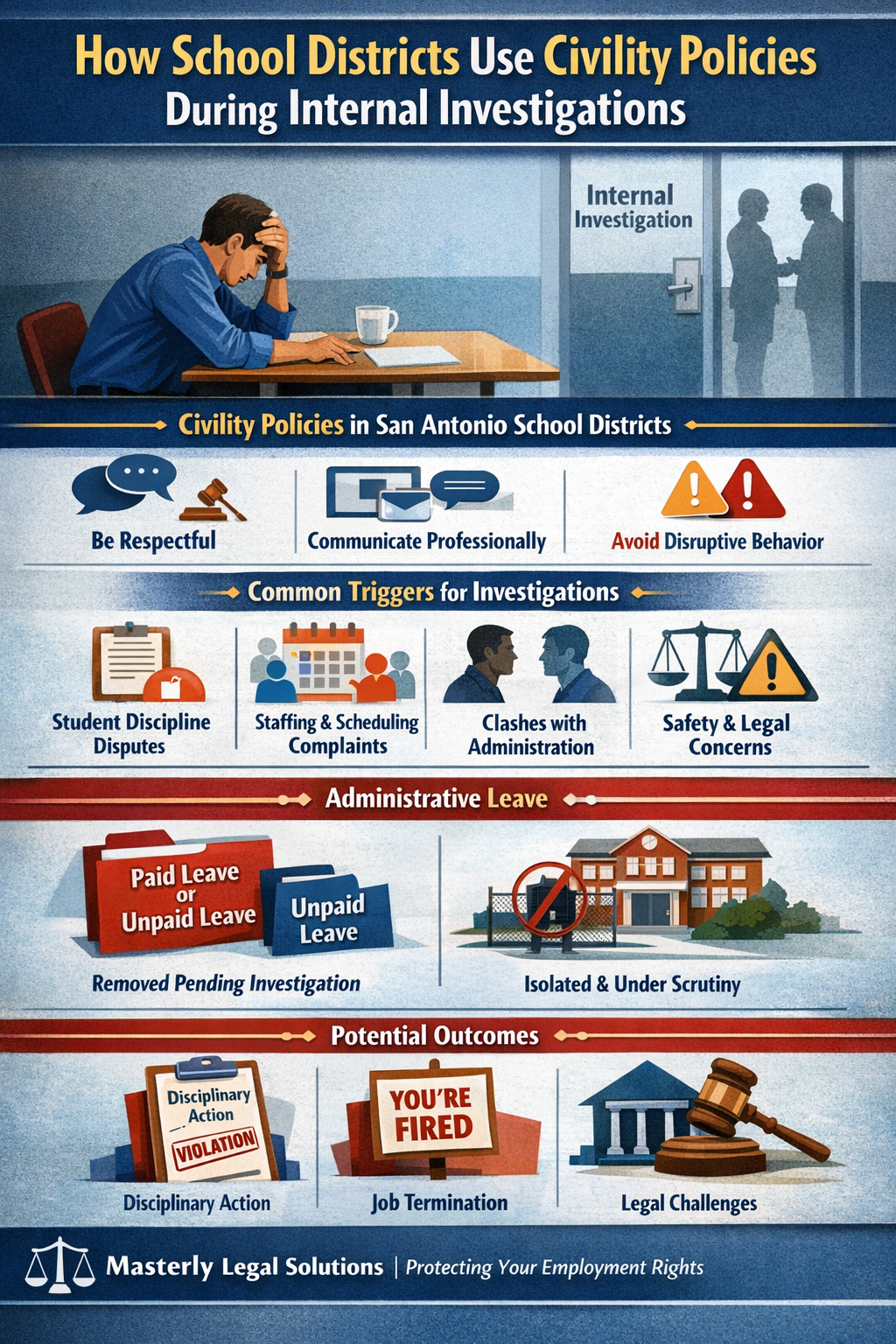
In many san antonio texas school districts, one of the most commonly used tools during these investigations is a “civility policy.” At face value, it sounds simple: be respectful, communicate professionally, and avoid disruptive behavior. But in real-world employment situations, civility policies are often used as more than a reminder to stay calm—they can shape outcomes, define “misconduct,” and sometimes even influence whether an employer decides to terminate someone’s job.
At Masterly Legal Solutions, we speak with school district workers who feel like they are being investigated for one issue, but disciplined for another. We also hear concerns about retaliation, policy misuse, and whether a district’s own policies are being used fairly across other employees. If you’re facing an investigation, a civility accusation, or a possible termination, you may need clarity, strategy, and support—especially if you believe an employer violates your legal rights.
This article explains how civility rules show up in internal investigations, how public policy can affect employment decisions, and what legal concerns may arise when a district uses policy language to justify disciplinary action, administrative leave, or separation from employment.
What Is a “Civility Policy” in a School District Setting?
A civility policy is a written standard that tells staff how to communicate and behave professionally while on the job. In school environments, these policies usually focus on workplace interaction, public trust, student protection, and maintaining order.
In theory, civility rules exist to reduce disruptions and keep professional standards high. They can apply to teachers, paraprofessionals, administrators, custodial teams, transportation staff, and office professionals—essentially any employee interacting with others in the workplace.
However, the way these rules are enforced can vary widely across an employer. Some districts treat civility complaints like informal coaching issues. Other districts treat them like a serious violation that triggers an investigation.
Why Civility Policies Matter During Internal Investigations
Internal investigations often begin when someone files a complaint or reports an issue. That issue could involve conduct, student concerns, interpersonal conflict, or alleged illegal conduct.
Once the district begins its process, the civility policy often becomes the lens through which communication is evaluated. Even if the original issue is something else, your tone in emails, meetings, or conversations may be used as “evidence” of policy violation.
This is one reason civility policies can feel like a “moving target” during investigations. An employee may think they are answering questions about performance, but the district may be building a case around “unprofessional behavior” or “disruptive conduct.”
How Investigations Usually Begin in San Antonio School District Workplaces
In many san antonio texas school districts, investigations start in predictable ways. The district may receive a complaint from a coworker, parent, supervisor, or student-related report.
The district might assign the matter to human resources, a compliance office, an internal investigator, or a campus administrator. Some investigations are handled quietly. Others involve quick procedural steps that place an employee in a defensive position immediately.
Even when the investigation seems “informal,” what you say and do can later be used to justify disciplinary action or termination.
Common Reasons Civility Policies Get Triggered
Civility issues aren’t always about yelling or profanity. Districts sometimes interpret “civility” broadly, and that can create confusion for an employee who feels like they were simply advocating for themselves.
Some common triggers for internal investigations and corporate compliance include:
- Disagreements over student discipline or academic placement
- Complaints about scheduling, duty assignments, or staffing
- Conflicts about leadership decisions and campus culture
- Reporting concerns that the employer violates safety rules or employment laws
- Tense communication during meetings involving a union representative
- Frustrated emails that are seen as disrespectful or insubordinate
What one person sees as direct communication, another may label as “hostile.” During investigations, the district may claim it is enforcing own policies consistently, but outcomes can differ dramatically across departments.
Administrative Leave and Paid Administrative Leave: What It Often Means
One of the most stressful parts of a district investigation is being removed from the workplace. Districts often place staff on administrative leave while they gather statements and review documentation.
Some employees are placed on paid administrative leave, which can feel confusing. Being paid may sound “better,” but it often signals the district believes the allegations require immediate separation from the workplace.
In many cases, the district’s written notice may use broad language like:
- “Pending investigation”
- “Pending review of allegations”
- “Pending a final determination”
Whether you are placed on administrative leave or paid administrative leave, it is critical to understand that the decision can later be tied to termination or a claim that the district acted under its internal policies.
How Administrative Leave Can Shape the Final Outcome
When an employee is placed on administrative leave, it changes the entire dynamic of the investigation. The district controls access to work emails, records, and sometimes coworkers.
The district may limit what you can say, who you can contact, and whether you can return to campus. For many workers, it becomes a period of uncertainty where rumors spread and anxiety grows.
It’s also common for districts to claim they placed someone on administrative leave for “workplace safety,” even if the situation did not involve violence, threats, or direct student risk. That type of framing can later be used to justify harsher disciplinary action.
Why School Districts Often Use “Public Policy” Language
School districts are public employers, which means their actions are often linked to community expectations, state education standards, and legal accountability. Districts frequently reference public policy when they explain rules about conduct, professionalism, and workplace behavior.
In Texas, at will employment typically allows an employer to end employment for almost any reason. But districts still must avoid firing for illegal reasons, retaliation, or discriminatory motives.
Because of that, many districts rely on “public policy” explanations to justify decisions. They may claim:
- The district must maintain public trust and professionalism
- The district must avoid disruptive workplace behavior
- The district must protect students and ensure safe learning environments
- The district must enforce standards consistently across employees
The use of public policy language can make a termination decision sound “objective,” even when the situation is complex.
Civility Policies and “At Will Employment” in Texas
Texas is known for at will employment, meaning an employer can generally terminate employment without having to prove “cause.” This can apply to many school district positions, depending on contract type, policy, and role.
However, “at will” does not mean unlimited power. An employer may still face consequences if an employer violates employment laws, breaches a contract, retaliates against protected activity, or discriminates unlawfully.
So while districts may argue they can fire employees for “civility issues,” the key question is whether the district’s reasoning crosses into illegal territory.
How Civility Complaints Become “Misconduct” in Investigation Files
Many districts treat civility reports like formal misconduct reports. What begins as “tone” or “attitude” concerns can be written up as:
- Insubordination
- Harassment
- Disruptive behavior
- Unprofessional communication
- Failure to follow directives
Once that happens, a civility accusation may be used as strong evidence supporting disciplinary action or termination.
It is also common for an employer to gather statements from multiple coworkers. If a jury believes those statements reflect a pattern, the district may later argue it acted appropriately under policy—even when the employee strongly disagrees.
The Two Categories of Civility Investigations Schools Often Use
Most internal investigations involving civility fall into two categories.
The first category involves alleged interpersonal aggression—examples include yelling, intimidation, bullying, or repeated disrespect. The second category is more subtle and often involves communication disputes where an employee is accused of being difficult or uncooperative.
In both categories, the wording of the policy and the investigator’s interpretation matters. Small differences in how the district documents events can change the outcome of the entire case.
Examples of Civility Issues That Frequently Appear in District Findings
A few examples come up repeatedly in district investigation reports:
- “Employee used an unprofessional tone in written communication.”
- “Employee challenged a supervisor in a public setting.”
- “Employee disrupted a meeting by refusing to accept feedback.”
- “Employee created a hostile environment for other employees.”
- “Employee failed to follow directives and responded disrespectfully.”
An example like this may sound subjective, but districts often treat these findings as objective “policy violations.” In some cases, the employee believes the district is simply building a record to justify termination.
When Civility Policies Get Used Against Employees Reporting Problems
Some employees believe a civility complaint is being used as retaliation for speaking up. This is a major concern because workplace reporting is often protected under employment laws and, in certain situations, by federal laws and state law protections.
If an employee reports harassment, discrimination, unsafe practices, or unethical behavior, that reporting could qualify as protected activity depending on the circumstances.
If a civility policy is used to punish someone for reporting issues, the district may be exposing itself to a retaliation claim.
Civility Policies and Employment Discrimination Concerns
Civility rules may seem neutral on paper, but enforcement isn’t always neutral in practice. Districts may enforce civility more harshly against certain workers than others.
Civility-related discipline can sometimes overlap with:
- employment discrimination
- discrimination based on protected status
- uneven treatment compared to similarly situated staff
Federal laws such as title vii of the Civil Rights Act and the civil rights act generally prohibit discrimination in employment based on protected characteristics. Additionally, the disabilities act can apply when discipline relates to behaviors connected to certain medical conditions or disabilities.
If the district labels an employee “uncivil” but does not apply the same standard to other employees, a discrimination and retaliation analysis may be necessary.
How Retaliation Can Appear in a Civility Investigation
Retaliation does not always look dramatic. Sometimes it appears as a series of escalating discipline steps that begin shortly after an employee makes a complaint.
Retaliation may include:
- sudden write-ups
- increased monitoring
- reassignment to worse duties
- negative evaluations
- forced transfers
- pressure to resign
- administrative leave used as a control tool
Retaliation becomes even more serious when it leads to termination, lost benefits, and long-term career harm.
When “Working Conditions” Become a Legal Issue
Some employees stay employed but feel pushed out. They may be subjected to constant pressure, public criticism, or unrealistic expectations after an investigation begins.
If working conditions become so difficult that a reasonable person would feel they had no real option but to leave, this can raise questions about constructive termination.
While constructive termination is not always easy to prove, it matters because it helps explain situations where an employee did not “quit voluntarily.” District documents may label it a resignation, but the employee may claim the conditions were engineered to force them out.
How District Leadership Uses Internal Policies to Control the Narrative
During an investigation, a district often relies heavily on internal policies to justify actions. Those policies are used to define:
- what counts as “misconduct”
- what counts as “insubordination”
- what counts as a disciplinary violation
- what actions are allowed during investigation processes
Districts also rely on their own policies to control communication. Employees may be instructed not to discuss the matter with coworkers, which can isolate the employee and increase emotional pressure, or even force you to resign or quit your job.
The employee’s future may depend on whether the district is applying those policies fairly and legally.
When an Employer Fired Someone for “Civility,” But the Real Reason Is Something Else
We often hear from staff who say, “They claimed it was civility, but I think it was retaliation.” This type of concern can arise when:
- the employee previously filed a complaint
- the employee raised policy concerns
- the employee refused to participate in questionable conduct
- the employee challenged decisions involving student services
- the employee asked for accommodations
If an employer fired someone for civility on paper but the reality involves retaliation or discrimination, the employee may have a stronger case than they realize.
Wrongful Termination in School Districts: When Civility Becomes the Excuse
In Texas, districts sometimes believe they can fire employees freely under at will employment rules. But wrongful termination is still a serious issue when an employee is terminated unlawfully.
A wrongful termination claim may arise when an employer ends employment for illegal reasons. In district settings, wrongful termination sometimes follows investigations where civility is used as the official justification.
If the employee believes the employer wrongfully terminated them due to discrimination, retaliation, or a violation of legal protections, they may have options.
Wrongful Discharge and Policy-Based Termination Decisions
Wrongful discharge is a term often used when someone believes they were fired in a way that violates law, contract obligations, or legal standards.
In school district cases, wrongful discharge concerns often include claims that:
- discipline was uneven across other employees
- the investigation process was biased
- evidence was ignored or mischaracterized
- civility rules were used unfairly as a weapon
- reporting was punished rather than addressed
Because employment decisions can happen quickly, an employee may need guidance early to protect their future.
When “Employer Violates” Policy or Law During an Investigation
School districts have internal rules, but they also have legal obligations. Problems arise when an employer violates its own procedures or violates legal standards during investigative steps.
Potential violations can include:
- denying the employee an opportunity to respond
- ignoring exculpatory evidence
- refusing reasonable accommodations
- mishandling witness interviews
- applying policies inconsistently
Even if an employer claims the termination was justified, the process matters. In some cases, the process itself becomes part of a legal claim.
The Role of a Union Representative in a Civility Investigation
If the employee is in a role with union involvement, a union representative may be able to attend meetings or support communication. That support can reduce the risk of misunderstandings, but it does not automatically prevent discipline.
Districts may still proceed with administrative leave, write-ups, or termination based on policy language. And sometimes, employees are surprised by how quickly decisions are made, even after union involvement.
Because the stakes can be high, employees often benefit from legal guidance in addition to workplace representation.
When the District Labels an Employee “Aggressive” or “Unstable”
District documentation can be damaging. Some reports include loaded language that creates a negative narrative about the employee. It's crucial not only to be aware of such documentation in your professional life but also to ensure your personal affairs are in order by preparing essential legal documents for families before age 40.
That narrative can impact:
- future employment references
- certification concerns
- internal transfers
- later investigations
- credibility if litigation occurs
If an investigation report implies an employee is a “safety risk,” districts may use workplace safety language to justify extended administrative leave or removal.
Emotional Distress in High-Pressure Investigations
Internal investigations can create intense stress. Many employees experience sleeplessness, anxiety, depression symptoms, or strained family relationships during these periods.
In legal cases, emotional distress can become part of damages depending on the facts. While emotional harm alone does not automatically prove a legal violation, it can be relevant when combined with retaliation, discrimination, or wrongful termination facts.
Employees who feel overwhelmed should consider both legal support and medical support if needed, including medical care, because mental strain can become serious quickly.
How “Paid Leave” Decisions Impact the Employee’s Career
Districts may claim paid leave shows the employee was treated fairly. But in reality, paid leave can still come with serious consequences.
Being placed on paid administrative leave can create reputational harm, isolation, and professional stigma. Even if the employee is later cleared, the damage may already be done.
Paid leave may also be used strategically while an employer builds documentation for eventual discipline or termination.
The Hidden Risk of “Informal” Conversations With a Supervisor
Many employees assume they are in a casual conversation when speaking to a supervisor. But in investigations, those conversations can become documented statements.
Employees should be mindful that comments made in meetings may later be used to support an alleged civility violation or to justify disciplinary decisions.
If you feel pressured, it may be a sign you need professional guidance.
How Investigators “Determine” Credibility and Fault
During investigations, districts must determine who is credible and what happened. But that process can be subjective.
Investigators may rely on:
- witness statements
- emails and texts
- meeting notes
- prior discipline records
- employee history
- campus climate and interpersonal conflicts
When the district’s final report frames an employee as the problem, the employee may need to respond strategically—especially when termination is being considered.
The Role of “Strong Evidence” in District Decisions
Some employees assume that if there is no video proof or clear documentation, the district cannot take action. Unfortunately, that’s not always true.
Districts may rely on multiple witness statements as “strong evidence,” even when the employee disputes those statements. A one-sided investigation can still lead to discipline if the district feels it has enough support on paper.
That’s why it’s important to address inaccurate narratives early before they harden into official findings.
How a Wrongful Termination Lawsuit Can Develop From Civility Discipline
A wrongful termination lawsuit can occur when the employee believes termination was illegal, discriminatory, retaliatory, or otherwise unlawful.
In district settings, wrongful termination cases sometimes involve:
- retaliation for complaints
- discrimination under Title VII or disability law
- false accusations used to justify discipline
- inconsistent enforcement of district policies
- termination tied to protected reporting
Employees often wait too long because they think they have no options under at will employment. But legal analysis depends on details, timing, documentation, and the district’s stated reasons.
What a Wrongful Termination Claim Typically Focuses On
A wrongful termination claim often focuses on whether the termination was driven by illegal motives, not just whether the employer was “unfair.”
Key issues may include:
- was the employee engaged in protected activity?
- was there discrimination or disparate treatment?
- did the employer ignore its own policies?
- did the employer retaliate after complaints?
- was the termination tied to public policy concerns?
Even in Texas, wrongful termination cases can be meaningful when facts support illegal reasons.
Damages: Lost Wages, Back Pay, and More
If the employee wins or resolves a legal claim, potential damages may include financial recovery. Depending on the case, damages might include:
- lost wages from retaliation
- back pay
- reinstatement (in rare situations)
- benefit losses
- potential punitive damages (in certain cases)
Punitive damages are not available in every situation, but they may come up when an employer’s conduct is particularly severe or intentional under applicable law.
What “Illegal Reasons” Can Look Like in District Employment Decisions
A district may claim termination was about civility, but illegal reasons might include discrimination, retaliation, or punishment for reporting concerns.
Examples of potentially illegal reasons include termination tied to:
- protected discrimination categories
- requesting accommodations
- reporting harassment or discrimination
- reporting illegal or unethical conduct
- raising safety and compliance concerns
The real issue is not whether the district disliked the employee, but whether the district violated the law while acting on that dislike.
Employer Practices That Can Trigger Legal Action
An employee may consider legal action when the district’s investigation process becomes unfair, retaliatory, or discriminatory.
Situations that commonly trigger legal action include: (for detailed HR legal guidance, see HR outsourcing and consulting services).
- termination without fair review
- retaliation after internal reporting
- denial of due process promised in policy
- false allegations used to create a paper trail
- inconsistent enforcement of civility standards
Not every unfair situation is illegal, but many are more legally significant than employees realize.
Employment Laws That Commonly Affect School District Termination Cases
School district employment decisions can be influenced by both Texas law and federal standards.
Legal analysis may involve employment laws such as:
- federal anti-discrimination standards
- Title VII protections
- disability protections
- retaliation rules
- contractual or policy-based obligations
- state law concepts and public policy principles
In some situations, federal protections are the main focus. In others, state-based issues play a stronger role. A tailored review is often needed.
Employing Undocumented Workers and Investigation Complications
Not all district investigations involve civility alone. Sometimes investigations uncover separate issues like compliance violations or hiring irregularities.
Concerns about employing undocumented workers may trigger additional reporting, legal implications, or internal compliance reviews. Investigations involving undocumented workers can become complicated quickly, especially if the district is trying to contain liability.
In cases involving undocumented workers, the district’s internal actions may create a chain reaction of discipline decisions, terminations, and policy changes.
Undocumented Workers and Workplace Treatment Issues
Even when the investigation involves undocumented workers, the district must still follow lawful processes. Employees connected to the matter may face harsh treatment even if they were not responsible.
Undocumented workers issues can also create fear among staff, making people less willing to cooperate or speak openly. That fear may allow misinformation to spread and increase risk of wrongful accusations.
Each case depends on details, but these issues can impact investigations in major ways.
How a Former Employer Can Affect Your Future Opportunities
School district employees often worry about how they will be described after separation. A former employer may be contacted for references, background checks, or verification.
If the district documents the employee as “uncivil,” “disruptive,” or “unsafe,” it may affect the employee’s ability to secure future employment.
That’s why it is important to approach investigations strategically, even when the employee hopes to remain with the district.
Why Employees Need Legal Protections During Investigations
Many employees assume investigations are neutral and fair. But districts often act in ways that protect the institution first.
Employees may need legal protections when:
- they are facing termination
- they believe retaliation is involved
- discrimination concerns exist
- policy enforcement is inconsistent
- the investigation is biased or one-sided
Having clear support and legal guidance can help the employee protect their professional record, income, and long-term career.
When to Speak With an Employment Attorney or Employment Lawyer
If you are facing administrative leave, discipline, or termination threats, it may be time to talk to an employment attorney or employment lawyer.
An experienced attorney can help evaluate:
- what the district is claiming
- what policies were triggered
- whether retaliation is a factor
- whether discrimination might apply
- whether termination may support a claim
Even if the employee does not want to sue, early advice can prevent avoidable mistakes that worsen the situation.
How Masterly Legal Solutions Supports School Employees
At Masterly Legal Solutions, we understand the school district environment. Investigations can move fast, and district paperwork can be intimidating.
Our founding partner and team focus on helping employees understand their options, respond carefully, and protect their future. If you feel the district is building a case against you, a clear strategy matters.
We help clients evaluate documentation, identify risks, and respond to investigation steps in a way that protects their legal position.
Why Some Employees Believe They Were Wrongfully Terminated
Many employees don’t expect termination. They believe they did their job, followed procedures, and communicated responsibly.
But after a civility-based investigation, the district may say the employee created disruption or violated policy. This is where many wrongful termination questions begin.
If you believe your employer fired you unfairly—or your employer wrongfully terminated you—your concerns deserve a serious review.
The Risk of Accepting the District’s Story Without Question
Some employees accept a termination letter or investigation finding at face value. But district findings are not always the whole story.
If the district ignored key facts, mischaracterized conduct, or failed to account for retaliation, the employee may have grounds for a wrongful termination claim or other legal claims.
It is often worth exploring legal rights, especially when the termination impacts pay, benefits, and future employment opportunities.
How We Help You Evaluate Whether the Employer Violates the Law
Not every district mistake becomes a legal violation. But when an employer violates discrimination laws, retaliation protections, or due process promises, the employee may have strong options.
Our team evaluates:
- the timeline of events
- written district policies
- documentation and communications
- witness credibility concerns
- whether the discipline aligns with the district’s own policies
- whether the situation supports legal action
When facts show unfairness and illegality, the employee may be able to push back effectively.


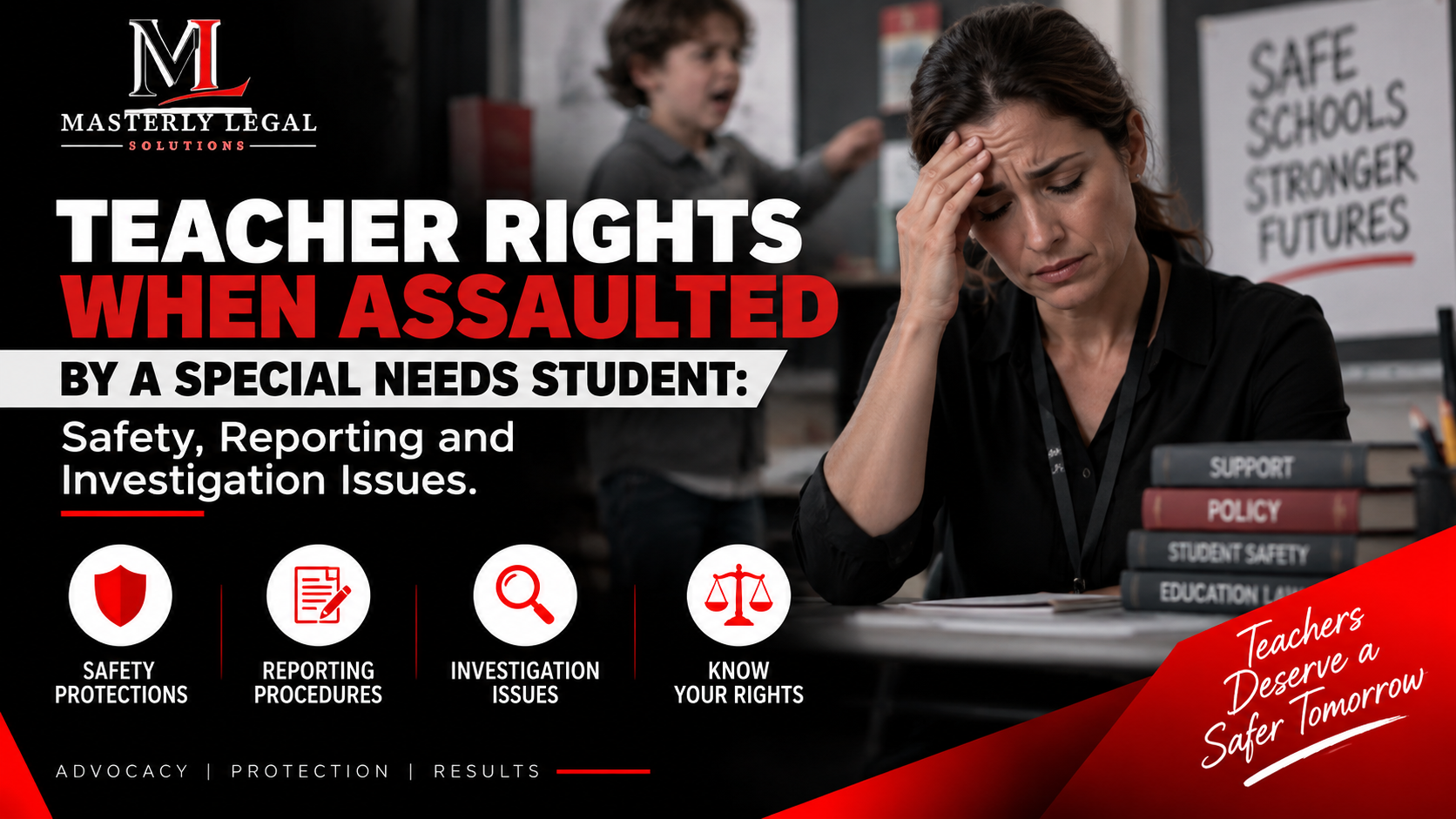
Teacher Rights When Assaulted by a Special Needs Student: Safety, Reporting and Investigation Issues



Looking for Legal & Business Solutions? Contact Us Now
Fill in the form or call us to set up a meeting