

From Administrative Leave to License Risk: TEA Investigations in School Districts in Austin
Getting pulled into a TEA investigation can feel like the ground shifts under your feet overnight. One day you’re focused on your students, your lesson plans, and your work schedule, and the next you’re told to pack up, hand over company property, and stop responding to messages. For many educators in Austin, the first sign of trouble is a sudden leave decision—often administrative leave—and a lot of confusion about pay, process, and what happens to your certificate.
This article is worth reading because it walks teachers through how a district investigation typically progresses, when things become critical, and what choices can protect your career. We’ll explain how leave administration works during a TEA matter, how hr and policy decisions can affect your future, and why your actions during an absence can matter just as much as the underlying allegation. If you’re an employee facing a TEA complaint, you deserve a roadmap that is clear, realistic, and focused on outcomes.
Article Outline for Teachers Facing Leave and TEA Investigations
Below is a practical outline you can use to track where you are in the process, what may come next, and when you should get help. Many of these steps involve leave, administrative leave, and district discretion, and it is easier to stay calm when you know what each stage usually means.
- Leave and the first phone call: what does it mean?
- HR and human resources: who controls the early steps?
- Administrative leave versus sick leave: what’s the difference?
- Leave administration and timelines: what do employees may see next?
- Annual leave and paid time: what happens to pay and benefits?
- Discretion and placing employees on leave: when does it become a warning sign?
- Administrative leave during investigation: what should you avoid saying or doing?
- Leave policies, leave laws, and laws and regulations: what rules matter most?
- Administrative decisions and license risk: when does TEA escalate?
- Leave after findings: dismissal, resignation pressure, and next steps
Leave and the First Phone Call: What Does It Mean?
For many teachers, the process starts with a brief message from a campus leader or designee asking you to report to an office. You may be told you are being temporarily removed for “process reasons,” “student protection,” or “fact gathering,” and you may hear the word leave before you hear any real details. In that moment, the district is often trying to remove an employee from daily contact while it decides how to handle the matter internally.
If you are told you are placed on administrative leave, treat it like a formal step, not a casual timeout. Even when the district says “this is routine,” an employee should assume the action will be documented and later used to justify decisions. The early stage is where misunderstandings multiply, especially if you start explaining yourself too quickly or start texting coworkers for assistance.
What “Administrative Leave” Typically Signals in a TEA Context
A district may use administrative leave because it wants an investigation to happen without interference or conflict. The stated reason might be workplace safety, protecting students, or preventing anyone from trying to share sensitive information. While those reasons can be legitimate, the practical impact is that your normal job duties stop immediately.
In many cases, administrative leave is framed as neutral, but it is also a tool that can shape the narrative. If the district’s internal policies allow wide discretion, administrators may use that discretion to control communication and decide who gets interviewed. That can matter later if TEA asks the district to explain how it handled the situation and why.
HR and Human Resources: Who Controls the Early Steps?
In most districts, hr is involved early because they handle leave paperwork, access restrictions, and communication rules. Sometimes human resources directs the process; other times, it supports an administrator who is already building a file. Either way, policy decisions at this stage can define what the district considers “misconduct” and what it calls a simple workplace conflict.
Teachers often assume the first meetings are informal, but they’re not. Every interview, every email, and every memo can become part of a district record that follows you into TEA. You do not need to panic, but you should not treat this like a casual coaching situation either.
Why HR Questions Are Not Just “Administrative” Questions
District staff may ask questions that sound like routine housekeeping, but the answers can shape the case. You might be asked about communications, classroom incidents, supervision, documentation, or interactions near campus boundaries. Even if the questions sound simple, they can become the foundation for a future violation claim.
Teachers should remember that districts often act with risk management in mind. If the district believes it may later need to defend a decision, it may gather statements quickly and preserve evidence. That can include device access, badge logs, or files pulled from platforms some staff casually refer to as “google docs.”
Administrative Leave Versus Sick Leave: What’s the Difference?
A common mistake is assuming you can “switch” types of leave to make the situation feel less serious. Sick leave is usually tied to medical need and personal health, while administrative leave is typically imposed by the district to manage risk or preserve an investigation. Teachers sometimes try to convert their status to sick leave to reduce stigma, but districts may resist if they want the leave labeled as administrative.
The type of leave matters because it can influence what the district reports internally and what it later shares with TEA. It can also affect how coworkers interpret your absence, how your supervisor documents events, and whether the district views your conduct as workplace-related. If you are unsure which leave category you are under, ask for written clarification and keep that documentation.
Paid Administrative Leave and Paid Leave: What Teachers Should Know
Some teachers are placed on paid administrative leave, which can feel like relief at first. Yet being paid does not mean the district thinks you did nothing wrong, and it does not mean the matter is minor. It often means the district is still gathering facts and wants to avoid claims that it acted prematurely.
Your pay and benefits should be clearly stated in writing, and you should track what the district says about time reporting and paid time. If the district later changes your status or moves you to leave without pay, it may claim it is following leave policies or a disciplinary track. That shift can become a critical turning point.
Leave Administration and Timelines: What Do Employees May See Next?
Teachers often ask how long a TEA-related leave period lasts, and the honest answer is that it depends on district speed, case complexity, and whether TEA gets involved early. During leave administration, districts usually set internal milestones: initial interviews, documentation collection, and leadership review. The pace can feel slow to the employee, even when the district believes it is moving quickly.
There are also times when the process stalls, and the employee sits in limbo for weeks. That limbo can be painful because it affects reputation, finances, and mental health. During long absences, it is easy to make emotional decisions that complicate the record.
The Role of Memorandum-Style Notices During Leave
Many districts communicate in formal written formats that resemble a memorandum. You may receive a memorandum explaining your leave status, restrictions, or expectations, and then a follow-up memorandum changing the terms. These documents often look procedural, but they can be used later to show that you were warned or instructed.
Some public employers also reference broader government concepts to justify administrative decisions, even when you are not a federal employee. For example, you may see references to “governmentwide” practices, agency guidance, or executive-level frameworks in policy discussions. Those references do not automatically control your case, but they show how a district thinks about risk, documentation, and defensibility.
Annual Leave and Paid Time: What Happens to Pay?
Teachers worry about whether they will lose income, and that concern is valid. Even when you remain on paid status, questions about stipends, duties, and future assignments can affect your total compensation. If the district shifts you into an unpaid status, it may claim it is acting without regard to intent and simply following a process, but the effect on the employee is real.
You should track leave balances, including annual leave where applicable, and understand what counts as absence for payroll. If you are pressured to use your own accrued leave to cover a district-imposed removal, that is a red flag worth discussing. The way the district handles pay can also signal how it expects the case to end.
Sick Leave, Unpaid Leave, and Financial Pressure Tactics
Some teachers experience what feels like financial pressure as the case drags on. A district may extend administrative leave and then shift to unpaid leave, or it may suggest you voluntarily change leave categories. Even if the district claims it is following policy, the timing can feel strategic.
This is also where teachers may hear statements like “it will be easier if you just resign.” Financial uncertainty can push people into decisions they later regret, especially if they believe they have no other options. A careful approach protects your future more than a rushed decision protects your stress in the moment.
Discretion and Placing Employees on Leave: When Does It Become a Warning Sign?
District discretion is often broad, and that can make the process feel unpredictable. When districts talk about “placing employees on administrative leave,” they may claim they are acting out of caution, not judgment. Yet repeated extensions, vague allegations, or shifting explanations can indicate the district is building a case for disciplinary action.
Watch how the district frames the situation in writing. If the language shifts from “pending review” to “misconduct” or “policy violation,” it suggests escalation. That escalation matters because TEA often becomes more serious when a district’s internal stance hardens.
What It Means When the District Says It Needs to “Review” One More Time
Teachers frequently hear, “We just need to do one more review.” That phrasing can be misleading because it sounds routine, but it often means leadership is deciding whether to report to TEA, impose discipline, or end employment. This is where the employee should slow down, request clarity, and avoid informal conversations that can be misquoted.
If a district is repeatedly extending administrative leave and saying it is still gathering information, ask what is driving the delay. You may not get full answers, but your request creates a record that you sought transparency. That record can be important later if the district claims you were uncooperative.
Administrative Leave During Investigation: What Should You Avoid Saying or Doing?
When you are on administrative leave, your instinct may be to defend yourself publicly or explain things to colleagues. That instinct is understandable, but it can backfire. Districts often warn employees not to contact students or staff, not to discuss the matter, and not to access systems, and violations can be treated as new misconduct.
Focus on protecting your record. Do not speculate in writing, do not vent in group chats, and do not post details online. If you must communicate, keep it short, factual, and professional.
Restrictions, Company Property, and the “Employee From the Workplace” Reality
A teacher on administrative leave is often treated as an employee from the workplace who must remain separate until a final decision is made. Districts may collect keys, devices, badges, or other company property and restrict access to systems. Sometimes these steps are framed as neutral safeguards, but the emotional impact is significant.
This is also where you may feel isolated and anxious. Take that seriously and build a plan that includes documentation, emotional support, and strategic guidance. The goal is to avoid creating new issues while the district is already investigating the original allegation.
Leave Policies, Leave Laws, and Laws and Regulations: What Rules Matter Most?
Districts usually rely on leave policies and internal policies to justify their actions, but teachers should also be aware of broader leave laws and other laws and regulations that may apply. While TEA investigations are unique, they still exist in a world shaped by workplace standards, contracts, and legal protections. Understanding the structure helps you recognize when a district is acting within policy versus stretching policy to fit a desired outcome.
Some teachers assume federal rules like family and medical leave act protections will apply automatically, but eligibility and facts matter. The district may also cite statewide rules or district administration policies to explain its authority. If you do not know what rules apply, seek help rather than guessing.
Federal Leave Concepts and Why Districts Sometimes Borrow the Language
Teachers are not typically governed by federal employee leave statutes, but districts sometimes borrow terminology from federal frameworks. You might see references like federal leave, 5 u.s.c, or united states code in policy templates or third-party guidance documents. You may even see vague nods to an opm memorandum, the office of personnel management, or a broader memorandum chain, especially when a district uses outside HR consultants.
For context, Title 5 frameworks govern many federal personnel rules, and documents sometimes cite title 5 of the united, 5 of the united states, or governmentwide approaches influenced by executive orders or a presidential memorandum. Those references can appear in template language even when they do not directly control a teacher’s situation. Still, the way an employer describes its authority matters, and you should understand what is truly binding in your case.
Administrative Decisions and License Risk: When Does TEA Escalate?
The turning point is often when the district believes it may need to report the matter to TEA or when a complaint is already in TEA’s hands. At that moment, the case stops being only about your district and becomes about your certificate and career mobility. The teacher’s license is not just a credential; it is the key to future work and stability.
Escalation can happen even if the underlying facts are disputed. TEA may review district materials, witness statements, and timelines, and the district’s framing can heavily influence TEA’s initial view. That’s why the early administrative phase is not “small”—it is often the foundation of the TEA record.
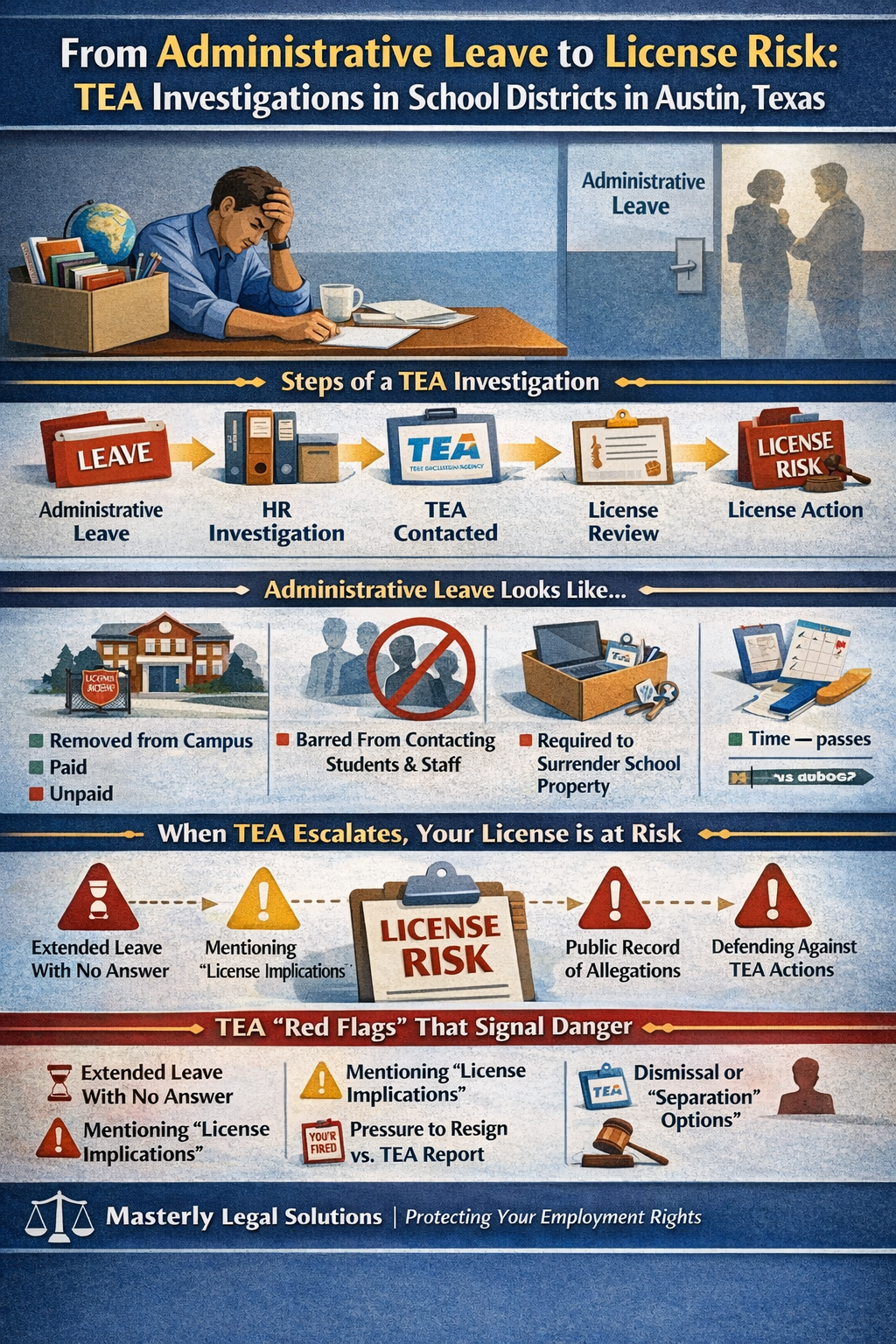
Red Flags That the Case Is Becoming Critical
Certain signs suggest you should treat the situation as urgent. You may not control the district’s direction, but you can control how you respond and what record gets created.
Common red flags include:
- Your administrative leave keeps getting extended with no explanation.
- You are told to avoid contact with “all staff,” not just specific individuals.
- The district mentions “license implications,” TEA reporting, or certification.
- The district begins discussing dismissal or “separation options.”
- You are told a decision is being made by a higher-level designee.
When these red flags show up, your choices can affect whether the district’s narrative becomes the dominant story in the file.
Leave After Findings: Dismissal, Resignation Pressure, and Next Steps
Once a district believes it has enough information, it may decide on discipline, continued leave, or termination. This is where the employee may be offered a choice: return under conditions, accept discipline, or leave the district. Teachers sometimes feel pressured to resign to “avoid a report,” but that depends on the facts and should not be decided in fear.
If the district moves toward dismissal, it may describe the action as policy-based and routine. But the impact on the employee is not routine, especially if license risk is involved. This is the stage where careful strategy matters most, because the district’s final documentation can follow you.
What It Means If You Were Placed on Administrative Leave and Then Terminated
If you were placed on administrative leave early and later removed from your position, the district may argue it followed a progressive process. It may claim it had to act to protect students, comply with policy, or respond to serious allegations. Whether that is accurate depends on the evidence, the timeline, and the district’s consistency.
Teachers should also consider how the district describes the matter in writing. If the district uses language that suggests you were dangerous, dishonest, or engaged in wrongdoing, the reputational harm can be significant. That harm can influence future employment applications and TEA’s view of the case.
Leave Administration Mistakes Teachers Make Without Realizing It
Teachers are trained to solve problems and move forward, and that mindset can lead to mistakes during investigations. Many employees try to be overly helpful, fill in gaps for investigators, or speak off the cuff because they want to appear cooperative. Yet the district can use those statements in ways the teacher never intended.
The other common mistake is assuming silence means the case is weakening. Sometimes silence means the district is building documentation, interviewing others, and preparing its next step. Your goal should be to stay consistent, document your side, and avoid emotional reactions that become “facts” in a file.
The Force of Uncertainty and the Need for a Plan
Investigations create a sense of force because time feels out of your control. You may worry about your students, your peers, and how your name is being discussed without you. That stress can tempt you to send long messages or confront people for answers.
Instead, build a plan. Track communications, save letters, and keep your responses short and professional. This approach protects you even if the district changes its story later.
Leave Benefits, Leave Programs, and What Teachers Should Track
While you are off work, the financial details matter. Teachers should track their leave benefits, any leave programs the district references, and what rules apply to part-time employees if that is relevant. The district may say employees would continue to be paid, or it may shift your status depending on the stage of the investigation.
Keep a written log of every update, including who told you what and when. If the district claims you failed to comply with instructions, your documentation can be invaluable. Even small details—like what your regular work hours were and whether the district changed them—can matter later.
Pay, Approval, and the Problem of Unclear Communication
Districts often require formal steps to approve certain leave categories. Teachers sometimes rely on verbal assurances about pay, then learn later that a different rule was applied. That gap between what you were told and what the paperwork says creates confusion and frustration.
If you need clarification, request it in writing. You can be respectful and still protect yourself. Clear records are one of the simplest forms of self-defense during a stressful process.
Workplace Realities: Reputation, Isolation, and Emotional Toll
The workplace impact of administrative leave is not just financial. Teachers often feel embarrassed, worried about gossip, and uncertain about how to explain their absence. These feelings are normal, but they can lead to decisions that hurt you later.
If you’re struggling, consider professional support and medical care if needed. Your health matters, and stress can become severe during long investigations. Taking care of yourself is not a weakness; it is part of staying steady and making good decisions.
Misunderstanding, Retaliation, and How Cases Get Twisted
Some cases begin with a misunderstanding and then spiral. Statements get repeated, motives get assumed, and the district begins to interpret normal conflict as misconduct. In some situations, teachers suspect retaliation, especially if they previously raised concerns or challenged decisions.
Whether retaliation is present depends on facts, timing, and documentation. Even if you are not sure, you should treat the possibility seriously and avoid reacting emotionally. Calm, consistent documentation is often the best way to protect yourself while you seek guidance.
Collective Bargaining and District Processes
In some settings, teachers may have support through collective bargaining structures or internal association resources. If collective bargaining agreements exist, they may provide procedures for meetings, representation, and dispute resolution. Those protections can help, but they don’t automatically prevent TEA reporting or license consequences.
Even with those structures, the district may still control the narrative if the teacher does not respond carefully. Representation is helpful, but it works best when combined with a strategy that considers both district consequences and TEA implications.
Placing Employees on Administrative Leave Is Not Always Neutral
Districts sometimes say administrative leave is “non-disciplinary,” but the outcome can still be severe. Administrative leave can lead to documentation, restrictions, and decisions that shape a case long before any final finding is made. That’s why teachers should treat administrative leave as a critical stage, not a waiting period.
If the district’s messaging feels inconsistent or vague, that can be a warning sign. The more vague the district is, the more important your documentation becomes. Teachers deserve clarity, and sometimes you only get clarity by asking for it directly.
Office-of-Government References and Why They Appear in HR Templates
Teachers are sometimes surprised to see formal-sounding references in leave documents. District templates may mention an opm memorandum, the office of personnel management, or even a comptroller general idea as part of policy language they borrowed. You might see references to “agencies to use” administrative leave, even though your employer is a local public entity.
These references can appear because vendors recycle federal HR language. You may also see a note about a memorandum chain, an “administration policies” section, or a reference to governmentwide standards influenced by executive orders. The presence of these terms does not automatically decide your case, but it shows that districts often rely on generalized templates rather than teacher-specific realities.
Title 5 and 5 U.S.C References in Leave Discussions
Sometimes documents cite 5 u.s.c or title 5 of the united frameworks as general context. You might even see awkward phrasing like 5 of the united states and united states code in policy attachments. Again, those federal citations are usually not the controlling authority for Texas teachers, but they may appear in materials used to justify administrative practices or explain how a district thinks about leave and investigation procedures.
If you see these references, do not assume they prove anything by themselves. The key question is what your district policy actually says, what state-level rules apply, and whether the district is using template language appropriately. A careful evaluation can prevent you from being intimidated by language that may not even be relevant to your employment status.
What Happens When TEA Contacts the District
When TEA is involved, the district may gather records more aggressively. That can include witness statements, emails, and timelines. The district may also adopt a more defensive posture because it wants to show it handled the situation responsibly.
This can affect your ability to return quickly and can increase the likelihood of a formal outcome. It can also shape how the district communicates with you, because it may be coordinating messaging for legal defensibility. Teachers should treat TEA involvement as a major shift, not a minor update.
Employees Covered, Amount of Leave, and Documentation Practices
Some teachers ask whether there are standard rules for “employees covered” by administrative leave procedures and the “amount of leave” a district can impose. Many districts have general policy frameworks rather than firm timelines. That flexibility gives the district control, which is why documentation and strategy are so important.
During long absences, employees may feel the district is ignoring them. In reality, the district may be documenting everything in preparation for its next step. Your best move is to stay professional, protect your record, and seek the right support.
The Best Time to Get an Attorney and Legal Counsel
Many teachers wait until the last moment because they hope things will blow over. But if you are on administrative leave and TEA may be involved, early help often provides the strongest protection. The best time to get support is before you give statements that become permanent, not after.
Working with an attorney or lawyer can help you understand what to say, what not to say, and how to protect your career. It can also help you identify whether the district is following its own policy or stretching it. Having legal counsel early can reduce mistakes that are hard to undo.
Comply Without Volunteering Extra Information
Teachers often ask how to balance cooperation and self-protection. A practical guideline is to comply with lawful instructions while avoiding unnecessary commentary. Answer what is asked, but do not guess, do not speculate, and do not fill silence with assumptions.
This approach keeps you professional and reduces the risk of misunderstandings. It also prevents an investigator from treating your guess as a fact. When the stakes include your license, precision matters.
Contact Masterly Legal Solutions for Assistance During Administrative Leave
If you are a teacher in Austin, Texas facing administrative leave, a district investigation, or rising TEA license risk, you do not have to navigate it alone. The most damaging moments often happen early—during the first meetings, the first paperwork, and the first weeks of silence—when the district is building its record and you are trying to make sense of your options. We help educators understand what their district’s leave decision really means, what rights an employee still has while removed from the workplace, and how to respond in a way that protects long-term career stability.
Masterly Legal Solutions focuses on practical guidance for teachers who feel stuck in the limbo of leave, uncertain pay, and shifting district policy language. If you are worried about extensions of administrative leave, pressure to accept discipline, or threats of dismissal, our team can help you make calm decisions based on the facts and the timeline. We can also help you organize documentation, prepare for interviews, and reduce the risk of accidental missteps while you are away from school.
Call (972) 236-5051 for a free consultation. If you’re looking for clear answers, a plan, and real support while you’re on administrative leave, we’re ready to help you protect your license and your future.
Key Things to Remember About Leave and TEA Investigations
- Administrative leave is often the first critical step, not a neutral pause.
- Document every notice, memorandum-style update, and instruction you receive.
- Protect your pay by confirming leave category, paid status, and time reporting rules in writing.
- Avoid venting to coworkers or posting details online while the investigation is pending.
- Watch for red flags like repeated extensions, vague explanations, and sudden escalation language.
- Treat TEA involvement as a major shift that can affect license standing and future employment.
- Consider professional support early, before statements and paperwork become permanent.
Disclaimer: This article is for educational purposes only and does not constitute legal advice or legal guidance. Every situation is different, and you should speak directly with a qualified attorney about your specific circumstances.




Teacher Rights When Assaulted by a Special Needs Student: Safety, Reporting and Investigation Issues



Looking for Legal & Business Solutions? Contact Us Now
Fill in the form or call us to set up a meeting





