

The First Mistake Teachers Make During School Investigations and How It Impacts Their Future
The phone call or hallway request usually sounds simple: “We need to talk.” Sometimes it comes as an email from administration. Sometimes it is a quiet directive to report to an office, right after the last bell. In that moment, most teachers are not thinking about a legal process, a record that follows them, or how one decision can shape the rest of their career. They are thinking about students, reputations, and the hope that honesty alone will clear everything up.
School investigations can move fast, and they rarely feel fair from the inside. A teacher can be placed under scrutiny based on incomplete facts, one-sided complaints, or internal politics that were already brewing. Even when the teacher has done nothing wrong, the district may frame the situation as “routine,” while simultaneously treating it like a crisis.
At Masterly Legal Solutions, our law firm works with teachers and other school employees who get blindsided by investigations and then face retaliation, discipline, or an exit they did not choose. This article explains the most common first mistake teachers make, why it happens, and how it can affect everything from job assignments to future employment options. It also outlines practical legal protections, and when to talk to retaliation attorneys before the situation hardens into a permanent employment issue.
Why School Investigations Feel Different From Other Workplace Problems
A school workplace is unique because the stakes are not only professional. A teacher’s identity is often tied to the classroom, to student outcomes, and to relationships built over years. When an allegation surfaces, the emotional pressure can be intense, and that pressure can push good people into bad decisions.
Investigations also unfold in a way that can isolate educators quickly. Teachers may be told to avoid contact with colleagues, stop discussing the matter, and wait for direction. Meanwhile, rumors spread across campuses and social media, and the teacher may feel powerless to defend their name.
This is where law and strategy become important. A school investigation can trigger consequences under employment contracts, licensing rules, district policy, and federal and state laws that govern discrimination, retaliation, and due process. The earlier the teacher understands the legal process, the more control they can keep over the outcome.
The First Mistake Teachers Make
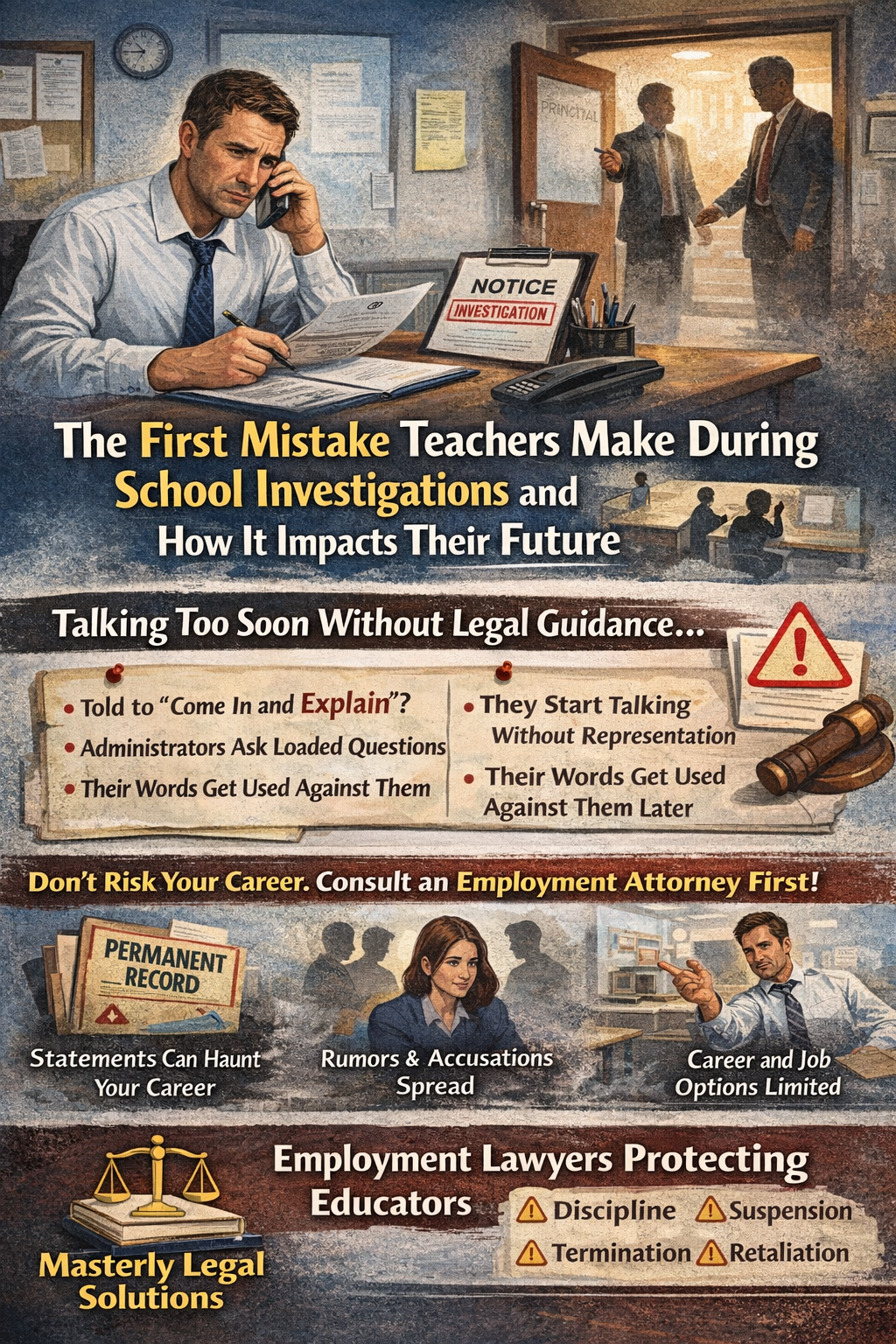
The first mistake teachers make during school investigations is trying to talk their way out of it immediately, without counsel, without preparation, and without understanding how their words will be used later.
It is a human reaction. Teachers are trained to communicate, explain, and de-escalate. They often believe that if they answer every question, cooperate fully, and show good intentions, the investigation will end quickly. Unfortunately, school investigations are not built around reassurance. They are built around documentation, risk management, and employment decisions.
When a teacher speaks too soon, they can unintentionally provide inconsistent details, unclear timelines, or statements that are taken out of context. Those statements may later be cited to justify disciplinary action, nonrenewal, or wrongful termination claims the district defends as “policy-based.” One meeting can become the foundation for months of adverse actions.
Why This Mistake Happens So Often
Teachers are used to being problem-solvers. In the classroom, quick communication is often the best tool. During an investigation, that same instinct can backfire because the teacher does not control the record, the framing, or the interpretation of what is said.
Administrators may ask questions that feel informal, but the answers may be written into official summaries. A teacher might be asked to “clarify” something without being told what the allegation is. Sometimes the teacher is told the district is “just gathering facts,” while the district is simultaneously building a case for discipline.
The stress of the moment also matters. Anxiety affects memory and wording. Even honest teachers can contradict themselves when asked rapid-fire questions. That is not a character flaw. It is a predictable human response to pressure, and it is exactly why legal assistance can be so valuable early.
How Early Statements Can Follow You Into the Future
Teachers often assume the investigation is limited to the current campus. In reality, records can travel. Statements made early may appear in internal files, HR documentation, and future references. Even if the teacher later gets a new job, the shadow of the investigation can appear again when a district checks prior employment history.
A rushed statement can also affect licensing and professional reporting. If the district claims a teacher admitted to a policy violation, that admission can influence the district’s next step. Even when the teacher intended to explain, not confess, the narrative can shift quickly.
These long-term effects are why the “first conversation” matters so much. The teacher may never get another chance to control the first impression the district writes down. That impression can shape performance reviews, job assignments, and future employment decisions.
The Investigation Timeline and the Pressure to Respond Fast
School investigations often move in uneven waves. There can be urgent meetings early, then long periods of silence. Teachers may spend weeks on edge, waiting for updates that never arrive. That silence can tempt teachers to reach out, volunteer details, or try to “smooth things over.”
But those attempts can create new risks. Emails, texts, and conversations can be interpreted as interference, policy violations, or even retaliation. Even contacting potential witnesses can be framed as misconduct if the district wants to escalate.
A better approach is structured, careful communication. Strategy matters more than speed. When a teacher understands the timeline and how documentation works, they can protect themselves without appearing uncooperative.
When Cooperation Turns Into Self-Sabotage
Cooperation is not the problem. The problem is unstructured cooperation that gives the employer ammunition. Teachers may offer extra details, speculate about motivations, or name people they think complained. That can create a perception of conflict, hostility, or instability.
Teachers may also try to protect others. They may minimize issues involving a co-worker, a student, or an administrator. They may do this out of loyalty or fear. But partial explanations can later look like dishonesty, even when the teacher believed they were being kind.
In employment law, a record matters. Districts often defend their actions by pointing to “inconsistencies” or “credibility concerns.” A teacher who speaks too quickly can unintentionally hand the district that justification.
How Workplace Dynamics Can Trigger Retaliation
Many investigations start after a teacher engages in protected activity, like reporting discrimination, raising safety concerns, or challenging unfair treatment. A teacher may not call it retaliation at first. They may assume the timing is coincidence. Then the investigation expands, and suddenly their file becomes a list of alleged problems.
Retaliation can look like discipline, but it can also look like isolation and subtle punishment. A teacher may lose leadership roles, get undesirable job assignments, or receive unusually harsh evaluations. Even small changes can add up to a career shift.
A retaliation complaint may become part of the legal strategy when there is a clear timeline: the teacher engages in protected activity, and then the employer responds with adverse actions. This is where retaliation attorneys can help connect the dots and build a coherent narrative grounded in law.
The Connection Between Investigations and Workplace Discrimination
Some school investigations are sincere efforts to address issues. Others are shaped by workplace discrimination or bias that already existed. Teachers may be targeted more aggressively because of national origin, sexual orientation, gender discrimination, or assumptions tied to age discrimination.
The teacher may notice patterns: certain employees are forgiven, while others are punished. Similar conduct is treated differently depending on who is involved. Complaints from some parents are taken as fact, while others are questioned. That pattern can be evidence of workplace discrimination when documented properly.
Under Title VII and other federal law frameworks, discrimination can include direct discrimination and hostile work environments. The civil rights act also plays a role in how these protections are understood and enforced. The key is connecting treatment to facts, not just feelings.
Title VII and the Rights Teachers Often Forget
Title VII is one of the central laws in employment law that can protect teachers from discrimination in the workplace. It can apply to school districts and many public employers. It is often part of employment discrimination cases where bias influences discipline, nonrenewal, or termination.
Title VII issues can arise in sex discrimination claims, sexual orientation discrimination claims, and national origin complaints. Title VII can also intersect with retaliation when a teacher reports discrimination and then faces punishment.
These protections exist on paper, but teachers must be strategic in how they use them. A poorly timed statement can weaken a claim. A well-documented timeline can strengthen it significantly.
How the Americans With Disabilities Act Can Appear in Investigations
Teachers with medical conditions sometimes get investigated under the label of “performance” or “attendance,” when the real issue is disability-related. The americans with disabilities act and related disabilities act protections can apply when an employer fails to provide reasonable accommodations.
Teachers may request schedule changes, temporary adjustments, or support and then face pushback. The employer may claim undue hardship, but that claim is not automatic. In many cases, the employer must show real facts to justify refusal.
When investigations involve medical conditions, it is essential to document requests, responses, and any shift in treatment. A teacher who is disciplined after requesting reasonable accommodations may be facing an employment issue that is bigger than a simple policy dispute.
Age Discrimination and the Quiet Push-Out Pattern
Age discrimination can show up in education in subtle ways. A teacher might be described as “not flexible,” “not adapting,” or “not a cultural fit,” while younger teachers are given extra patience. This pattern can overlap with age discrimination in employment and discrimination in employment act concerns.
When an investigation becomes a tool to push out a seasoned teacher, the district may frame it as performance-related. The teacher may suddenly receive negative reviews, increased scrutiny, or criticism that does not match prior evaluations.
Because these cases are fact-sensitive, documentation is critical. Employment lawyers often look for timelines, comparative treatment, and shifting explanations that reveal bias.
The Role of Federal and State Laws in Teacher Investigations
Teachers are often surprised by how many layers of law can apply. Federal and state laws shape discrimination standards, retaliation rules, due process expectations, and reporting obligations. State laws, local laws, and state and local laws can add protections beyond federal law.
Some disputes end internally. Others escalate into state agency complaints, administrative processes, or litigation. In certain cases, a matter can reach state and federal courts depending on the claims and the evidence.
The legal process is not always fast, but a teacher’s early steps can determine whether they have leverage later. Understanding the overlap of federal law, state laws, and district policy helps teachers avoid missteps and protect their rights.
Reporting Discrimination Without Creating New Risk
Reporting discrimination is important, but the way it is done matters. Teachers should keep reports factual, professional, and focused on specific conduct. Emotional language is understandable, but vague accusations can be dismissed as “conflict” rather than evidence.
Reporting discrimination can also trigger retaliation, especially when it challenges business interests or internal power structures. That does not mean teachers should stay silent. It means they should report carefully and document everything.
Teachers should preserve emails, meeting notes, and any communication that shows the employer’s response. When a district later claims the teacher was disciplined for “performance,” the earlier documentation can reveal a different story.
Employer Denies, Teacher Doubts, Record Stays
A common pattern in these cases is simple: the employer denies wrongdoing. The district may deny discrimination. The district may deny retaliation. The district may deny that the investigation was biased. The teacher then wonders whether pursuing the matter is worth it.
But denial does not erase facts. It simply shifts the burden onto documentation and strategy. That is why early missteps matter so much. If the first record is messy, the teacher loses leverage.
A law firm can help teachers develop a clean record, identify what matters, and avoid unnecessary statements that give the employer more room to deny responsibility.
How Teachers Get Trapped by Informal Conversations
Teachers often get pulled into “quick chats” that feel casual. An administrator may say, “Just help me understand,” or “This is off the record.” In employment disputes, off the record often becomes on the record later through summaries, emails, and witness statements.
A teacher might speak in a hallway, in a classroom, or in a parking lot conversation. A teacher might vent to a colleague who later becomes a witness. A teacher might send a text they regret.
These moments can become evidence. That does not mean teachers should live in fear. It means teachers should treat investigations as formal, not personal, and respond with structure.
Potential Witnesses and Why Timing Matters
Teachers sometimes try to “clear things up” by talking to potential witnesses. That instinct is understandable. Unfortunately, the employer may frame those conversations as interference or intimidation, even when the teacher intended no harm.
Teachers should also be careful about discussing the matter with a co worker. In a tense workplace environment, information spreads. What feels like support can turn into a rumor or a misquote.
A better option is to document what you remember privately, list who may have relevant information, and let counsel guide the appropriate next step. This protects the teacher and reduces the chance the district claims the teacher acted improperly.
Employment Contracts and the Hidden Rights in the Fine Print
Employment contracts can provide important protections teachers do not realize they have. Contracts may outline investigation procedures, notice requirements, and disciplinary steps the district must follow. In some cases, contract language can create leverage for the teacher.
Employment contracts also shape settlement negotiations. If the district wants a resignation, it may need to offer something meaningful in exchange. Teachers who do not review their contract may miss opportunities to protect their record.
Even if a teacher is at-will, policies and procedures still matter. Employment practices, district handbooks, and internal guidelines can influence whether the district acted fairly.
Retaliation Complaints and Why They Must Be Built Carefully
A retaliation complaint is most effective when it is grounded in a clear timeline and specific events. The teacher must show protected activity, and then show what changed. Retaliation cases often hinge on the timing of adverse actions.
Adverse actions can include suspension, transfer, loss of duties, sudden negative evaluations, or termination. Retaliation can also involve hostile treatment, exclusion, or pressure to resign.
When retaliation occurs, the teacher’s first instinct may be to defend themselves emotionally. A more effective approach is to document, preserve evidence, and pursue legal assistance that aligns with federal and state laws.
Equal Employment Opportunity Commission Steps Teachers Should Know
Many teachers do not learn about the equal employment opportunity commission until late in the process. Yet deadlines can matter, and delay can cost rights. The EEOC process can apply to discrimination and retaliation matters, depending on the facts.
It is not enough to “tell HR.” HR is internal. The EEOC is external. The teacher needs a strategy that accounts for the legal process, the record, and what the teacher wants as an outcome.
A teacher may want reinstatement, a clean separation, compensation, or protection of future job prospects. Each goal can shape how the EEOC path is used and how settlement negotiations unfold.
Litigation, Commercial Litigation, and When Cases Escalate
Not every teacher case goes to court. But some disputes escalate into litigation when the district refuses to act fairly or when the harm is severe. Depending on the claims, matters may involve state courts, federal courts, or both. Some claims reach state and federal courts under federal and state laws.
In broader disputes, legal teams may also address commercial litigation concepts, particularly when the employer’s actions intersect with broader organizational risk. In some complex disputes, the case can involve business torts or related issues tied to reputation and professional standing.
Civil trial law is not about drama. It is about proof. Teachers who want to preserve options should think early about evidence, timelines, and consistency, because those elements matter in any legal dispute.
Wrongful Termination and the Career Impact of a Bad Record
Wrongful termination is not always obvious at the moment it happens. Sometimes it shows up through a nonrenewal, a forced resignation, or a “mutual separation” that was not really mutual. The teacher may feel pressured to leave to avoid embarrassment or to protect future options.
But a forced exit can still harm a career. It can affect references, future hiring, and the teacher’s ability to secure a new job. It can also follow the teacher into background checks and job applications.
When a teacher is considering resignation, they should pause. An early resignation can destroy leverage and remove legal options that would have existed if the teacher stayed strategic.
Punitive Damages, Attorney’s Fees, and What Remedies Can Exist
In some cases, punitive damages may be available depending on the claim and the evidence. Other remedies can include back pay, front pay, policy changes, reinstatement, and negotiated separation terms. Attorney's fees may also be part of a remedy structure in certain cases.
Teachers should understand that remedies are not automatic. They depend on proof, timelines, and legal standards under federal law and state laws. The civil rights act and Title VII can influence what is possible in discrimination and retaliation matters.
The most important point is this: outcomes improve when teachers act early. Waiting until termination or resignation often reduces options and increases stress.
How a Winning Strategy Starts Before the District Decides
A winning strategy is not about being aggressive. It is about being precise. It starts by preserving evidence, controlling communication, and understanding which laws protect employees in the teacher’s situation.
Teachers should keep a private timeline with dates, names, and details. They should save relevant emails, texts, and written directives. They should document shifts in job assignments, new supervision patterns, or sudden changes in performance expectations.
They should also think about what they want. Do they want to stay? Do they want a clean exit? Do they want a public correction? A strategy works best when the goal is clear.
How Masterly Legal Solutions Helps Teachers Protect Their Future
Masterly Legal Solutions is a law firm that supports teachers navigating investigations, retaliation, and high-stakes employment decisions. We focus on protecting careers, reputations, and future opportunities, not just reacting after damage is done.
Our attorneys have represented clients facing workplace discrimination, retaliation cases, wrongful termination, and complex disputes involving professional standing. We approach each matter with a clear plan grounded in employment law, federal and state laws, and the realities of school workplace politics.
If you feel targeted, isolated, or pressured to resign, you are not alone. The earlier you seek legal assistance, the more leverage you may have to protect your record and negotiate a favorable outcome.
Labor and Employment Lawyers Who Understand School-Based Cases
When your career is on the line, working with labor and employment lawyers can make a major difference in how your situation is handled from the start. These cases are not just about what happened in a classroom or on campus—they often involve employment records, HR policies, and long-term professional consequences. A strong legal team helps protect your rights, control communication with the district, and avoid mistakes that can permanently damage your future. At Masterly Legal Solutions, we focus on helping educators and other workers protect their careers through smart, strategic legal action.
Federal and State Courts, Federal Employees, and Career-Defining Outcomes
Some employment disputes can escalate into federal and state courts, depending on the facts, deadlines, and legal claims involved. While many school employees are not federal employees, federal workplace rules still influence how discrimination, retaliation, and due process cases are evaluated. In certain cases, legal disputes may involve federal standards, district compliance concerns, or claims shaped by federal agencies. Even when a case never reaches court, preparing as if it could helps ensure your side of the story stays consistent and defensible.
Whistleblower Laws and Reporting Misconduct Without Fear
Many educators worry that speaking up will cost them their job, especially when the issue involves internal misconduct or policy violations. This is where whistleblower laws can become critical, because they may protect employees who report wrongdoing through appropriate channels. If you raise concerns and then suddenly face discipline, negative evaluations, or forced leave, your report may qualify as protected activity. When the facts support it, legal action can help hold the employer accountable and stop retaliatory treatment before it becomes permanent.
The Medical Leave Act and How Health Needs Become Employment Disputes
When investigations overlap with health conditions, legal protection may come from the medical leave act, especially when employees need time away for treatment, recovery, or serious medical issues. Educators are often pressured to keep working even when their health is declining, and that can lead to unfair performance claims or disciplinary problems. If your leave request triggers hostility, scrutiny, or threats, the situation may shift from “workplace policy” into a legal issue. Early legal support helps protect your job, your record, and your right to fair treatment.
Experienced Litigators and the Strength Behind Your Case
Not every employment dispute should go to court, but every case should be handled like it could end up there. That is why working with experienced litigators matters when your employer refuses to act reasonably or tries to pressure you into silence. A strong legal team understands how evidence is built, how timelines are proven, and how retaliation patterns are exposed. Even if the goal is settlement, having attorneys prepared for litigation often leads to stronger negotiations and better outcomes.
When a Family Member and Personal Life Become Part of the Problem
School investigations sometimes expand into issues that have nothing to do with job performance. Accusations can involve a family member, off-campus disagreements, or something tied to your personal life that gets misinterpreted by the district. Even when the situation is private, districts may treat it as a professional concern if it creates controversy or triggers complaints. Teachers deserve fair treatment, and legal options may exist when an employer uses outside issues to justify workplace punishment or termination.
The Supreme Court and How Big Legal Rules Shape Small Workplaces
Most educators will never walk into a courtroom, but the rules that affect teacher investigations often come from higher decisions, even reaching the supreme court level. These decisions shape how discrimination, retaliation, and employee rights are defined across the country. That matters because school districts often base policies and legal defenses on those interpretations. When your future is at stake, understanding how these legal standards work can help you avoid decisions that quietly weaken your position.
Practice Areas That Help Teachers Under Pressure
Employment problems in schools are rarely “just one issue.” That is why working with a legal team with broad practice areas is important, especially when investigations involve discrimination, retaliation, contract disputes, or termination threats. Some cases involve HR complaints, while others require deeper strategy involving licensing risk or record protection. The right approach depends on the full story, not just the allegation the district chooses to focus on. Having a complete legal plan helps educators protect both their job and their long-term career path.
Helping Individual Employees Through Employee Based Legal Strategy
School districts have legal counsel, administrative teams, and HR departments working behind the scenes. Individual employees deserve the same level of protection, strategy, and support when their careers are threatened. An employee based legal approach focuses on defending your record, preserving your options, and making sure your side is not dismissed or distorted. The earlier you act, the easier it becomes to stop the situation from becoming a permanent stain on your professional reputation.
Super Lawyers, Finding Strong Representation, and Choosing the Best Lawyer
When educators start searching online, they often see rankings like super lawyers or websites that claim they help clients find lawyers instantly. While those tools can be useful, the real key is finding the best lawyer for your situation—someone who understands employment investigations, school workplace politics, and how retaliation unfolds. Strong legal representation is not just about credentials, it is about strategy, communication, and knowing how to protect your future. At Masterly Legal Solutions, we focus on real solutions, practical guidance, and aggressive protection when your career is on the line.
A Practical Checklist for Teachers Facing an Investigation
If you are under investigation, consider these practical steps before your next meeting:
- Keep communication professional and minimal until you understand the allegation
- Write a private timeline of events while your memory is fresh
- Preserve emails, texts, and directives from administrators
- Avoid discussing details with a co worker or anyone who could become a witness
- Do not guess, speculate, or fill silence in interviews
- Seek legal assistance early if the situation involves retaliation, harassment, or discrimination
These steps are not about hiding anything. They are about protecting yourself in a system that documents everything and may use your words in ways you did not intend.
Contact Masterly Legal Solutions for a Free Consultation
If you are a teacher facing an investigation and you suspect retaliation or workplace discrimination is part of what is happening, you do not have to carry the weight alone. The first mistake many educators make is trying to fix the situation in one conversation, only to learn later that the conversation became the district’s evidence.
Our retaliation attorneys and employment lawyers can help you understand the legal protections that may apply, evaluate your employment contracts, and respond in a way that protects your future. Whether the issue involves Title VII concerns, harassment, age discrimination, national origin claims, or disability accommodation disputes under the americans with disabilities act, we can help you build a plan.
Call Masterly Legal Solutions at (972) 236-5051 to schedule your free consultation. You will get clear guidance on next steps, the legal process, and how to protect your record before the district makes a decision that follows you into your next chapter.
Disclaimer: This article is for educational purposes only and does not constitute legal guidance or legal advice. Every situation is different, and you should consult a qualified attorney regarding your specific facts and circumstances.



Teacher Rights When Assaulted by a Special Needs Student: Safety, Reporting and Investigation Issues



Looking for Legal & Business Solutions? Contact Us Now
Fill in the form or call us to set up a meeting





